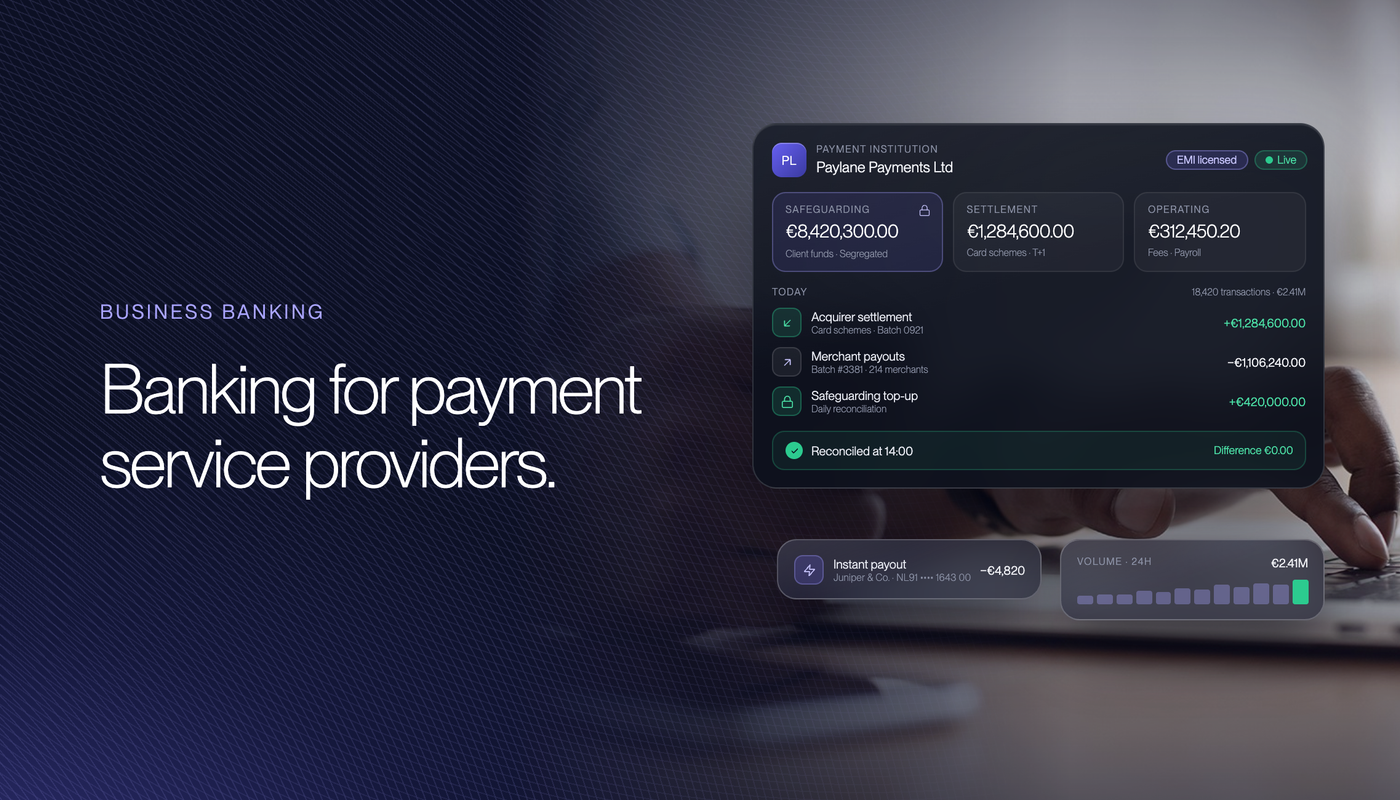
Banking for payment service providers sits under everything a payment business does. The safeguarding account protects customer money the way the law requires, and the operating account pays staff, suppliers, card schemes and tax, often in several currencies. With both in place, a PSP can onboard merchants, settle on time and pass its regulator's reviews.
The hard part is the banks. The European Banking Authority found banks exiting payment and e-money institutions wholesale, some after 8 to 10 years on one or two months' notice. In the UK, Barclays Bank UK and Santander UK say they cannot currently take them on at all. Where banks do say yes, opening fees for payment firms reach €3,000.
We make it simple. We prepare your full file with you, from the licence and flow of funds to the AML framework and merchant profile. Our licensed banking partners then open a multi-currency operating account in days, fully online. One team, one contact, done.
Our top-rated, licensed banking providers open multi-currency operating accounts for payment companies in days, with dedicated IBANs and SEPA and SWIFT payments.

MoneyGate
Business Banking
Monthly fee
€30
Onboarding fee
€500
Time to onboard
2-3 days
Features
Dedicated IBAN, SEPA, FX and more

3S Money
Cross-border payments
Time to onboard
4 Days
Account opening fee
Free
Monthly fee
Starting from € 100
Why Banking for Payment Service Providers Is Hard
Banking for payment service providers is hard because banks rate payment firms as high risk, some refuse the whole category, and the safeguarding rules put the bank inside the PSP's compliance chain. A payment company needs more from its bank than almost any other business, and banks filter and price it accordingly.
Banks See Payment Firms as High Risk
The EBA's June 2023 report on payment institutions says supervisors see the sector as carrying high inherent money laundering and terrorist financing risk, and that its controls are not always effective. It cites the EBA's 2021 finding that more than two-thirds of national AML supervisors consider the payment institution sector a significant or very significant risk. A bank that takes on a PSP takes on part of that risk, because the PSP's merchants and customers move money through it.
That is why a PSP file is read line by line. The bank looks at the licence, the merchants, the countries, the chargeback levels and the AML controls, and it asks how much of the flow it will see. A file that leaves any of these vague is refused before it is even priced.
Whole Sectors Refused at Once
Some banks do not assess payment firms at all. Barclays Bank UK says it is currently unable to onboard small or authorised payment institutions and small or authorised e-money institutions. Santander UK says it is currently unable to offer bank accounts to payment institutions, e-money institutions, or payment initiation and account information providers.
The EBA's January 2022 opinion on de-risking found the same pattern across the EU. Payment institutions described sector-wide blanket exit policies, and some e-money institutions were exited after relationships of 8 to 10 years on one or two months' notice. A few were left unable to deposit client money and held large amounts of cash on their own premises.
Open a Bank Account for a Payment Service Provider
Opening a bank account for a payment service provider is very doable with the right partner and a file built for payments. This is what we handle for you.
- Partners built for payments: One partner counts payment firms and fintechs among its core clients.
- Banks refusing PSPs: Our partners review payment companies on their merits.
- Fast opening: An operating account in days, not months.
- Multi-currency from day one: EUR, GBP, USD, AED and more in one account.
- Flow of funds mapped: We draw it the way reviewers want to see it.
- API and bulk payments: Connect the account to your own systems.
- No back-and-forth emails: One point of contact from start to finish.
The Right to a Bank Account Is Still Weak
PSD2 already says payment institutions must have access to bank payment account services on an objective, non-discriminatory and proportionate basis, and that a bank must give the regulator duly motivated reasons for any refusal. In practice the EBA found those notifications applied inconsistently, and the rule covered refusals at onboarding but not exits. The UK version, regulation 105 of the Payment Services Regulations 2017, goes a step further and also requires banks to tell the FCA when they withdraw access.
The new EU Payment Services Regulation goes further. Under the text agreed on 27 November 2025, banks may refuse or close a payment institution's account only on set grounds, such as an AML breach or missing documents, must give specific reasons within one month and must give four months' notice of a closure. It is not in force yet: Parliament's indicative plenary date is 14 December 2026, and the regulation applies 21 months after it enters into force.
Safeguarding Raises the Bar Further
A PSP that receives customer funds must safeguard them. Under Article 10 of PSD2, funds still held at the end of the business day after receipt go into a separate account at a credit institution or into secure, liquid, low-risk assets, never commingled and protected from other creditors in insolvency, or they are covered by insurance or a guarantee. For e-money institutions, funds received by card or another payment instrument must be safeguarded no later than five business days after the e-money is issued.
The UK has gone further. The FCA's CASS 15 rules, in force since 7 May 2026, require daily reconciliation, a monthly safeguarding return, an annual audit for firms that hold more than £100,000 and a resolution pack that can be retrieved within 48 hours. The FCA found that payment firms that failed between 2018 and 2023 had an average shortfall of 65% of client funds, and respondents told it firms currently have difficulty getting safeguarding accounts.
Failures That Made Banks Cautious
Banks remember the failures. Wirecard said on 22 June 2020 that €1.9 billion of trust account balances probably did not exist and filed for insolvency three days later, and the FCA restricted its UK e-money arm for about four days. BaFin fined Solaris €6.5 million in March 2024 for late suspicious transaction reports. In the US, partner banks found a shortfall of $60 to $90 million after Synapse filed for bankruptcy in April 2024. Each case made banks look harder at every payment firm.
Why PSP Bank Accounts Get Refused
Refusals usually come down to a few gaps: a flow of funds the bank cannot follow, a merchant base with high-risk categories and no controls, chargeback levels near card scheme limits, an AML framework that exists only on paper, or a licence that is still pending. Visa's monitoring programme flags European merchants at a fraud and dispute ratio of 150 basis points from April 2026, and a bank will ask where your merchants stand. Our guide to why banks reject business account applications covers the general reasons.
What to Do After a Refusal
Do not send the same file to the next bank. Find the gap, fix it with documents, then apply once to a provider that works with payment firms. Keep a record of every refusal and the reason given, because regulators and the next provider will ask about them. Our guide to reapplying after a rejected business account covers the rebuild step by step.
Banks That Accept Payment Service Providers
Banks that accept payment service providers exist, but few say so publicly, and those that do price the risk in. The table shows how a sample of European banks treat payment firms and what they charge. The picture is similar across most markets: a narrow door and a high fee.
Bank | Who it takes | Who it turns away | Monthly fee |
|---|---|---|---|
Barclays Bank UK | Other business customers | Payment and e-money institutions, currently not onboarded | No account offered |
Santander UK | Other business customers | Payment and e-money institutions, currently not offered accounts | No account offered |
Bank of Valletta | Payment processors, on a special tariff | Files outside its risk appetite | Up to €600 a month, €3,000 to open |
MeDirect | Payment-related entities, at a higher opening fee | Some clients located outside the EU | €25 to €200 in maintenance, €700 to open |
Bank of Cyprus | International companies, with enhanced due diligence on higher-risk files | Files that fail enhanced due diligence | €50 to €75 a month, reviews €500 to €2,000 |
Alpha Bank Cyprus | Payment and e-money companies after enhanced due diligence | Shell companies | €60 a month on its international tariff |
The pattern is clear. Some large banks have closed the door, and the banks for payment service providers that stay open charge payment firms several times what other companies pay: €3,000 to open at Bank of Valletta against €300 for its specialised business banking, and €700 at MeDirect against €500 for other legal entities. Central banks are opening up, but not as a replacement, as the section below explains.
Closure on Short Notice
A bank account is only as good as its notice period. The EBA found e-money institutions exited on one or two months' notice, sometimes after a decade, and PSD2's reporting duty did not cover exits at all. For a PSP, a closure is not an inconvenience: merchants wait for settlement, safeguarded funds need a new home and the regulator wants a plan, all inside a few weeks. The four-month notice period in the new regulation will help, once it applies.
One Bank Is a Single Point of Failure
PSD3 will tell payment institutions that safeguard by segregation to avoid concentration risk where appropriate and to endeavour not to keep all customer funds with one credit institution. The FCA already asks UK firms to consider diversifying the third parties holding their funds. Lithuanian payment firms, one of the largest groups in the EU, held customer funds at the end of 2024 across central banks (€671 million), credit institutions (€1.2 billion) and safe liquid assets (€742 million).
Central Bank Accounts Are Not a Way Out
The Bank of England opened settlement accounts to non-bank PSPs in July 2017, and a client funds settlement account there counts as a safeguarding account, but the Bank says firms still need commercial bank accounts. In the euro area, the Eurosystem said in July 2024 that it will not provide safeguarding accounts to non-bank PSPs. It planned access to T2 and TIPS for settlement only, with no credit and balances capped at twice a firm's peak outgoing payments over 12 months.
Slow, Paper-Heavy Onboarding
Barclays' published criteria for PSPs show how deep the review goes: authorised status, a business plan covering the model, target clients and geographies, management experience, a risk assessment of the underlying client base with mitigating controls, and scalable technology. Each is a separate review, and a question on any one of them restarts the clock. Enhanced due diligence and review fees of €500 to €1,500 appear in the tariffs of banks that publish them.
Read more: banking for fintech and EMI companies and what de-risking is and why banks close business accounts.
3S Money
Cross-border payments
Time to onboard
4 Days
Account opening fee
Free
Monthly fee
Starting from € 100
A Faster Way to Open a PSP Business Account
There is a better way to open a PSP business account for the operating side of the business. Our banking partners are licensed e-money institutions that work with payment companies every day, and one lists payment service providers, fintechs and marketplaces among its core clients. They open accounts online, with identity checks by passport and selfie, usually within days.
Accounts come with dedicated IBANs and SEPA and SWIFT payments, and one partner adds bulk payments, API access and physical and virtual business cards. The partners are licensed in Cyprus, with a branch in Greece, and in the UK, Luxembourg and the DIFC, so a PSP can hold euros, sterling, dollars and dirhams in one place. Each partner safeguards its own clients' money at banks, apart from its own funds.
Feature | Banks | Our partners |
|---|---|---|
Policy on payment firms | Some large banks not onboarding them | Payment companies reviewed on their merits |
Time to open | Weeks to months of enhanced review | About 2 to 10 business days |
Opening fee for payment firms | €700 to €3,000 at some banks | Free to €500 |
Monthly cost | Up to €600 a month at one bank | Free to €100 a month |
Currencies | EUR, others in separate accounts | EUR, GBP, USD, AED and dozens more |
Bulk payments and API | Varies by bank and package | Built in at one partner |
Currency conversion | Bank rate plus a commission | One margin, shown before you confirm |
For the operating side of banking for payment service providers, the partner route removes the sector ban, the risk-priced opening fee and most of the wait. A long-standing bank relationship with good terms is still worth keeping, and we say so when it applies.
Operating Accounts vs Safeguarding Accounts
Be clear on what each account does. Under PSD2, customer funds a PSP must safeguard sit in a separate account at a credit institution, or in secure, liquid, low-risk assets, or are covered by insurance or a guarantee. An e-money institution is not a credit institution, so a partner account cannot be your safeguarding account under those rules. What it can be is your operating account: your own revenue, fees, payroll, suppliers, tax and treasury, kept apart from customer money.
Most PSPs run both: a bank for safeguarding and a partner for operations. Keeping them apart is also what regulators want to see. Our guide on EMI safeguarding covers the safeguarding side in detail, and the file we build for the partner supports a safeguarding application too.
How to Open a Bank Account for a PSP
How to open a bank account for a PSP with us comes down to five steps. First, we check your licence, merchants, countries and volumes against each partner's rules. Second, we build the file with you: licence, flow of funds, AML framework, merchant profile, ownership chart and source of funds. Third, every director and owner completes an online identity check. Fourth, one partner reviews one complete file. Fifth, the account goes live and you receive your IBANs and, where needed, API access.
Which Payment Companies Our Partners Accept
Our partners review payment companies of most kinds, from licensed payment and e-money institutions to payment gateways, marketplaces, money transfer businesses and fintechs, incorporated in the EU, from Greece to Malta, or in the UK, the UAE, Switzerland, Gibraltar or the Crown Dependencies. Firms that need a licence and do not have one, shell companies and anything linked to sanctioned countries are declined. If you are setting up a payment processing company, we check the fit before you open a PSP business account with any of them, so you never collect a refusal.
MoneyGate
Business Banking
Monthly fee
€30
Onboarding fee
€500
Time to onboard
2-3 days
Features
Dedicated IBAN, SEPA, FX and more
3S Money
Cross-border payments
Time to onboard
4 Days
Account opening fee
Free
Monthly fee
Starting from € 100
Documents Needed for a Payment Service Provider Bank Account
The documents needed for a payment service provider bank account go far beyond a normal company file. In banking for payment service providers, a reviewer wants to see the licence, how money moves, who the merchants are and how the firm controls risk. Barclays' published criteria for PSPs are a fair outline of what any reviewer asks, and the list below follows the same logic. If you are working out how to open a bank account for a payment service provider, start here.
Licence and Regulator Correspondence
Include the authorisation or registration, the licence conditions, passporting notifications for each country you serve, and recent regulator correspondence. An agent of a licensed firm adds the agency agreement and its registration. A firm still applying shows its application and timeline, and should expect some reviewers to wait for the licence before they open anything.
Flow of Funds and Safeguarding
Draw one diagram showing where customer money comes in, where it is safeguarded, how it reaches merchants or payees, and where your own revenue lands. Name the safeguarding bank or insurer, the reconciliation routine and the daily cut-off times. This is the page reviewers read most closely, and a diagram that matches the business plan answers half their questions before they ask.
AML Framework and Merchant Profile
Add the business-wide risk assessment, AML and sanctions policies, the MLRO's details, transaction monitoring and screening tools, and the merchant or customer profile: categories, countries, expected volumes, excluded sectors and current fraud and chargeback ratios. Card-scheme high-risk categories need their own controls, since Visa requires acquirers to register payment facilitators and high-brand-risk merchants before they process.
Company, Owners and Capital
Then come the company documents: certificate of incorporation, articles, registers of directors and shareholders, the ownership chart up to the ultimate beneficial owners, passports and proofs of address, financial statements, and evidence of the initial capital your licence requires, such as €350,000 for an e-money institution under the current EU rules. The source of funds behind that capital matters as much as the amount.
Read more: documents needed to open a business bank account and KYC for business account opening.
Prepare Your PSP Bank Account File
A PSP bank account opens fastest when the file answers the reviewer's questions before they are asked. We build it with you, including the documents needed for a payment service provider bank account.
- Flow of funds drawn: One clear diagram, from customer to merchant.
- AML pack in order: Policies, risk assessment and MLRO details together.
- Merchant profile ready: Categories, countries and ratios in one table.
- Licence documents checked: Passporting and agency papers where they apply.
- Video identity checks: Passport and selfie from your own phone.
- Clear pricing: Every fee confirmed in writing before you apply.
PSP Bank Account Costs
PSP bank account costs at banks start with a risk premium. Payment firms pay higher opening fees, higher monthly fees and review fees that other companies never see, and the cost of losing an account on short notice sits on top. The table sets typical ranges at European banks that publish tariffs against our partners' plans.
Charge | Typical range at a bank | With our partners |
|---|---|---|
Opening fee for payment firms | €700 to €3,000 | Free to €500 |
Enhanced due diligence | €500 to €1,500 on international files | No separate review fee |
Monthly administration | €50 to €600 a month | Free to €100 a month |
Periodic compliance review | €500 to €2,000 at one bank | No separate review fee |
Minimum balance | None to 100,000 in EUR, USD or GBP at one bank | None |
SEPA payment out | €1 to €12, with surcharges on higher-risk files | From €2 per payment |
SEPA payment in | Free to €30, by amount and bank | Free to €5 |
SWIFT payment out | 0.15% plus €17 to €25, with €30 to €40 surcharges on higher-risk files | Around €25 to €30 plus a small percentage |
SWIFT payment in | €8 to €40 | Free to €20 |
Currency conversion | 0.30% to 0.40% commission plus the bank's rate | One margin, shown before you confirm |
Account closure | €200 per account at some banks | Up to €200 |
The fees in the table are the visible part. In banking for payment service providers, the larger cost is dependency. A bank that exits on one or two months' notice, as the EBA found, leaves merchants waiting for settlement and staff moving the whole business in weeks. PSD3 will tell payment institutions to avoid concentration risk where appropriate, and the FCA already asks UK firms to consider diversifying where funds are held, so a second provider is a cost worth planning for.
Banks can be cheaper on some lines, and that is fair to say plainly. A euro SEPA payment at a Maltese bank can cost €1, and a PSP with a long-standing relationship may pay less than the published tariff. So the saving with our partners is in the opening fee, the monthly risk premium, the review fees and the time, not in the price of every payment. All figures are planning ranges from published tariffs, and we confirm your final price in writing before you apply.
MoneyGate
Business Banking
Monthly fee
€30
Onboarding fee
€500
Time to onboard
2-3 days
Features
Dedicated IBAN, SEPA, FX and more
3S Money
Cross-border payments
Time to onboard
4 Days
Account opening fee
Free
Monthly fee
Starting from € 100
How Long PSP Bank Account Opening Takes
PSP bank account opening at a bank usually takes weeks to months, because every payment firm goes through enhanced due diligence and several teams review the file. For comparison, agents in Malta report two to four weeks for a standard business file and 10 to 16 weeks at the country's largest bank. With our partners, a complete PSP file usually opens within 2 to 10 business days. Speed matters more in banking for payment service providers than almost anywhere else, because merchants cannot wait for their money.
Stage | Bank | Our partners |
|---|---|---|
Preparing the file | Licence, AML pack, flow of funds and merchant data | Built with us in parallel |
Enhanced due diligence | Compliance, risk and sometimes group review | One review of one complete file |
Follow-up questions | Several rounds by email or meeting | Answered from the file upfront |
Account open and ready | Weeks to months | About 2 to 10 business days |
What Slows It Down
A licence still pending, a flow of funds that does not match the business plan, merchant data without ratios, an AML policy that does not match the controls in use, owners who are hard to verify, and initial capital without documents behind it. A bank that is still deciding whether to serve PSPs at all adds its own delay on top.
Opening Accounts Before the Licence Arrives
New payment firms often get stuck between the regulator and the bank. The licence application has to describe the safeguarding arrangements, while banks such as Barclays list authorised status among their criteria. Start the bank file while the application is with the regulator, using the same business plan, AML framework and ownership chart, so the operating account can open soon after authorisation.
How to Speed It Up
Put the flow of funds, AML pack and merchant profile together before you apply, answer every question the same day, and apply once to a provider whose rules fit. The fastest route for the operating account is a partner that reviews one complete file online. Our guide on how long a business bank account takes compares the routes.
MoneyGate
Business Banking
Monthly fee
€30
Onboarding fee
€500
Time to onboard
2-3 days
Features
Dedicated IBAN, SEPA, FX and more
What Happens After the Account Is Open
Once the operating account is open, connect it to your systems, set users and limits, and keep it apart from customer money. From then on, reconciliation, reporting and reviews all run through it.
Reconciliation and Reporting
Customer funds and your own money must stay separate every day. In the UK, CASS 15 requires daily reconciliation and a monthly safeguarding return within 15 business days of month end, and PSD3 will ask the EBA to set EU standards for reconciliation and concentration risk. Keep the operating account clean, so fees move out of safeguarding on a clear schedule and every movement between the two can be explained.
Instant Payments and Direct Access
Under the Instant Payments Regulation, euro-area payment and e-money institutions must offer instant euro transfers by 9 April 2027. The same regulation lets them join designated payment systems directly, with the national rules due by 9 April 2025, and the Eurosystem has planned settlement access to T2 and TIPS for non-bank PSPs. Direct access reduces how much a PSP depends on one bank, but it does not replace a bank account.
Annual Reviews and Merchant Changes
Banks and partners review a PSP's file every year, and sooner when something changes: a new country, a new merchant category, a new product or a jump in volumes. Tell your provider before you launch, not after. A change the provider spots in the flows, rather than hears from you, can turn a routine review into a restriction.
Why the Licence Comes Before the Account
A bank or partner can only assess a payment firm once its status is clear: authorised, registered as an agent, or clearly outside the licensing rules. The company comes first, then the licence or registration, then the accounts. For a new firm, that means choosing the jurisdiction with the banking in mind, since the country of the licence shapes which providers will review you.
If you are still at that stage, our guides cover a payment institution licence in Europe, an EMI licence in Europe, and local routes such as a payment institution licence in Cyprus or an e-money institution in Malta. We prepare the bank file alongside the application, so the account can open soon after authorisation.
3S Money
Cross-border payments
Time to onboard
4 Days
Account opening fee
Free
Monthly fee
Starting from € 100
Common PSP Bank Account Mistakes
In banking for payment service providers, most files that stall, and most accounts that get closed, fail for the same few reasons. These are the ones we see most, and what to do instead.
Keeping Everything at One Bank
A single bank relationship is the most common weakness we see. If that bank exits, the PSP loses its operating account and often its safeguarding account at the same time, with one or two months to replace both. PSD3 will tell payment institutions to avoid concentration risk where appropriate, and the FCA already asks UK firms to consider diversifying. Open a second relationship while the first one is healthy, and split operating money from safeguarded funds across providers.
Mixing Customer Money With Operating Money
Commingling breaches the safeguarding rules and is a red flag for any reviewer. Fees that sit in the safeguarding account for weeks, or customer funds that pass through the operating account, blur the line the law draws. Take fees out on a clear schedule, reconcile daily, and keep the operating account for the business's own money. The FCA found that failed UK payment firms had an average shortfall of 65% of client funds, which is why this line is watched so closely.
Describing the Business Too Vaguely
A one-line description such as payment solutions for merchants tells a reviewer nothing. Say which services you provide under which licence, which merchants you serve, in which countries, at what volumes, and what you will not accept. The more precisely the file describes the flows, the fewer questions come back, and the easier it is for a reviewer to say yes without escalating the file to a committee.
Taking On Merchants Your Providers Would Refuse
Your merchants become your bank's exposure. Onboarding high-risk categories without controls, or letting chargeback ratios drift toward card scheme thresholds, can end the relationship even after the account is open. Visa's excessive threshold for European merchants dropped from 220 to 150 basis points on 1 April 2026. Agree your merchant policy with your providers, and tell them before you add a new category or country.
Waiting for the Licence to Start the Bank File
The bank file takes as long to build as parts of the licence application, and much of it is the same material: the business plan, the AML framework, the safeguarding arrangements and the ownership chart. Firms that wait for authorisation before starting lose weeks holding a licence with no account to use it. Build both together, so the operating account can open soon after the licence arrives.
Banking for Payment Service Providers
Banking for payment service providers is manageable with the right partners and a clean file. Talk to us before you apply anywhere.
- Refused before: We review the old file and fix what failed.
- Bank exit notice: We work to open a new operating account fast.
- New licence: Bank file built alongside your application.
- High-risk merchants: Controls described the way reviewers need.
- Honest advice: We tell you when a bank is the better fit.
Bottom Line
Banking for payment service providers is harder than for almost any other business. Banks rate payment firms as high risk, some will not onboard them at all, and those that do charge up to €3,000 to open and €600 a month, then review the file every year. The safeguarding rules add daily reconciliation and a bank that must understand every flow.
Our licensed partners open the operating account online in days instead, including one built around payment companies and fintechs. Keep safeguarding with a credit institution as the law requires, run operations through a partner, and spread the risk across providers. If you are working out how to open a bank account for a PSP, start with a complete file and apply once to a provider that fits.
What is banking for payment service providers?
Why do banks refuse payment service providers?
Which banks accept payment service providers?
What is the difference between a safeguarding account and an operating account?
Can an e-money institution hold a PSP's safeguarded funds?
What documents does a PSP need to open a bank account?
How long does it take to open a bank account for a payment service provider?
How much does a PSP bank account cost?
Will the new EU payment rules give PSPs a right to a bank account?
Can a payment company get an account at the central bank?
Can an unlicensed payment company open a business account?
What happens if a bank closes a PSP's account?
Should a PSP use more than one bank?
Sources
- Directive (EU) 2015/2366, PSD2
- Council of the EU, payment services agreement, 27 November 2025
- Council of the EU, Payment Services Regulation compromise text, April 2026
- EBA, report on ML and TF risks associated with payment institutions, 2023
- EBA, guidelines on ML and TF risk management and access to financial services
- FCA, PS25/12 changes to the safeguarding regime
- Barclays, PSP account criteria
- Santander UK, payment service providers
- Bank of England, access to UK payment systems for non-bank PSPs
- ECB, access of non-bank PSPs to central bank services, July 2024
- Regulation (EU) 2024/886 on instant payments
- Visa, acquirer monitoring program fact sheet
- Bank of Lithuania, EMI and PI sector results for 2024
- FCA, statement on Wirecard