
Client onboarding in financial services is the structured process used to establish new customer relationships with confidence and control. It goes beyond collecting an application form, incorporating identity verification, AML screening, customer due diligence, risk assessment, and account approval to ensure clients are legitimate and compliant. Strong client onboarding compliance practices also lay the foundation for ongoing monitoring and long-term trust.
Financial firms face pressure to deliver fast digital onboarding while meeting strict regulatory requirements. Customers expect quick account opening with minimal friction, yet institutions must still verify identities, assess risk, identify beneficial owners, and comply with KYC, AML, and sanctions rules as part of onboarding process compliance. According to McKinsey, up to 40 percent of customers abandon onboarding due to complexity or delays, which highlights the need for efficient and user friendly onboarding workflows.
This guide outlines the client onboarding process in financial services, covering key compliance checks, common challenges, and how automation improves speed and consistency across client onboarding financial services workflows.
Binderr Client Onboarding Software
When evaluating onboarding solutions, businesses should look for:
- KYC Identity Verification with AI-powered document checks and biometrics
- KYB Business Verification with global registry access
- AML Screening across sanctions, PEPs, watchlists, and adverse media
- Dynamic Risk Scoring based on customer profiles
- UBO Identification & Ownership Mapping
- Customisable Workflows & E-signatures
What Is Client Onboarding in Financial Services?
Client onboarding in financial services is the process of collecting, verifying, and assessing customer information to establish a secure and compliant relationship. It includes steps such as identity verification, KYC or KYB checks, AML screening, risk assessment, due diligence, account approval, and ongoing monitoring. This process applies to individuals, businesses, and other legal entities.
While “client” and “customer” onboarding are often used interchangeably, sectors like wealth management and investment firms typically prefer “client.” The main goals are to confirm identity, identify beneficial ownership, understand the purpose of the relationship, detect financial crime risks, ensure client onboarding compliance, and provide a smooth onboarding experience.
Verify Clients in Minutes with Binderr
Step-by-Step Client Onboarding Process in Financial Services
From first contact to full account activation, discover how financial institutions streamline client onboarding financial services with precision and care while maintaining onboarding process compliance.
Explore key stages like KYC verification, AML screening, risk assessment, and digital onboarding workflows that ensure compliance and efficiency.
Step 1: Initiate the Client Relationship and Capture Core Details
The client onboarding process starts when a customer shows interest in a financial product. Institutions collect basic information to begin eligibility checks, KYC verification, and initial risk assessment within a structured onboarding process compliance framework. For individuals, this includes name, date of birth, address, contact details, ID number, and sometimes occupation and expected account use. For businesses, it includes company name, registration details, location, activities, and expected transactions.
At this stage, only essential data is collected, with further checks added later based on risk and regulatory requirements tied to client onboarding compliance.
Modern onboarding systems can connect information collection directly to risk assessment. With Binderr Compliance, dynamic forms adapt to the entity type, jurisdiction, and answers provided, while collected data flows into the risk assessment process without duplicate entry.
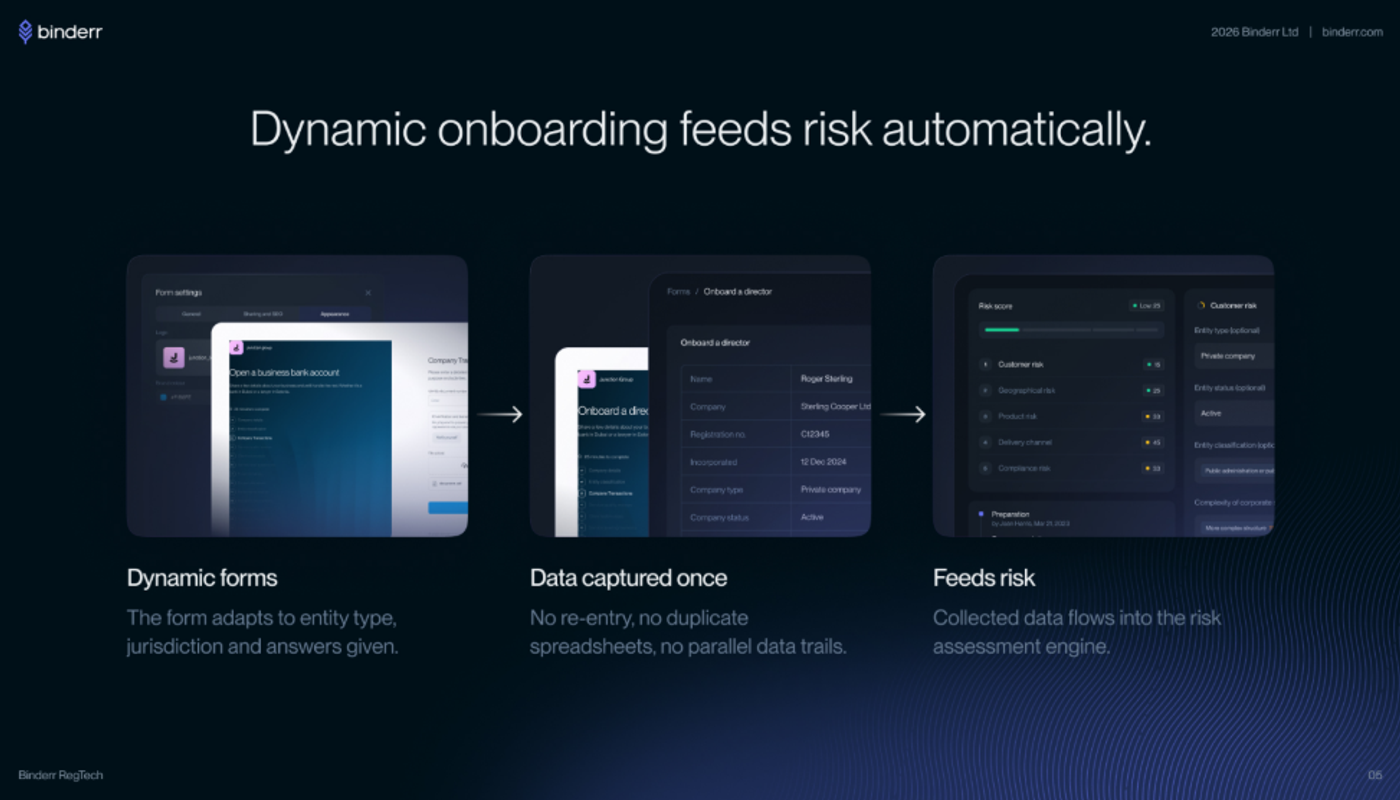
(Binderr Compliance connects dynamic onboarding forms, client data collection, and automated risk assessment in one workflow.)
Step 2: Establish Legal Basis and Client Agreement
Before progressing further in the financial services onboarding process, institutions must ensure that the client understands and agrees to the legal framework governing the relationship. This step formalises the onboarding process and ensures onboarding process compliance with regulatory disclosure requirements.
Clients are typically required to accept terms and conditions, acknowledge product features and associated risks, and agree to preferred communication methods. They must also confirm receipt of regulatory disclosures, provide consent for identity verification and background checks, and agree to submit accurate and complete information throughout the relationship.
This stage is critical for establishing transparency and trust. It ensures that both the financial institution and the client clearly understand their rights, responsibilities, and obligations before proceeding with deeper KYC, AML screening, and risk assessment activities within client onboarding financial services.
Step 3: Confirm Identity Authenticity
This stage focuses on verifying that the applicant is a real individual and that the identity provided is genuine. Identity verification is a core part of KYC compliance and supports strong client onboarding compliance by helping prevent fraud and financial crime.
Institutions review documents such as passports, national ID cards, driving licences, and residence permits, checking their validity and authenticity using manual review and automated tools like OCR and fraud detection systems. To confirm presence and ownership, financial institutions use biometric methods such as facial comparison, liveness detection, and video verification. These checks help ensure the applicant matches the submitted documents and reduce impersonation risks.
Data cross-verification strengthens identity assurance by comparing client information against trusted databases, credit records, and address or contact verification systems. Combining these methods improves accuracy and supports a reliable onboarding process compliance framework.
Step 4: Establish Business Legitimacy and Control Structure
For corporate onboarding, financial institutions must verify the legal existence of the business and identify the individuals who ultimately own or control it. This is essential for KYB compliance and beneficial ownership transparency within client onboarding financial services.
Entity validation includes confirming registration, checking operational status, reviewing official filings, and ensuring business activities match the application. These checks help detect inactive, dissolved, or fraudulent entities.
Ownership and control identification focuses on shareholders, individuals with voting rights, those exercising indirect control, and senior management where ownership is unclear. Identifying ultimate beneficial owners (UBOs) is key to assessing financial crime risk and meeting onboarding process compliance requirements.
Corporate onboarding becomes more complex when ownership is spread across multiple companies and individuals. Binderr Compliance helps teams visualise the ownership structure, connect people to legal entities, and see whether ownership or control has been verified.
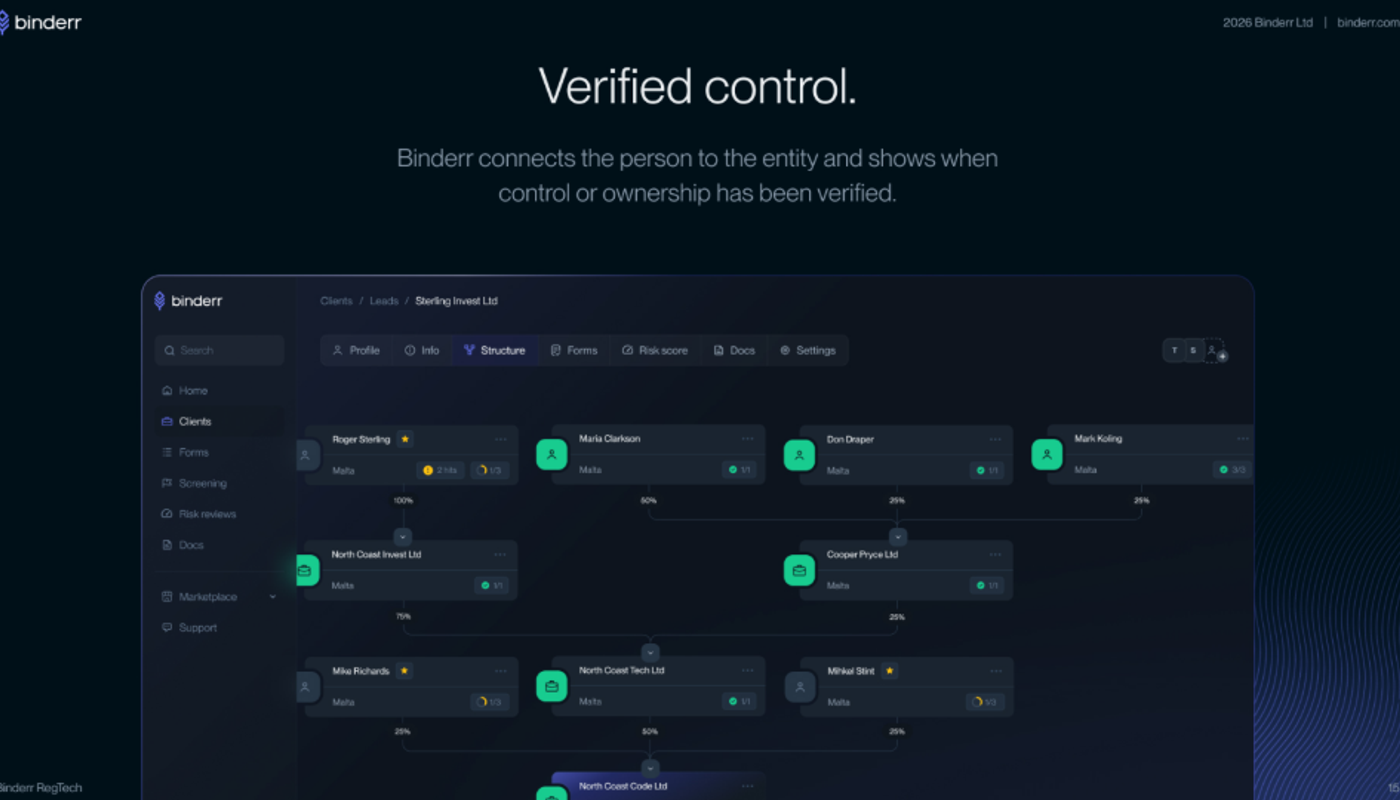
(Binderr maps corporate ownership and control relationships, helping compliance teams identify and verify connected individuals and entities.)
Step 5: Screen for Financial Crime Exposure
At this stage, financial institutions conduct AML screening to identify links to financial crime, sanctions violations, or reputational risk as part of client onboarding compliance.
Sanctions screening compares client details against global and local lists using identifiers like name, date of birth, and nationality to reduce false positives. Politically exposed person (PEP) screening identifies individuals with prominent public roles. While not a barrier to onboarding, PEP status signals higher risk and may require enhanced due diligence. Adverse media screening reviews credible negative news for signs of fraud, corruption, or other illicit activity, assessing relevance and reliability.
Institutions also review internal risk indicators, such as past account closures or fraud alerts, to build a more complete risk profile aligned with onboarding process compliance.
Screen Customers in Seconds for FREE
Step 6: Determine the Client’s Risk Profile
Financial institutions use a structured risk assessment process to evaluate the overall risk a client presents during the client onboarding process in financial services. This step is essential for identifying potential AML risks, fraud exposure, and compliance obligations. By applying a risk-based approach, firms can prioritise high-risk clients while streamlining onboarding for lower-risk profiles within client onboarding financial services.
Key risk dimensions include client characteristics, geographic exposure, product usage, interaction channels, and expected transaction activity. These factors are analysed together to assign a customer risk rating, typically low, medium, or high, which directly influences the level of customer due diligence (CDD), enhanced due diligence (EDD), and ongoing AML monitoring required for onboarding process compliance.
Step 7: Tailor Due Diligence Measures
Customer due diligence (CDD) is applied based on the client’s risk profile to ensure compliance with KYC and AML regulations while maintaining an efficient onboarding workflow. This risk-based approach supports strong client onboarding compliance and allows financial institutions to allocate resources effectively.
Low-risk clients may undergo simplified due diligence with basic identity verification, while standard-risk clients require full CDD, including identity checks, ownership verification, and understanding the purpose of the relationship. High-risk clients require enhanced due diligence (EDD), involving deeper background checks, additional documentation, and senior management approval to mitigate financial crime risks and maintain onboarding process compliance.
Step 8: Validate Financial Background
As part of the financial services onboarding process, institutions assess whether the client’s financial background aligns with their intended account usage. This step helps detect inconsistencies that may indicate money laundering, fraud, or other suspicious activity within client onboarding financial services.
Financial consistency checks include reviewing income sources, business revenue, investment activity, and asset ownership. Supporting documentation such as financial statements, payslips, transaction history, and contracts helps verify the source of funds and ensures the client’s financial profile is legitimate and consistent with their declared information, reinforcing client onboarding compliance.
Step 9: Make an Onboarding Decision
At this stage, financial institutions review all collected data, verification results, and risk assessments to decide whether to proceed with the client relationship. This decision is a critical part of the client onboarding workflow and must align with internal compliance policies and AML regulations tied to onboarding process compliance.
Possible outcomes include approval, conditional approval, requests for additional information, escalation for compliance review, or rejection. High-risk or complex cases are typically reviewed by compliance teams to ensure that sanctions risks, adverse media findings, or inconsistencies are properly assessed before a final decision is made, ensuring strong client onboarding compliance.
Step 10: Finalise Setup and Begin Relationship
Once approved, the institution completes account setup and activates the client relationship. This stage transitions the client from onboarding to active service use within the financial services lifecycle.
Key steps include account creation, issuing access credentials, activating financial products, initiating funding, and providing client guidance. A smooth onboarding completion process improves customer experience while ensuring readiness for ongoing monitoring, periodic KYC reviews, and long-term compliance management within client onboarding financial services.
See How Binderr Streamlines Client Onboarding
- Automates KYC, KYB, and AML checks in one platform
- Reduces onboarding time with real-time verification
- Improves accuracy with AI-powered fraud detection
- Enables risk-based onboarding workflows
- Ensures full compliance across jurisdictions
How Client Onboarding Differs Across Financial Services
Every financial sector shapes its client onboarding process around unique risks, regulations, and customer expectations. From digital onboarding in fintech to complex KYC and KYB checks in banking and wealth management, each industry adapts its approach to balance compliance, efficiency, and user experience while maintaining onboarding process compliance.
Retail and Commercial Banks
Retail and commercial banks rely on a structured client onboarding process focused on identity verification, customer due diligence, and regulatory compliance. They verify individuals and businesses through KYC procedures, assess beneficial ownership, and evaluate expected account activity to detect anomalies early. Deposit, payment, and lending services require banks to understand how customers will use their accounts, ensuring alignment with AML standards and reducing financial crime risk.
Transaction monitoring is also essential for ongoing compliance. By analyzing payment patterns, volumes, and geographic activity, banks can identify suspicious behavior and trigger alerts. Credit risk assessment is integrated into onboarding, particularly for lending, helping institutions maintain compliance and sound risk management throughout the customer lifecycle.
Fintech and Payment Companies
Fintech and payment companies focus on digital onboarding, enabling fast account opening through remote verification and mobile-first experiences. They use automated identity checks, biometrics, and real-time data validation to streamline onboarding while meeting KYC and AML requirements. High transaction volumes and cross-border payments require scalable systems that can support large user bases without weakening fraud detection.
Automation plays a key role in fintech onboarding, helping detect fraud signals, flag suspicious activity, and reduce friction. Technologies like machine learning and behavioral analytics identify unusual patterns, while integrated AML screening supports sanctions and PEP compliance. This balance of speed, scalability, and control helps fintech firms deliver smooth customer experiences while managing financial crime risks.
Investment and Brokerage Firms
Investment and brokerage firms require a more detailed onboarding process beyond basic identity verification. They must assess investor identity, verify the source of investment funds, and evaluate tax status to meet regulatory obligations. Suitability and appropriateness checks are often used to ensure clients understand the risks of specific financial products, especially in complex or high-risk environments.
These firms must also monitor for market abuse risks, such as insider trading and manipulation, making strong customer identification and transaction transparency essential. AML screening, ongoing monitoring, and clear record-keeping support compliance and help protect market integrity. By combining regulatory checks with investor profiling, brokerage firms can deliver compliant and tailored investment services.
Wealth and Asset Management Firms
Wealth and asset management firms focus on understanding the source of wealth and financial background of high-net-worth clients. Onboarding often involves complex ownership structures, trusts, and family offices, requiring enhanced due diligence and detailed beneficial ownership analysis. PEP screening and adverse media checks are important due to higher risk profiles and cross-border investments.
These firms also assess investment objectives, risk tolerance, and long-term goals to deliver personalized portfolio management. Given the high-value relationships, onboarding must balance thorough compliance with a premium client experience. Continuous monitoring and periodic reviews help keep client profiles accurate and aligned with regulatory expectations.
Lending Platforms
Lending platforms prioritize identity verification and creditworthiness during onboarding. They verify borrower identity, confirm bank account ownership, and assess affordability through income checks and credit data. Fraud detection tools help identify synthetic identities, falsified documents, and suspicious application patterns.
They also evaluate loan purpose and financial behavior to determine risk and support responsible lending. Automated underwriting and real-time data analysis streamline onboarding while maintaining compliance with AML and consumer protection requirements, enabling faster approvals with reduced fraud and default risk.
Insurance Providers
Insurance providers require onboarding processes that include policyholder verification, beneficiary identification, and premium funding checks. These steps help ensure policies are issued to legitimate individuals and that funds are not linked to illicit activity. AML screening and fraud detection are important for preventing claims fraud and identifying suspicious changes.
Higher-risk products, such as life insurance and investment-linked policies, often require enhanced due diligence due to their potential misuse. Insurers must also monitor ownership and beneficiary changes to detect unusual patterns. Integrating compliance checks into onboarding helps protect against financial crime while maintaining trust with policyholders.
Cryptoasset Businesses
Cryptoasset businesses operate in a high-risk environment that requires strong digital identity verification and enhanced AML controls. These firms must verify users remotely, assess wallet risks, and analyze the source of funds to prevent illicit activity. Blockchain analytics tools help trace transactions and identify links to sanctioned entities or suspicious networks.
Cross-border transactions and pseudonymous activity add complexity to onboarding in the crypto sector. As a result, enhanced monitoring, sanctions screening, and risk-based controls are essential for compliance. By combining advanced technology with solid compliance frameworks, cryptoasset businesses can manage financial crime risks while supporting innovation in digital finance.
Automate Customer Verification with Binderr
Best Practices for Improving Financial Services Client Onboarding
Streamline your client onboarding process with smarter workflows, stronger compliance, and seamless digital experiences. Discover proven strategies for KYC onboarding, AML compliance, risk-based verification, and automated financial services onboarding that strengthen onboarding process compliance.
Apply a Risk-Based Process - A risk-based approach is central to effective client onboarding in financial services. Instead of applying the same level of scrutiny to every customer, institutions should tailor their KYC, KYB, and AML checks based on the client’s risk profile. This supports efficient client onboarding compliance while reducing friction.
Verify Information Against Independent Sources - Relying solely on client-submitted data can expose financial institutions to fraud and regulatory breaches. Cross-checking information against trusted independent sources strengthens onboarding process compliance and improves data accuracy.
Separate Low-Risk and High-Risk Workflows - Segmenting onboarding workflows based on risk levels allows financial institutions to streamline operations and improve customer experience. Low-risk clients can benefit from automated processing with minimal manual intervention. High-risk clients should be routed to specialist compliance teams for enhanced due diligence. This separation ensures that resources are focused where they are most needed.
Explain Why Information Is Required - Transparency plays a key role in reducing onboarding friction and improving completion rates. When clients understand why sensitive information is required, they are more likely to cooperate and provide accurate data. Including short explanations within onboarding forms helps build trust and align expectations. It also demonstrates the institution’s commitment to compliance and data protection.
Minimise Duplicate Data Entry - Repeated requests for the same information can frustrate clients and increase onboarding abandonment rates. Financial institutions should design systems that reuse verified data across multiple forms and platforms. By leveraging centralized client profiles and integrations, firms can reduce manual input and improve data consistency. This approach also accelerates onboarding workflows.
Build Screening into the Workflow - AML screening should be an integral part of the onboarding journey rather than a separate step. Integrating sanctions screening, PEP checks, and adverse media analysis into the workflow enables real-time risk detection. Automated tools can flag potential matches early for faster resolution. This approach strengthens financial crime prevention.
Maintain Human Oversight - While automation enhances efficiency, human expertise remains essential in financial services onboarding. Compliance professionals should review complex cases involving ownership structures or ambiguous screening results. Human oversight ensures that nuanced risk factors are properly assessed. Combining automation with expert judgment improves accuracy and accountability.
Record Every Material Decision - Maintaining a comprehensive audit trail is critical for regulatory compliance and governance. Financial institutions should document key steps including data sources, verification results, and approval decisions. Detailed records provide transparency and support regulatory audits. Strong documentation also helps improve future onboarding performance.
Test and Review Onboarding Technology - Onboarding systems must be regularly tested to ensure they remain effective and reliable. Institutions should assess verification accuracy, fraud detection capabilities, and system performance. Continuous testing helps identify weaknesses and reduce false positives. Regular reviews ensure alignment with regulatory changes.
Stay Compliant After Onboarding
Common Client Onboarding Challenges
Navigating client onboarding in financial services often reveals hidden friction points that slow growth and increase compliance risk, especially when onboarding process compliance is not fully integrated.
From KYC verification delays to AML screening inefficiencies and onboarding abandonment, understanding these challenges is key to building a faster, more reliable onboarding process.
Repeated Requests for Client Information - Repeated requests for client information occur when disconnected systems force teams to collect the same KYC and KYB data multiple times, causing delays, poor customer experience, and inefficiencies in the financial services onboarding process; implementing a centralised client data repository with integrated onboarding systems ensures a single source of truth, reduces duplication, and improves client onboarding compliance and operational efficiency.
High Application Abandonment - High application abandonment in digital client onboarding is often driven by long forms, unclear instructions, and excessive document requests, which negatively impact conversion rates and customer acquisition; using progressive data collection, pre-filled fields, conditional logic, and mobile-friendly UX design helps streamline onboarding workflows and improve completion rates.
Slow Manual Verification - Slow manual verification arises when staff manually review documents and cross-check data across systems, increasing onboarding time and the risk of human error; automating identity verification, document checks, and AML screening with OCR and AI-powered tools accelerates onboarding while allowing compliance teams to focus on high-risk cases and maintain onboarding process compliance.
Excessive False Positives - Excessive false positives in AML screening occur when weak name matching generates irrelevant sanctions and PEP alerts, overwhelming compliance teams and delaying decisions; using advanced matching algorithms, additional identifiers, and machine learning improves screening accuracy and reduces unnecessary alerts.
Screening automation should help analysts understand and prioritise results rather than simply generate more alerts. Binderr uses a white-box screening approach that shows why a match appeared, allows firms to configure screening logic around their own policies, and helps reduce time spent reviewing weak matches.
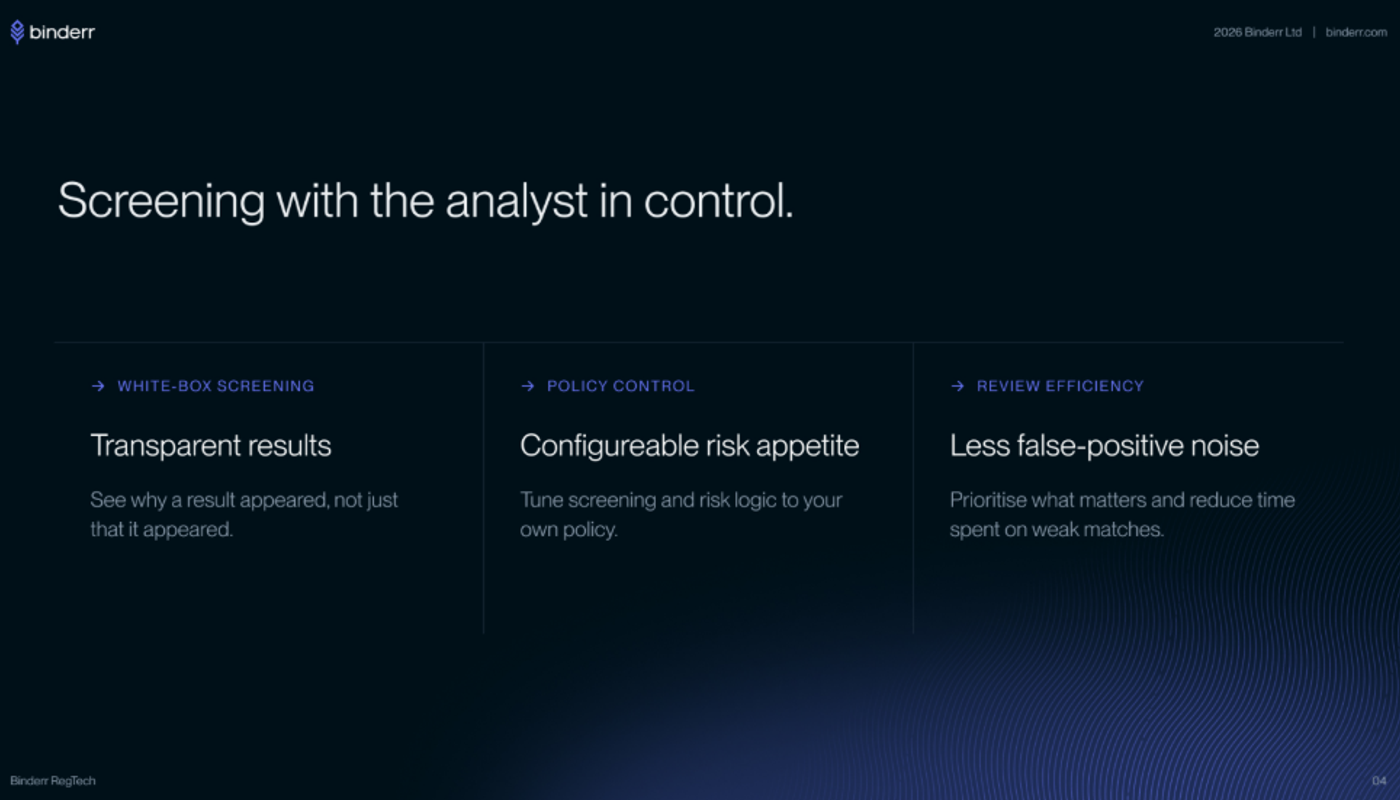
(Binderr gives analysts transparent screening results, configurable policy controls, and clearer prioritisation of potential matches.)
Complex Corporate Ownership - Complex corporate ownership structures involving layered entities, trusts, and cross-border arrangements make UBO identification challenging and increase financial crime risk; using ownership mapping tools, KYB verification systems, and enhanced due diligence helps trace beneficial ownership and ensure AML compliance within client onboarding financial services.
Inconsistent Risk Decisions - Inconsistent risk decisions happen when analysts apply subjective judgement, leading to uneven customer risk assessments and compliance gaps; implementing standardised risk scoring models, documented criteria, and automated risk engines ensures consistent, transparent, and auditable onboarding decisions aligned with client onboarding compliance.
Poor Integration Between Systems - Poor integration between onboarding systems creates data silos across identity verification, AML screening, and risk assessment tools, slowing down workflows and increasing operational complexity; adopting API-driven integrations or unified compliance platforms improves data flow, reduces manual work, and enhances onboarding efficiency.
A compliance platform delivers greater value when it works with the institution’s existing CRM, document, reporting, and operational systems. Binderr can connect onboarding and screening workflows with commonly used business applications through Zapier and API integrations.
(Binderr connects compliance workflows with CRMs and existing operational tools through Zapier and custom APIs.)
Inadequate Ongoing Monitoring - Inadequate ongoing monitoring occurs when client data is not updated after onboarding, increasing exposure to financial crime and regulatory risk; implementing continuous AML screening, transaction monitoring, periodic KYC reviews, and event-driven alerts ensures accurate risk profiles and ongoing compliance throughout the customer lifecycle.
How Socure Supports Risk-Based Client Onboarding
Every step in a risk-based onboarding flow, from KYC and KYB through AML screening and enhanced due diligence, is only as strong as the identity intelligence sitting underneath it. When those steps run on disconnected tools, the same consumer looks like a different person to each check, and analysts spend their time reconciling conflicting signals instead of clearing real customers.
Socure approaches this as one connected problem rather than a stack of point solutions. The platform is built on 400+ trusted sources for identity verification and 40 billion historical known outcomes, with an additional 200+ external data sources available through the RiskOS® marketplace for cases where a firm wants to pull in registry, credit header, or sector-specific data. That shared foundation is what lets a low-risk consumer clear in seconds while a high-risk applicant is routed for enhanced due diligence with the underlying evidence already attached.
RiskOS® is the decisioning layer where teams design, test, and deploy the workflows the onboarding process actually runs on, orchestrating rule-based and model-driven decisions across KYC, third-party and synthetic fraud, device intelligence, watchlist screening, and bank account verification. Socure supports identity verification for 3,000+ customers, including 19 of the top 20 U.S. banks, and made 5 billion identity and risk decisions in 2025. The practical consequence for onboarding teams is fewer false positives to chase and a cleaner audit trail behind every approval, decline, or escalation.
Get Complete Compliance Solution with Binderr
Binderr provides a fully integrated compliance platform designed to streamline onboarding from start to finish.
- KYC identity verification with biometrics and AI
- KYB business verification with global registry access
- AML screening across sanctions, PEPs, and adverse media
- UBO identification and ownership mapping
- Dynamic risk scoring and automated workflows
- Centralised audit trails and reporting
Bottom Line
Effective client onboarding financial services is a structured process that combines compliance and operational steps into one workflow. It starts with client data collection and digital forms, followed by identity verification (KYC), business verification (KYB), and beneficial ownership checks. Institutions then perform AML screening, including sanctions, PEP, and adverse media checks, assess customer risk, and apply the appropriate level of due diligence to meet client onboarding compliance requirements. The process concludes with approval, account activation, and ongoing monitoring.
Effective onboarding balances onboarding process compliance and customer experience. A risk-based approach speeds up low-risk cases while applying stricter checks to higher-risk clients. Automation improves efficiency and accuracy, but strong governance and oversight remain essential. Binderr Compliance helps streamline KYC, KYB, AML screening, risk assessment, and monitoring for faster, more consistent onboarding.