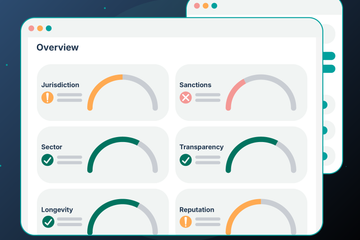
Accountants and financial advisors rely on business clients for growth, yet every corporate onboarding carries hidden risk. A registered company can mask complex ownership, nominee directors, or exposure to sanctions and financial crime. The KYB Guide for Accountants & Financial Advisors explains how firms can verify companies, identify UBOs, and apply AML checks to reduce risk before engagement, strengthening kyb accountants processes and kyb accounting compliance.
Corporate client verification is no longer optional. FATF reports show that over 40 percent of major money laundering cases involve misuse of legal entities. KYB for accountants and financial advisors helps uncover beneficial ownership, screen for sanctions and PEP exposure, and assess business risk with clarity. Firms that apply structured KYB compliance protect their reputation and strengthen client trust while improving kyb accounting compliance standards.
In this guide, you will learn how KYB works in practice for accountants and financial advisors, the key checks to perform during corporate onboarding, common red flags to watch for, and how to build a risk-based verification process that supports compliance and business growth.
Binderr KYB Software for Accountants & Financial Advisors
When evaluating KYB tools, firms should look for:
- Global company registry access
- UBO identification and ownership mapping
- Integrated AML screening (sanctions, PEPs, adverse media)
- Automated risk scoring
- Ongoing monitoring and alerts
- Audit-ready compliance records
What Is KYB for Accountants and Financial Advisors?
KYB, or Know Your Business, is a core compliance process that helps accountants and financial advisors verify the identity and legitimacy of corporate clients before onboarding them. In simple terms, KYB ensures that a business is real, properly registered, and operating within legal boundaries. It involves reviewing company registration details, confirming the registered address and jurisdiction, and understanding the ownership structure, including directors, shareholders, and Ultimate Beneficial Owners (UBOs). This process is essential for reducing exposure to financial crime, fraud, and regulatory penalties while supporting kyb accountants responsibilities.
For accounting and advisory firms, KYB goes beyond basic verification. It includes AML screening of the company and its key individuals, assigning a risk score based on factors like geography and industry, and implementing ongoing monitoring to detect changes in ownership or risk profile. By combining company verification, UBO identification, and risk-based due diligence, KYB helps professionals build trust with clients while maintaining strong AML compliance and safeguarding their firm’s reputation through effective kyb accounting compliance.
Cut compliance time. Screen & detect risk for FREE.
Why KYB Matters for Accountants and Financial Advisors
KYB plays a critical role in helping accountants and financial advisors verify business clients, assess ownership structures, and identify potential AML risks before onboarding. By conducting proper business verification and UBO checks, firms can reduce exposure to fraud, tax evasion, and financial crime while strengthening kyb accountants' practices.
Strong KYB compliance ensures safer client relationships, supports regulatory obligations, and strengthens trust in accounting and advisory services.
Reducing Exposure to Financial Crime - KYB helps accountants and financial advisors reduce exposure to financial crime by verifying business clients before onboarding. By conducting company verification, UBO checks, and AML screening, firms can identify risks such as shell companies, sanctions exposure, or suspicious ownership structures early in the process, improving kyb accounting compliance.
Improving Client Risk Assessment - A structured KYB process allows firms to perform more accurate client risk assessments. By reviewing company data, ownership structures, and business activities, accountants and financial advisors can assign appropriate risk levels and apply a risk-based approach to client onboarding and monitoring.
Strengthening Regulatory Compliance - KYB supports stronger AML compliance by ensuring that firms meet regulatory expectations around business verification and due diligence. Performing CDD and EDD checks, screening for sanctions and PEPs, and maintaining audit-ready records helps firms stay aligned with compliance requirements and kyb accounting compliance standards.
Enhancing Transparency in Ownership Structures - KYB improves transparency by identifying directors, shareholders, and Ultimate Beneficial Owners. This helps firms understand who ultimately controls a business, reducing the risk of hidden ownership, nominee arrangements, or complex structures designed to obscure control.
Protecting Firm Reputation - Working with high-risk or non-compliant business clients can damage a firm’s reputation. KYB helps prevent this by identifying red flags early, allowing firms to avoid relationships that could lead to regulatory issues, financial crime exposure, or negative publicity.
Supporting Long-Term Client Relationships - By implementing KYB and ongoing monitoring, firms can build more secure and trustworthy client relationships. Understanding a client’s business structure and risk profile from the start supports better advisory services and helps maintain compliance throughout the client lifecycle.
All-in-one AML & KYB Screening. No contracts needed.
KYB Documents Accountants and Financial Advisors May Need
Understand the essential KYB documents required for business verification and AML compliance, especially for kyb accountants workflows.
These documents help verify company identity, ownership structure, and UBO details during corporate client onboarding.
- Certificate of incorporation: Confirms the legal existence of the company and provides key details such as the date of incorporation and registration number.
- Company registry extract: Verifies official company information, including status, registered address, and filing history from a trusted government source.
- Articles of association or memorandum of association: Outlines the company’s structure, governance rules, and the rights and responsibilities of shareholders and directors.
- Shareholder register: Lists all shareholders and their ownership percentages, helping to identify who owns the company.
- Director register: Provides details of current and past directors, showing who manages and controls the business.
- UBO declaration: Identifies the ultimate beneficial owners who ultimately own or control the company, even through indirect structures.
- Proof of registered address: Confirms the official business address, which helps validate the company’s physical or legal presence.
- Business licence: Demonstrates that the company is authorised to operate in its industry, especially important for regulated sectors.
- Financial statements: Offers insight into the company’s financial health, operations, and potential risk indicators.
- Ownership structure chart: Visually maps out the company’s ownership layers, making it easier to understand complex structures and identify UBOs.
KYB Process for Accountants and Financial Advisors
Understand the step-by-step KYB workflow for verifying business clients, identifying UBOs, and managing AML risk, with a focus on kyb accountants execution and kyb accounting compliance.
Learn how accountants and financial advisors can streamline business verification, corporate due diligence, and client onboarding with a risk-based approach.
Step 1: Collect Basic Business Information
Begin the KYB process by gathering essential company details such as the company name, registration number, jurisdiction of incorporation, registered address, nature of business activity, and official contact information. This foundational data supports accurate business verification and ensures that the entity can be properly identified across company registries and compliance databases.
Collecting complete and consistent information at this stage helps streamline subsequent KYB checks, including AML screening and UBO verification. It also reduces onboarding delays and improves the accuracy of risk assessment for accountants and financial advisors managing corporate client onboarding.
Step 2: Verify Company Registration
Next, verify the company’s legal existence by checking official registry records in the relevant jurisdiction. Confirm that the business is active, in good standing, and not dissolved or struck off. This step is critical for validating the legitimacy of the corporate client and ensuring compliance with KYB and AML requirements.
Reliable company verification helps detect fraudulent or shell entities early in the onboarding process. It also provides key insights into incorporation date, legal status, and filing history, which are important for assessing business risk and applying a risk-based approach.
Step 3: Identify Directors and Shareholders
Identify and verify the individuals and entities that manage and own the company, including directors, officers, and shareholders. This step is essential for understanding the ownership structure and determining who has control over the business.
Accurate identification of directors and shareholders supports UBO verification and enables effective AML screening against sanctions, PEP lists, and adverse media. It also helps uncover hidden ownership risks, nominee arrangements, or complex corporate structures that may require enhanced due diligence.
Step 4: Identify UBOs
Identify the Ultimate Beneficial Owners (UBOs) by tracing ownership through all layers of the corporate structure until you reach the natural persons who ultimately own or control the business. This includes reviewing shareholder registers, corporate filings, and ownership charts to uncover individuals with significant control or ownership, typically those holding 25% or more of shares or voting rights.
UBO identification is a critical part of KYB compliance and AML checks, as it helps prevent the misuse of complex structures, shell companies, or nominee arrangements. Accurate UBO verification ensures transparency and supports effective risk assessment during business client onboarding.
Verify UBOs instantly & automate your KYB process.
Step 5: Screen the Company and Key People
Conduct comprehensive AML screening on the company, its directors, shareholders, and identified UBOs. This includes checking against global sanctions lists, Politically Exposed Persons (PEP) databases, watchlists, and adverse media sources to detect any links to financial crime, corruption, or regulatory violations.
Screening is essential for identifying high-risk entities and individuals early in the onboarding process. It supports compliance with AML regulations and helps accounting and financial advisory firms avoid exposure to sanctioned or high-risk clients.
Step 6: Assess Business Risk
Evaluate the overall risk profile of the business by analyzing key factors such as industry type, geographic exposure, ownership structure, transaction patterns, source of funds, and the intended purpose of the client relationship. This risk-based approach aligns with AML compliance standards and helps determine the level of due diligence required.
A thorough business risk assessment enables firms to classify clients into risk categories and decide whether standard Customer Due Diligence (CDD) is sufficient or if Enhanced Due Diligence (EDD) is necessary. This step is crucial for maintaining a compliant and secure client onboarding process.
Step 7: Apply CDD or EDD
At this stage, apply Customer Due Diligence (CDD) or Enhanced Due Diligence (EDD) based on the client’s risk profile. For low to medium-risk business clients, standard CDD involves verifying company registration, identifying directors and UBOs, and conducting basic AML screening. This ensures that the business verification process meets baseline KYB compliance requirements.
For higher-risk clients, Enhanced Due Diligence (EDD) is required. This includes deeper analysis of ownership structures, source of funds, source of wealth, and more extensive sanctions, PEP, and adverse media screening. A risk-based approach is essential here, as it helps accountants and financial advisors manage AML risk effectively while maintaining regulatory compliance.
Step 8: Approve, Reject, or Escalate
Once due diligence is complete, make a clear onboarding decision: approve, reject, or escalate the client. Approval should only occur when the business client meets KYB compliance standards and presents an acceptable risk level. If red flags or inconsistencies remain unresolved, the relationship should be rejected or escalated for further review.
It is critical to document every decision thoroughly. Maintain a detailed audit trail that includes KYB checks, AML screening results, risk assessments, and supporting documents. This ensures transparency, supports regulatory audits, and strengthens internal compliance processes tied to kyb accounting compliance.
Step 9: Monitor Changes Over Time
KYB is not a one-time process. Ongoing monitoring is essential to detect changes in a business client’s risk profile. Track updates such as ownership changes, new directors, changes in business activity, sanctions list updates, and adverse media developments.
Automated KYB software can support continuous monitoring by providing real-time alerts and updates. This helps accountants and financial advisors stay compliant with AML obligations, respond quickly to emerging risks, and maintain accurate, up-to-date client records.
Check How Binderr Simplifies the KYB Process
- Run KYC, KYB, and AML checks in one platform
- Automatically assign risk scores
- Trigger EDD workflows for high-risk clients
- Collect documents and verify data instantly
- Monitor clients continuously with alerts
Best Practices for KYB Compliance
Discover how to strengthen your KYB compliance process with practical, risk-based strategies for verifying business clients and improving kyb accountants workflows.
Explore how these best practices help accountants and financial advisors improve business verification, UBO checks, AML screening, and ongoing monitoring.
- Build a standard KYB checklist for every business client by creating a consistent onboarding framework that includes company verification, ownership structure mapping, UBO identification, AML screening, and risk scoring. A well-defined checklist ensures that no critical compliance step is missed and helps accounting and advisory firms maintain audit-ready processes across all corporate clients.
- Identify UBOs, not just directors, by tracing ownership through layers of shareholders, holding companies, or trusts to uncover the natural persons who ultimately own or control the business. Beneficial ownership transparency is essential for detecting hidden risks, shell companies, and nominee arrangements that may not be visible at the director level.
- Screen both the company and connected individuals by running sanctions screening, PEP checks, watchlist screening, and adverse media searches on the business entity as well as its directors, shareholders, and UBOs. This dual-layer AML screening helps uncover financial crime risks that may be linked to individuals behind the company.
- Use a risk-based approach by assessing each business client based on factors such as industry, jurisdiction, ownership complexity, transaction patterns, and screening results. This allows firms to allocate compliance resources efficiently and apply appropriate levels of Customer Due Diligence (CDD) or Enhanced Due Diligence (EDD).
- Escalate high-risk clients for EDD when red flags such as complex ownership structures, high-risk jurisdictions, PEP exposure, or negative media are identified. Enhanced Due Diligence should include deeper source of funds checks, additional documentation, and senior management approval to mitigate potential AML risks.
- Keep clear records of every check by maintaining detailed documentation of KYB processes, including company verification results, UBO identification, AML screening outcomes, and risk assessments. A strong audit trail supports regulatory compliance and demonstrates that proper due diligence has been performed.
- Refresh KYB data periodically by updating company information, ownership structures, and screening results at regular intervals or when significant changes occur. Ongoing monitoring ensures that firms remain aware of evolving risks such as new sanctions listings, ownership changes, or emerging adverse media.
- Use automation to reduce manual errors and delays by implementing KYB software that streamlines company verification, UBO checks, AML screening, and risk scoring. Automation improves accuracy, speeds up client onboarding, and enables scalable compliance workflows for accounting and financial advisory firms focused on kyb accounting compliance.
Binderr UBO Identification & Ownership Mapping for Accountants
One of the most critical KYB components is identifying who truly owns a business.
Binderr simplifies this with:
- Automated ownership structure mapping
- Detection of multi-layered corporate hierarchies
- UBO identification across jurisdictions
- Integrated AML screening for UBOs and directors
Common KYB Mistakes Accountants and Financial Advisors Should Avoid
Avoiding common KYB mistakes helps accountants and financial advisors strengthen business verification, reduce AML risk, and improve client onboarding processes while enhancing kyb accountants practices.
Understanding these pitfalls ensures better compliance with KYB, UBO verification, AML screening, and corporate due diligence requirements.
Treating directors as owners without verification
A common KYB mistake is assuming that company directors are the same as the Ultimate Beneficial Owners (UBOs). In many cases, directors may be nominees or appointed representatives, which can obscure the true ownership structure. This can lead to incomplete business verification, missed AML risks, and exposure to shell companies or hidden beneficial ownership.
To avoid this, firms should conduct proper UBO verification as part of their KYB process. This includes reviewing shareholder registers, ownership structures, and identifying individuals who ultimately control or benefit from the company. Using KYB software can help map ownership layers and ensure accurate beneficial ownership checks.
Ignoring corporate shareholders
Another issue in corporate client verification is overlooking corporate shareholders. When a company is owned by another company, failing to investigate further can hide complex ownership chains and increase AML compliance risk. This is especially problematic in cross-border structures or high-risk jurisdictions.
The solution is to trace ownership through all layers until the natural persons (UBOs) are identified. Accountants and financial advisors should perform enhanced due diligence (EDD) where corporate shareholders are involved, ensuring full transparency in ownership structures and reducing exposure to financial crime.
Relying on outdated registry documents
Using outdated company registry documents can lead to inaccurate KYB checks. Company details such as directors, shareholders, or legal status may have changed, creating gaps in business verification and increasing compliance risk.
Firms should always verify company information using up-to-date registry data and reliable sources. Automated KYB tools can provide real-time access to company records, ensuring that onboarding decisions are based on current and accurate information.
Using the same checks for every client regardless of risk
Applying a one-size-fits-all approach to KYB ignores the risk-based approach recommended by AML frameworks. Treating all business clients the same can result in insufficient checks for high-risk entities or unnecessary friction for low-risk clients.
Instead, firms should implement a risk-based KYB process. This means adjusting the level of Customer Due Diligence (CDD) or Enhanced Due Diligence (EDD) based on factors such as industry, jurisdiction, ownership complexity, and AML screening results. Risk scoring helps prioritize resources and improve compliance efficiency.
Not documenting decisions
Failing to document KYB decisions creates gaps in audit trails and weakens AML compliance. Without proper records, firms cannot demonstrate how they assessed risk, verified business clients, or justified onboarding decisions.
To address this, firms should maintain clear and structured documentation for every KYB check. This includes company verification results, UBO identification, AML screening outcomes, and risk assessments. Using compliance software ensures that all records are stored centrally and are audit-ready.
Waiting until after onboarding to review risk
Delaying KYB checks until after onboarding exposes firms to unnecessary risk. Accepting a business client without proper verification can lead to onboarding high-risk or non-compliant entities, increasing exposure to fraud, sanctions breaches, or reputational damage.
KYB should be completed before onboarding as part of a structured client onboarding process. Firms should verify companies, identify UBOs, and conduct AML screening upfront. Ongoing monitoring should then be used to track changes in risk over time, ensuring continuous compliance.
Get End-to-End Compliance with Binderr
Binderr provides a complete compliance solution that combines:
- KYC (Identity Verification) with AI-powered checks
- KYB (Business Verification) with global registry access
- AML Screening across sanctions, PEPs, and adverse media
- Dynamic Risk Assessment with automated scoring
- UBO Identification & Ownership Mapping
- Full CDD and EDD workflow automation
Bottom Line
KYB has become a critical part of modern compliance for accountants and financial advisors working with corporate clients. As financial crime risks evolve, firms can no longer rely on basic company checks or surface-level verification. A robust KYB process enables professionals to verify company registration details, map ownership structures, identify Ultimate Beneficial Owners (UBOs), and conduct thorough AML screening across sanctions, PEPs, and adverse media sources.
By implementing KYB, firms gain deeper visibility into who they are doing business with, reduce exposure to fraud, tax evasion, and money laundering, and strengthen their client onboarding and risk management frameworks. It also supports a risk-based approach, allowing firms to apply Customer Due Diligence (CDD) or Enhanced Due Diligence (EDD) where necessary, while maintaining clear audit trails and ongoing monitoring.
Binderr Compliance helps accounting and advisory firms streamline KYB, automate AML checks, and onboard business clients with confidence.