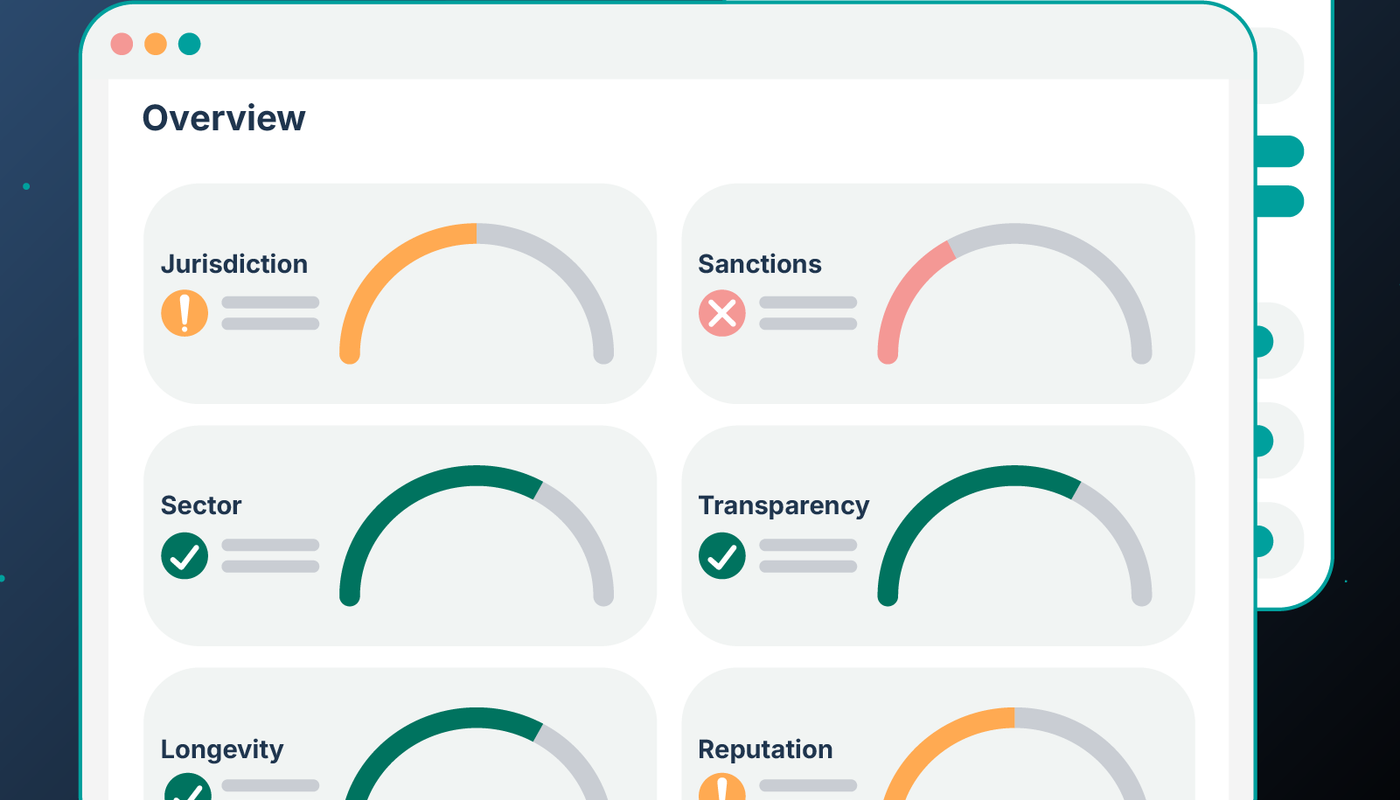
Confirming that a company legally exists is only the beginning of Know Your Business compliance. Regulated organisations must also determine who owns and controls the company, what activities it conducts, where it operates, and whether the relationship creates money laundering, sanctions, fraud, or reputational risk.
A well-designed corporate risk assessment places these findings within a consistent framework so that each business is evaluated against relevant and documented indicators. KYB risk scoring converts company, ownership, geographic, screening, and expected transaction data into a structured risk classification. This enables organisations to apply proportionate due diligence, prioritise higher-risk cases, and avoid treating every business customer identically.
This guide explains how KYB risk assessment works in practice. It covers major risk factors, scoring methodologies, CDD and EDD triggers, automated KYB risk assessment, model governance, and ongoing monitoring throughout the customer relationship.
Binderr KYB Risk Assessment Software
- Global business verification: Access official company data across 200+ countries.
- UBO identification: Identify individuals who ultimately control the business.
- Ownership mapping: Visualise complex ownership structures clearly.
- AML screening: Screen entities and individuals against global risk databases.
- Dynamic risk scoring: Generate consistent risk scores from verified data.
A reliable KYB risk assessment requires more than company verification. Binderr brings KYB checks, sanctions screening, PEP screening, adverse-media analysis, and enhanced due diligence into one connected compliance workflow.
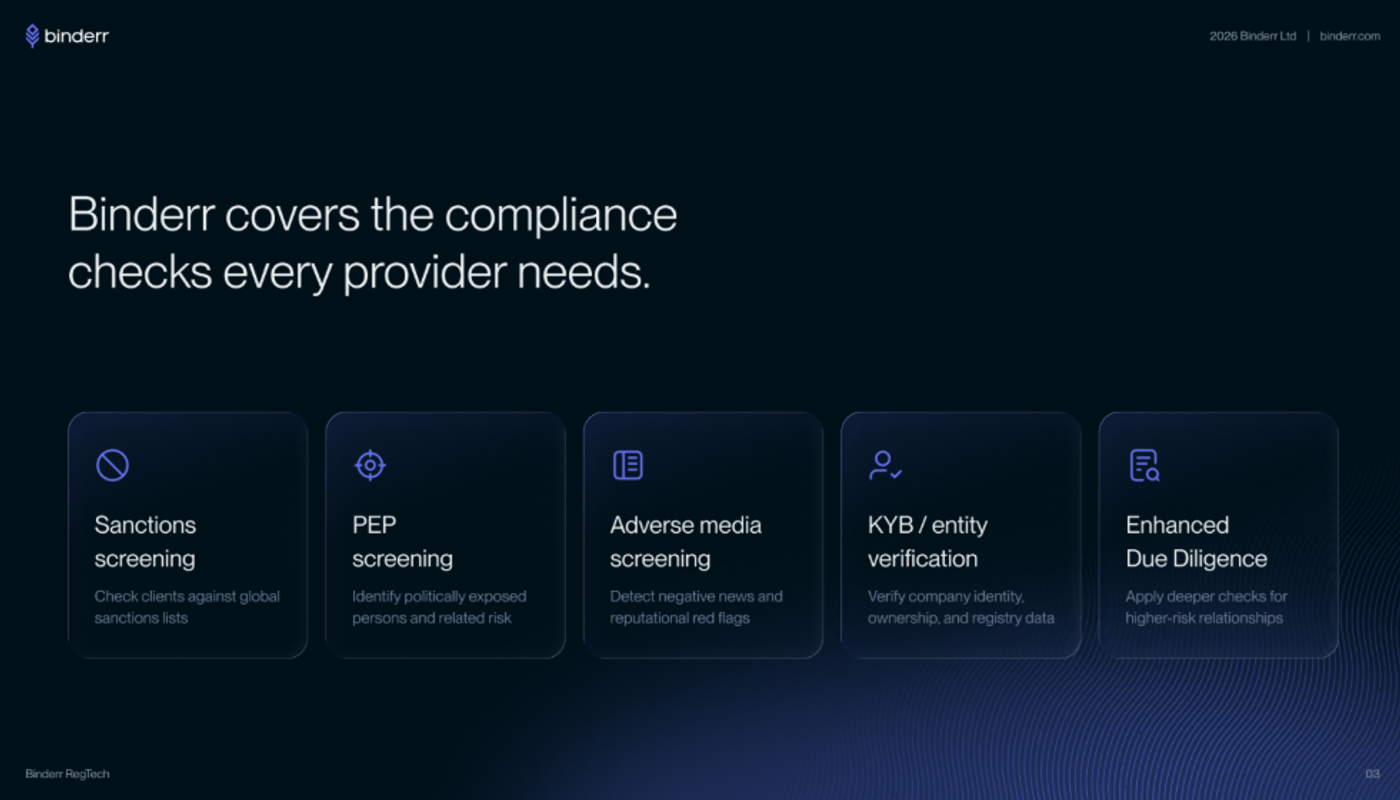
(Binderr combines business verification, AML screening, and enhanced due diligence to support more complete corporate risk assessments.)
What Is a KYB Risk Assessment?
A KYB risk assessment is the process of identifying, analysing, and classifying the financial crime and compliance risks associated with onboarding or maintaining a relationship with a legal entity.
The assessment goes beyond checking whether a company appears in an official registry. It brings together information about the business, its ownership, its activities, the people connected to it, and the way the customer expects to use a product or service.
In practice, the KYB risk assessment often forms the customer-level component of a broader corporate risk assessment framework.
Run Your First KYB Check with Binderr
Why Is Business Risk Scoring Important?
Business risk scoring creates a consistent way to turn complex KYB data into proportionate compliance decisions. A structured KYB scoring model uses defined risk factors, weightings, thresholds, and escalation rules to reduce subjective assessments.
For a business risk assessment AML programme, this consistency helps translate internal policy and regulatory expectations into repeatable customer decisions.
Applies Due Diligence Proportionately - A KYB risk score helps organisations apply risk-based KYB controls instead of treating every business customer identically. Lower-risk companies can follow standard CDD, while high-risk business customers may trigger EDD, senior approval, and enhanced monitoring.
Identifies High-Risk Businesses Earlier - Business risk scoring highlights concerns such as opaque beneficial ownership, high-risk jurisdiction exposure, sanctions matches, PEP involvement, and serious adverse media. Earlier detection allows compliance teams to investigate material risks before approving the relationship.
Supports Consistent Onboarding Decisions - A documented customer risk-rating model gives analysts clear definitions, scoring criteria, and decision thresholds. This improves consistency across business onboarding risk assessments, even when cases are reviewed by different team members.
Reduces Unnecessary Manual Reviews - Automated KYB risk assessment can direct straightforward cases through standard workflows while routing complex or conflicting applications for manual review. This allows compliance teams to focus their resources on customers that require deeper analysis.
Creates Clear CDD and EDD Triggers - A structured KYB scoring model connects the customer’s risk classification to specific compliance actions. Elevated risk factors can automatically trigger additional documents, source-of-funds checks, enhanced due diligence, or senior management approval.
Strengthens Monitoring and Audit Readiness - Business risk scoring helps organisations determine suitable review frequencies and ongoing monitoring controls. A clear audit trail showing risk factors, score calculations, overrides, and approval decisions also makes the methodology easier to explain during regulatory reviews.
Verify Businesses Without the Manual Work
What Factors Affect a KYB Risk Score?
A KYB risk score is influenced by factors related to the company, its ownership, locations, products, transactions, and onboarding behaviour.
Together, these inputs allow corporate risk assessment teams to evaluate the full relationship rather than relying on one isolated data point.
Business and Industry Risk
Business and industry risk looks at how a company operates, earns revenue, and delivers its services. Certain sectors like crypto, gambling, charities, and cash-heavy businesses may carry higher exposure. These industries can present increased risks of fraud or money laundering due to their nature. However, risk should be balanced with licensing, controls, and whether activity aligns with the business model.
Within a business risk assessment AML model, sector exposure should therefore be assessed alongside the company’s actual controls and operating profile.
Geographic and Jurisdiction Risk
Geographic risk includes where the company operates, trades, and conducts financial activity. It also considers links to customers, suppliers, and owners across different regions. Connections to sanctioned or high-risk jurisdictions can increase the KYB risk score. Because country risk changes often, organisations must rely on updated data and dynamic assessments.
Consistent jurisdiction analysis also helps a corporate risk assessment reflect changes in sanctions, regulatory expectations, and cross-border exposure.
Ownership and Control Risk
Ownership and control risk focuses on identifying the true individuals behind a company. Complex structures, nominee shareholders, or layered ownership can obscure transparency. Frequent ownership changes or inconsistent registry data may raise verification concerns. While complexity is not always suspicious, ownership should be clear, logical, and well-documented.
Ownership risk becomes harder to assess when control is distributed across several people, entities, and corporate layers. Binderr helps compliance teams visualise these relationships and see whether ownership and control have been verified.
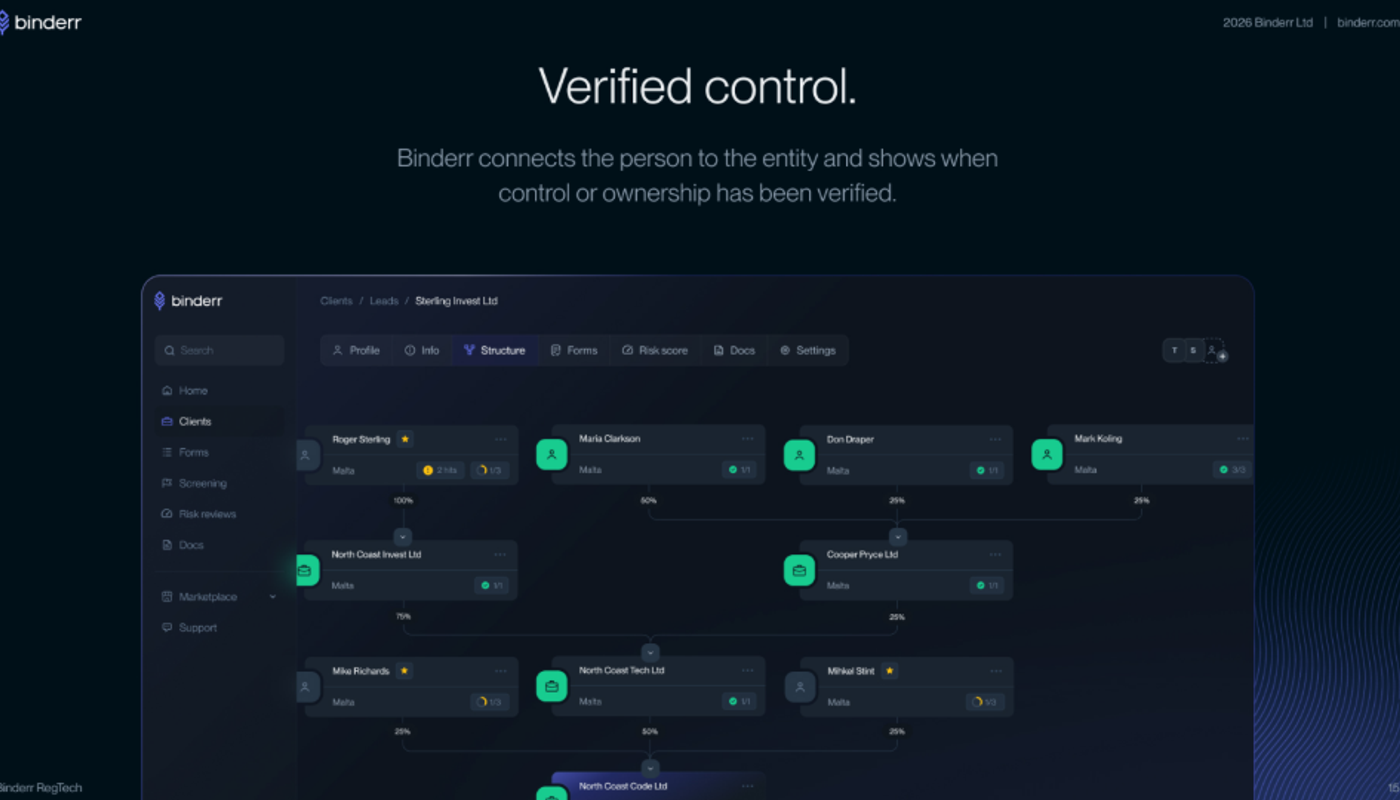
(Binderr connects individuals to corporate entities and displays verified ownership and control relationships across the company structure.)
Sanctions, PEP, and Adverse-Media Risk
AML screening should include the company and all relevant associated individuals. This includes directors, shareholders, UBOs, and other controlling parties. Potential matches must be reviewed carefully using identifiers like names, nationality, and ownership links. Only verified and relevant alerts should impact the KYB risk score.
This screening evidence is a central input in a business risk assessment AML process because it can materially change the level of due diligence required.
Screening results should not operate as an unexplained pass-or-fail decision. Analysts need to understand why an alert appeared, adjust screening rules to the organisation’s risk appetite, and prioritise the matches that require genuine investigation.
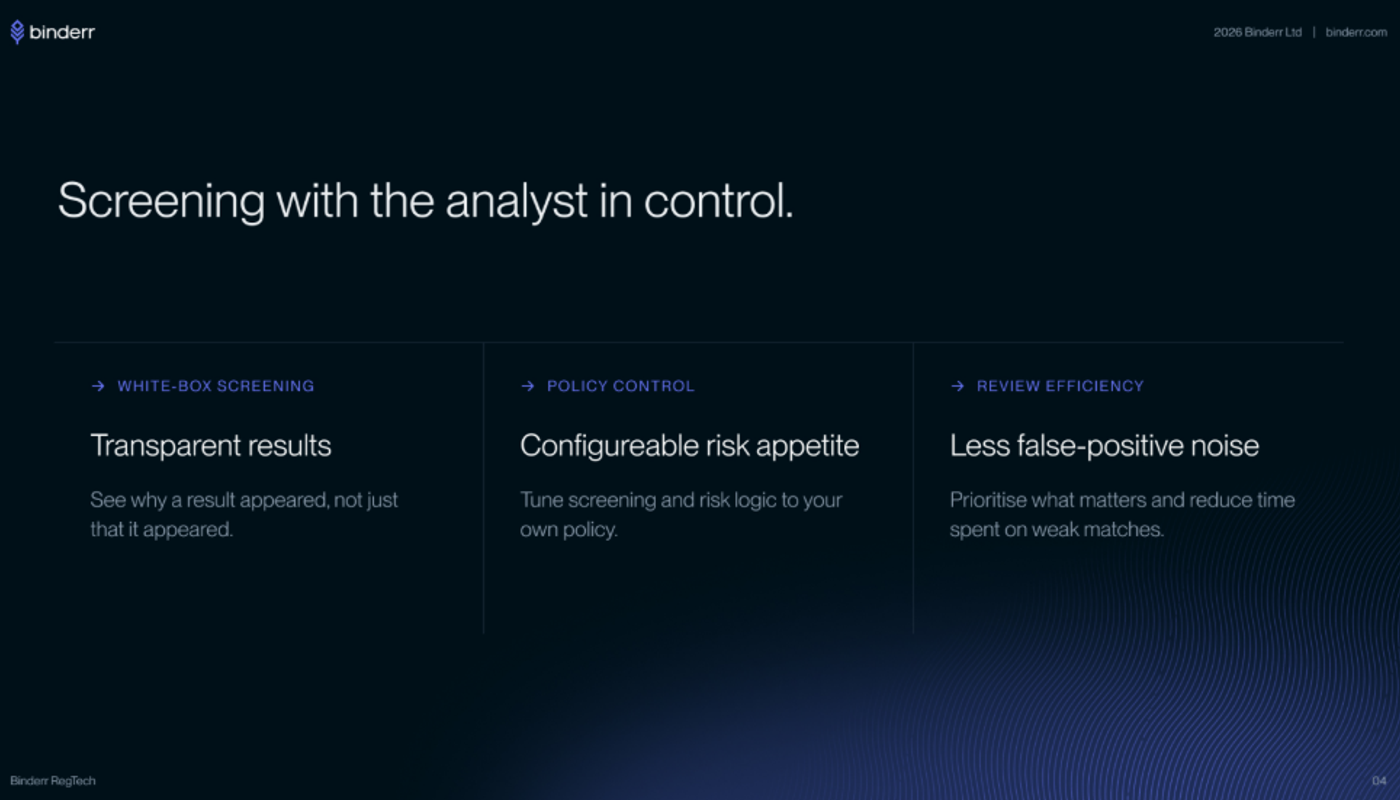
(Binderr gives analysts transparent screening results, configurable policy controls, and clearer prioritisation of potential matches.)
Product, Service, and Delivery-Channel Risk
This risk considers what services the customer can access and how they are delivered. Products involving cross-border payments or rapid fund movement may increase exposure. Remote onboarding or use of intermediaries can also introduce additional risks. Risk levels may change depending on the services the customer is allowed to use.
Expected Activity and Transaction Risk
Expected activity defines what normal behaviour looks like for the customer. It includes transaction size, volume, frequency, and geographic flow of funds. Unusual patterns like sudden spikes or new high-risk corridors may signal concern. Such deviations can trigger enhanced monitoring or further due diligence.
Comparing actual behaviour with this expected profile helps the corporate risk assessment remain relevant after onboarding.
Information Quality and Behavioural Risk
This risk focuses on the accuracy and consistency of onboarding information. Missing documents or conflicting details may indicate potential issues. Reluctance to disclose ownership or repeated changes can raise red flags. Patterns of inconsistency should lead to closer review and possible risk escalation.
A KYB risk score is influenced by factors related to the company, its ownership, locations, products, transactions, and onboarding behaviour.
Get FAST Alerts When Risk Changes
How Does the KYB Risk-Assessment Process Work?
A consistent KYB risk-assessment process can be organised into eight stages. Together, these stages create a repeatable corporate risk assessment that connects verified data with an explainable risk outcome.
Step 1: Collect Company Information
Collect the information required to identify the business and understand the proposed relationship. This typically includes the legal name, registration number, incorporation date, legal form, registered address, trading address, industry, licences, tax details, expected activity, and requested products.
Information requirements should adapt to the customer type. A regulated payment provider, trust, partnership, charity, or multinational group will usually require different evidence from a simple private company.
This information establishes the baseline evidence needed for the initial KYB risk assessment.
Step 2: Verify the Business
Check the company against authoritative registry, regulator, licensing, or tax sources where appropriate.
Confirm whether the business is active and whether its name, registration number, address, legal form, incorporation date, and status match the information provided. Identify signs that it has been dissolved, struck off, suspended, placed into liquidation, or made subject to regulatory restrictions.
Registry verification establishes legal existence, but it does not prove that every submitted detail is accurate or that the business is low risk. The verified registry data should then feed into the broader corporate risk assessment alongside ownership, screening, and expected-activity information.
Step 3: Map the Ownership Structure
Identify direct and indirect shareholders, ownership percentages, voting rights, control relationships, and the natural persons who qualify as UBOs under applicable rules.
The process may require following several corporate layers across different jurisdictions. Where ownership percentages do not reveal the true controller, examine other forms of influence, such as voting agreements, appointment rights, trusts, or control exercised through another entity.
Record how each UBO was identified and how the ownership calculation was performed.
Step 4: Verify Connected Individuals
Complete identity verification on relevant UBOs, directors, authorised representatives, and controlling persons.
Depending on the risk and legal framework, this can involve identity documents, biometric or liveness checks, address evidence, database validation, and confirmation that the person is authorised to act for the company.
Any identity discrepancy should be resolved before the case receives a final risk classification.
Step 5: Complete AML Screening
Screen the entity and relevant connected parties against sanctions, PEP, watchlist, enforcement, and adverse-media data.
Potential matches should enter a structured review process. Analysts need sufficient information to distinguish false positives from genuine matches and determine the effect on the customer relationship.
Screening should not end after onboarding. Lists, public positions, enforcement records, and media coverage change over time. Within a business risk assessment AML workflow, screening results should be reviewed alongside the wider customer profile rather than interpreted in isolation.
Step 6: Evaluate the Risk Factors
Assess the relevant company, ownership, jurisdiction, industry, product, transaction, delivery channel, and information quality risks.
Each factor should have a clear definition and evidence requirement. Broad categories such as “complex business” or “unusual geography” are difficult to apply consistently unless the methodology explains what they mean.
This stage connects verified evidence to the corporate risk assessment and helps ensure that similar cases are treated consistently.
Step 7: Calculate and Review the Risk Score
Apply documented values, weightings, thresholds, and decision rules.
Low-risk cases may proceed through a standard workflow. High-risk, uncertain, or conflicting cases should be routed for manual review. A reviewer should be able to see the underlying evidence instead of receiving only a final number.
Document any score adjustment or override, including who approved it and why. The resulting KYB risk assessment should remain transparent enough for analysts, approvers, auditors, and regulators to understand how the outcome was reached.
Step 8: Apply Due Diligence and Monitoring Controls
Use the final risk level to determine:
- Whether the relationship can be accepted
- Whether CDD or EDD is required
- Whether senior management approval is needed
- What additional evidence must be collected
- Which product or transaction restrictions apply
- How frequently the customer should be reviewed
- What events should trigger reassessment
The assessment is complete only when the classification leads to a defined compliance action.
This ensures that the business risk assessment AML outcome produces a practical response rather than remaining only a numerical classification.
Binderr connects data collection directly to the risk-assessment process. Information gathered through dynamic onboarding forms can flow into the same customer profile and risk engine without repeated data entry or separate spreadsheets.
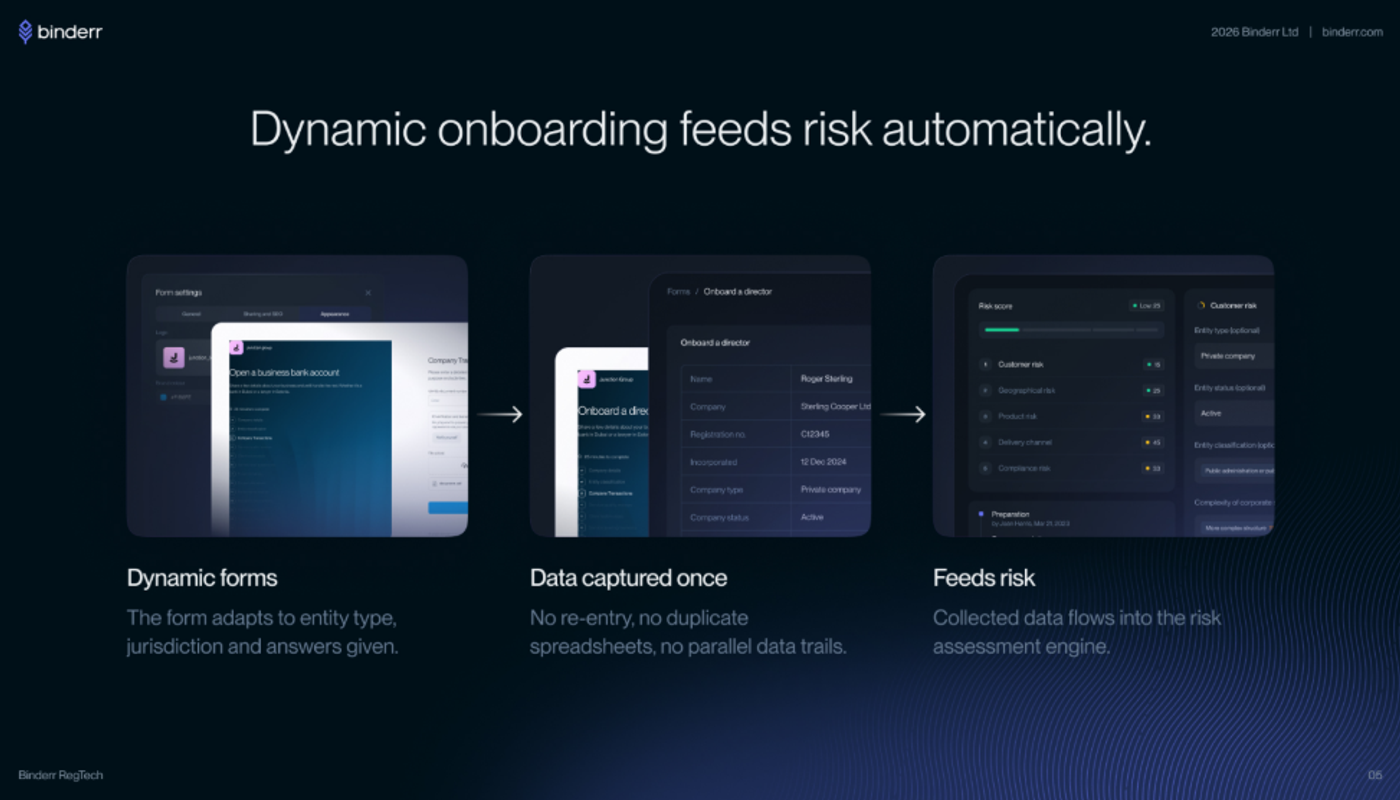
(Binderr captures business information once and uses the collected data to support automated KYB risk scoring.)
Simplify Every Stage of KYB Risk Assessment with Binderr
- Collect business data: Gather company and ownership details through custom forms.
- Verify companies: Retrieve official registration and corporate records.
- Map ownership: Identify indirect ownership and control relationships.
- Screen parties: Check all connected individuals against AML databases.
- Automate risk scoring: Apply rules to generate consistent risk ratings.
How to Build a KYB Risk-Scoring Model
A KYB scoring model should reflect the organisation’s customers, services, jurisdictions, legal obligations, and risk appetite. A generic template can provide a starting point, but it should not be adopted without validation.
The same principles can also support a broader corporate risk assessment framework across different legal-entity customer types.
Select Relevant Risk Categories
A practical model may begin with:
- Business and industry risk
- Geographic risk
- Ownership and control risk
- AML screening risk
- Product and service risk
- Transaction risk
- Delivery-channel risk
- Information-quality risk
The categories should match the organisation’s actual exposure. A payments company may place greater emphasis on transaction corridors and speed, while a corporate services provider may focus more heavily on ownership complexity and jurisdiction risk.
For a business risk assessment AML model, the selected categories should cover the risks that can materially affect customer acceptance, due diligence, and monitoring.
Avoid overlapping categories that count the same issue twice. For example, high-risk-country exposure should not be scored independently under jurisdiction, ownership, and transaction risk unless each score measures a distinct form of exposure.
Assign Risk Values
A simple five-point scale could be used:
Score | Interpretation |
1 | Low risk |
2 | Low-to-moderate risk |
3 | Moderate risk |
4 | Elevated risk |
5 | High risk |
This scale is illustrative, not a regulatory formula. Organisations can use different numerical ranges, categorical models, decision trees, or hybrid approaches.
Every value should have a documented definition. Analysts should be able to determine what distinguishes a score of three from a score of four using observable evidence.
Clear definitions also make the corporate risk assessment easier to test, calibrate, and explain.
Weight Each Risk Category
Weighting reflects the relative importance of each category.
Risk category | Example weighting |
AML screening | 25% |
Ownership and control | 20% |
Jurisdiction | 20% |
Business and industry | 15% |
Products and transactions | 15% |
Information quality | 5% |
Total | 100% |
The illustrative formula is:
Overall risk score=∑(category score×category weight)\text{Overall risk score}=\sum(\text{category score}\times\text{category weight})Overall risk score=∑(category score×category weight)
Assume a customer receives the following scores:
- AML screening: 2 × 25% = 0.50
- Ownership and control: 4 × 20% = 0.80
- Jurisdiction: 3 × 20% = 0.60
- Business and industry: 3 × 15% = 0.45
- Products and transactions: 4 × 15% = 0.60
- Information quality: 2 × 5% = 0.10
The overall weighted score would be 3.05, placing the customer in the illustrative high-risk band below.
Weightings should be tested against real customer profiles and known risk outcomes. They should not be copied directly from a generic model simply because the percentages appear reasonable.
This validation helps confirm that the business risk assessment AML methodology identifies meaningful differences between lower-risk and higher-risk customers.
Set Risk Thresholds
An illustrative classification structure could be:
Weighted score | Example classification | Typical response |
1.00–1.99 | Low | Standard verification and periodic review |
2.00–2.99 | Medium | CDD and closer monitoring |
3.00–3.99 | High | EDD, senior approval, and enhanced monitoring |
4.00–5.00 | Very high | Escalation and possible rejection |
Thresholds must align with the organisation’s policies and risk appetite. They should also be tested to determine how many customers fall into each category and whether the resulting workload is operationally realistic.
A threshold that classifies nearly every customer as high risk may produce excessive manual review without improving decision quality. A threshold that rarely produces high-risk results may fail to detect meaningful exposure.
Threshold testing should also consider whether the corporate risk assessment creates manageable review volumes and proportionate compliance actions.
Add Overrides and Hard-Stop Rules
Certain findings should override the numerical KYB risk score and trigger immediate escalation or rejection. Confirmed sanctions matches, prohibited jurisdictions, unidentified UBOs, fraudulent documents, shell-company misuse, missing mandatory information, or activity outside the organisation’s risk appetite should follow documented approval and audit-trail rules.
These rules protect the integrity of the KYB risk assessment by preventing a serious legal or policy concern from being diluted by lower scores in other categories.
Measure Inherent and Residual Risk
Inherent risk is the exposure before controls, while residual risk is what remains after effective verification, monitoring, restrictions, or approvals. A completed check should only reduce the business risk rating when it directly addresses the identified concern, such as verified UBOs and source-of-wealth evidence mitigating complex ownership risk.
Separating these two measures gives the corporate risk assessment a clearer view of the customer’s original exposure and the risk remaining after controls.
Track Risk Without Manual Reviews
How Automation Improves KYB Risk Assessment
KYB risk assessment software connects business verification, AML screening, risk scoring, document collection, and ongoing monitoring within one workflow. This creates faster onboarding, more consistent decisions, and a clearer audit trail across every corporate customer.
A connected corporate risk assessment workflow also reduces gaps between data collection, analyst review, approval, and post-onboarding monitoring.
Retrieve Company Information From Registries - Automated KYB software can retrieve company names, registration numbers, incorporation dates, addresses, and legal forms directly from authoritative registries, reducing manual data entry and verification errors. This ensures that data is sourced from reliable and up-to-date databases. It also minimizes the risk of human error during the onboarding process.
Verify Registration Details and Company Status - Registry checks confirm whether a business is active, dissolved, struck off, or restricted, and highlight discrepancies between official records and submitted information. This helps organisations avoid onboarding inactive or fraudulent entities. It also strengthens compliance by validating the legitimacy of business operations.
Map Directors, Shareholders, and UBOs - Ownership-mapping tools connect directors, shareholders, corporate entities, and ultimate beneficial owners, helping compliance teams understand who ultimately controls the business. This provides a clear view of ownership structures across multiple layers. It also supports transparency in identifying hidden or indirect ownership links.
Screen Entities and Connected Individuals - Automated AML screening checks the company and associated individuals against sanctions, PEP, watchlist, enforcement, and adverse-media data. This enables early detection of potential financial crime risks. It also ensures compliance with global regulatory screening requirements. In a business risk assessment AML process, these screening results can automatically inform risk levels, escalation routes, and evidence requests.
Adverse-media screening can generate significant manual work because analysts must determine whether an article concerns the correct person or company and whether the information is relevant to financial crime risk. Binderr uses AI-assisted analysis to help identify meaningful results within large volumes of media coverage.
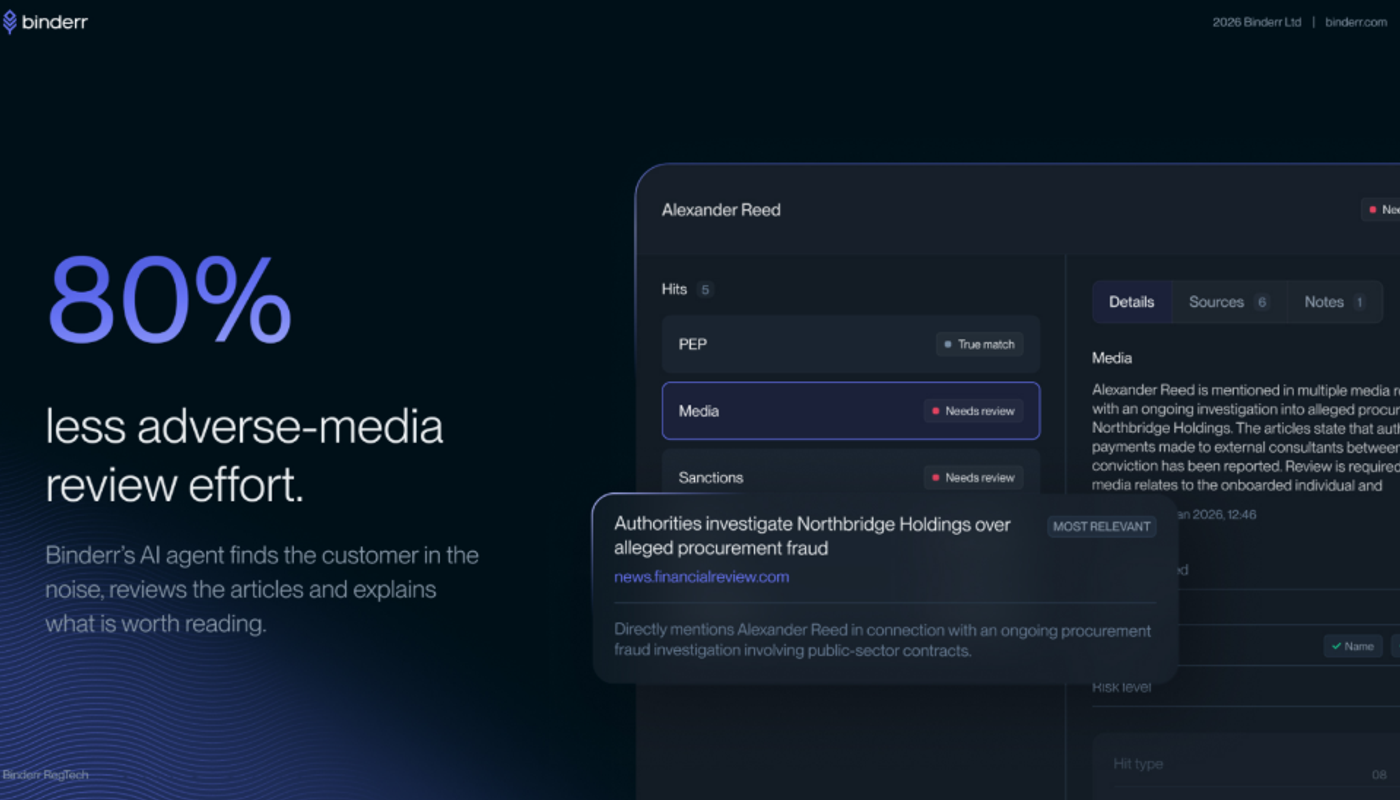
(Binderr helps analysts identify relevant adverse-media results and understand why a source may affect the customer’s risk profile.)
Calculate Consistent Risk Scores - Automated scoring applies consistent values and thresholds across customers, reducing subjectivity and improving reliability in risk ratings. This standardisation enhances fairness in decision-making. It also allows organisations to align scoring with their defined risk appetite.
Route Cases According to Risk Level - Workflow automation directs standard cases for routine processing while escalating high-risk or complex cases to analysts for manual review. This improves operational efficiency by prioritising resources effectively. It also ensures that critical cases receive appropriate human attention.
Monitor Changes in Company Information - Ongoing monitoring detects updates to company status, ownership, or key details, enabling timely reassessment of risk. This helps organisations stay informed about material changes in customer profiles. It also supports proactive risk management and regulatory compliance. This allows the KYB risk assessment to change when the customer’s circumstances or exposure changes.
Do Dynamic Risk Assessment and Automated Scoring with Binderr
- Combine KYC, KYB, AML, and ownership data into one risk view.
- Assign automated risk scores based on defined rules.
- Identify high-risk factors across ownership and jurisdictions.
- Trigger CDD or EDD workflows based on risk levels.
- Maintain clear records of scoring decisions and changes.
KYB Risk Assessment Requirements in 2026
KYB requirements vary according to the jurisdiction, industry, customer type, and regulated activity. Any corporate risk assessment used in 2026 should therefore be aligned with the specific rules and supervisory expectations that apply to the organisation.
FATF Risk-Based Approach
FATF standards support risk-based AML and counter-terrorist-financing systems worldwide. Organisations should identify relevant business risks, apply proportionate controls, and strengthen verification, approval, monitoring, or EDD measures when exposure is higher.
Risk-based KYB should influence the information collected, verification depth, product restrictions, review frequency, and allocation of compliance resources. Simplified measures should only be applied when lower risk has been properly established and local regulations permit them. A business risk assessment AML framework should document how these risk-based principles influence customer acceptance, escalation, and ongoing review.
European Union Developments
The EU AML package is reshaping customer due diligence, beneficial ownership, risk assessment, and enhanced compliance measures. Regulation (EU) 2024/1624, known as the AMLR, is generally scheduled to apply from 10 July 2027.
Organisations should treat 2026 as an important preparation period while AMLA develops supporting regulatory instruments. Compliance teams can use this time to review KYB data, customer risk-rating models, ownership verification, inherent and residual risk, and audit-trail capabilities. Reviewing the wider corporate risk assessment during this preparation period can help organisations identify gaps before the new framework becomes applicable.
United Kingdom
The UK Money Laundering Regulations require relevant businesses to assess financial crime risk, conduct CDD, understand the purpose of customer relationships, and maintain ongoing monitoring. For corporate customers, Regulation 28 includes identifying beneficial owners and taking reasonable measures to understand ownership and control.
Higher-risk relationships may require enhanced due diligence and enhanced ongoing monitoring under Regulation 33. A UK customer risk-assessment model should therefore use meaningful risk factors, defensible weightings, controlled overrides, and evidence supporting every decision. A defensible business risk assessment AML methodology should also show how UK-specific requirements are reflected in customer risk classifications and monitoring controls.
Jurisdiction-Specific Requirements
KYB scoring models must account for local differences in UBO thresholds, definitions of control, high-risk-country lists, PEP treatment, EDD triggers, record-retention periods, reporting rules, and data protection requirements. A model designed for one jurisdiction may therefore need significant adjustment before being used elsewhere.
Sanctions obligations can also apply independently of an AML risk score, meaning a low rating cannot override a legal prohibition. Organisations should review applicable regulations, supervisory guidance, and professional advice when developing their KYB compliance framework.
Never Miss a Compliance Change with Binderr
Common KYB Risk-Scoring Mistakes to Avoid
These weaknesses can reduce the accuracy, consistency, and defensibility of both the KYB risk assessment and the wider corporate risk assessment.
Giving Every Factor the Same Weighting
Equal weighting may be easy to administer, but it can produce misleading results. A minor documentation issue should not necessarily carry the same influence as opaque ownership or a serious sanctions concern.
Weightings should reflect the organisation’s actual exposure and be supported by a documented rationale. In a business risk assessment AML model, weighting decisions should be based on material financial-crime exposure rather than administrative convenience.
Relying on Outdated Jurisdiction Lists
Country risk changes as sanctions, FATF statements, conflicts, regulatory frameworks, and corruption indicators develop.
Static tables should be reviewed frequently or connected to maintained sources. Teams should also document which list and version supported a particular decision. A corporate risk assessment that relies on stale country data may understate emerging exposure or create unnecessary reviews for jurisdictions whose risk profile has changed.
Treating Potential Matches as Confirmed Matches
Screening systems generate possible matches that require resolution. Treating every alert as confirmed can unfairly reject legitimate customers and overwhelm compliance teams.
Reviewers should compare identifiers, ownership links, source reliability, and contextual information before reaching a conclusion. The KYB risk assessment should only change after the alert has been reviewed and its relevance to the customer has been established.
Using Unclear or Overly Broad Categories
Terms such as “complex,” “international,” or “unusual” can produce inconsistent scores unless the model defines them.
Risk factors should be specific, observable, and tied to evidence. The methodology should explain how each factor is measured and why it matters. A business risk assessment AML methodology should therefore replace vague labels with measurable criteria and defined evidence requirements.
Failing to Distinguish Inherent From Residual Risk
A model that mixes pre-control exposure with post-control risk can make customers appear safer than they are.
Record the inherent risk first, assess whether relevant controls are genuinely effective, and then determine the residual risk. Keeping these measures separate makes the corporate risk assessment more transparent and prevents controls from obscuring the customer’s underlying exposure.
Assessing Customers Only During Onboarding
Ownership, sanctions exposure, company status, adverse media, and transaction behaviour can change after approval.
Periodic reviews should be supported by event-driven reassessment where the organisation’s risk, volume, and technology allow it. A KYB risk assessment should remain dynamic so that significant events can update the score, due diligence level, and monitoring plan.
Keeping Inadequate Evidence
A score without supporting evidence is difficult to defend. Audit records should show the data reviewed, factor values, weightings, alerts, decisions, approvals, overrides, and later changes.
An independent reviewer should be able to reconstruct why the customer received its risk classification. Strong evidence also allows the wider corporate risk assessment to be independently tested and reconstructed.
A compliance system should not hide missing evidence behind an apparently complete customer profile. Analysts need to see which checks have been completed, when they were completed, and what information remains unverified or unassessed.
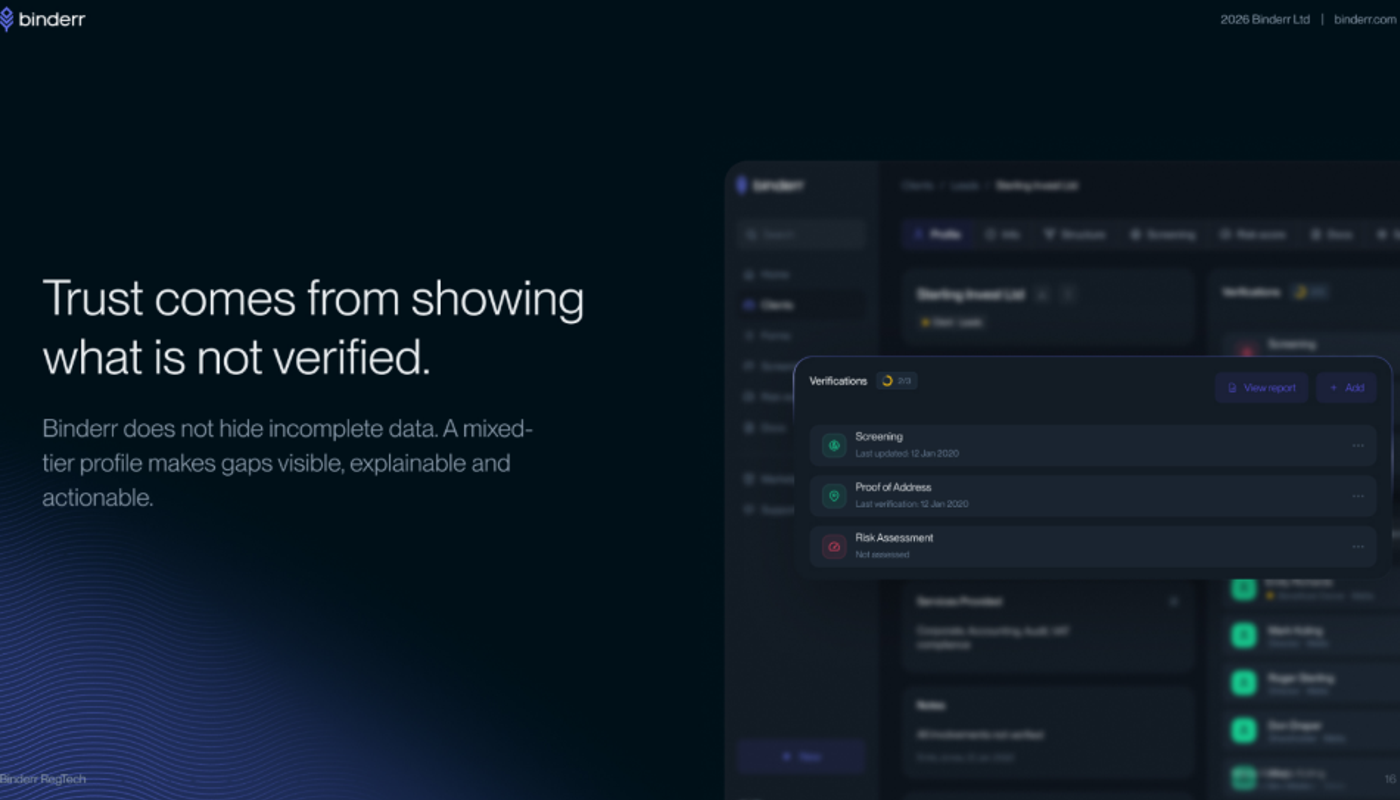
(Binderr makes incomplete checks and verification gaps visible so compliance teams can take appropriate action.)
Manage Business Onboarding and Ongoing Compliance with Binderr
Binderr Compliance supports the complete workflow through:
- KYC verification: Verify identities with AI-powered checks and biometrics.
- KYB verification: Validate company data and corporate records globally.
- UBO identification: Discover and map beneficial ownership structures.
- AML screening: Screen entities and individuals against global watchlists.
- Risk and workflow management: Automate scoring, CDD, and EDD processes.
Bottom Line
KYB risk assessment connects business verification with proportionate compliance action. A reliable model evaluates the company, beneficial ownership, jurisdictions, screening results, requested products, information quality, and expected activity instead of relying on one isolated indicator. It is the customer-level foundation of a broader corporate risk assessment and helps organisations apply a consistent risk-based approach to legal entities.
Dynamic risk scoring and ongoing monitoring help organisations identify material changes sooner and maintain more accurate corporate customer risk ratings. The result should be an explainable decision, supported by evidence and connected to appropriate CDD, EDD, approval, and monitoring controls.
A well-governed business risk assessment AML framework should therefore combine reliable data, documented scoring logic, human oversight, and event-driven reassessment. Verify businesses, assess ownership, screen for AML risk, automate risk scoring, and monitor customers with Binderr Compliance.