
AML compliance teams face a surge in alert overload as screening systems generate thousands of matches daily. Most of these alerts are AML false positives, forcing analysts to spend valuable time reviewing low-risk cases instead of focusing on genuine threats. This imbalance slows decision-making and weakens overall screening efficiency.
According to industry research, up to 95 percent of AML alerts are false positives, highlighting the urgent need for better AML screening optimisation and smarter alert management.
Reducing AML false positives has become a critical priority for organisations aiming to improve compliance performance without increasing risk. By adopting a risk-based approach and refining screening processes, businesses can enhance AML screening accuracy, reduce alert fatigue, and create more efficient compliance workflows.
In this guide, we will explore the key causes of AML false positives, the impact they have on compliance operations, and practical strategies to reduce alert volume while maintaining strong regulatory controls.
Binderr AML Screening Software
Binderr provides a unified compliance platform designed to reduce false positives while improving screening accuracy and efficiency:
- Smart matching algorithms to reduce false positives
- Dynamic risk scoring for prioritising high-risk alerts
- Ongoing AML monitoring with real-time alerts
- Screening for individuals, businesses, UBOs, and complex entities
- Integrated KYC and KYB for better data quality and accuracy
- Automated alert management and compliance workflows
What Are AML False Positives?
AML false positives are alerts generated by Anti-Money Laundering (AML) screening systems that incorrectly flag a customer, transaction, or entity as a potential match to a sanctions list, Politically Exposed Person (PEP), or adverse media record. In simple terms, a false positive occurs when the system identifies a risk that does not actually exist.
Understanding the difference between true and false matches is critical for effective AML compliance. A true positive means the individual or entity genuinely appears on a sanctions list, is a verified PEP, or is linked to credible adverse media. A false positive, by contrast, is triggered by superficial similarities, such as a matching name, without any real connection.
False positives are common in sanctions, PEP, and adverse media screening due to reliance on name matching and large global watchlists. Fuzzy matching helps capture variations in spelling and aliases, but also increases the likelihood of irrelevant matches.
Examples:
- Common names: Individuals with widely used names like "Mohammed Ali" or "John Smith" frequently trigger AML alerts due to multiple entries on sanctions or PEP lists.
- Similar spellings: Minor variations such as "Katherine" vs "Catherine" or "Mohamed" vs "Muhammad" can result in unnecessary matches.
- Transliteration issues: Names translated from non-Latin alphabets (e.g., Arabic, Cyrillic, Chinese) often have multiple acceptable spellings, increasing screening ambiguity.
- Outdated watchlist records: Legacy or duplicate entries in sanctions databases can trigger alerts even when the information is no longer relevant.
- Incomplete customer information: Missing identifiers such as date of birth, nationality, or address make it harder for AML screening software to accurately distinguish between individuals.
These challenges highlight why reducing AML false positives is essential for improving screening accuracy, minimising alert fatigue, and enabling compliance teams to focus on genuine financial crime risks.
Try FREE AI powered AML screening
Why AML Screening Systems Generate So Many False Positives
Understand the key factors that drive high alert volumes in AML screening systems and impact screening accuracy.
Explore how matching rules, data quality, and watchlist complexity contribute to AML false positives and alert fatigue.
Overly Broad Matching Rules - AML screening systems often use loose matching thresholds and aggressive fuzzy matching to avoid missing potential risks, but this can significantly increase false positives. Without proper contextual filtering, even minor similarities in names or entities can trigger alerts, leading to unnecessary investigations and reduced screening accuracy.
Poor Customer Data Quality - Incomplete or inaccurate customer data is a major contributor to AML false positives. Missing dates of birth, incomplete addresses, and inconsistent spelling variations make it difficult for screening systems to distinguish between individuals, resulting in more alerts that require manual review.
Large and Complex Watchlists - Financial institutions must screen against multiple global sanctions lists, PEP databases, and adverse media datasets to meet regulatory requirements. The sheer volume and complexity of these sources increase the likelihood of overlapping or duplicate records, which can trigger excessive false positives during AML screening.
Name Similarity Challenges - Name similarity is one of the most common causes of false positives in AML screening. Common surnames, regional naming conventions, transliteration differences, and the use of aliases or alternative spellings can all lead to incorrect matches, especially when systems rely heavily on name-based screening alone.
No credit card needed. Start AML screening with Binderr.
The Cost of High False Positive Rates
High AML false positive rates significantly impact compliance efficiency, increasing operational costs and slowing down customer onboarding.
Excessive alerts lead to alert fatigue, reduced screening accuracy, and higher investigation workloads for compliance teams.
Compliance Team Overload
High volumes of AML alerts place immense pressure on compliance teams, especially when the majority are false positives. Analysts are forced to manually review large numbers of low-risk matches generated by sanctions screening, PEP screening, and adverse media checks. This overload reduces productivity, increases burnout, and limits the team’s ability to focus on high-risk cases that require deeper investigation. Without effective AML screening optimisation, compliance teams struggle to maintain efficiency while meeting regulatory expectations.
Alert Fatigue
Alert fatigue occurs when compliance analysts are exposed to excessive volumes of repetitive or low-quality alerts. Over time, this leads to reduced attention to detail and slower decision-making. In AML compliance environments, alert fatigue can significantly impact screening accuracy, as analysts may begin to dismiss alerts too quickly or overlook subtle indicators of financial crime. Reducing AML false positives is critical to maintaining analyst vigilance and ensuring that genuine risks are properly assessed.
Slower Customer Onboarding
Excessive false positives directly impact customer onboarding speed. When AML screening systems generate too many alerts, onboarding workflows become delayed due to manual reviews and escalations. This creates friction in the customer experience, increases abandonment rates, and affects business growth. Optimising AML screening accuracy and implementing risk-based screening approaches can significantly reduce onboarding delays while maintaining compliance standards.
Increased Compliance Costs
High false positive rates drive up operational costs across compliance functions. Organisations must allocate more resources to investigate alerts, hire additional compliance staff, and maintain complex screening systems. Manual reviews, duplicated investigations, and inefficient workflows all contribute to rising costs. By improving AML alert management and leveraging automation, businesses can reduce unnecessary investigations and optimise compliance spending.
Risk of Missing Genuine Threats
When compliance teams are overwhelmed by false positives, the risk of missing genuine threats increases. Critical alerts may be buried within large volumes of low-risk matches, making it harder to identify suspicious activity. This creates regulatory risk and exposes organisations to potential financial crime.
How to Reduce AML False Positives
Learn practical strategies to reduce AML false positives, improve screening accuracy, and streamline compliance workflows.
Discover how risk-based screening, better data quality, and AI-driven AML screening optimisation can minimise alert fatigue and enhance compliance efficiency.
Improve Customer Data Collection
Improving customer data collection is a foundational step in reducing AML false positives and enhancing AML screening accuracy. High-quality, structured, and verified customer data enables more precise matching during sanctions screening, PEP screening, and adverse media checks, significantly lowering the chances of irrelevant alerts.
- Better onboarding forms: Design structured onboarding forms that capture complete and standardised customer information, including full legal names, date of birth, and address details to improve AML screening optimisation.
- OCR-powered document extraction: Use OCR technology to automatically extract accurate data from identity documents, reducing manual entry errors and improving data consistency.
- Identity verification: Implement robust identity verification processes to confirm customer identity at onboarding, ensuring reliable data for AML compliance checks.
- Data validation processes: Apply real-time validation rules to detect incomplete or incorrect data, ensuring only high-quality information enters the AML screening system.
Higher-quality customer data directly improves screening accuracy by enabling better name matching, reducing ambiguity, and minimising false positive alerts across AML compliance workflows.
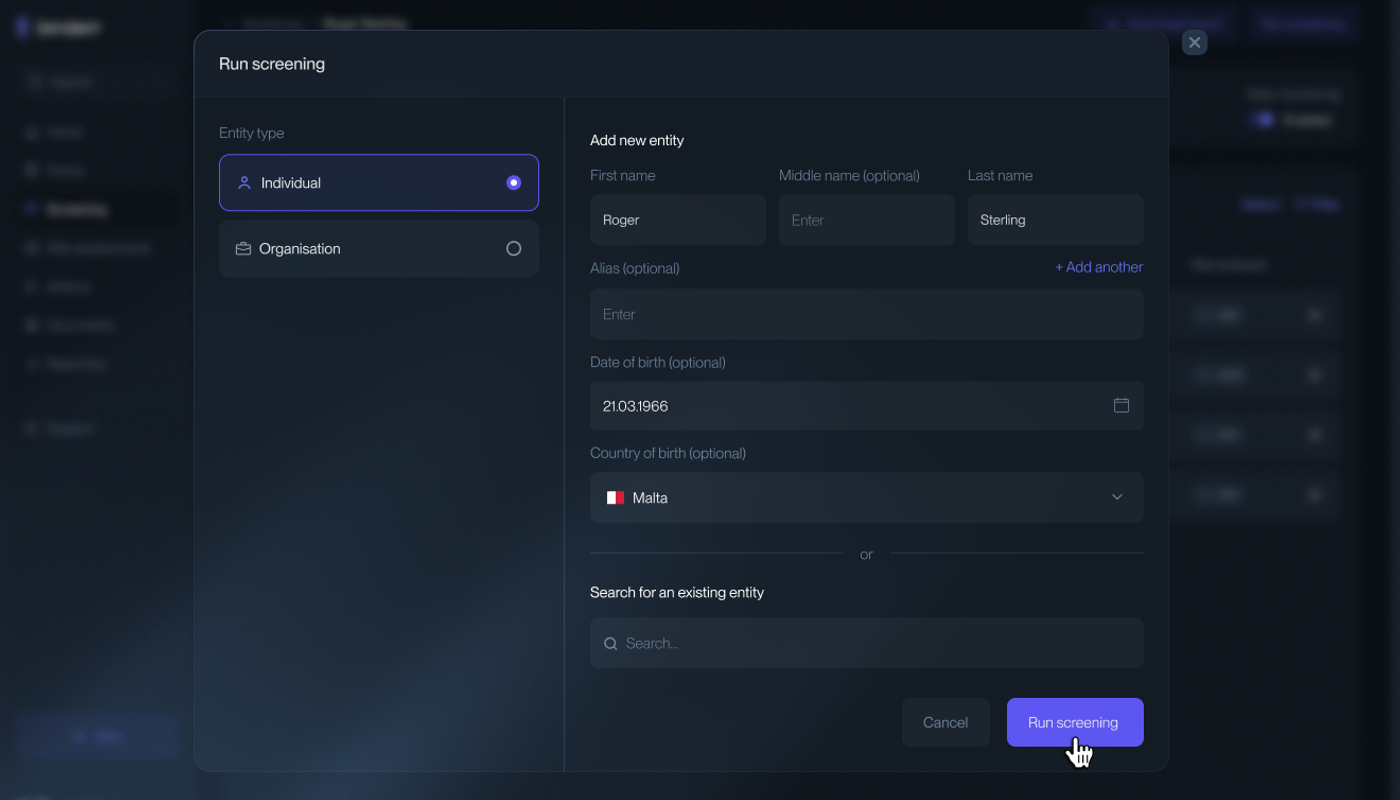
(Binderr allows teams to capture customer identifiers such as date of birth, nationality, aliases, and other verification data before screening begins. More complete customer records lead to more accurate AML screening results and fewer unnecessary alerts.)
Implement Risk-Based Screening
A risk-based screening approach allows organisations to tailor AML screening processes based on customer risk profiles, helping reduce unnecessary alerts while maintaining strong compliance controls. This approach aligns with regulatory expectations and improves overall AML screening efficiency.
- Different screening rules for different risk categories: Apply customised screening thresholds and rules depending on whether a customer is low, medium, or high risk.
- Low-risk versus high-risk customers: Reduce screening intensity for low-risk customers while applying stricter controls for high-risk individuals or entities.
- Enhanced screening for elevated-risk profiles: Conduct enhanced due diligence (EDD) and deeper screening for customers with higher risk indicators, such as foreign PEPs or high-risk jurisdictions.
A one-size-fits-all screening model generates excessive AML false positives because it applies the same strict criteria to all customers, regardless of risk level, leading to unnecessary alerts and increased compliance workload.
Cut compliance time. Screen and detect risk for FREE.
Optimise Matching Thresholds
Optimising matching thresholds is critical for balancing detection accuracy and reducing false positives in AML screening systems. Proper calibration ensures that relevant matches are identified without overwhelming compliance teams with irrelevant alerts.
- Exact matching: Use strict matching criteria for high-confidence identification where precise data is available.
- Fuzzy matching: Apply flexible matching algorithms to detect variations in names, spellings, and transliterations.
- Similarity scoring: Assign scores to matches based on how closely they align with watchlist entries, enabling better prioritisation.
- Balancing sensitivity and precision: Adjust thresholds to ensure the system captures genuine risks without generating excessive false positives.
- Regular calibration of screening rules: Continuously review and fine-tune matching parameters based on performance metrics and evolving risk patterns.
Optimised thresholds help reduce AML false positives while maintaining effective detection of high-risk individuals and entities.
Use Secondary Identifiers
Using secondary identifiers enhances AML screening accuracy by providing additional data points to distinguish between individuals with similar names. This significantly reduces mistaken identity matches in sanctions and PEP screening.
- Date of birth: Helps differentiate individuals with identical or similar names.
- Nationality: Adds geographic context to screening results.
- Address: Provides location-based verification for more accurate matching.
- Company registration numbers: Ensure precise identification of legal entities.
- Passport numbers: Offers unique identifiers for individuals, improving screening confidence.
- Reduces mistaken identity matches: Additional identifiers minimise confusion between unrelated individuals.
- Improves screening confidence: More data points increase the reliability of screening outcomes.
Incorporating secondary identifiers strengthens AML compliance processes and reduces unnecessary investigations caused by ambiguous matches.
Improve Watchlist Quality
High-quality watchlists are essential for effective AML screening and reducing false positives. Poorly maintained or duplicated data sources can significantly increase alert volumes and reduce screening efficiency.
- Removing duplicate records: Eliminate redundant entries to prevent repeated alerts for the same entity.
- Consolidating data sources: Integrate multiple watchlists into a unified, structured dataset for consistent screening.
- Updating lists regularly: Ensure watchlists reflect the latest sanctions, PEP, and adverse media updates.
- Using reliable screening data providers: Partner with trusted providers to access accurate and comprehensive data.
Improving watchlist quality enhances AML screening accuracy by reducing noise in the system and ensuring only relevant matches are flagged for review.
Create Alert Prioritisation Rules
Creating alert prioritisation rules helps compliance teams manage high alert volumes more effectively by focusing on the most critical risks first. This is essential for reducing alert fatigue and improving AML investigation efficiency.
- Risk-based alert queues: Categorise alerts based on risk level to ensure high-risk matches are reviewed first.
- Automated escalation: Automatically escalate high-severity alerts to senior compliance analysts for faster action.
- Severity classification: Assign severity levels to alerts based on risk indicators and screening results.
- Faster investigations: Prioritised alerts enable quicker decision-making and resolution.
- Reduced analyst workload: Automation reduces manual sorting and review efforts.
- Better resource allocation: Compliance teams can focus on high-risk cases rather than low-value alerts.
Effective alert prioritisation improves AML screening workflows, reduces false positives, and ensures compliance teams focus on genuine financial crime risks.
How Binderr Simplifies AML Screening
Binderr streamlines AML screening and reduces false positives through automation and intelligent workflows:
- Combines KYC, KYB, and AML screening in one platform
- Uses AI-powered matching to reduce irrelevant alerts
- Applies dynamic risk scoring to prioritise high-risk matches
- Automates alert management and investigation workflows
- Enables continuous monitoring with real-time updates
How to Optimise Sanctions Screening for Greater Accuracy and Efficiency
Unlock smarter ways to enhance sanctions screening accuracy while cutting down false positives and operational inefficiencies.
Explore proven strategies for sanctions screening optimisation, risk-based screening, and compliance automation to elevate AML performance.
Screen Against Relevant Lists
Screening against relevant sanctions lists, PEP databases, and watchlists is essential for effective AML compliance. Organisations should prioritise globally recognised lists such as OFAC, UN, EU, and UK HMT sanctions, while also incorporating jurisdiction-specific and industry-relevant databases. Using high-quality, regularly updated data sources ensures that screening systems capture genuine risks without introducing unnecessary noise that leads to AML false positives.
In addition to global lists, firms should tailor their screening scope based on their geographic footprint and customer base. For example, businesses operating in high-risk regions may need to include local regulatory lists or regional enforcement databases. By aligning screening lists with actual exposure, compliance teams can improve AML screening accuracy, reduce irrelevant alerts, and strengthen overall sanctions screening effectiveness.
Configure Geographic Risk Rules
Geographic risk rules allow organisations to apply a risk-based approach to AML screening by factoring in country-specific risks. Certain jurisdictions are associated with higher levels of financial crime, corruption, or sanctions exposure, making it critical to adjust screening sensitivity accordingly. By assigning higher risk scores to customers linked to high-risk countries, firms can prioritise alerts that require deeper investigation.
At the same time, configuring geographic rules helps reduce false positives for low-risk regions by avoiding overly aggressive screening thresholds. This balance ensures that compliance teams focus on meaningful alerts rather than being overwhelmed by low-risk matches. Incorporating geographic risk into AML risk scoring models enhances screening efficiency and supports more targeted compliance workflows.
Use Advanced Name Matching Technology
Advanced name-matching technology plays a crucial role in reducing AML false positives while maintaining detection accuracy. Traditional exact matching often misses variations, while overly broad fuzzy matching generates excessive alerts. Modern AML screening software uses intelligent algorithms, phonetic matching, and transliteration handling to accurately identify true matches across different languages and naming conventions.
These technologies also incorporate contextual data such as date of birth, nationality, and aliases to improve entity resolution. By combining multiple identifiers, compliance teams can distinguish between individuals with similar names and reduce unnecessary investigations. Implementing AI-powered name matching significantly improves sanctions screening accuracy and enhances overall AML screening optimisation.
Apply Risk-Based Escalation
Risk-based escalation ensures that AML alerts are prioritised according to their severity and likelihood of being genuine threats. Instead of treating all alerts equally, compliance teams can use dynamic risk scoring to categorise matches into low, medium, and high-risk tiers. High-risk alerts, such as confirmed sanctions matches or high-risk PEPs, are escalated immediately for detailed investigation.
Lower-risk alerts can be automatically deprioritised or resolved using predefined rules, reducing manual workload and alert fatigue. This approach improves operational efficiency while maintaining strong compliance controls. By applying risk-based escalation, organisations can streamline AML alert management and ensure that critical risks receive timely attention.
Continuously Review Screening Performance
Continuous review of AML screening performance is essential to maintain accuracy and effectiveness over time. Compliance teams should regularly analyse key metrics such as false positive rates, true positive rates, and alert volumes to identify areas for improvement. Monitoring these KPIs helps organisations fine-tune screening thresholds, update matching rules, and optimise overall system performance.
Regular audits and model recalibration also ensure that screening systems adapt to evolving regulatory requirements and emerging financial crime risks. By continuously improving screening processes, organisations can reduce AML false positives, enhance detection capabilities, and maintain a robust, risk-based compliance framework.
How to Optimise PEP Screening for Greater Accuracy and Efficiency
Step into a smarter approach to PEP screening that sharpens accuracy while cutting down false positives and easing compliance workload.
Unlock proven strategies for risk-based PEP screening, automated monitoring, and streamlined AML compliance workflows.
Distinguish Domestic and Foreign PEPs
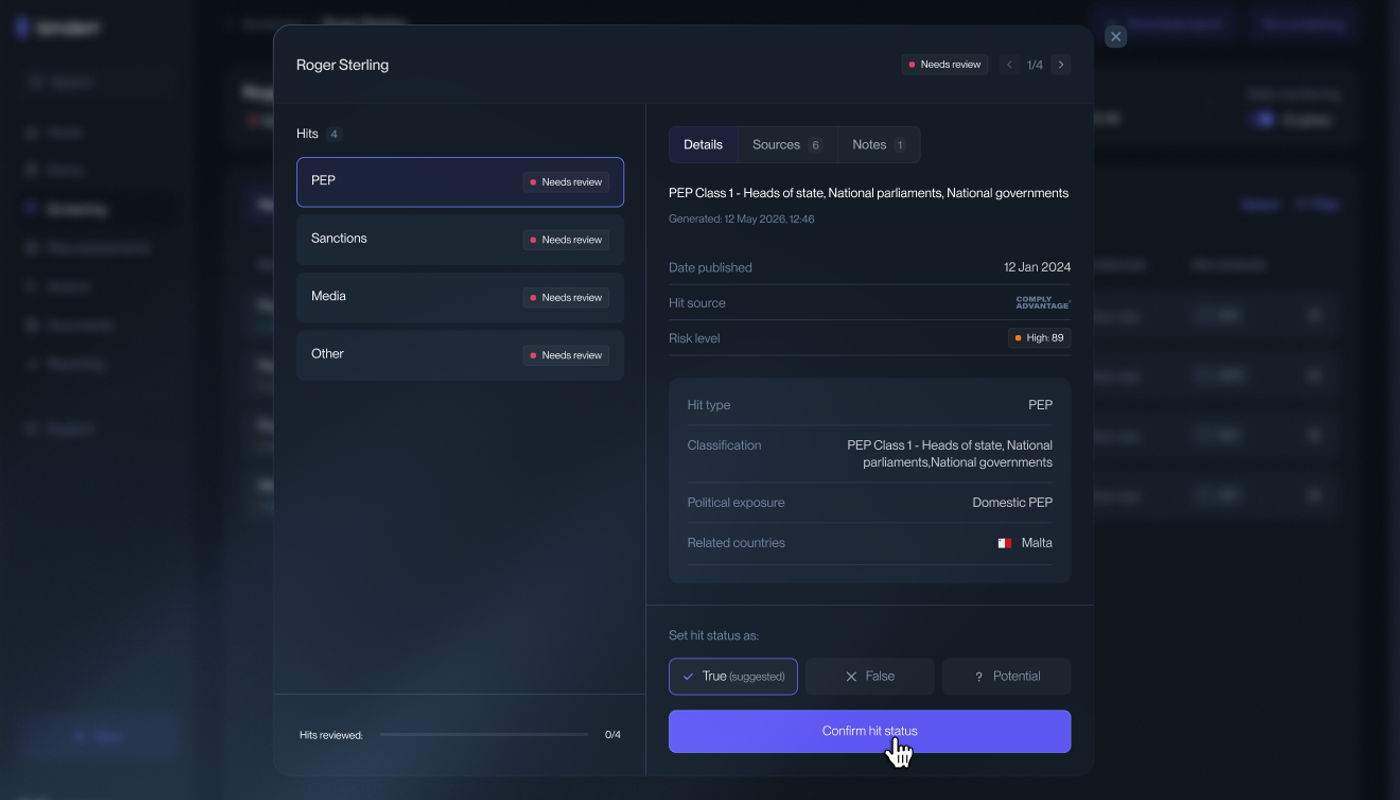
Distinguishing between domestic and foreign politically exposed persons (PEPs) is essential for effective AML screening and risk-based compliance. Foreign PEPs are generally considered higher risk due to increased exposure to cross-border corruption, bribery, and financial crime. Domestic PEPs, while still requiring monitoring, often present lower risk depending on jurisdictional transparency and governance standards. Understanding these differences helps compliance teams apply appropriate screening thresholds and due diligence measures.
By categorising PEPs accurately, organisations can reduce unnecessary false positives and focus resources on higher-risk profiles. Advanced AML screening software can automatically classify PEP types using global databases, improving screening accuracy and reducing alert fatigue. This distinction supports a more efficient risk-based approach while maintaining regulatory compliance.
Apply Risk-Based PEP Controls
Applying risk-based controls to PEP screening ensures that compliance efforts are proportionate to the level of risk presented. High-risk PEPs, such as foreign officials or individuals linked to high-risk jurisdictions, require enhanced due diligence (EDD), including deeper background checks and ongoing monitoring. Lower-risk PEPs may only require standard customer due diligence (CDD), reducing unnecessary investigative workload.
Risk-based PEP controls also help minimise AML false positives by avoiding a one-size-fits-all screening approach. By leveraging dynamic risk scoring and automated compliance workflows, organisations can prioritise high-risk alerts and streamline onboarding processes. This improves operational efficiency while ensuring that genuine financial crime risks are not overlooked.
Monitor PEP Status Changes
PEP status is not static, and individuals may become or cease to be politically exposed over time. Continuous monitoring is critical to ensure that changes in status are detected promptly, allowing compliance teams to reassess risk levels and apply appropriate controls. Automated ongoing monitoring systems can track updates across global PEP databases and trigger alerts when changes occur.
Monitoring PEP status changes helps reduce compliance gaps and ensures that organisations remain aligned with regulatory expectations. It also prevents unnecessary investigations by updating risk profiles in real time, reducing outdated alerts and improving screening accuracy. This proactive approach enhances AML compliance and reduces operational inefficiencies.
Reduce Duplicate Investigations
Duplicate investigations are a common challenge in AML screening, often caused by repeated alerts for the same individual across multiple watchlists or screening cycles. These redundant alerts increase alert fatigue and consume valuable compliance resources. Implementing intelligent alert management systems can help identify and consolidate duplicate matches, reducing unnecessary reviews.
By using advanced entity resolution and AI-powered screening tools, organisations can link related alerts and maintain a single investigation record. This improves workflow efficiency, reduces false positives, and ensures that compliance teams focus on genuine risks. Streamlining investigations not only lowers operational costs but also enhances the overall effectiveness of AML screening programs.
Binderr Advanced AML Screening Features
Binderr enhances AML screening accuracy with advanced features:
- AI-powered name matching and entity resolution
- Adverse media screening with relevance filtering
- Continuous monitoring for sanctions and PEP updates
- Ownership structure mapping for complex entities
- UBO identification and verification
- Automated alert suppression and prioritisation
Best Practices for Optimising Adverse Media Screening
Learn how to improve adverse media screening accuracy while reducing false positives and compliance risk.
Discover practical strategies to enhance AML screening efficiency, strengthen risk assessment, and streamline ongoing monitoring processes.
Relevance Filtering
Relevance filtering is essential in adverse media screening to ensure that only meaningful and risk-related information is surfaced during AML checks. Without proper filtering, compliance teams can be overwhelmed by irrelevant articles that mention individuals with similar names but no connection to financial crime. By applying keyword-based filtering, contextual analysis, and entity recognition, organisations can significantly reduce noise and focus on high-risk matches that truly matter.
Advanced AML screening systems use AI-driven relevance filtering to assess whether an article is genuinely linked to financial crime, fraud, corruption, or sanctions violations. This improves screening accuracy and reduces false positives, allowing compliance teams to prioritise investigations more effectively. Strong relevance filtering also enhances customer due diligence (CDD) processes by ensuring that only credible risk indicators are considered during onboarding and ongoing monitoring.
Source Quality Assessment
Source quality assessment plays a critical role in determining the reliability of adverse media alerts. Not all news sources carry the same level of credibility, and relying on low-quality or unverified sources can lead to inaccurate risk assessments. AML compliance teams must evaluate whether information comes from reputable publishers, regulatory bodies, or verified investigative outlets before taking action.
Modern AML screening software incorporates source ranking and credibility scoring to distinguish between high-quality journalism and unreliable content. This helps reduce false positives caused by misinformation or duplicate reporting. By prioritising trusted sources, organisations can improve the integrity of their adverse media screening process and ensure that compliance decisions are based on accurate and verifiable information.
Risk Categorisation
Risk categorisation helps compliance teams classify adverse media findings based on severity and relevance to financial crime. Not all negative news carries the same level of risk, so categorising alerts into levels such as low, medium, or high risk allows for more efficient investigation workflows. This approach aligns with a risk-based AML framework and ensures that resources are focused on the most critical threats.
Effective risk categorisation uses predefined criteria such as the type of offence, recency of the event, jurisdiction, and involvement of politically exposed persons (PEPs). By integrating risk scoring models into AML screening systems, organisations can automate the prioritisation of alerts and reduce manual review time. This improves operational efficiency while maintaining strong compliance controls and regulatory alignment.
Automated Media Monitoring
Automated media monitoring enables continuous scanning of global news sources, regulatory updates, and online publications for adverse media related to customers or entities. Unlike manual searches, automated systems provide real-time alerts, ensuring that compliance teams are immediately informed of new risks. This is particularly important for ongoing AML monitoring and maintaining up-to-date risk profiles.
AI-powered monitoring tools use natural language processing (NLP) and machine learning to detect relevant articles, identify entities, and assess risk context. This reduces the burden on compliance teams and improves detection accuracy. By automating adverse media screening, organisations can enhance their AML compliance programs, reduce false positives, and ensure timely responses to emerging financial crime risks.
How Automated AML Platforms Improve Screening Efficiency
Automated AML platforms streamline compliance processes by reducing manual effort and improving screening accuracy across sanctions, PEP, and adverse media checks.
By leveraging AML automation, risk scoring, and intelligent alert management, organisations can minimise false positives, accelerate onboarding, and enhance overall compliance efficiency.
Sanctions screening - Sanctions screening checks customers and entities against global sanctions lists such as OFAC, UN, EU, and UK HMT. It helps organisations identify individuals or businesses that are restricted from financial activity, ensuring compliance with AML regulations and preventing exposure to financial crime risks.
PEP screening - PEP screening identifies politically exposed persons who may present a higher risk due to their position or influence. By screening customers against PEP databases, organisations can apply enhanced due diligence and monitor relationships more closely to meet AML compliance requirements.
Adverse media screening - Adverse media screening scans news sources and public data for negative information linked to individuals or entities. It helps detect potential involvement in financial crime, fraud, or corruption, allowing compliance teams to assess reputational and regulatory risk more effectively.
Dynamic risk scoring - Dynamic risk scoring assigns and updates risk levels based on customer behaviour, screening results, and ongoing activity. This risk-based approach helps prioritise high-risk cases, reduce unnecessary reviews, and improve overall AML screening efficiency.
Ongoing monitoring - Ongoing monitoring continuously screens customers after onboarding to detect changes in risk status. It ensures that new sanctions listings, PEP status updates, or adverse media alerts are captured in real time, supporting continuous AML compliance.
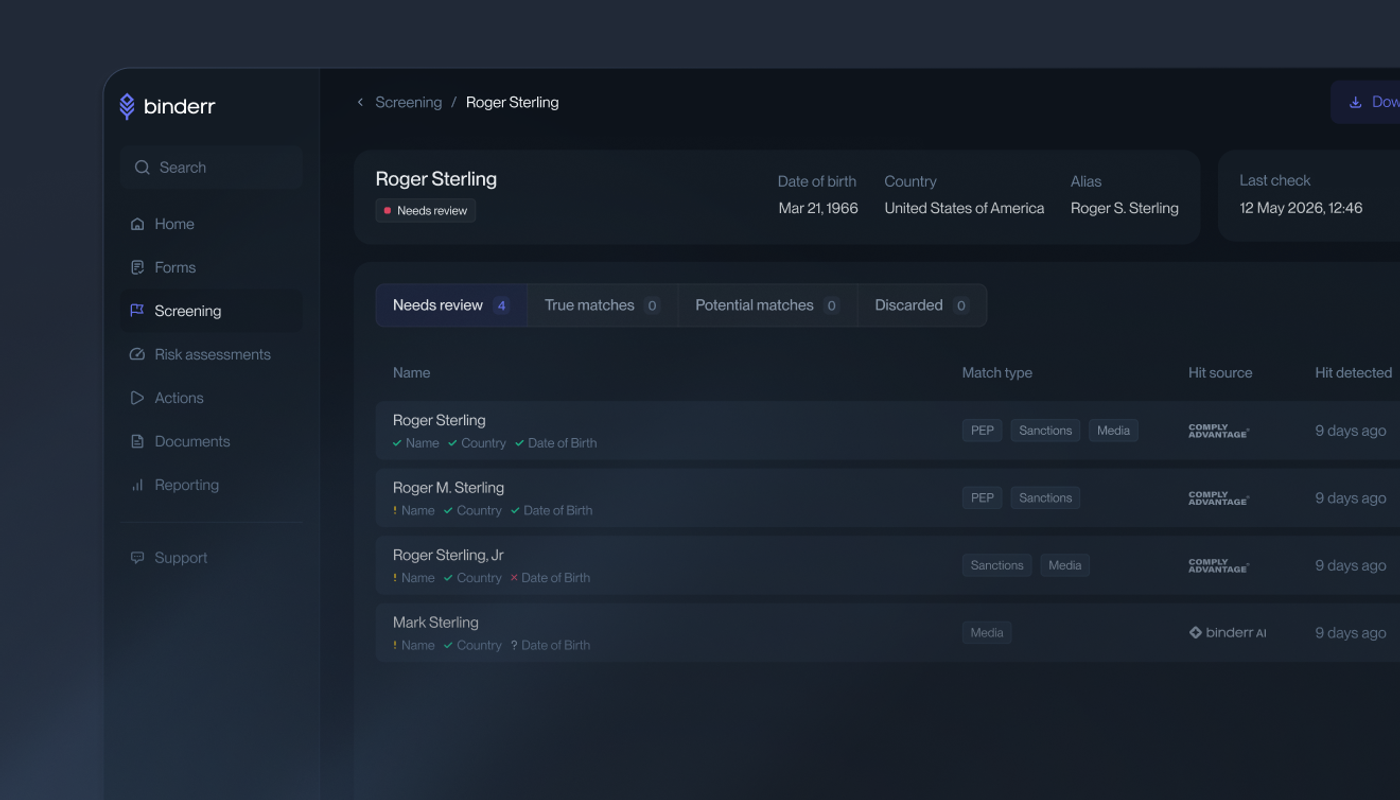
(Binderr’s unified AML screening dashboard helps compliance teams review alerts, prioritise risks, and reduce unnecessary investigations.)
AI-driven matching - AI-driven matching improves screening accuracy by using advanced algorithms to analyse names, aliases, and contextual data. It reduces false positives by distinguishing between similar identities and enhances the effectiveness of sanctions and watchlist screening.
Alert management - Alert management systems organise and prioritise screening alerts based on risk levels. They help compliance teams handle large volumes of alerts efficiently, reduce alert fatigue, and ensure that high-risk matches are investigated promptly.
Audit trails - Audit trails provide a complete record of screening decisions, investigations, and compliance actions. They support regulatory reporting, internal reviews, and demonstrate that proper AML procedures were followed during customer due diligence and monitoring processes.
Binderr Complete Compliance Solution
Binderr provides an end-to-end compliance platform covering the full onboarding lifecycle:
- KYC (Identity Verification) with biometric checks and liveness detection
- KYB (Business Verification) with global registry access
- AML Screening across sanctions, PEPs, watchlists, and adverse media
- Ongoing monitoring with real-time alerts
- Dynamic risk assessment for CDD and EDD
- UBO identification and ownership mapping
- Automated workflows, reporting, and audit trails
Bottom Line
Reducing AML false positives is essential for improving efficiency and maintaining strong compliance. By adopting risk-based screening, improving data quality, and using AI-driven tools, organisations can minimise unnecessary alerts while focusing on genuine risks.
Modern platforms like Binderr help streamline this process, enabling faster onboarding and more effective AML controls.