AML compliance sits at the core of financial institution operations as regulators tighten oversight and financial crime grows more sophisticated. Banks, fintechs, and payment institutions face constant pressure to meet AML compliance requirements while protecting their systems from money laundering and fraud. Strong AML controls, including KYC, KYB, transaction monitoring, and proper handling of aml documents, are no longer optional but essential for maintaining trust and regulatory standing within any AML compliance program.
Global regulators issued over $5 billion in AML-related fines in recent years, highlighting the cost of weak compliance frameworks. Financial institutions that fail to implement effective AML compliance processes and AML compliance solutions risk severe penalties, reputational damage, and operational disruption. A structured AML compliance checklist helps organizations align with regulatory expectations while strengthening their anti money laundering defenses.
In this guide, we will walk through a comprehensive AML compliance checklist for financial institutions, outlining the key controls, processes, aml documents management practices, and best practices needed to build a robust and audit-ready AML compliance program.
Binderr AML Compliance Software Solutions
Binderr Compliance Platform helps financial institutions streamline AML compliance with:
- KYC (Identity Verification) with AI-powered document checks, biometric face matching, and liveness detection
- KYB (Business Verification) with global registry access and corporate data retrieval
- AML Screening across sanctions lists, watchlists, PEPs, and adverse media
- Dynamic Risk Assessment with automated risk scoring
- UBO Identification & Ownership Structure Mapping
- Centralised AML documents management and audit trails
What Is AML Compliance?
AML compliance refers to the laws, regulations, and controls financial institutions use to detect, prevent, and report money laundering and terrorist financing as part of a broader anti-money laundering (AML) compliance framework. Its goal is to protect the financial system from criminal misuse, support financial crime prevention, and ensure transparency across banking, fintech, and payment institutions using structured AML compliance solutions.
Institutions must follow key AML compliance requirements such as Know Your Customer (KYC) verification, Know Your Business (KYB) checks, customer due diligence (CDD), enhanced due diligence (EDD), sanctions screening, PEP screening, adverse media screening, transaction monitoring, suspicious activity reporting (SAR/STR), and proper storage of aml documents. These AML controls are applied using a risk-based approach, enabling organizations to perform AML risk assessments, assign customer risk scores, and focus on higher-risk customers, beneficial owners (UBOs), and transactions while maintaining regulatory compliance and meeting global AML standards.
Cut compliance time. Screen and detect risk for FREE.
Why AML Compliance Matters for Financial Institutions
AML compliance is essential for financial institutions to prevent money laundering, mitigate financial crime risks, and meet AML compliance requirements.
A strong AML compliance framework and AML compliance program helps protect institutions from penalties, enhances customer trust, and ensures effective risk management.
- Regulatory penalties - Financial institutions that fail to meet AML compliance requirements risk significant regulatory penalties, including fines, sanctions, and operational restrictions. Regulators expect firms to maintain a robust AML compliance framework and properly manage aml documents, and gaps in areas like KYC, transaction monitoring, or reporting can quickly lead to enforcement actions.
- Reputational damage - Non-compliance with AML regulations can severely harm a financial institution’s reputation. Negative publicity from compliance failures or involvement in financial crime can erode stakeholder confidence and make it difficult to attract new customers or partners.
- Customer trust - Strong AML compliance processes help build and maintain customer trust by demonstrating that the institution takes financial crime prevention seriously. Effective KYC, KYB, and ongoing monitoring reassure customers that their funds and data are protected within a secure and compliant environment supported by reliable AML compliance solutions.
- Operational efficiency - A well-structured AML compliance program improves operational efficiency by standardising processes such as customer due diligence, risk assessment, and reporting. Automation tools and AML compliance solutions can further streamline workflows, reduce manual errors, and ensure consistent application of AML controls.
- Financial crime prevention - At its core, AML compliance is designed to detect and prevent money laundering, terrorist financing, and other illicit activities. By implementing comprehensive AML controls, including screening, monitoring, risk scoring, and proper aml documents handling, financial institutions can identify suspicious behaviour early and mitigate financial crime risks.
How Binderr Simplifies AML Processes
Binderr streamlines AML compliance workflows by:
- Automating KYC identity verification with AI-powered checks
- Running KYB verification with global registry access
- Performing AML screening across sanctions, PEPs, and adverse media
- Assigning dynamic risk scores automatically
- Triggering EDD workflows for high-risk customers
- Managing AML documents in a centralised system
AML Compliance Checklist for Financial Institutions
Financial institutions must implement robust AML compliance frameworks and AML compliance solutions to detect, prevent, and report financial crime effectively. This AML compliance checklist outlines the essential controls, processes, aml documents requirements, and regulatory expectations needed to maintain compliance and reduce risk exposure.
Use this checklist to strengthen your AML compliance program, improve customer due diligence, enhance transaction monitoring, and ensure adherence to global anti-money laundering regulations.
Quick AML Compliance Checklist Table
AML Area | Key Requirement | Description | Priority |
AML Governance | Policies & Procedures | Documented AML policies, internal controls, and aml documents | High |
Compliance Leadership | AML Officer / MLRO | Appointed officer with clear authority and board oversight | High |
KYC | Customer Verification | Identity verification for individuals and authorised persons | High |
KYB | Business Verification | Validate company registration, structure, and activities | High |
UBO Verification | Ownership Transparency | Identify and verify ultimate beneficial owners | High |
Risk Assessment | Customer Risk Scoring | Assign risk levels based on multiple risk factors | High |
Screening | Sanctions & PEP Checks | Screen against sanctions lists, PEPs, and watchlists | High |
Monitoring | Transaction Monitoring | Detect unusual or suspicious transaction patterns | High |
Ongoing Monitoring | Continuous Reviews | Periodic reviews, rescreening, and data updates | Medium |
Reporting | SAR/STR Filing | Suspicious activity reporting and regulatory communication | High |
Recordkeeping | Audit Trail | Maintain aml documents and compliance records | Medium |
Training | Staff Training | Regular AML training and awareness programs | Medium |
Audits | Independent Testing | Conduct internal and external AML audits | Medium |
#1 Establish AML Policies and Procedures
Establishing robust AML policies and procedures is the cornerstone of any effective AML compliance framework and AML compliance program. Financial institutions must develop clearly documented anti money laundering policies and maintain accurate aml documents that outline how they identify, assess, and mitigate financial crime risks. A risk-based AML framework ensures that resources are allocated efficiently, focusing on higher-risk customers, transactions, and jurisdictions. Strong internal controls, escalation procedures, and regulatory reporting processes help institutions respond quickly to suspicious activity while maintaining compliance with evolving AML compliance requirements.
Documented AML policies and aml documents also provide consistency across teams, ensuring that compliance officers, analysts, and frontline staff follow standardized procedures. These policies support audit readiness by creating a clear AML audit trail and demonstrating adherence to regulatory expectations. Without well-defined AML controls and procedures, financial institutions risk gaps in their AML compliance process, leading to regulatory penalties, reputational damage, and increased exposure to money laundering and terrorist financing risks.
#2 Appoint an AML Compliance Officer
Appointing a qualified AML compliance officer or Money Laundering Reporting Officer (MLRO) is essential for managing and overseeing the institution’s AML compliance program and ensuring AML compliance requirements are met. This individual is responsible for implementing AML policies, managing aml documents, monitoring compliance activities, and ensuring that the organization meets all AML compliance requirements. Clear responsibilities and independent authority enable the compliance officer to make unbiased decisions, escalate risks, and report suspicious activity without interference.
Strong AML leadership also ensures alignment between operational teams and senior management. With board-level oversight, the AML compliance officer can communicate risks effectively and secure the necessary resources to strengthen AML controls and adopt AML compliance solutions. This leadership role is critical in maintaining a proactive AML compliance framework.
#3 Conduct Enterprise-Wide AML Risk Assessments
Enterprise-wide AML risk assessments are a fundamental component of a risk-based AML compliance program. Financial institutions must evaluate various risk factors, including customer profiles, geographic exposure, product offerings, transaction patterns, and delivery channels. By identifying high-risk areas, institutions can tailor their AML controls, due diligence processes, and monitoring systems to effectively mitigate potential threats using advanced AML compliance solutions.
Regular AML risk assessments also support dynamic risk scoring and ongoing monitoring, ensuring AML compliance requirements are continuously met.
#4 Implement Customer Identification and Verification (KYC)
Implementing strong Know Your Customer (KYC) procedures is essential for preventing fraud, identity theft, and money laundering. Financial institutions must verify the identity of individual customers, directors, shareholders, and authorized representatives using reliable documentation such as government-issued IDs and proof of address. This process ensures that institutions understand who they are doing business with and reduces the risk of onboarding fraudulent or high-risk entities.
Effective customer identification and verification also support broader AML compliance efforts, including customer due diligence (CDD), sanctions screening, and risk scoring. By establishing accurate customer profiles at onboarding, institutions can enhance transaction monitoring and detect suspicious activity more efficiently. A robust KYC process is a critical first line of defense in any AML compliance checklist, helping financial institutions maintain regulatory compliance and protect against financial crime.
Try Binderr KYC screening for Free.
#5 Verify Businesses and Corporate Customers (KYB)
Know Your Business (KYB) verification is a critical component of AML compliance for financial institutions, ensuring that corporate customers are legitimate and not being used as shell companies for illicit activities. By validating company registration details, confirming legal existence, and identifying directors and shareholders, institutions can uncover hidden risks and prevent fraud. KYB checks also help assess the nature of business activities, ensuring they align with expected transaction behavior and regulatory requirements.
Effective business verification reduces exposure to financial crime by identifying complex ownership structures and detecting inconsistencies early in the onboarding process. It strengthens compliance with AML regulations, supports risk-based due diligence, and enhances transparency across corporate relationships. Without robust KYB procedures, financial institutions risk onboarding high-risk entities that could facilitate money laundering, tax evasion, or terrorist financing.
#6 Identify and Verify Ultimate Beneficial Owners (UBOs)
Identifying and verifying Ultimate Beneficial Owners (UBOs) is essential for achieving full transparency in corporate ownership and meeting AML compliance requirements. UBO verification involves uncovering the individuals who ultimately own or control a business, even through layered or complex ownership structures. Financial institutions must apply regulatory ownership thresholds and assess control relationships to ensure no hidden stakeholders are overlooked.
Regulators expect institutions to maintain accurate and up-to-date information on beneficial ownership to prevent misuse of corporate entities for financial crime. By screening all UBOs against sanctions lists, PEP databases, and adverse media sources, institutions can detect high-risk individuals and apply enhanced due diligence where necessary. Strong UBO verification practices improve risk assessment accuracy and support a comprehensive AML compliance framework.
Advanced AML Screening & Risk Detection with Binderr
Binderr enhances AML screening with:
- Global sanctions, watchlist, and PEP screening
- AI-powered adverse media analysis
- Smart matching to reduce false positives
- Continuous monitoring with real-time alerts
- Screening for complex entities (trusts, partnerships, vessels)
#7 Perform Sanctions, PEP, and Adverse Media Screening
Sanctions screening, PEP screening, and adverse media checks are vital AML controls that help financial institutions identify high-risk individuals and entities before and during the customer lifecycle. By screening customers, businesses, UBOs, and associated parties against global sanctions lists and politically exposed persons (PEP) databases, institutions can prevent onboarding prohibited or high-risk clients. Adverse media screening further enhances risk detection by uncovering negative news, legal issues, or reputational concerns.
These screening processes reduce exposure to regulatory penalties and financial crime by enabling early detection of suspicious profiles. Continuous screening and real-time monitoring ensure that changes in risk status are captured promptly, allowing institutions to take appropriate action. Integrating automated AML screening tools improves efficiency, reduces false positives, and strengthens overall compliance processes.
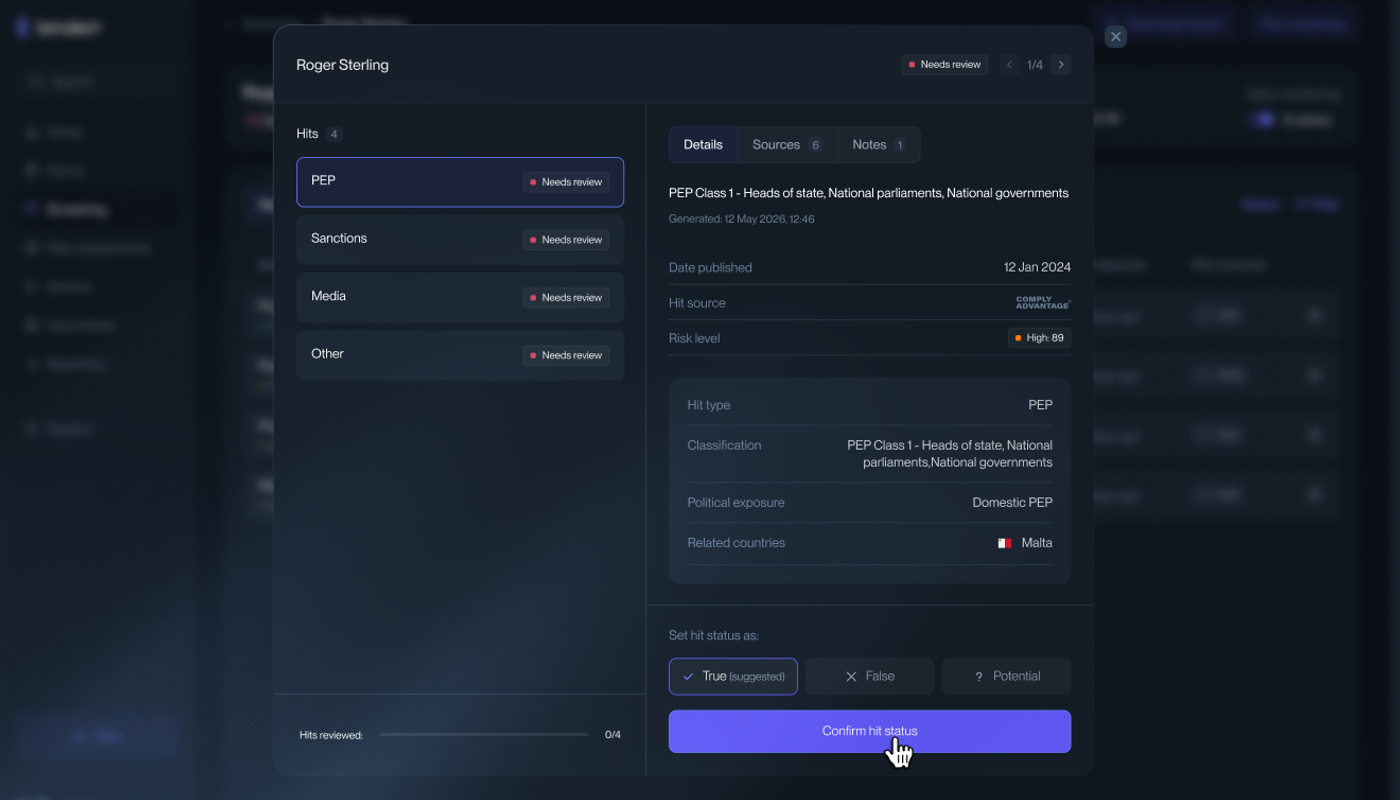
(This screenshot demonstrates the starting point of the AML screening process and naturally introduces Binderr's screening capabilities.)
#8 Apply Customer Risk Scoring
Customer risk scoring is a fundamental element of a risk-based AML compliance approach, allowing financial institutions to categorize customers based on their potential exposure to financial crime. By evaluating factors such as geographic risk, industry type, ownership complexity, screening outcomes, and transaction patterns, institutions can assign accurate risk levels and tailor due diligence accordingly. This ensures that higher-risk customers receive enhanced scrutiny while lower-risk customers experience streamlined onboarding.
Dynamic risk scoring models enable continuous reassessment as new data becomes available, improving the effectiveness of ongoing monitoring and compliance controls. Automated risk scoring systems help reduce manual errors, increase consistency, and support faster decision-making. Ultimately, a well-designed risk scoring framework enhances AML compliance efficiency, strengthens financial crime prevention, and ensures regulatory expectations are consistently met.
#9 Conduct Customer Due Diligence (CDD)
Customer Due Diligence (CDD) is a foundational component of any AML compliance checklist, ensuring that financial institutions properly identify and verify customers before establishing a business relationship. This process involves collecting and validating key identity information, understanding the nature and purpose of the relationship, and assessing expected transaction behavior. By implementing strong KYC procedures and AML controls, institutions can detect inconsistencies early and reduce exposure to financial crime risks.
Effective CDD also supports a risk-based approach to AML compliance by enabling institutions to categorize customers based on their risk profiles. This includes evaluating factors such as geographic location, industry, and transaction patterns. When properly executed, CDD helps institutions meet regulatory compliance requirements, improve customer onboarding efficiency, and build a solid foundation for ongoing monitoring and suspicious activity detection.
#10 Apply Enhanced Due Diligence (EDD) When Required
Enhanced Due Diligence (EDD) is a critical extension of standard AML due diligence, applied when customers present a higher level of risk. Financial institutions must conduct deeper investigations into high-risk individuals or entities, including politically exposed persons (PEPs), customers from high-risk jurisdictions, or those with complex ownership structures. EDD involves gathering additional documentation, verifying the source of wealth and funds, and obtaining senior management approval before proceeding with the relationship.
By implementing EDD procedures, institutions strengthen their AML compliance framework and reduce the likelihood of facilitating money laundering or terrorist financing. This process enhances transparency, improves risk assessment accuracy, and ensures that high-risk customers are subject to stricter monitoring and controls. EDD is essential for maintaining regulatory compliance and protecting institutions from reputational and financial damage.
#11 Implement Transaction Monitoring Controls
Transaction monitoring is a core element of AML compliance, enabling financial institutions to detect suspicious activity in real time or through periodic reviews. By analyzing transaction data against predefined rules and behavioral patterns, institutions can identify red flags such as structuring, rapid fund transfers, or transactions involving high-risk jurisdictions. Effective AML monitoring systems help reduce false positives while ensuring that genuine risks are escalated promptly.
Modern AML compliance programs rely on automated transaction monitoring tools that integrate with risk scoring models and customer profiles. These systems support continuous surveillance, allowing institutions to adapt to evolving financial crime tactics. Strong transaction monitoring controls not only support suspicious activity reporting (SAR/STR) obligations but also enhance overall financial crime prevention and regulatory compliance.
#12 Establish Ongoing Monitoring Procedures
Ongoing monitoring is essential to maintaining an effective AML compliance program, as customer risk profiles can change over time. Financial institutions must continuously review customer activity, update risk assessments, and rescreen individuals and entities against sanctions lists, PEP databases, and adverse media sources. This ensures that emerging risks are identified and addressed promptly.
A robust ongoing monitoring framework includes automated alerts, trigger-based reviews, and regular data refresh processes to keep customer information accurate and up to date. By implementing continuous AML monitoring, institutions can strengthen their compliance posture, improve risk detection, and ensure adherence to evolving regulatory requirements.
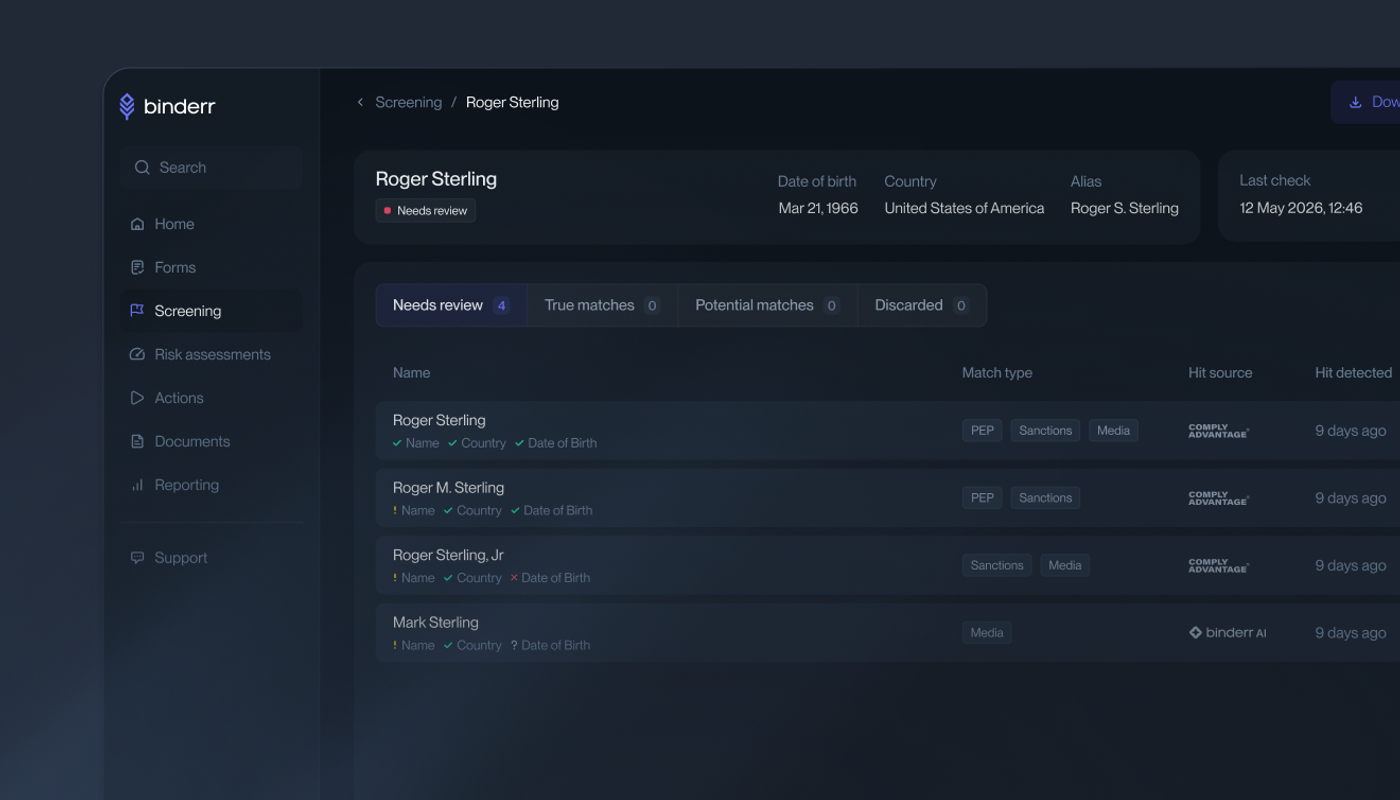
(Binderr helps investigators review supporting evidence, source information, risk classifications, and screening details before confirming or dismissing alerts. )
#13 Create Suspicious Activity Reporting Processes
Establishing robust suspicious activity reporting (SAR) processes is a critical component of any AML compliance framework. Financial institutions must ensure that employees can quickly identify and escalate unusual or potentially suspicious transactions through clearly defined internal reporting channels. Once flagged, these activities should be investigated thoroughly using transaction monitoring data, customer profiles, and risk indicators. Timely SAR/STR filing with the appropriate financial intelligence unit (FIU) is essential to meet regulatory reporting requirements and avoid penalties. A well-structured AML reporting process not only ensures compliance but also strengthens financial crime prevention efforts.
Effective SAR processes also rely on proper documentation retention and regulatory communication. Maintaining detailed records of investigations, decisions, and filings creates a strong audit trail that supports transparency and accountability. Automated AML compliance systems can streamline suspicious activity detection, reduce manual errors, and ensure consistent reporting standards. By integrating SAR workflows into the broader AML compliance process, institutions can respond faster to risks, improve regulatory relationships, and demonstrate a proactive approach to anti-money laundering obligations.
#14 Maintain AML Records and Audit Trails
Maintaining comprehensive AML records and audit trails is essential for demonstrating compliance with regulatory requirements and supporting internal audits. Financial institutions must securely store customer due diligence (CDD) data, KYC and KYB verification documents, risk assessments, and AML screening results. These records provide evidence that proper procedures were followed during onboarding and ongoing monitoring. In the event of a regulatory examination, having organized and accessible documentation ensures that institutions can quickly validate their AML compliance processes.
Strong recordkeeping practices also enhance transparency and accountability across the AML compliance program. Detailed audit trails of investigations, SAR filings, and decision-making processes help identify gaps, improve controls, and support continuous improvement. Leveraging AML compliance software can automate record retention, ensure data integrity, and simplify retrieval during audits. By maintaining accurate and complete records, financial institutions can reduce compliance risks, strengthen governance, and build trust with regulators.
#15 Deliver AML Training to Employees
AML training is a fundamental pillar of an effective compliance program, ensuring that employees understand their responsibilities in preventing financial crime. Staff across all departments must be trained to recognize red flags such as unusual transaction patterns, high-risk customers, and suspicious behavior. Regular training sessions should also cover AML compliance requirements, reporting procedures, and updates to regulatory frameworks. By equipping employees with the right knowledge, institutions can strengthen their first line of defense against money laundering and terrorist financing.
Ongoing AML training programs also promote a culture of compliance and accountability within the organization. Interactive training modules, real-world case studies, and role-specific guidance can improve engagement and retention of key concepts. Automated training platforms can track participation, assess knowledge gaps, and ensure regulatory compliance with training requirements. Well-trained employees are more likely to identify risks early, escalate concerns appropriately, and contribute to a more resilient AML compliance framework.
#16 Conduct Independent AML Audits and Testing
Independent AML audits and testing play a crucial role in evaluating the effectiveness of a financial institution’s compliance program. Regular reviews of AML policies, internal controls, transaction monitoring systems, and reporting procedures help identify weaknesses and ensure alignment with regulatory expectations. These audits should be conducted by qualified internal teams or external experts to provide an unbiased assessment of the AML compliance framework. Identifying gaps early allows institutions to implement corrective actions and reduce exposure to regulatory penalties.
Periodic AML testing also supports continuous improvement and strengthens overall risk management. By assessing the effectiveness of training programs, screening processes, and monitoring systems, institutions can refine their AML controls and adapt to evolving financial crime risks. Leveraging data analytics and automated audit tools can enhance accuracy and efficiency during reviews. Ultimately, independent AML audits demonstrate a commitment to compliance, improve operational resilience, and reinforce trust with regulators and stakeholders.
Automate onboarding & run checks instantly with Binderr.
Common AML Compliance Mistakes Financial Institutions Make
Across the financial landscape, institutions frequently encounter recurring AML compliance challenges that can expose them to regulatory risk and financial crime.
By recognizing these common AML compliance mistakes, organizations can strengthen their AML programs, enhance risk management, and ensure adherence to anti-money laundering regulations.
Missing UBO Verification
Problem: Many financial institutions fail to properly identify and verify Ultimate Beneficial Owners (UBOs), leaving gaps in AML compliance and increasing exposure to financial crime. Without accurate UBO verification, institutions risk onboarding shell companies or high-risk entities, which can lead to regulatory penalties and reputational damage.
Solution: Implement a robust UBO verification process as part of your AML compliance checklist. Use automated KYB tools to map ownership structures, verify beneficial owners, and apply risk-based screening. Integrating UBO identification with AML screening and ongoing monitoring ensures transparency and strengthens your AML compliance framework.
Incomplete Customer Due Diligence
Problem: Inadequate Customer Due Diligence (CDD) can result in insufficient understanding of customer profiles, increasing the risk of onboarding high-risk individuals or entities. Missing key information such as source of funds or business purpose weakens AML controls and exposes institutions to compliance failures.
Solution: Strengthen your AML due diligence checklist by ensuring comprehensive CDD procedures are followed at onboarding. Collect and verify all required customer information, assess risk levels, and apply Enhanced Due Diligence (EDD) where necessary. Automating CDD workflows improves consistency and supports regulatory compliance requirements.
Poor Risk Scoring Models
Problem: Ineffective or outdated AML risk scoring models can misclassify customers, leading to either excessive false positives or missed high-risk cases. This undermines the risk-based approach required for AML compliance and reduces the efficiency of monitoring systems.
Solution: Develop dynamic AML risk assessment models that incorporate multiple risk factors such as geography, industry, transaction behavior, and screening results. Regularly update scoring criteria and leverage automated AML compliance software to ensure accurate and real-time risk scoring aligned with AML compliance best practices.
Ineffective Transaction Monitoring
Problem: Weak transaction monitoring systems fail to detect suspicious activity, allowing potential money laundering or terrorist financing to go unnoticed. Poorly configured rules or lack of real-time monitoring can result in missed alerts and regulatory breaches.
Solution: Implement advanced AML transaction monitoring tools that analyze customer behavior and flag unusual patterns. Use rule-based and AI-driven monitoring systems to improve detection accuracy. Continuous monitoring and regular tuning of alerts are essential components of an effective AML monitoring checklist.
Manual Compliance Processes
Problem: Relying on manual AML compliance processes increases the risk of human error, slows down onboarding, and creates inefficiencies in screening and monitoring. Manual workflows make it difficult to scale compliance operations and maintain consistency across the AML compliance process.
Solution: Adopt AML automation solutions to streamline KYC, KYB, screening, and reporting tasks. Automated AML compliance software reduces operational burden, improves accuracy, and ensures consistent application of AML controls. This enhances overall efficiency and supports scalable financial institution AML compliance.
Weak Audit Trails
Problem: Inadequate recordkeeping and weak audit trails make it difficult to demonstrate compliance during regulatory audits. Missing documentation or incomplete records can lead to fines and enforcement actions, even if controls are in place.
Solution: Maintain comprehensive AML audit trails by securely storing all customer data, verification documents, screening results, and compliance actions. Use centralized AML compliance platforms to ensure records are easily accessible and audit-ready. Strong documentation practices are critical for meeting AML reporting requirements and regulatory expectations.
Complete AML Compliance Solution with Binderr
Binderr provides an end-to-end AML compliance platform:
- KYC and KYB verification in one system
- UBO identification and ownership mapping
- AML screening and ongoing monitoring
- Dynamic risk scoring and automated workflows
- Centralised aml documents management
- Full audit trails and compliance reporting
Bottom Line
AML compliance requires a continuous, risk-based approach that goes beyond basic KYC. Financial institutions must combine verification, screening, risk scoring, monitoring, reporting, and auditing to stay compliant and reduce financial crime risk. Automation helps streamline these processes and minimize errors.
This is where AML automation becomes essential. Leveraging advanced AML compliance software enables institutions to streamline onboarding, automate screening and monitoring, enhance risk assessments, and maintain audit-ready records all while reducing operational costs and improving accuracy.
Binderr Compliance helps financial institutions simplify AML compliance with automated KYC, KYB, screening, and monitoring workflows in one unified platform.