
Today’s digital onboarding environment places identity verification at the centre of risk management. Businesses need secure KYC platforms and reliable KYC software to confirm identities quickly while preventing the use of stolen documents, impersonation, synthetic identities, and deepfake attacks. A modern KYC system must strike a careful balance between speed and accuracy to safeguard revenue, reputation, and customer trust.
Across modern compliance operations, KYC software now combines document verification, biometric identity checks, liveness detection, AML screening, and automated risk scoring within a single workflow. Juniper Research estimates that online payment fraud losses will exceed $362 billion globally between 2023 and 2028, underscoring the growing importance of robust customer verification systems and scalable KYC solutions. These KYC tools support customer due diligence, reduce manual workloads, and enable teams to manage compliance more efficiently at scale.
In this guide, six leading KYC platforms are compared based on identity verification capabilities, fraud prevention tools, AML compliance features, global coverage, workflow flexibility, integrations, and user experience. The aim is to help businesses identify the most suitable KYC solution for secure and scalable onboarding across different industries.
Binderr KYC Platform for Secure Customer Verification
- KYC (Identity Verification) with AI-powered document checks and biometrics
- KYB (Business Verification) with global registry access and ownership mapping
- AML Screening across sanctions, PEPs, watchlists, and adverse media
- Dynamic Risk Assessment with automated scoring
- UBO Identification and ownership structure visualisation
- Streamlined CDD and EDD workflows
What Is a KYC Platform?
A KYC platform is a type of KYC software that helps businesses verify customer identities and assess risk during onboarding and throughout the relationship.
It combines KYC tools like document checks, biometrics, and data screening to confirm identity and detect fraud. While identity verification checks if someone is who they claim to be, a complete KYC system also evaluates risk factors such as background, location, and potential links to financial crime.
Try Binderr KYC screening for Free
Why Businesses Need Secure KYC Software
Weak customer verification processes can expose businesses to regulatory penalties, financial losses, operational inefficiencies, and reputational damage. Secure KYC software and well-designed KYC solutions help organisations verify identities accurately, detect fraud early, and maintain consistent compliance across onboarding and ongoing monitoring.
Prevent Identity and Document Fraud - KYC platforms use document authenticity checks, facial comparison, device intelligence, and liveness detection to identify suspicious activity during onboarding. These KYC tools help detect stolen IDs, altered documents, spoofing attempts, and deepfakes by analysing document features, matching biometric data, and verifying that a real person is present during the verification process.
Meet KYC and AML Obligations - Regulated businesses need reliable KYC and AML procedures supported by a robust KYC system to identify customers, verify identity information, assess risk, retain records, and apply ongoing due diligence. While KYC software supports these processes, it does not guarantee compliance on its own. Businesses must align technology with internal policies, jurisdictional requirements, risk assessments, and human oversight.
Verifying a customer’s identity is only one part of a complete KYC process. Businesses may also need to screen individuals and connected entities against sanctions lists, PEP databases, adverse media sources, and other risk indicators. Binderr connects these checks within the same compliance workflow.
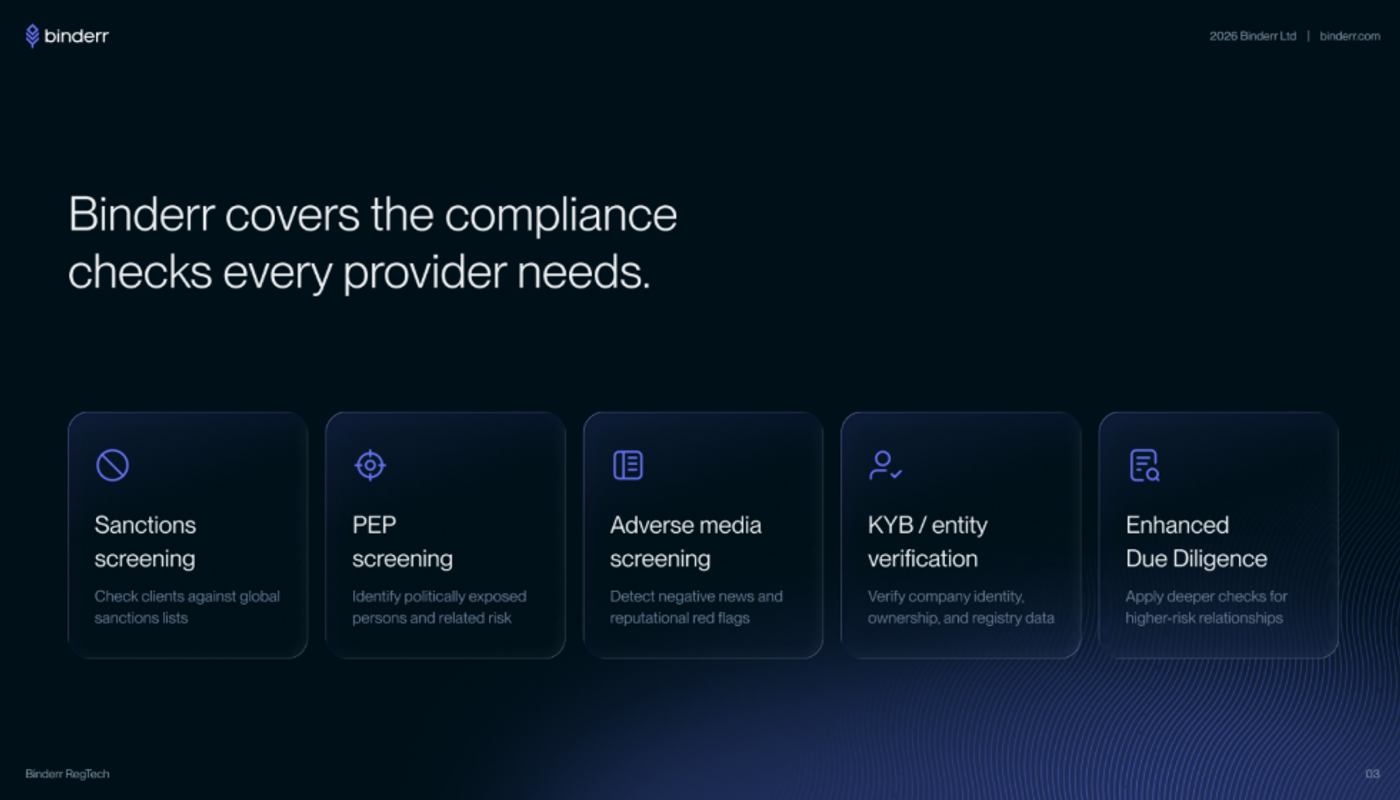
(Binderr combines customer verification with sanctions, PEP, adverse media, entity, and enhanced due diligence checks.)
Reduce Customer Onboarding Friction - Automated document capture, real-time user guidance, OCR data extraction, and risk-based workflows help streamline the customer onboarding process. By reducing manual steps for lower-risk customers, KYC platforms and digital KYC solutions can improve completion rates while maintaining secure identity verification standards.
Scale Compliance Operations - Reusable workflows, API integrations, automated decision-making, case queues, and centralised records allow compliance teams to handle higher onboarding volumes efficiently. KYC software helps standardise processes and reduce operational bottlenecks as businesses grow.
Improve Risk-Based Decision-Making - KYC platforms combine identity data, AML screening results, fraud signals, customer information, and business rules to support risk-based decisions. This enables businesses to approve, reject, or escalate applications for review based on a structured assessment of customer risk using advanced KYC tools.
Cut compliance time. Screen and detect risk for FREE.
Quick Comparison of Top KYC Platforms
Explore a side-by-side comparison of leading KYC platforms to identify the best fit for your customer verification and compliance needs.
Compare features like identity verification, AML screening, biometric checks, global coverage, and workflow automation across top KYC software providers.
Feature | Binderr | Sumsub | Onfido | Jumio | Ondato |
ID Document Verification | ✅ | ✅ | ✅ | ✅ | ✅ |
Global Document Support | ✅ | ✅ | ✅ | ✅ | ❌ |
Proof of Address (PoA) | ✅ | ✅ | ❌ | ❌ | ❌ |
Face Match: Selfie vs ID | ✅ | ✅ | ✅ | ✅ | ✅ |
Liveness Detection | ✅ | ✅ | ✅ | ✅ | ✅ |
Anti-Fraud / Deepfake Detection | ✅ | ❌ | ❌ | ❌ | ❌ |
OCR Data Extraction | ✅ | ✅ | ✅ | ✅ | ✅ |
Essential Features to Look for in KYC Software
Discover the must-have capabilities that power secure, scalable, and compliant customer verification in today’s digital landscape.
From identity verification and biometric checks to AML screening and risk-based workflows, these features define modern KYC platforms and KYC systems.
Government ID Verification
Government ID verification is the foundation of any robust KYC platform, enabling businesses to confirm a customer’s identity using official documents such as passports, national identity cards, residence permits, and driving licences. Modern KYC software uses advanced technologies like OCR (optical character recognition), AI-powered document analysis, and machine learning to extract and validate data from these documents in real time.
A strong identity verification system should be capable of detecting fraudulent or altered documents while ensuring a smooth user experience during onboarding. This includes guiding users through image capture, validating document quality, and cross-checking extracted data against known templates and security features.
Important evaluation points:
- Document authenticity checks using AI and template matching
- Expiry date validation to ensure documents are still valid
- MRZ (machine-readable zone) and barcode reading for structured data extraction
- Tampering detection to identify edits, overlays, or inconsistencies
- OCR accuracy across different document formats and layouts
- Supported scripts and languages for global customer onboarding
- Country-specific document coverage, including regional variations and formats
Biometric Face Matching
Biometric face matching is a critical component of digital identity verification, ensuring that the person submitting the identity document is the same individual presenting themselves during onboarding. KYC platforms use facial recognition algorithms to compare a live selfie or video capture with the photo on the government-issued ID.
This process involves analyzing facial features such as eye distance, jawline, and facial contours to generate a similarity score. High-quality systems can perform this comparison in seconds while maintaining accuracy across different lighting conditions, camera qualities, and user environments.
Advanced biometric verification tools also account for variations in appearance, such as aging, facial hair, glasses, or makeup. By combining face matching with other signals like device data and behavioral patterns, platforms can significantly reduce impersonation fraud and identity theft.
Liveness and Deepfake Detection
Liveness detection ensures that the biometric data being captured comes from a real, physically present person rather than a spoofing attempt. There are two main types of liveness detection used in KYC platforms:
- Passive liveness: Runs in the background without requiring user interaction, analyzing subtle cues such as skin texture, light reflection, and micro-movements.
- Active liveness: Requires the user to perform specific actions, such as blinking, smiling, or turning their head, to prove they are live.
Both methods help prevent common fraud techniques, including the use of printed photographs, screen replays, masks, or pre-recorded videos. As fraud tactics evolve, deepfake detection has become increasingly important. Advanced KYC solutions now use AI models to identify synthetic media, manipulated facial features, and inconsistencies in video streams that may indicate AI-generated faces.
By combining liveness detection with deepfake analysis, businesses can strengthen their fraud prevention strategy, protect against sophisticated identity attacks, and maintain trust in digital onboarding processes.
Database Verification
Database verification is a key component of modern KYC platforms, allowing businesses to validate customer information against trusted third-party data sources. Instead of relying solely on uploaded identity documents, this method cross-checks personal details such as name, date of birth, address, phone number, and national ID against authoritative databases.
Depending on the country, these sources may include:
- Government registries (civil records, national ID databases)
- Credit bureaus and financial records
- Telecom and mobile network operator data
- Electoral rolls and public records
- Utility and address databases
This approach is particularly useful for non-documentary verification, helping businesses confirm identity in regions where document verification may be less reliable or where customers prefer a faster onboarding experience. Database verification can also improve match rates and reduce friction by eliminating the need for manual uploads in low-risk scenarios.
AML Screening
AML screening is essential for identifying whether a customer poses financial crime risks beyond basic identity verification. While identity checks confirm who a person is, AML screening evaluates whether that individual is associated with sanctions, corruption, criminal activity, or reputational risk.
Key AML screening components include:
- Sanctions screening: Checking customers against global sanctions lists issued by authorities such as the UN, EU, OFAC, and HM Treasury.
- Politically exposed persons (PEPs): Identifying individuals who hold or have held prominent public positions and may present higher corruption risk.
- Regulatory watchlists: Screening against law enforcement, financial regulators, and international enforcement databases.
- Adverse media screening: Monitoring negative news coverage linked to fraud, money laundering, terrorism financing, or other illicit activities.
- Relatives and close associates (RCAs): Identifying individuals connected to PEPs who may also carry elevated risk.
- Ongoing rescreening: Continuously monitoring customers for changes in risk status after onboarding.
AML screening helps businesses meet regulatory expectations for customer due diligence (CDD) and enhanced due diligence (EDD). It is important to note that identity verification and AML screening serve different purposes: one confirms identity, while the other assesses risk, and both are typically required for a complete KYC and AML compliance framework.
Try FREE AI powered AML screening with Binderr
Risk Scoring and Conditional Workflows
Risk scoring allows businesses to assign a dynamic risk level to each customer based on multiple data points, enabling a risk-based approach to KYC and AML compliance. Instead of applying the same checks to every user, conditional workflows adapt verification requirements based on the customer’s profile and behaviour.
Factors that commonly influence risk scoring include:
- Customer location and jurisdiction risk
- Product type and inherent financial risk
- Transaction limits and expected activity
- Occupation and industry exposure
- Source of funds and wealth indicators
- AML screening results (sanctions, PEP, adverse media)
- Fraud signals such as device anomalies or suspicious patterns
- Customer type (individual vs business)
- Delivery channel (online, mobile, in-person)
For example, a low-risk customer may only require basic identity verification, while a high-risk customer may trigger enhanced due diligence, additional document requests, or manual review. Conditional workflows help reduce onboarding friction for legitimate users while strengthening controls for higher-risk cases.
Manual Review and Case Management
Even with advanced automation, manual review remains a critical part of KYC and AML processes. Case management tools allow compliance teams to investigate flagged applications, resolve discrepancies, and make informed decisions when automated checks are inconclusive.
Key capabilities include:
- Escalation queues for high-risk or failed verifications
- Analyst notes and internal communication logs
- Centralised evidence storage for documents, screenshots, and verification results
- Decision history tracking for approvals, rejections, and escalations
- Multi-level approval workflows for sensitive cases
- Comprehensive audit trails for regulatory reporting and internal audits
Screening workload is not determined by risk level alone. Sanctions and PEP matches may be serious but relatively structured to review, while adverse media results can require analysts to assess large numbers of weak, duplicated, or irrelevant articles.
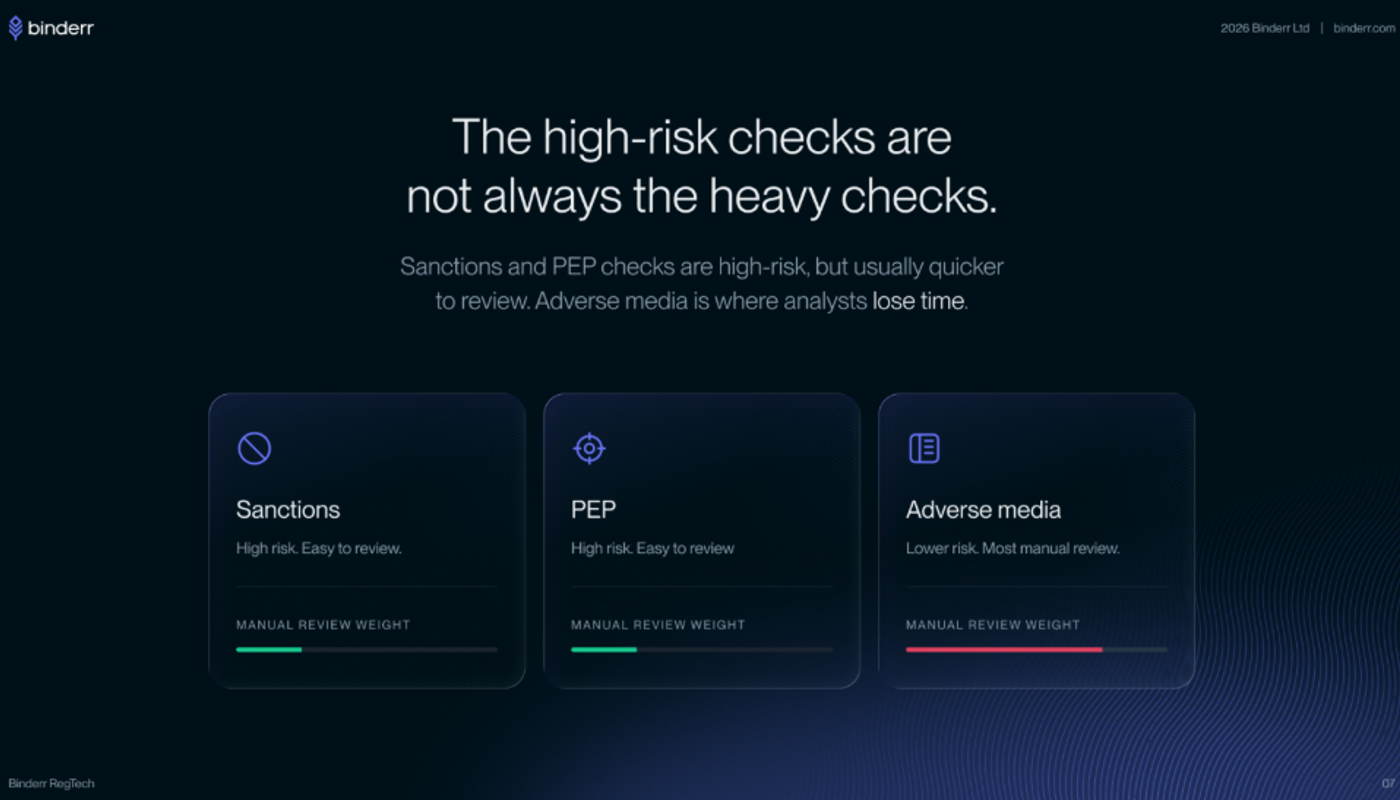
(Adverse media screening can create a heavier manual-review burden than more structured sanctions or PEP checks.)
By combining automation with structured manual review, businesses can maintain high verification accuracy, reduce false positives, and demonstrate robust compliance controls to regulators.
API and Integration Options
Modern KYC platforms rely heavily on flexible API integration to connect seamlessly with existing systems such as CRMs, onboarding portals, payment gateways, and compliance tools. REST APIs, SDKs, and webhooks allow businesses to automate identity verification workflows, trigger real-time checks, and receive instant verification results. Many providers also offer hosted verification pages and low-code or no-code configuration tools, making it easier for non-technical teams to deploy digital KYC solutions quickly.
When evaluating API capabilities, businesses should consider scalability, documentation quality, uptime reliability, and ease of implementation. Strong integration options enable faster customer onboarding, reduce manual intervention, and support a consistent user experience across web and mobile platforms. Choosing a KYC platform with robust API support ensures that identity verification, AML screening, and fraud detection processes can be embedded directly into the customer journey.
Data Privacy and Security
Data privacy and security are critical when handling sensitive customer identity information. KYC platforms must implement strong encryption protocols, secure data storage, and strict access controls to protect personal data from breaches or unauthorized use. Businesses should assess how providers manage data retention, consent collection, and cross-border data transfers, especially when operating in multiple jurisdictions with varying privacy regulations.
It is also important to evaluate a provider’s compliance with recognized security standards and their approach to incident response and risk management. Features such as audit trails, role-based access, and data minimization help ensure that customer information is handled responsibly. A secure KYC platform not only protects users but also strengthens trust, supports regulatory compliance, and reduces the risk of financial and reputational damage.
See How Binderr Simplifies the KYC Process
Binderr transforms complex compliance workflows into a streamlined process:
- Run KYC, KYB, and AML checks in one platform
- Automatically assign risk scores using dynamic risk assessment
- Trigger EDD workflows for high-risk users
- Collect documents and data dynamically
- Monitor customers continuously for risk changes
- Maintain full audit trails for compliance
Best KYC Software of 2026
Binderr
Binderr is a comprehensive compliance and onboarding platform designed for businesses that need more than just identity verification. It functions as a powerful KYC system that connects customer verification directly with broader AML and due diligence workflows, helping organisations manage risk, meet regulatory expectations, and streamline onboarding processes. By combining identity checks with screening, monitoring, and workflow automation, Binderr enables compliance teams to operate more efficiently while maintaining strong oversight.
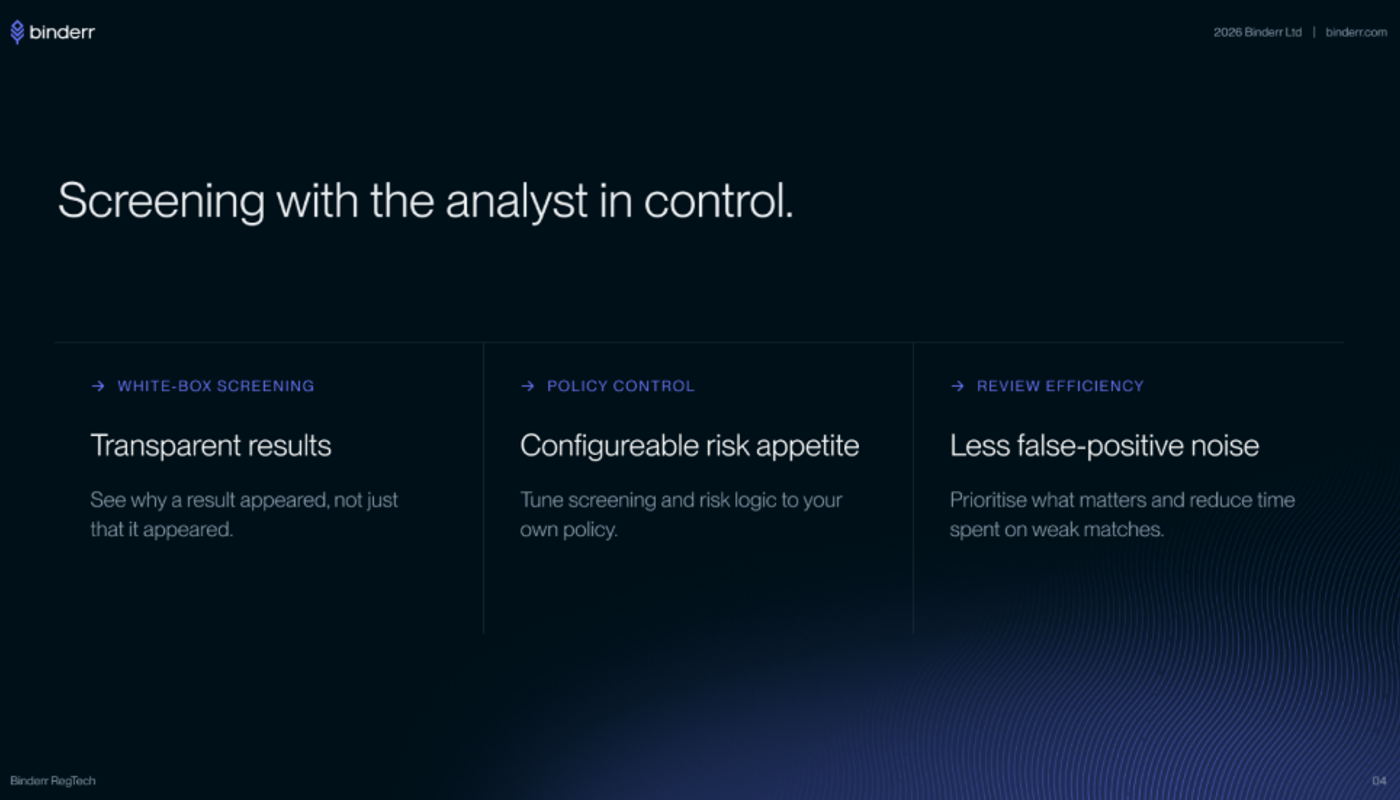
(Binderr gives analysts transparent screening results, configurable risk controls, and more focused review queues.)
The platform supports AI-powered document verification, facial recognition, liveness detection, deepfake detection, and automated data extraction. Its KYC solution covers more than 11,000 identity document types across over 230 countries and territories. Binderr also integrates verification results with sanctions, PEP, watchlist, adverse media screening, and ongoing monitoring, creating a unified compliance environment powered by advanced KYC software.
Key Binderr Features:
- Comprehensive identity verification: Supports passports, national IDs, and driving licences with AI-powered document checks and global coverage.
- Advanced biometric security: Uses facial recognition, face matching, and liveness detection to reduce impersonation and fraud risks.
- Deepfake and fraud detection: Identifies sophisticated threats such as synthetic identities and manipulated media during onboarding.
- Integrated AML screening: Includes sanctions, PEP, watchlist, and adverse media checks within the same workflow.
- Automated risk assessment: Combines identity data and screening results to generate customer risk profiles and support decision-making.
- End-to-end compliance workflows: Covers KYC, KYB, UBO verification, document collection, e-signatures, and ongoing monitoring with audit-ready records.
Best For: Binderr is best suited for organisations that need a unified compliance solution rather than separate KYC tools. It works particularly well for firms handling both individual and corporate customers across multiple jurisdictions. Ideal for teams that want to connect onboarding, risk assessment, and ongoing monitoring in one streamlined KYC platform.
All-in-one AML & KYC Screening. No contracts needed.
Sumsub
Sumsub is a comprehensive identity verification and compliance platform designed to support businesses throughout the entire customer journey from onboarding to ongoing monitoring. It brings together identity verification, business verification, fraud prevention, and transaction monitoring into a single, unified KYC system. This allows organisations to manage compliance processes more efficiently while maintaining a seamless user experience.
With flexible workflow orchestration, businesses can apply different checks at various stages based on risk levels, customer types, or regulatory requirements, making it suitable for both fast-growing startups and large-scale enterprises using scalable KYC software.
Key Sumsub Features:
- Comprehensive identity verification: Supports government-issued ID checks, biometric verification, and document validation to confirm user identities accurately.
- Advanced liveness and face matching: Uses AI-driven facial recognition and liveness detection to prevent spoofing, deepfakes, and impersonation attempts.
- Flexible non-documentary verification: Enables identity checks using trusted databases and alternative data sources where document verification may not be sufficient.
- Integrated AML and compliance screening: Includes sanctions, PEP, and watchlist screening, along with ongoing monitoring to detect changes in customer risk profiles.
- End-to-end fraud prevention and transaction monitoring: Identifies suspicious behaviour and unusual transaction patterns in real time to reduce financial crime risks.
- Customisable workflows and case management: Allows businesses to configure verification flows, automate decisions, and manage manual reviews through a centralised dashboard.
Sumsub is particularly well suited for fintech companies, crypto exchanges, and digital platforms that require scalable identity verification and fraud prevention using advanced KYC tools. It works well for businesses handling high volumes of users across multiple jurisdictions with varying compliance requirements. It is also ideal for organisations that want a single KYC platform to manage onboarding, risk assessment, and ongoing monitoring.
Onfido
Onfido is now part of Entrust, with its identity verification products, documentation, and integration tools operating under the Entrust Identity Verification platform. The solution combines document verification, facial biometrics, trusted data checks, fraud signals, and compliance screening to help businesses establish confidence in customer identities during remote onboarding.
The platform is particularly focused on creating flexible verification journeys. Businesses can combine identity documents, selfies, biometric checks, database verification, proof of address, watchlist screening, and fraud detection according to their customer types, markets, and regulatory obligations.
Key Onfido Features:
- AI-powered document verification: Onfido analyses passports, national identity cards, and driving licences using data-integrity checks, visual-authenticity analysis, and database records. It can also compare information extracted from the document with customer-submitted data to identify discrepancies or potential manipulation.
- Facial matching and biometric verification: The platform compares a customer’s selfie or video with the photograph on their identity document. AI-generated similarity scores help businesses assess whether the document belongs to the person completing the verification.
- Advanced liveness and spoofing detection: Onfido’s biometric checks are designed to identify presentation attacks involving photographs displayed on screens, 2D or 3D masks, manipulated image uploads, and other attempts to bypass facial verification.
- Layered identity fraud detection: Specialist AI evaluates document anomalies, biometric fraud signals, device information, and repeat verification attempts. Combining multiple signals helps businesses identify forged documents, impersonation, synthetic identities, and coordinated fraud more effectively.
- AML and watchlist screening: Onfido can screen customers against sanctions lists, politically exposed person databases, regulatory and law-enforcement watchlists, and adverse media sources. Ongoing monitoring can also identify changes in customer risk after onboarding.
- Configurable workflows and integrations: Workflow Studio allows businesses to combine verification checks and create different customer journeys based on geography, product, or risk level. The platform can be integrated through APIs, web SDKs, and mobile SDKs for iOS, Android, and React Native.
Best For: Onfido is best suited to fintech companies, payment providers, digital banks, marketplaces, and online platforms requiring automated customer identity verification.
It is particularly useful for businesses that need configurable document, biometric, fraud, and AML checks within one customer journey.
Socure
Socure is an AI-driven identity platform used for KYC, fraud prevention, compliance, age assurance, and workforce verification. It combines document and biometric checks with predictive models for third-party and synthetic fraud, injection and deepfake detection, sim swap detection, watchlist screening, and bank account verification, all running against a shared identity verification graph built from hundreds of billions of data points and 40 billion historical known outcomes.
At the center of the platform is RiskOS, a decisioning layer that lets compliance and fraud teams design, test, and deploy identity, risk, compliance, age assurance, and authentication workflows across the full customer journey. It orchestrates rule-based and AI decisions across Socure's products and 200+ additional external data sources available through the RiskOS marketplace, so verification is not treated as a single onboarding event but as a connected view of the applicant.
Key Socure Features:
- Predictive KYC and fraud models: Covers third-party fraud, synthetic identity, and first-party fraud with models tuned on 40 billion historical known outcomes rather than isolated document signals.
- Deepfake and injection detection: Identifies AI-generated faces, presentation attacks, and injection attempts where manipulated media is inserted into the verification stream.
- Bank account verification and account intelligence: Confirms account ownership and status to reduce payment fraud and misdirected funds during onboarding.
- Device and behavioral intelligence: Uses device signals and network relationships to expose coordinated attacks, device farms, and repeat applicants that per-application checks miss.
- Global watchlist screening with monitoring: Runs sanctions, PEP, and adverse media checks with ongoing monitoring after onboarding.
- RiskOS orchestration: Configurable workflows and case management that route decisions across Socure's products and more than 180 external data sources without stitching separate vendors together.
Best For: Socure works well for banks, fintechs, crypto exchanges, gaming and prediction market operators, telcos, ecommerce platforms, and public sector organizations that need identity verification, KYC, and fraud detection connected across the full customer journey. It is trusted by 19 of the top 20 U.S. banks and more than 3,000 customers across 190 countries, and was named a Leader in the 2026 Gartner Magic Quadrant for Identity Verification.
Jumio
Jumio is an end-to-end identity verification and AML platform built to help organisations establish and maintain trust in customer identities. It combines government ID verification, biometric checks, risk signals, AML screening, and cross-transaction analysis within a broader identity intelligence platform.
Its approach extends beyond assessing a single onboarding attempt. Jumio uses information from previous identity interactions and fraud patterns to identify connections between applications, devices, documents, and known identities. This can be valuable for high-volume businesses facing repeat fraud, account creation abuse, or coordinated identity attacks.
Key Jumio Features:
- Extensive global document verification: Jumio supports more than 5,000 identity document types across approximately 200 countries and territories. Its system verifies passports, national identity cards, driving licences, and different regional or historical document versions.
- Biometric face matching and liveness: The platform compares a live selfie with the photograph on the customer’s identity document. Liveness detection assesses whether the captured face belongs to a physically present person rather than a photograph, video replay, or AI-assisted spoofing attempt.
- AI-powered document and fraud analysis: Computer vision, machine learning, and AI assess document authenticity, image quality, security features, and fraud indicators. Jumio also reads barcodes, machine-readable zones, and NFC-enabled passport chips to extract and cross-check identity data.
- Identity Graph and cross-transaction risk: Jumio’s identity intelligence capabilities analyse relationships across identities and transactions to expose repeat attempts, suspicious connections, and patterns that may not be visible when each application is reviewed separately.
- AML screening and ongoing monitoring: Jumio provides configurable sanctions, PEP, watchlist, and adverse media screening. Customers can be screened during onboarding and monitored afterwards, with alerts delivered through email or API when relevant risk information changes.
- Proof of address and omnichannel integration: Supporting documents such as utility bills and bank statements can be used to extract and validate address information. Jumio also supports native mobile SDKs, mobile web, desktop capture, and API-based implementations, with human review available for difficult or inconclusive cases.
Best For: Jumio is best suited to banks, fintech companies, crypto platforms, travel businesses, gaming operators, and other enterprises processing large verification volumes. It works particularly well for organisations that need to connect identity verification with biometric security, AML screening, and cross-transaction fraud analysis.
Ondato
Ondato is a digital identity and compliance platform that combines individual identity verification, business onboarding, AML screening, customer due diligence, age verification, and identity authentication. It is designed to help businesses automate customer onboarding while maintaining structured compliance processes and fraud controls.
The platform offers several methods for establishing and confirming identity, including photo-based document verification, biometric checks, video verification, NFC verification, and authentication for returning customers. Its wider compliance offering also supports sanctions screening, PEP checks, adverse media screening, ongoing monitoring, and KYB processes.
Key Ondato Features:
- Automated document verification and OCR: Customers photograph their identity document, after which Ondato’s AI extracts personal information using OCR and evaluates document authenticity. The system checks document data, structure, and visible characteristics to identify inconsistencies or potential tampering.
- Facial biometrics and liveness detection: Ondato compares the customer’s face with the photograph on the submitted identity document. Biometric liveness checks help detect photographs, masks, video replays, face swaps, and other spoofing techniques used to impersonate legitimate customers.
- AI fraud and device risk detection: The platform analyses document, behavioural, browser, device, and network information to identify risky verification patterns. Device fingerprinting can help detect repeated attempts, suspicious environments, and synthetic user creation.
- AML screening and ongoing monitoring: Ondato supports customer screening against sanctions, PEP, watchlist, and adverse media data. Continuous monitoring can alert compliance teams when new risk information appears after the customer has been onboarded.
- Multiple verification and due diligence methods: Businesses can use photo-based verification, video identity verification, NFC document checks, biometric authentication, customer due diligence, business onboarding, age verification, and electronic signature authentication according to the required assurance level.
- Configurable workflows and integrations: Ondato provides API-based integration, SDKs, webhooks, real-time callbacks, and configurable risk and review rules. Its workflow tools can support different escalation steps, manual review logic, and customer journeys based on business or regulatory requirements.
Best For: Ondato is best suited to fintech companies, payment businesses, gaming operators, telecommunications providers, legal firms, and other regulated organisations. It is particularly useful for businesses seeking KYC, KYB, AML screening, age verification, and authentication capabilities from one provider.
How to Pick the Right KYC Platform for Your Business Needs
Find the perfect balance between security, compliance, and user experience with the right KYC platform tailored to your operations.
Define Your Regulatory Requirements
Start by clearly identifying the regulatory frameworks that apply to your business, including AML (Anti-Money Laundering), KYC (Know Your Customer), and data privacy laws such as GDPR or regional equivalents. Consider sector-specific obligations for industries like fintech, crypto, banking, or legal services. Map out requirements for customer due diligence (CDD), enhanced due diligence (EDD), sanctions screening, and record-keeping. Understanding these obligations ensures your KYC platform supports compliance workflows, audit trails, and reporting standards required by regulators.
Map Your Customer Risk
Develop a risk-based approach by segmenting customers according to key factors such as geographic location, product usage, transaction patterns, delivery channels, and expected behaviour. High-risk jurisdictions, unusual transaction volumes, or complex ownership structures may require enhanced verification. By mapping customer risk profiles, businesses can apply proportionate KYC checks, reduce fraud exposure, and optimise onboarding efficiency while maintaining compliance.
Identify Required Verification Methods
Determine which identity verification methods are essential for your business model. This may include document verification (passports, IDs, driver’s licences), biometric authentication (facial recognition, liveness detection), database verification, proof of address checks, and AML screening (sanctions, PEP, adverse media). Consider whether enhanced due diligence is needed for high-risk customers. Selecting the right combination of verification tools ensures accurate identity validation and fraud prevention.
Test the Customer Experience
Evaluate the onboarding journey from the customer’s perspective across multiple devices (mobile, desktop), operating systems, and environments. Test different document types, languages, lighting conditions, and network speeds to ensure a seamless digital KYC experience. A smooth onboarding process reduces friction, improves completion rates, and enhances customer satisfaction while maintaining strong identity verification standards.
Run a Representative Pilot
Before full implementation, conduct a pilot using real-world customer scenarios from your target markets and risk segments. This helps validate the effectiveness of your KYC platform under realistic conditions.
Measure key performance indicators such as:
- Completion rate
- First-time pass rate
- False positive rate
- Manual review rate
- Decision time
- Customer abandonment
- Fraud detection accuracy
- Analyst workload
These insights help refine workflows, optimise automation, and balance compliance with user experience.
Review Governance and Vendor Risk
Assess the KYC provider’s governance framework and operational resilience. Evaluate service availability (uptime), business continuity planning, incident response procedures, and data handling practices. Review subcontractors, data processors, and third-party dependencies. Ensure the provider offers audit rights, transparent reporting, and clear exit arrangements. Strong vendor risk management helps protect sensitive customer data and ensures compliance with regulatory expectations.
Binderr Feature Highlight: Advanced KYC + AML in One Platform
Binderr combines identity verification with risk intelligence:
- Detect fraud using AI-powered signals
- Screen individuals and businesses globally
- Automatically score risk profiles
- Trigger enhanced due diligence instantly
- Monitor customers continuously
Are KYC Platforms Enough for AML Compliance?
KYC platforms play a critical role in modern AML compliance by enabling efficient customer identity verification, risk scoring, and onboarding workflows. However, relying solely on KYC software does not constitute a complete AML programme. While these tools support digital KYC, identity verification, and AML screening, they must be integrated into a broader compliance framework that includes regulatory policies, governance structures, and ongoing monitoring. Businesses must ensure that their AML compliance strategy aligns with jurisdictional requirements and incorporates both automated systems and human oversight.
To build a robust AML programme, organisations still need to implement enterprise-wide risk assessments, define customer acceptance criteria, and establish clear CDD and EDD procedures. Additional components such as transaction monitoring, suspicious activity reporting (SAR), staff training, independent audits, and record retention controls are essential for maintaining regulatory compliance. A strong KYC platform enhances these processes by streamlining workflows and improving data accuracy, but it cannot replace legal analysis, compliance accountability, or informed human judgement in managing financial crime risks.
Binderr Your End-to-End Compliance Solution
Binderr offers a full end-to-end compliance platform:
- KYC (Identity Verification)
- KYB (Business Verification)
- AML Screening and Monitoring
- Risk Assessment and Scoring
- UBO Identification
- CDD and EDD workflows
- Document collection and e-signatures
Bottom Line
Choosing the right KYC platform is not just about ticking a compliance box—it’s about building a secure, scalable, and user-friendly customer verification process that protects your business while enabling growth.
Ultimately, a strong KYC platform should help you verify genuine customers quickly, detect fraudulent activity early, and maintain clear, audit-ready compliance records. By selecting a solution that aligns with your operational needs and compliance obligations, you can reduce onboarding friction, improve fraud prevention, and strengthen your overall risk management strategy.
Binderr Compliance helps businesses streamline KYC verification, AML screening, and customer risk assessment through one powerful, integrated platform designed for modern compliance teams.