
Verifying customers across digital and international markets is complex and high stakes. Businesses must deliver fast onboarding while preventing identity fraud. They also need to meet KYC compliance requirements and maintain a smooth user experience. As expectations rise and fraud tactics evolve, balancing speed, security, and regulatory accuracy becomes a critical challenge for organisations relying on modern kyc service providers.
KYC as a Service, sometimes referred to as Kyc-as-a-service, offers a scalable solution. It combines identity verification, biometric checks, AML screening, risk assessment, and ongoing monitoring into a single platform or API integration. According to Juniper Research, global losses from online payment fraud are expected to exceed $343 billion between 2023 and 2027. This highlights the urgent need for stronger digital identity verification and fraud prevention systems.
This guide explains how KYC as a Service works. It covers core technologies, benefits, and real-world use cases across industries. It also explores limitations, implementation considerations, and how to choose the right provider.
Try Binderr KYC Software
Binderr Compliance Platform offers:
- AI-powered identity verification across 230+ countries
- Biometric face matching and liveness detection
- Deepfake and fraud detection capabilities
- Integrated AML screening (sanctions, PEPs, watchlists, adverse media)
- Dynamic risk scoring and automated decisioning
What Is KYC as a Service?
KYC as a Service (KYCaaS), also known as Kyc-as-a-service, is a cloud-based solution that lets businesses perform identity verification, AML screening, and compliance checks through external kyc service providers.
It helps streamline onboarding using tools like document verification, biometrics, and automated risk scoring, without building systems in-house.
KYCaaS may include APIs, hosted platforms, SDKs, or managed services. Businesses still remain responsible for compliance and risk decisions when using any kyc service.
Try Binderr KYC screening for Free
Why Are Businesses Adopting KYCaaS?
Fast, secure, and scalable identity verification is no longer optional it's a competitive advantage in digital onboarding.
KYC as a Service helps businesses streamline compliance, reduce fraud risk, and accelerate customer onboarding with automated KYC, identity verification, and AML screening solutions delivered by trusted kyc service providers.
Accelerates customer onboarding while maintaining compliance standards - KYC as a Service helps businesses streamline customer onboarding by automating identity verification and compliance checks. This allows organisations to verify customers quickly without compromising regulatory requirements, improving both user experience and compliance outcomes.
Reduces manual workload for compliance and operations teams - By automating repetitive KYC processes such as document verification and AML screening, KYCaaS significantly reduces the manual workload for compliance and operations teams. This enables staff to focus on higher-risk cases and more complex investigations.
Supports scalable growth across multiple markets and jurisdictions - KYC as a Service platforms are designed to support global operations, allowing businesses to onboard customers across different countries and regulatory environments. This scalability makes it easier to expand into new markets without rebuilding compliance infrastructure using a flexible kyc service.
Enhances fraud detection through advanced verification technologies - Modern KYCaaS solutions use technologies like biometric verification, liveness detection, and document authentication to identify fraudulent activity. These tools help detect identity fraud, deepfakes, and synthetic identities more effectively.
Improves consistency in KYC processes and decision-making - Automated workflows and predefined rules ensure that KYC checks are applied consistently across all customers. This reduces human error and helps maintain uniform decision-making aligned with internal compliance policies.
Helps manage regulatory complexity with configurable workflows - KYCaaS platforms allow businesses to configure workflows based on jurisdiction, customer type, and risk level. This flexibility helps organisations adapt to changing regulatory requirements and maintain compliance across different regions.
Provides better audit trails and reporting for compliance reviews - KYC as a Service systems maintain detailed records of verification steps, decisions, and customer data. These audit trails support regulatory reporting and make it easier to demonstrate compliance during audits and reviews.
Screen users for FREE in seconds with Binderr
How Does KYC as a Service Work?
Powering seamless digital onboarding, KYC as a Service combines identity verification, AML screening, and automated compliance workflows into one streamlined process supported by advanced KYC service providers.
From document checks to risk scoring and ongoing monitoring, KYCaaS platforms help businesses verify customers quickly while strengthening fraud prevention and regulatory compliance.
Collecting Customer Identity Information
The first step in any KYC as a Service (KYCaaS) workflow is gathering accurate and complete customer identity information. This foundational stage ensures that businesses can establish a reliable identity profile for each user, which is essential for identity verification, AML compliance, and fraud prevention within any kyc service.
- Full legal name to uniquely identify the individual
- Date of birth to verify age and distinguish between similar identities
- Residential address for location verification and risk assessment
- Nationality to determine jurisdiction-specific compliance requirements
- Contact details such as email and phone number for communication and verification
- Government identification number for official identity validation
Forms used in this stage should be highly configurable, allowing businesses to tailor data collection based on customer type, geographic location, product offering, and regulatory obligations. This flexibility ensures compliance with global KYC requirements while supporting a seamless digital onboarding experience.
Verifying Identity Documents
Once customer data is collected, the next step involves verifying identity documents to confirm that the provided information is authentic and belongs to the individual. This process is a core component of digital identity verification and helps detect fraudulent or altered documents during onboarding within a Kyc-as-a-service environment.
- Document image quality checks to ensure clarity and readability
- OCR data extraction to capture text from documents automatically
- Document template recognition to match documents against known formats
- Expiry-date validation to confirm the document is still valid
- Security-feature analysis to detect holograms, watermarks, and other safeguards
- Tampering and forgery detection to identify manipulated documents
- Machine-readable zone checks to validate encoded identity data
By automating these checks, KYC platforms can significantly reduce manual review time while improving accuracy and consistency in identity verification processes.
Performing Biometric and Liveness Checks
Biometric verification adds an additional layer of security by confirming that the person submitting the identity document is physically present and matches the document holder. This step is critical in preventing identity fraud, account takeovers, and synthetic identity attacks in remote onboarding environments supported by kyc service providers.
- Facial similarity checks to compare the selfie with the document photo
- Passive or active liveness detection to confirm the presence of a real person
- Presentation attack detection to prevent spoofing using photos or videos
- Deepfake and injection attack controls to identify manipulated media
- Manual escalation for uncertain or borderline verification results
Remote identity proofing systems must be equipped to handle evolving threats such as deepfakes, synthetic identities, and video injection attacks. ENISA guidance highlights the importance of implementing robust countermeasures to strengthen digital identity verification systems and maintain trust in KYC processes.
Conducting Database and Address Verification
Database and address verification is a critical step in the KYC process, where customer-provided information is cross-checked against trusted data sources to confirm authenticity and accuracy. This stage strengthens identity verification by ensuring that the individual’s details align with independent records, reducing the risk of fraud and synthetic identities within a kyc service framework.
- Customer data is validated using reliable databases such as credit bureaus, government registries, and utility records
- Address verification confirms residency through postal databases, geolocation tools, or proof-of-address documents
- Electronic identity systems (eID) may be used in certain jurisdictions to verify identities digitally
- Data matching techniques compare submitted information with external records to detect inconsistencies
- Verification sources vary by country, meaning coverage and reliability depend on local infrastructure and regulations
In summary, database and address verification enhance the integrity of digital KYC by adding an extra layer of validation. However, businesses must account for regional differences in data availability and accuracy when designing their verification workflows.
Running AML and Watchlist Screening
AML screening is a core component of KYC compliance, designed to identify individuals who may pose financial crime risks. By screening customer names against global watchlists and databases, businesses can detect potential links to sanctions, corruption, or criminal activity before onboarding using a reliable KYC service.
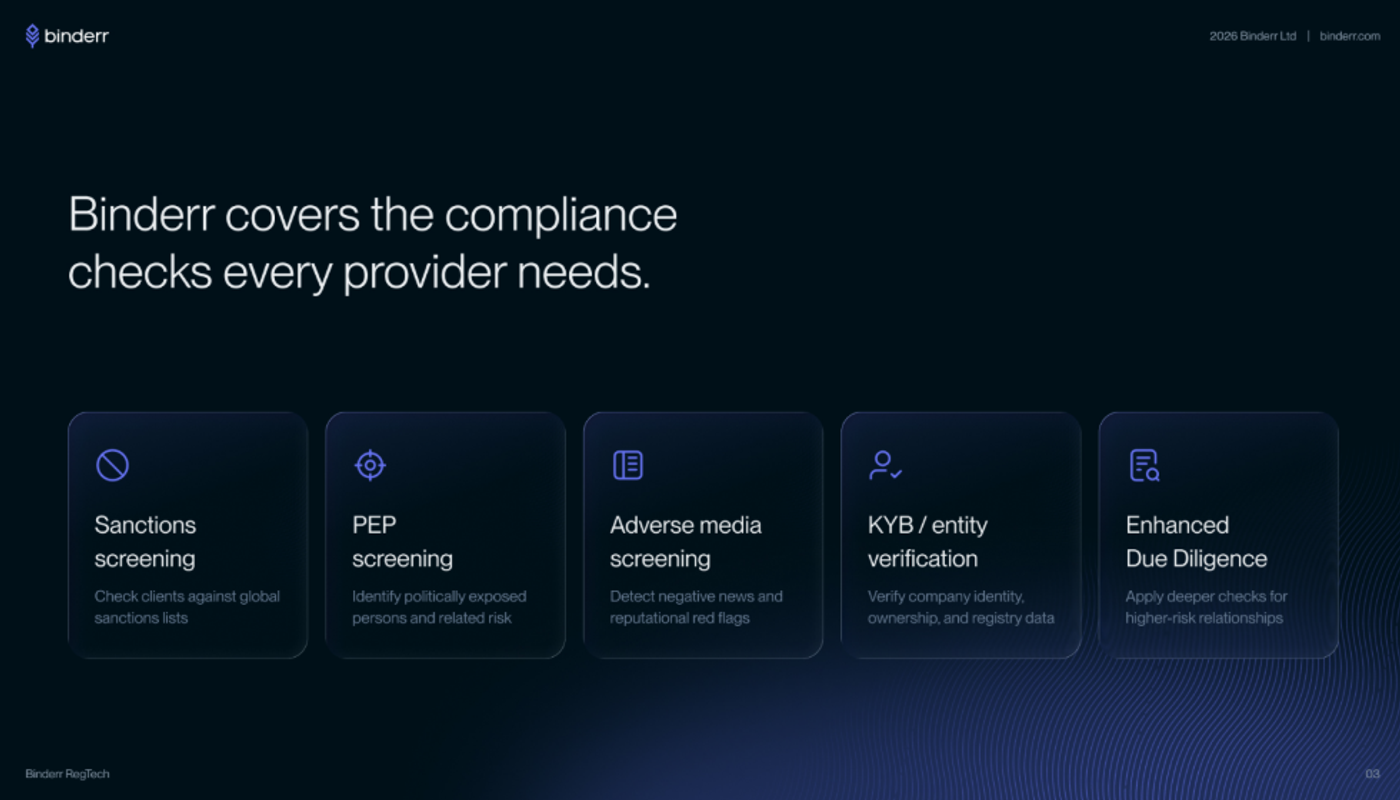
(Binderr centralises sanctions, PEP, adverse-media, entity verification, and enhanced due diligence checks within one compliance platform.)
- Sanctions lists are checked to ensure the customer is not subject to international restrictions
- Politically exposed person (PEP) databases identify individuals with heightened corruption risk
- Regulatory watchlists highlight individuals flagged by financial authorities
- Law enforcement databases may reveal criminal associations or investigations
- Adverse media screening uncovers negative news related to fraud, crime, or misconduct
- Internal blocklists prevent previously rejected or suspicious individuals from reapplying
It is important to distinguish AML screening from identity verification. A customer may pass identity checks but still trigger AML alerts due to sanctions exposure, political connections, adverse media, geographic risk, or suspicious behaviour.
Try FREE AI-powered AML screening with Binderr
Assessing Customer Risk Levels
Customer risk assessment is a fundamental part of KYC and AML compliance, enabling businesses to apply a risk-based approach to onboarding and monitoring. By evaluating multiple risk factors, platforms can determine the level of due diligence required for each customer within a Kyc-as-a-service model.
- Customer type (individual or business) influences the complexity of verification
- Country of residence and nationality indicate jurisdictional risk levels
- Product risk reflects the nature of the service being used
- PEP status increases the need for enhanced due diligence (EDD)
- Sanctions exposure and adverse media raise potential compliance concerns
Using predefined rules and automated risk scoring, customers are typically classified as low, medium, or high risk. This classification determines whether standard customer due diligence (CDD) is sufficient or if enhanced due diligence is required.
Making Automated Decisions or Escalating for Review
In a KYC as a Service workflow, automated decision-making plays a critical role in determining whether a customer can be onboarded instantly or requires further scrutiny. These decisions are typically based on predefined risk rules, identity verification results, AML screening outcomes, and fraud detection signals provided by kyc service providers.
- Automatically approved: Low-risk customers who pass identity verification, AML screening, and risk scoring checks can be onboarded instantly, improving customer onboarding speed and user experience.
- Rejected: Applications that clearly fail verification checks, such as invalid documents or confirmed sanctions matches, are declined to prevent fraud and regulatory breaches.
- Referred for manual review: Cases with ambiguous results, partial matches, or low-confidence verification scores are escalated to compliance teams for further investigation.
- Asked to resubmit information: Customers may be prompted to provide clearer documents, updated details, or additional verification if initial submissions are incomplete or unclear.
- Escalated for enhanced due diligence: High-risk customers, such as politically exposed persons (PEPs) or those linked to high-risk jurisdictions, require deeper investigation through enhanced due diligence (EDD) processes.
Businesses should define their own risk appetite, acceptance criteria, and escalation workflows rather than relying solely on default KYC provider settings. Customising these rules ensures alignment with regulatory requirements, internal compliance policies, and overall risk management strategies.
Managing Ongoing Monitoring and Reverification
KYC compliance does not end at onboarding; it is an ongoing process that requires continuous monitoring to detect changes in customer risk profiles and ensure regulatory compliance. Ongoing monitoring helps businesses identify suspicious activity, maintain accurate customer records, and respond to evolving financial crime risks using a scalable KYC service.
- Periodic customer reviews: Regularly reassessing customer profiles based on risk level ensures that due diligence remains up to date.
- Sanctions and PEP rescreening: Continuous or scheduled screening against updated sanctions lists and PEP databases helps detect newly flagged individuals.
- Changes in risk level: Monitoring customer behaviour, transactions, or external data can trigger a reassessment of risk classification.
- Document expiry notifications: Automated alerts ensure that expired identity documents are updated promptly to maintain valid records.
- Alert investigation: Compliance teams review alerts generated by monitoring systems to determine if further action is required.
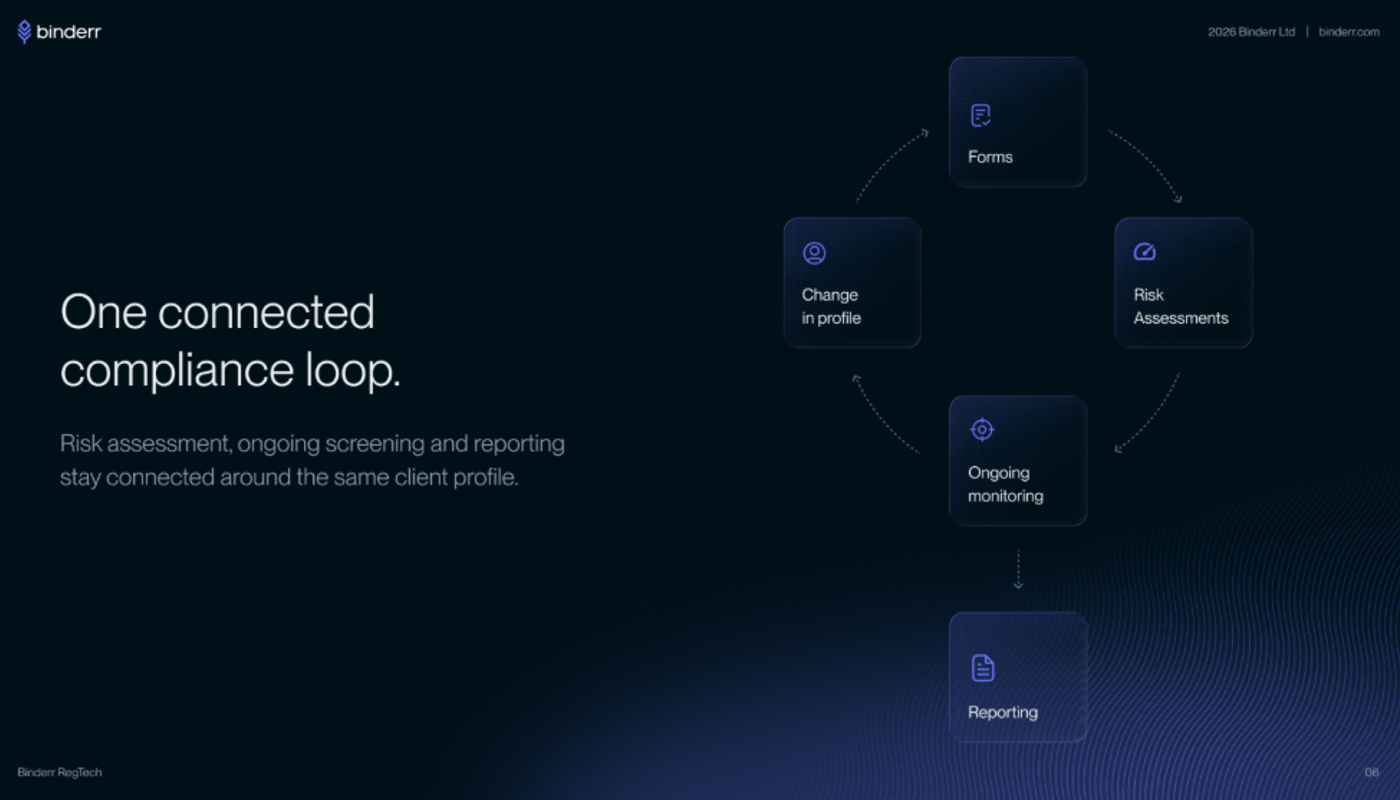
(Binderr connects onboarding, risk assessment, continuous screening, profile changes, and compliance reporting in one monitoring loop.)
Effective ongoing monitoring and reverification strengthen AML compliance, reduce fraud risk, and ensure that customer data remains accurate throughout the relationship lifecycle. By combining automation with human oversight, businesses can maintain a robust and scalable KYC framework.
Simplify KYC Workflows with Binderr
Binderr automates the entire KYC lifecycle:
- Run KYC, KYB, and AML checks in one platform
- Automatically assign risk scores based on collected data
- Trigger EDD workflows for high-risk users
- Collect additional documents dynamically
- Monitor customers continuously for risk changes
- Maintain full audit trails for compliance
Different KYCaaS Delivery Models
Explore how modern KYC as a Service platforms adapt to different business needs, from flexible API integrations to fully managed identity verification solutions offered by leading KYC service providers.
Understanding these KYCaaS delivery models helps organisations choose the right approach for scalable onboarding, compliance automation, and seamless customer identity verification.
API-Based KYC
API-based KYC solutions suit businesses that want control over onboarding while using external verification tools. By integrating a KYC API, companies can customise workflows, user interfaces, and checks to match their needs. This approach is common among fintechs, digital banks, and crypto platforms that require fast, scalable onboarding. It also allows integration with systems like CRM and fraud tools, creating a more connected compliance setup.
Hosted Verification Flow
Hosted verification flows provide a ready-to-use KYC onboarding experience that businesses can deploy quickly with minimal development. The provider hosts the full verification journey, including document upload, biometrics, and AML checks. Companies can redirect users or embed the flow in their app. This model suits startups and SMEs needing fast setup and low technical effort. It often includes audit trails, risk scoring, and automated decisions.
Mobile and Web SDK
Mobile and web SDKs let businesses embed KYC features directly into their apps for a seamless experience. They support document capture, OCR, facial recognition, and liveness checks within the app. This is ideal for mobile-first platforms and services focused on user experience. SDKs also improve security with device-level fraud detection and encrypted data handling.
White-Labelled KYC Portal
White-labelled KYC portals allow businesses to offer a branded verification experience without building the system themselves. Companies can customise the interface while using the provider’s backend for checks and screening. This suits firms that want brand consistency with minimal development. These portals often support multiple languages, workflows, and global document types.
Managed KYC Review
Managed KYC review combines automation with human checks by outsourcing complex cases to compliance experts. It helps handle unclear documents, PEP matches, and high-risk alerts. This reduces internal workload and improves consistency. It is useful during high onboarding volumes or when entering new markets with support from experienced KYC service providers.
Hybrid KYCaaS
Hybrid KYCaaS combines automation with internal oversight. Low-risk cases are processed automatically, while complex ones go to compliance teams. This improves efficiency while keeping control over key decisions. It works well for organisations that need both scale and strong risk management.
How to Implement KYC as a Service
Streamline onboarding, strengthen identity verification, and scale your compliance workflows with a modern KYCaaS approach supported by reliable kyc service providers.
Step 1: Define Regulatory and Business Requirements
Start by identifying the key regulations that apply to your business, such as AML, CTF, GDPR, and local KYC laws. Map the countries where your customers are based and understand their specific verification requirements. Define your business model, customer types, and risk levels based on factors like geography and behavior. Then decide which KYC checks are required, such as document verification, biometrics, and AML screening, along with your record-keeping needs.
Step 2: Document the Existing KYC Process
Review your current KYC workflow to understand how onboarding and verification are handled. Identify manual steps, customer drop-off points, duplicated efforts, and bottlenecks in compliance reviews. Also, check for gaps in AML screening or risk assessment. This helps highlight areas that can be improved or automated using a more efficient kyc service.
Step 3: Design Risk-Based Customer Journeys
Create onboarding workflows based on customer risk levels. Low-risk customers can follow a simple, automated process. Medium-risk users may require extra checks like address verification or additional screening. High-risk customers should go through Enhanced Due Diligence (EDD), including manual review and ongoing monitoring. Use flexible workflows that adjust based on risk signals to balance compliance and user experience.
Cut compliance time. Screen and detect risk for FREE.
Step 4: Conduct Vendor Due Diligence
Before selecting a KYC as a Service provider, perform comprehensive due diligence. Evaluate the provider’s legal standing, compliance certifications, and adherence to global standards like ISO 27001 or SOC 2. Assess their technical capabilities, including API reliability, uptime, and scalability. Review their data protection practices, including encryption, data residency, and GDPR compliance. Analyze their financial stability and track record in the industry. Ensure they offer robust AML screening, biometric verification, and fraud detection tools. This step ensures you partner with a reliable and secure kyc service provider.
Step 5: Configure and Integrate the Platform
Once a provider is selected, configure the KYCaaS platform to match your business and regulatory requirements. Set up customizable onboarding forms, define acceptable identity documents, and configure verification rules such as OCR extraction and biometric matching. Establish AML screening thresholds, risk scoring models, and escalation workflows for manual review. Integrate the platform with your existing systems using APIs or SDKs, ensuring seamless data flow between your CRM, onboarding interface, and compliance tools. Enable real-time reporting and audit trails to support compliance and operational visibility.
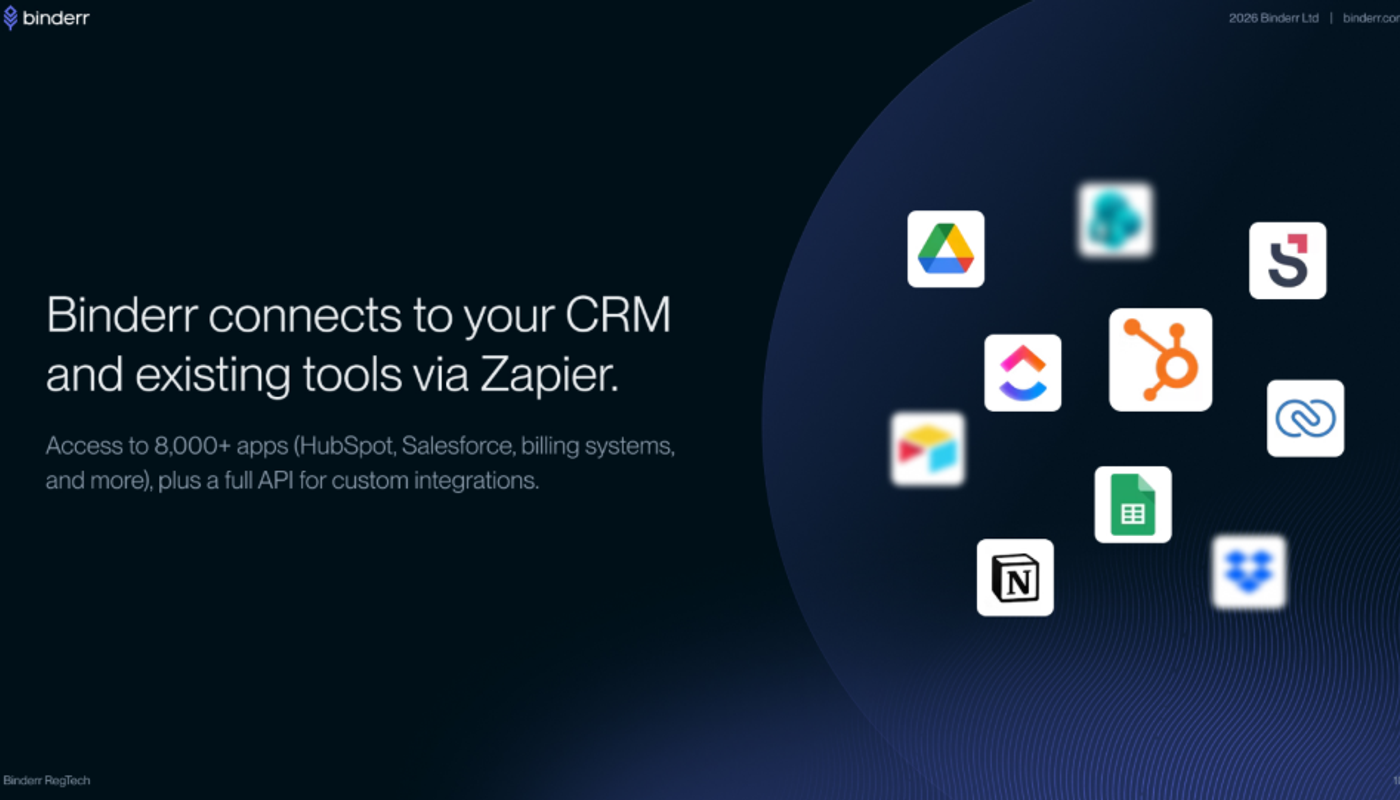
(Binderr connects compliance workflows with CRM platforms and existing business applications through Zapier and custom APIs.)
Step 6: Test the Complete Journey
Conduct end-to-end testing of your KYC workflows to ensure accuracy, reliability, and user experience. Simulate various scenarios, including:
- Genuine customers with valid documents
- Poor-quality or blurry document uploads
- Expired or invalid identity documents
- Name variations and transliteration issues
- Politically Exposed Person (PEP) matches
- Sanctions list alerts
- Deepfake or spoofing attempts
- Duplicate or synthetic identity applications
- Manual review and escalation workflows
Testing ensures your KYC system can handle real-world complexities and edge cases effectively.
Step 7: Train Compliance and Operations Teams
Equip your compliance officers and operations staff with the knowledge and tools needed to manage KYC workflows effectively. Provide training on how to interpret verification results, handle AML alerts, and assess risk scores. Ensure they understand how to use the platform’s case management features, including reviewing evidence, applying overrides, and escalating cases. Reinforce documentation standards and audit requirements. Ongoing training helps maintain consistency, reduces errors, and ensures your team can respond to evolving regulatory expectations.
Get End-to-End Compliance with Binderr
Binderr provides a complete compliance ecosystem:
- KYC (Identity Verification Process)
- KYB (Business Verification Checks)
- AML Screening and Monitoring Systems
- Dynamic Risk Assessment Models
- UBO Identification and Ownership Mapping Tools
- Automated CDD and EDD workflows Solutions
Bottom Line
KYC as a Service (KYCaaS) helps businesses streamline identity verification, improve onboarding speed, and strengthen fraud prevention using scalable, cloud-based tools. However, organisations must still maintain strong internal controls, clear policies, and oversight to ensure effective and compliant customer onboarding.
Binderr Compliance helps businesses build secure, scalable KYC journeys with identity verification, AML screening, automated risk scoring, CDD and EDD workflows, and ongoing monitoring in one platform.