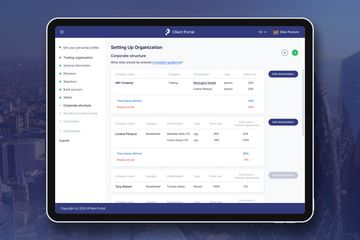
Verifying a company's registration is one thing. Knowing who controls it is another. According to the ACFE's 2026 Report to the Nations, organizations are estimated to lose 5% of their revenue to occupational fraud annually. Fraudulent entities, hidden ownership, and weak onboarding checks make thorough business due diligence essential.
KYB vs business verification is a common compliance question. Both processes help confirm business legitimacy, but their scope can differ. Business verification typically checks company identity and registration, while KYB extends to beneficial ownership, AML screening, and risk assessment.
So, how does business verification vs KYB compare in practice? This guide explores their key differences, verification steps, regulatory requirements, and use cases. After all, confirming a company exists is only the first step toward understanding who owns, controls, and operates it.
Binderr KYB Software for Businesses
Why stop at company registration checks? Binderr's KYB and business verification software helps compliance teams verify legitimate businesses, uncover hidden ownership, and assess corporate risks in one platform.
- Global business registry coverage across 200+ countries
- Access to 30,000+ corporate data sources
- Automated company registration and status verification
- Director, shareholder, and UBO identification
- Integrated sanctions, PEP, and adverse media screening
- Automated risk scoring and compliance workflows
What Is KYB (Know Your Business)?
Know Your Business (KYB) is a due diligence process that verifies a company's identity, ownership, legitimacy, and compliance risks. It includes business registration checks, UBO identification, AML screening, risk assessment, and ongoing monitoring. In KYB vs business verification, KYB goes beyond basic company checks to identify hidden ownership, financial crime risks, and potential compliance issues.
Run Your First KYB Check
What Is Business Verification?
Business verification confirms a company's legitimacy by checking its registration, legal status, address, business activities, documents, and director details against reliable records. In KYB vs business verification, business verification primarily focuses on company identity, while KYB covers ownership and compliance risks. However, some providers also include UBO checks and AML screening.
Verify a Business Today
KYB vs Business Verification: Key Differences
The KYB vs business verification comparison highlights key differences in verification scope, ownership checks, AML compliance, and risk assessment.
Here's a quick business verification vs KYB breakdown to understand how these processes differ.
Comparison Factor | Business Verification (Basic) | KYB |
Primary purpose | Confirm company identity and legitimacy | Establish identity, ownership, control, and compliance risk |
Company registration checks | Yes | Yes |
Business document verification | Commonly included | Included as relevant |
Director and representative checks | Sometimes | As required by due diligence |
UBO identification | Not always | Typically essential |
Ownership structure analysis | Limited or optional | Risk-based and more comprehensive |
Sanctions and PEP screening | Optional | As legally required or risk-appropriate |
Risk assessment | Limited | Central to the process |
Ongoing monitoring | Not always included | Applied according to legal requirements and risk |
Primary outcome | Verified company details | Documented corporate due diligence and risk decision |
Simplify Every Step of KYB Verification with Binderr
From collecting company details to assessing ownership and compliance risks, Binderr streamlines the entire KYB verification process. Automate repetitive checks, reduce manual work, and make faster onboarding decisions.
- Automated company data collection and verification
- Official registry checks across multiple jurisdictions
- Director, shareholder, and UBO verification
- Multi-layered corporate ownership structure mapping
- Integrated AML screening and dynamic risk scoring
- Continuous monitoring with real-time risk alerts
How Do KYB and Business Verification Overlap?
In the KYB vs business verification comparison, both processes share essential checks that confirm a company's identity, legitimacy, and legal standing. Here's where they overlap:
Company Identity and Registration Checks - Both processes verify a company's legal name, registration number, incorporation status, and registered address against official business registries. These checks help confirm that the company legally exists and operates under a valid registration.
Business Document Verification - Both involve reviewing certificates of incorporation, registry extracts, and other official documents to validate company information. Document checks help identify inconsistencies, outdated records, or potentially fraudulent business details.
Directors and Company Information - Both processes may verify company directors, officers, and authorized representatives to establish who manages or represents the business. However, KYB typically goes further by examining ownership structures, control relationships, and ultimate beneficial owners (UBOs).
While business verification vs KYB shares several verification steps, neither term alone guarantees full regulatory compliance. The actual scope of checks determines whether applicable due diligence requirements are met.
How Does the KYB Process Go Beyond Basic Business Verification?
In the KYB vs business verification comparison, KYB goes beyond confirming a company's identity to uncover ownership, assess financial crime risks, and support ongoing compliance. Here's how:
Ultimate Beneficial Ownership Identification - KYB identifies the ultimate beneficial owners (UBOs) who ultimately own or control a company, directly or through other entities. It involves tracing ownership chains, verifying individuals, and identifying hidden controllers to improve transparency and meet applicable AML requirements.
Corporate Ownership and Control Analysis - KYB examines complex corporate structures involving parent companies, subsidiaries, and multiple ownership layers. Compliance teams assess control relationships, verify shareholder information, and investigate ownership discrepancies that basic business registration checks may overlook.
AML, Sanctions, and PEP Screening - KYB may involve screening companies, beneficial owners, and relevant associated individuals against applicable sanctions lists and politically exposed person (PEP) databases. Adverse media checks can also help identify financial crime concerns and potential reputational risks requiring further investigation.
Business Risk Assessment - KYB evaluates corporate risk based on jurisdiction, industry, ownership complexity, business activities, and expected customer transactions. These factors help compliance teams assign risk levels, determine appropriate due diligence measures, and identify relationships requiring enhanced scrutiny.
Ongoing Monitoring and Risk Reviews - Unlike a one-time company check, KYB can continue throughout the business relationship. Periodic reviews, ownership updates, risk-based rescreening, and sanctions alerts help compliance teams identify emerging threats and keep customer records accurate.
The key distinction in business verification vs KYB is that KYB supports a broader, risk-based compliance process. The specific checks required depend on the applicable regulations, the organization's regulated status, and the customer's risk profile.
Uncover Hidden Ownership with Binderr's KYB Tools
A verified company can still have a complicated ownership structure. Binderr's KYB and UBO verification tools help compliance teams trace corporate relationships, identify ultimate owners, and detect potential financial crime risks.
- Identify ultimate beneficial owners across jurisdictions
- Map complex, multi-layered corporate ownership structures
- Verify company directors and shareholder information
- Uncover hidden affiliations and controlling entities
- Screen UBOs against sanctions and PEP databases
- Flag ownership-related risks for further investigation
KYB vs Business Verification: How Does Each Process Work?
The KYB vs business verification comparison becomes clearer when examining their workflows. Both begin with company identity checks, but KYB adds ownership verification, risk assessment, and compliance monitoring.
Business Verification Process
Business verification focuses on confirming a company's legal existence and validating its registered information through four steps:
Step 1: Collect Business Information
Gather the company's legal name, registration number, registered address, and jurisdiction to establish its identity. Additional details, such as business activities, legal entity type, and incorporation date, help build an accurate company profile and support further verification.
Step 2: Verify Official Registry Records
Cross-check submitted details against government business registries and reliable databases to confirm accuracy. This helps establish whether the company is officially registered, active, and operating under the declared legal identity. Any mismatched information is flagged for further investigation.
Step 3: Validate Business Documents
Review incorporation status, company addresses, registration certificates, and supporting documents to identify inconsistencies. Compare these documents with official records to confirm authenticity and detect outdated, altered, or potentially fraudulent information.
Step 4: Confirm Verification Results
Investigate discrepancies and determine whether the company's information is verified, requires further review, or cannot be confirmed. Document the verification findings and flag unresolved issues before approving the business for onboarding.
KYB Verification Process
KYB builds on business verification by examining ownership, control, and financial crime risks through seven steps:
Step 1: Collect Company Information
Gather business registration details, corporate documents, ownership information, and relevant onboarding data. This includes the company's legal identity, operating jurisdiction, business activities, and declared ownership structure. Complete information helps establish a reliable foundation for further KYB checks.
Step 2: Verify Business Legitimacy
Confirm the company's registration, legal status, business activities, and official documents against reliable sources. Cross-check registry information to identify inactive entities, inconsistent records, or potentially fraudulent businesses. Resolve discrepancies before proceeding with onboarding.
Step 3: Identify Key Individuals
Identify directors, authorized representatives, shareholders, and ultimate beneficial owners (UBOs). Verify relevant individuals using reliable identification documents or independent sources. This helps establish who manages, represents, and ultimately controls the company.
Step 4: Analyze Ownership Structures
Trace direct and indirect ownership, identify controlling individuals, and investigate complex corporate relationships. Review parent companies, subsidiaries, and intermediate entities to uncover hidden ownership or unusual control arrangements. Flag discrepancies that require additional investigation.
Step 5: Conduct AML Screening
Perform applicable sanctions, PEP, and adverse media checks on the company and relevant associated individuals. Investigate potential matches to distinguish genuine risks from false positives. Screening findings help determine whether additional due diligence or restrictions are necessary.
Step 6: Assess Compliance Risks
Evaluate jurisdiction, industry, ownership complexity, and business activities to determine risk levels and additional due diligence needs. Assign a risk rating based on relevant findings and the organization's assessment criteria. Higher-risk relationships may require enhanced due diligence (EDD), additional documentation, or management approval.
Step 7: Monitor and Maintain Records
Document onboarding decisions, update customer information, and conduct ongoing monitoring and risk-based reviews. Track relevant changes in ownership, sanctions exposure, company status, and business activities. Maintain audit trails and review records to support regulatory compliance and future investigations.
The key difference in business verification vs KYB is that business verification confirms company identity, while KYB extends the process to ownership transparency, compliance risk, and ongoing due diligence.
Bring Business Verification and KYB Together with Binderr
Why manage company verification, ownership checks, and AML screening separately? Binderr's unified compliance platform connects business verification with end-to-end KYB, customer due diligence, and ongoing monitoring.
- Global KYB and business verification capabilities
- Automated KYC checks for relevant individuals
- UBO identification and corporate ownership mapping
- Integrated sanctions, PEP, and adverse media screening
- Dynamic risk scoring with CDD and EDD workflows
- Ongoing monitoring, audit trails, and compliance reporting
KYB vs Business Verification: Which Approach Should Your Business Choose?
Choosing between KYB vs business verification depends on your business's compliance obligations, customer risk levels, and onboarding requirements. Business verification is ideal for confirming a company's legal existence, registration details, and legitimacy through reliable records. However, KYB goes further by examining beneficial ownership, corporate control, AML risks, and ongoing monitoring needs. For regulated businesses, basic company verification alone may not satisfy mandatory customer due diligence requirements.
When comparing business verification vs KYB, focus on the actual checks performed rather than the terminology used by providers. The right approach should align with applicable regulations, industry risks, and the complexity of your corporate customers. Binderr Services simplifies both processes by combining business verification, ownership analysis, AML screening, and ongoing monitoring in one compliance platform.