
Verifying a company is no longer as simple as checking a registration number or reviewing an incorporation certificate. Businesses today face growing risks from shell companies, misrepresented ownership, and unauthorised representatives. Without proper business identity verification and identity verification for business processes, organisations may unknowingly onboard entities that appear legitimate but hide compliance risks, inactive status, or false corporate information.
Business identity verification solutions help organisations confirm that a company is real, active, and accurately represented. These systems combine corporate registry checks, document verification, ownership mapping, KYC, and AML screening to validate both the legal entity and the individuals behind it.
This guide explains how business identity verification solutions work and why they matter. It covers the full verification process, key checks such as company registry validation and UBO identification, common technologies used in business verification software, and the risk indicators organisations should watch for.
Binderr Business Identity Verification Software
- Global KYB verification across 200+ countries and 30,000+ data sources
- Automated ownership structure mapping and UBO identification
- Integrated KYC with AI-powered identity verification and biometric checks
- AML screening across sanctions, PEPs, watchlists, and adverse media
- Dynamic risk scoring for CDD and EDD workflows
- Ongoing monitoring with real-time alerts for risk changes
What Is Business Identity Verification?
Business identity verification confirms that a company is legitimate, properly registered, and accurately represented. It involves checking official registry data, verifying key details like name, registration number, and address, and identifying directors, shareholders, and beneficial owners. It also includes screening for AML risks such as sanctions and PEPs, helping organisations prevent fraud and ensure compliant onboarding.
In practice, identity verification for business extends beyond basic checks by linking corporate data with individual identity verification, ensuring that both the entity and its associated people are genuine. This makes company identity verification and business id verification essential components of modern compliance frameworks.
Start Business Verification for Free
Why Do Companies Need Business Identity Verification?
In a world of complex corporate structures and rising fraud risks, verifying who you do business with is no longer optional.
Business identity verification helps organisations ensure legitimacy, uncover ownership, and strengthen compliance across KYB, AML, and corporate due diligence processes. It also supports identity verification for business by ensuring that both companies and their representatives are properly validated.
Meet KYB and AML Compliance Requirements - Regulated firms must verify corporate customers, identify beneficial owners, and understand the purpose of the relationship as part of KYB and AML compliance. This involves risk-based due diligence and accurate record-keeping. Company identity verification and business id verification play a key role in meeting these obligations across industries.
Detect Fraudulent and Misrepresented Companies - Business identity verification helps detect fraudulent or misrepresented companies by spotting inconsistencies in documents, ownership, and operations. Identity verification for business ensures that both corporate entities and individuals are legitimate, reducing risks such as fake records, dissolved entities posing as active, impersonation, and synthetic identities.
Identify Hidden Ownership and Control - A direct shareholder is not always the ultimate beneficial owner, as ownership can be layered through multiple entities across jurisdictions. Business verification solutions must trace each ownership layer to identify the natural persons or controlling parties behind the company. This is a core part of company identity verification and business id verification.
Prevent Sanctions and Financial Crime Exposure - Companies must screen not only the business entity but also its directors, shareholders, UBOs, and representatives for sanctions and financial crime risks. Identity verification for business ensures that individuals linked to the company are properly vetted alongside the entity itself.
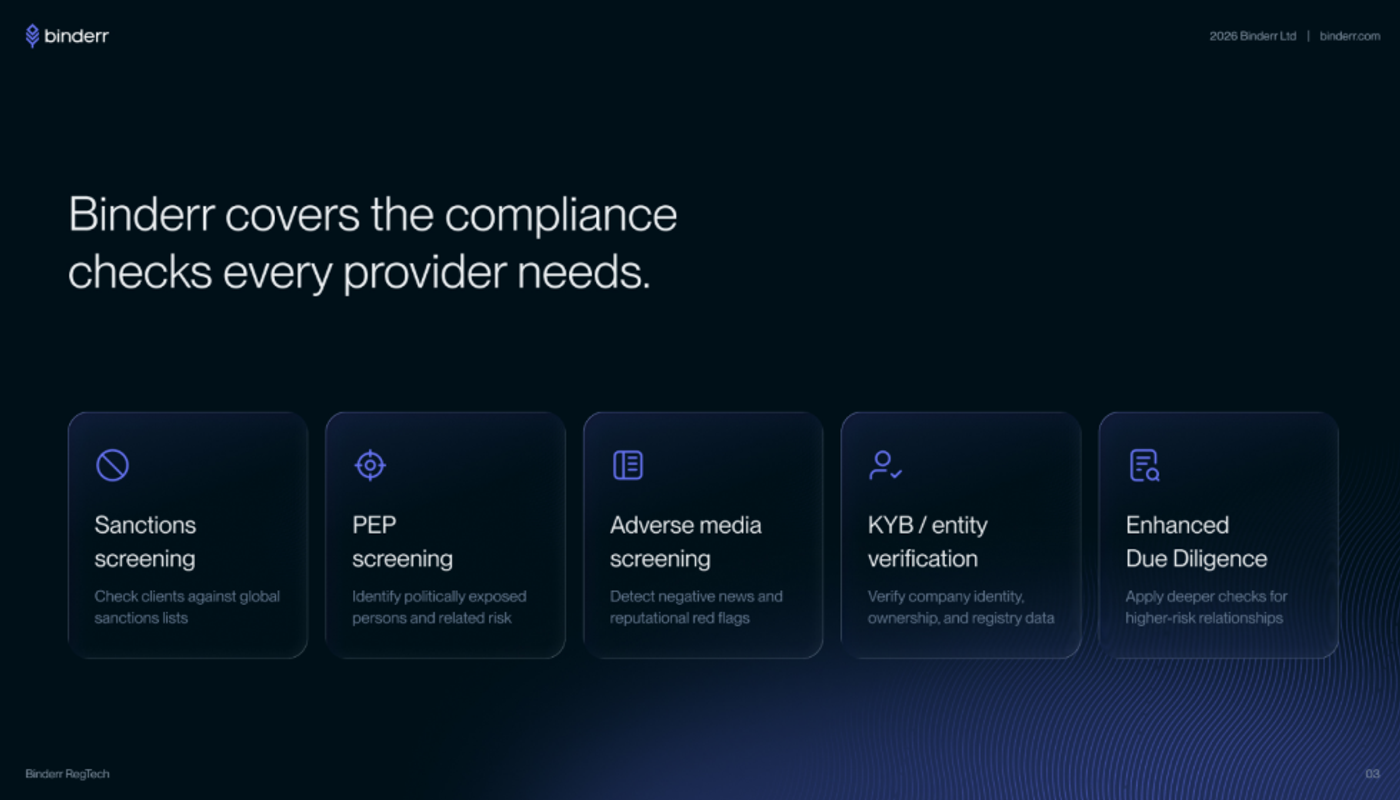
Business identity verification becomes more effective when company checks and financial crime screening operate within the same workflow. Binderr combines KYB and entity verification with sanctions, PEP, adverse media, and enhanced due diligence checks, helping compliance teams evaluate both the company and the people connected to it.
Make Better Commercial Decisions - Business identity verification supports informed commercial decisions by providing reliable company data and risk insights. It strengthens company identity verification processes and enables organisations to reduce risk and build trusted business relationships.
Complete KYB Checks Faster with Binderr
Quick Comparison of Business Verification Solutions
Explore how leading business identity verification solutions streamline KYB, automate compliance checks, and enhance risk assessment across global markets, including identity verification for business and business id verification.
Feature | Binderr | Trulioo | Sumsub | Middesk | Kyckr |
Business registry checks | ✅ | ✅ | ✅ | ✅ | ✅ |
Company data validation | ✅ | ✅ | ✅ | ✅ | ✅ |
Business address verification | ✅ | ✅ | ✅ | ✅ | ❌ |
Corporate document verification | ✅ | ✅ | ✅ | ✅ | ❌ |
UBO identification | ✅ | ❌ | ✅ | ❌ | ❌ |
Ownership structure mapping | ✅ | ❌ | ❌ | ❌ | ❌ |
Bulk corporate structure screening | ✅ | ❌ | ❌ | ❌ | ❌ |
What Information Should a Business Verification Solution Check?
Every legitimate business leaves a trail of verifiable data. Effective business identity verification and identity verification for business rely on checking the right information at every stage.
Legal Company Name and Registration Number
A robust business identity verification process starts by validating the legal company name and registration number against an official registry or authoritative source. This confirms the entity exists and that the submitted details are accurate. Key checks include the registered name, any previous or trading names, company number, incorporation date, legal form, jurisdiction, and registry authority. Verification tools often use fuzzy matching to handle variations like abbreviations or alternate names, improving accuracy across datasets.
Company Status
Verifying a company’s legal status is essential to determine whether it is eligible for onboarding and ongoing business relationships. A business identity verification solution should check whether the entity is active, dissolved, in liquidation, struck off, dormant, suspended, under administration, or subject to filing defaults. These indicators show the company’s operational standing and financial health. Importantly, incorporation alone does not guarantee that a company is currently trading or suitable as a customer, making status verification a key step in KYB compliance and risk assessment.
Registered and Operating Address
Address verification helps confirm a business’s physical and operational presence. A robust verification solution compares key address data points, such as the registered office, principal place of business, mailing address, supporting evidence, and website details. Discrepancies between these sources may indicate fraud or misrepresentation. Common red flags include mail drops, mass-registration addresses, unexplained foreign locations, or mismatches between business activities and location, all of which can signal higher compliance risk.
Incorporation and Corporate Documents
Corporate document verification confirms that a business has provided valid, up-to-date legal documents supporting its existence and structure. These may include incorporation certificates, articles of association, registry extracts, and ownership records. Modern verification platforms should request documents dynamically based on entity type, jurisdiction, risk level, and ownership complexity, improving efficiency while maintaining strong compliance controls.
Directors and Officers
Verifying directors and officers helps confirm who manages and controls the company. This includes checking names, appointment details, and current status, along with identity verification and AML screening for sanctions, PEPs, and adverse media. Ensuring directors are legitimate reduces the risk of impersonation, nominee abuse, and corporate fraud.
Shareholders and Ownership Structure
A comprehensive business verification solution should identify both direct shareholders and indirect ownership across corporate layers. This involves mapping the ownership structure to show parent companies, subsidiaries, and ownership percentages. Visual charts help illustrate control relationships and identify ultimate beneficial owners (UBOs), enabling organisations to understand who ultimately controls the business for KYB compliance and risk management.
Ultimate Beneficial Owners
Identifying ultimate beneficial owners involves more than ownership percentages. Control may also come from voting rights, contracts, nominee arrangements, trusts, or the power to appoint management. Effective verification solutions must assess both ownership and control. FATF guidance highlights the need for accurate and up-to-date ownership data to help detect hidden control and prevent financial crime.
Map Company Ownership Automatically
Authorised Representatives
It is crucial to verify that the individual acting on behalf of the company has the legal authority to do so. Business identity verification solutions should confirm the role and authority of authorised representatives using evidence such as board resolutions, powers of attorney, employment positions, authorised signatory registers, corporate mandates, or registry appointments. This step helps prevent unauthorised account access, impersonation, and fraudulent transactions by ensuring that only legitimate representatives can act for the business.
Business Activities and Industry Classification
Verifying a company’s declared business activities helps confirm that its operations match its legal registration and risk profile. A business identity verification solution should compare stated activities with registry data, website content, licences, and expected transactions. Any mismatch may signal misrepresentation or higher risk, making this step important for accurate risk assessment and compliance.
Regulatory Licences and Permissions
Some industries require licences or regulatory approvals to operate. Business verification should check both company registries and relevant regulators to confirm valid licences, such as financial, crypto, gambling, legal, healthcare, or insurance permissions. This helps ensure the business is authorised and reduces risk.
See How Binderr Streamlines the Verification Process
Binderr simplifies business identity verification by automating every step:
- Run KYB, KYC, and AML checks in one platform
- Automatically retrieve company data from global registries
- Map ownership structures and identify UBOs instantly
- Screen entities and individuals in real time
- Assign dynamic risk scores for CDD and EDD
- Trigger enhanced due diligence workflows automatically
Essential Features of a Business Identity Verification Platform
Discover the core capabilities that power reliable business identity verification solutions and identity verification for business.
Reliable Source Transparency
Reliable source transparency is essential in business identity verification solutions, as it allows compliance teams to clearly understand where data originates and how trustworthy it is. A robust business verification platform should display the data source, retrieval date, registry status, match confidence, and supporting evidence in a structured and accessible format.
This level of visibility helps organisations validate company identity with confidence, reduces reliance on unverifiable information, and strengthens audit readiness. By ensuring that every data point is traceable to an authoritative source, businesses can improve KYB compliance, reduce fraud risk, and make informed onboarding decisions.
Automated Ownership Mapping
Automated ownership mapping is a critical feature in modern business verification software, enabling organisations to uncover complex corporate structures with ease. Advanced solutions should support multi-layer ownership calculations, corporate shareholder tracing, and visual structure charts that clearly illustrate relationships between entities.
Features such as UBO threshold configuration, control-based identification, and unresolved ownership alerts help compliance teams identify ultimate beneficial owners accurately and detect hidden control. This automation not only saves time but also enhances transparency, making it easier to comply with KYB regulations and mitigate risks associated with opaque ownership structures.
Integrated KYC
Integrated KYC capabilities allow business identity verification platforms to seamlessly verify the natural persons associated with a company, such as directors, shareholders, and authorised representatives, without requiring a separate onboarding system. By combining company verification with individual identity checks, including document verification, biometric authentication, and liveness detection, organisations can streamline their compliance workflows.
This unified approach reduces friction during onboarding, improves data consistency, and ensures that both the business entity and its key individuals are thoroughly vetted in line with AML and KYC requirements.
Entity and Individual AML Screening
Entity and individual AML screening is a fundamental component of business verification solutions, ensuring that both companies and their associated individuals are checked against global risk databases. A comprehensive screening process should cover the company, trading names, parent entities, subsidiaries, directors, shareholders, UBOs, and authorised representatives.
By integrating sanctions screening, PEP checks, watchlist monitoring, and adverse media analysis, businesses can identify potential financial crime risks early. This holistic approach to AML screening strengthens compliance, reduces exposure to regulatory penalties, and supports safer business relationships.
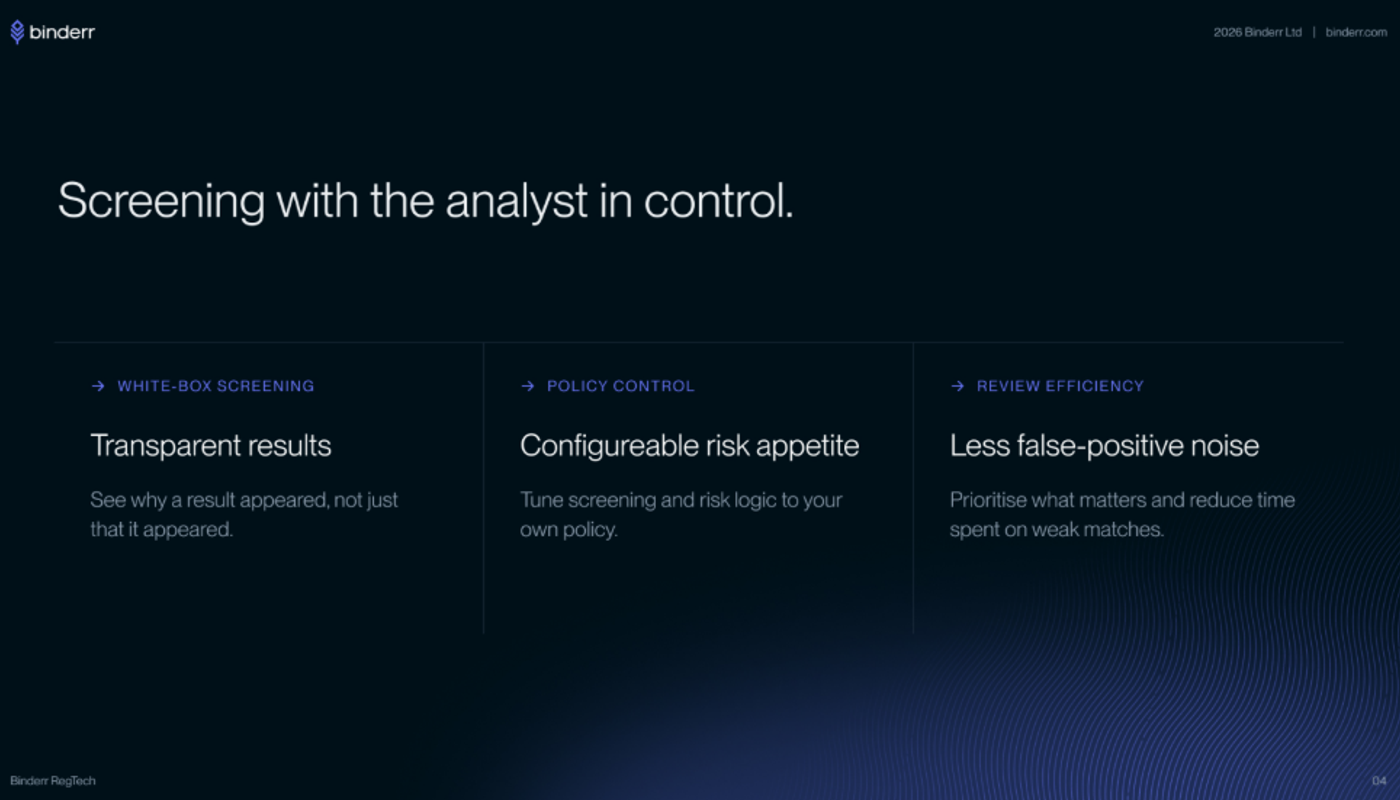
Screening software should not produce unexplained alerts that analysts must accept at face value. Binderr uses a white-box approach that shows why a result appeared, while configurable screening rules allow teams to align matching and escalation logic with their own risk appetite.
Start AML Screening for Free
Configurable Risk Scoring
Configurable risk scoring enables organisations to tailor their business verification processes according to their specific risk appetite and regulatory requirements. A flexible system should allow risk rules to reflect factors such as industry, geography, ownership structure, screening results, customer activity, and product exposure.
By assigning weighted scores to different risk indicators, businesses can prioritise high-risk cases, trigger enhanced due diligence, and automate decision-making. This dynamic approach to risk assessment improves efficiency, ensures consistency across onboarding processes, and supports a risk-based compliance framework.
Dynamic Document Collection
Dynamic document collection enhances the efficiency of business identity verification by requesting only the documents necessary for each specific case. A smart system should adapt its requirements based on entity type, jurisdiction, risk level, verification gaps, ownership structure, and licence requirements.
This targeted approach reduces unnecessary friction for customers while ensuring that compliance teams receive all relevant documentation for accurate verification. By automating document requests and validation, businesses can accelerate onboarding, maintain regulatory compliance, and improve the overall user experience.
API and No-Code Options
API and no-code options provide flexibility for organisations implementing business verification solutions, catering to both technical and non-technical teams. API integration allows developers to embed verification workflows directly into existing systems, enabling seamless automation and scalability.
At the same time, no-code interfaces empower compliance teams to configure workflows, manage cases, and adjust rules without relying on engineering resources. By offering both options, business verification platforms can support rapid deployment, customisation, and operational efficiency, making it easier for companies to adapt to evolving compliance needs.
Advanced KYB Features with Binderr
Binderr enhances business verification with powerful capabilities:
- AI-powered document verification and OCR extraction
- Biometric face matching and liveness detection for KYC
- Deep ownership structure analysis across jurisdictions
- Extended entity screening (trusts, partnerships, vessels)
- AI-driven adverse media screening
- Continuous monitoring with real-time alerts
Top 5 Business Verification Solutions
Choosing the right provider is critical for effective onboarding and compliance. Below are five leading business identity verification solutions widely used across industries:
Binderr
Binderr Compliance is a comprehensive KYB platform designed to simplify and strengthen business identity verification and identity verification for business. It brings together multiple compliance processes into a single workflow, helping organisations verify companies, understand ownership structures, and perform business id verification efficiently.
Key features include:
- Global business verification across multiple jurisdictions using authoritative data sources
- Automated ownership mapping to identify shareholders and ultimate beneficial owners
- Integrated KYC checks for directors, UBOs, and authorised representatives
- Built-in AML screening covering sanctions, PEPs, watchlists, and adverse media
- Risk scoring and configurable workflows to support due diligence decisions
- Continuous monitoring with alerts for changes in company status, ownership, or risk profile
Best for organisations that need a unified KYB solution combining verification, screening, and monitoring in one platform. Ideal for scaling compliance operations while maintaining full visibility and control.
Trulioo
Trulioo Business Verification is a global KYB solution designed to help organisations verify companies quickly and accurately across multiple jurisdictions. It combines access to official company registries with identity verification and AML screening tools, enabling businesses to onboard corporate clients while maintaining compliance with regulatory requirements.
Key features include:
- Access to global company registries across numerous countries for real-time verification
- Integrated identity verification for directors, shareholders, and beneficial owners
- Built-in AML screening covering sanctions, PEPs, and watchlists
- Automated data matching to validate submitted company information
- Flexible API integration for seamless onboarding workflows
- Scalable solution suitable for both small businesses and large enterprises
Best for: Companies needing a global, all-in-one KYB solution. Businesses operating across multiple jurisdictions. Organisations prioritising fast and automated onboarding.
Sumsub
Sumsub provides a comprehensive business verification solution designed to streamline onboarding while ensuring compliance with global regulations. It combines company verification, identity checks, and AML screening into a single platform, making it suitable for organisations that need an all-in-one compliance workflow.
Key features include:
- Global business verification with access to multiple registries
- Integrated AML screening including sanctions, PEPs, and watchlists
- Identity verification for directors and beneficial owners
- Risk scoring and automated decision-making tools
- Ongoing monitoring with configurable alerts
- API-first platform for seamless integration into existing systems
Best for: Businesses seeking an all-in-one KYB and KYC solution. Organisations operating across multiple jurisdictions. Compliance teams looking for streamlined onboarding and monitoring.
Middesk
Middesk is a business identity verification platform designed to simplify KYB onboarding, particularly for US-based companies. It provides access to reliable business data, document collection tools, and monitoring capabilities to help organisations verify and manage corporate customers efficiently.
Key features include:
- Access to comprehensive US business data and official records
- Automated business verification and onboarding workflows
- Document collection and verification for compliance requirements
- Monitoring tools to track changes in business status and ownership
- Identity verification for associated individuals
- Easy integration with APIs and developer-friendly tools
Best for: US-focused businesses and fintech companies. Organisations needing streamlined onboarding workflows. Teams looking for reliable US business data and monitoring.
Kyckr
Kyckr offers global business verification services by providing access to official company registry data across multiple jurisdictions. It enables organisations to verify company information, monitor changes, and maintain compliance with regulatory standards.
Key features include:
- Direct access to official company registries worldwide
- Real-time business verification and data retrieval
- Monitoring services for changes in company status and records
- Coverage across multiple jurisdictions and entity types
- Reliable source data for compliance and due diligence
- API integration for automated verification processes
Best for: Businesses requiring direct access to official registry data. Organisations operating internationally. Compliance teams needing reliable and up-to-date company information.
How to Choose a Business Identity Verification Solution
Cut through the noise and find a solution that truly verifies businesses, not just their paperwork.
The right business identity verification solution should combine accuracy, automation, and compliance-ready insights to support confident onboarding decisions.
Assess Global Coverage and Data Availability
When selecting a business identity verification solution, assess its global coverage and data availability to ensure it supports the jurisdictions where your customers operate. A robust platform should provide access to authoritative corporate registries, beneficial ownership data, and real-time updates across multiple countries. Look for solutions that handle cross-border verification, multilingual data sources, and varying regulatory requirements, enabling accurate company verification and seamless KYB compliance at scale.
Check Integration Options and Workflow Flexibility
Evaluate whether the business verification software offers flexible integration options such as APIs, webhooks, and no-code tools that fit your existing systems. A strong solution should support customizable workflows, allowing you to automate onboarding, trigger risk-based checks, and adapt verification steps based on customer profiles. Workflow flexibility ensures efficient business onboarding verification while maintaining compliance with internal policies and regulatory standards.
Examine Audit Trails, Reporting, and Compliance Support
A reliable business identity verification platform should provide comprehensive audit trails and reporting features to support regulatory compliance. This includes detailed logs of verification steps, data sources, screening results, and decision-making processes. Strong reporting capabilities help compliance teams demonstrate adherence to KYB and AML requirements, streamline audits, and maintain transparency across all business verification activities.
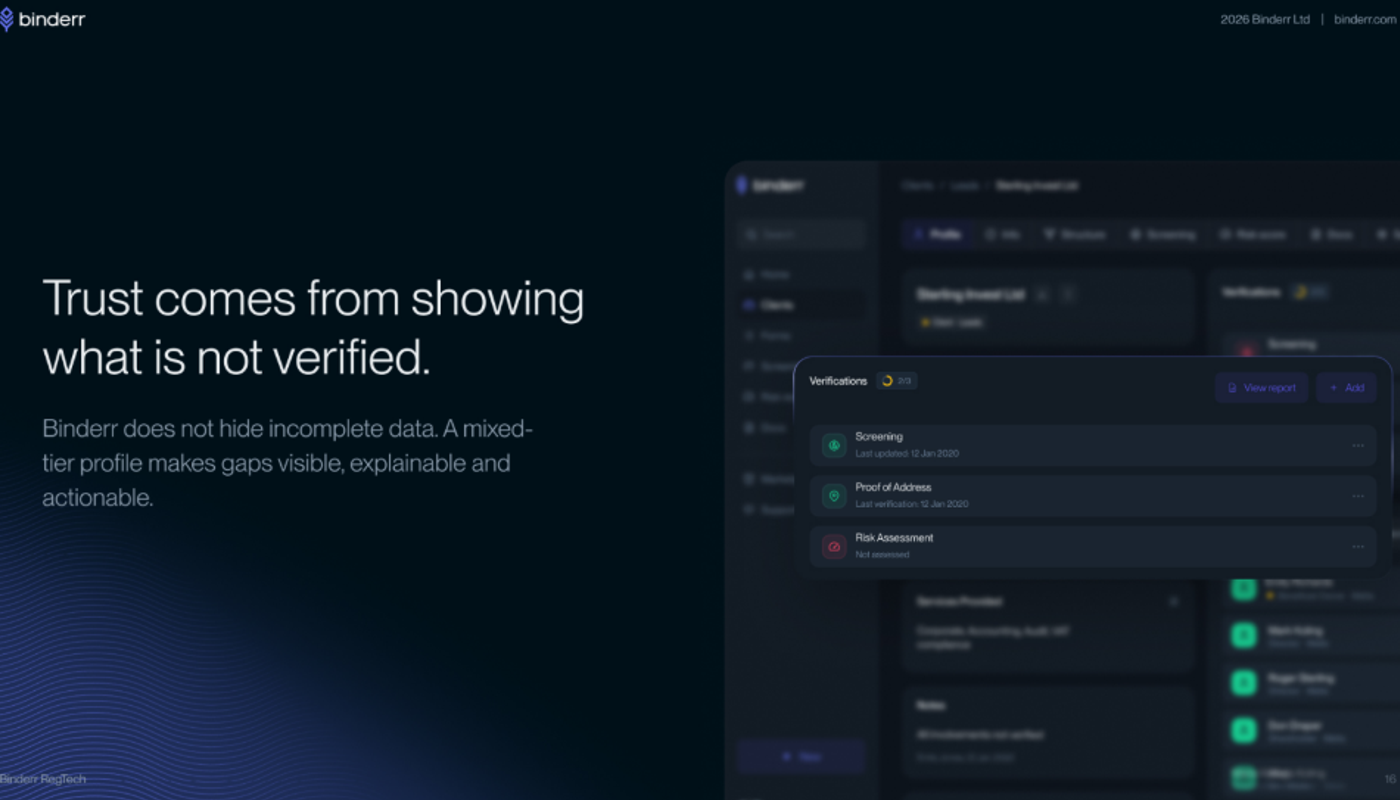
A reliable verification platform should not mark an entire company as verified when important checks remain incomplete. Binderr uses a mixed-status profile that shows which checks have been completed, when they were last reviewed, and where additional action is still required.
Evaluate Data Security and Privacy Controls
Data security and privacy controls are critical when handling sensitive business and personal information. Ensure the verification solution uses encryption, secure data storage, and strict access controls to protect customer data. Compliance with data protection regulations such as GDPR is essential, along with features like data minimization and retention policies. A secure platform builds trust while safeguarding against data breaches and unauthorized access.
Review Customer Support and Implementation Assistance
Consider the level of customer support and implementation assistance offered by the provider. Effective onboarding, technical guidance, and responsive support teams can significantly impact the success of your business verification solution. Look for providers that offer dedicated account management, training resources, and ongoing support to help optimize your KYB processes and ensure smooth integration into your compliance workflows.
Complete Compliance Solution with Binderr
Binderr delivers a full end-to-end compliance platform:
- KYC, KYB, and AML in one unified system
- Dynamic risk assessment and automated scoring
- Streamlined CDD and EDD workflows
- Customisable onboarding forms and e-signatures
- Continuous monitoring and compliance reporting
- Full audit trails for regulatory requirements
Bottom Line
Reliable business identity verification goes beyond confirming a company exists. It combines registry data, ownership, documents, and AML checks to give a clear view of who you’re dealing with and reduce fraud risk. Identity verification for business and company identity verification ensure both entities and individuals are properly validated.
Integrated solutions automate verification, speed up onboarding, and improve compliance while maintaining strong audit trails.
Binderr Compliance helps businesses verify companies, uncover ownership structures, perform business id verification, and monitor compliance risk through one unified platform.