
Financial institutions, fintech companies, crypto platforms, and regulated businesses now face stricter AML compliance requirements as regulators increase scrutiny on customer onboarding, fraud prevention, and financial crime monitoring. AML, KYC, and KYB often work together within the same compliance workflow, but each serves a different role in identity verification, business verification, and ongoing AML monitoring.
According to Nasdaq’s Global Financial Crime Report, an estimated $3.1 trillion in illicit funds moved through the global financial system in 2023. This has increased demand for stronger AML screening, sanctions screening, customer due diligence, and compliance automation across regulated industries.
This article explains what AML, KYC, and KYB mean, their key differences, and how businesses use KYC verification, KYB verification, UBO verification, and AML monitoring within modern onboarding workflows. It also covers compliance automation strategies and AML KYC KYB software solutions for regulated businesses.
Binderr AML & KYC Compliance Solution
Binderr’s AML and KYC compliance solution is designed to help regulated businesses automate customer onboarding, identity verification, AML screening, and ongoing compliance monitoring through one unified platform.
- AI-powered KYC verification with biometric checks and document authentication
- AML screening across sanctions, watchlists, PEPs, and adverse media
- OCR extraction and liveness detection for faster onboarding
- Real-time risk scoring and ongoing AML monitoring
- Automated CDD and EDD compliance workflows
- API-based onboarding infrastructure for regulated businesses
- Centralised compliance reporting and monitoring dashboards
What is AML (Anti-Money Laundering)?
Anti-Money Laundering (AML) refers to the compliance framework businesses use to detect, prevent, and report money laundering, fraud, terrorist financing, and suspicious financial activity. AML compliance is essential for banks, fintech companies, crypto exchanges, EMIs, and payment processors handling customer onboarding or financial transactions.
AML regulations require businesses to perform AML screening, sanctions screening, customer due diligence, transaction monitoring, and suspicious activity reporting to identify high-risk customers and financial crime risks. Regulators such as FATF, FinCEN, FCA, MAS, and the EU AML Directives continue strengthening global AML compliance requirements.
How does the AML Process Work?
The AML process starts when a customer or business begins onboarding with a regulated institution. Businesses collect customer information, identity documents, and company details to perform customer due diligence, KYC verification, KYB verification, and AML screening before approving an account or transaction.
Businesses then run sanctions screening, PEP screening, adverse media screening, and risk assessment checks to identify suspicious activity or financial crime risks. AML compliance teams also monitor transactions and customer behaviour to detect unusual activity and sanctions violations.
Many regulated businesses now use AI-powered AML compliance software, automated monitoring systems, and real-time risk scoring tools to streamline compliance workflows, strengthen fraud prevention, and improve ongoing AML monitoring.
What is KYC (Know Your Customer)?
Know Your Customer (KYC) refers to the identity verification and customer onboarding process businesses use to verify the identity of individual customers before providing financial services or account access. KYC compliance is essential for banks, fintech companies, crypto exchanges, EMIs, payment processors, and other regulated businesses to prevent fraud, financial crime, and identity theft.
KYC verification involves collecting and verifying customer information such as passports, national IDs, proof of address documents, and biometric data. Businesses use identity verification technologies like OCR extraction, biometric verification, facial recognition, and liveness detection to automate onboarding and improve compliance accuracy.
How does the KYC Process Work
The KYC process starts when a customer submits identity documents and onboarding information to a regulated business. Companies verify customer identities using document verification, biometric checks, OCR technology, and liveness detection to confirm the customer is genuine.
Businesses then perform AML screening, sanctions screening, PEP screening, and customer risk assessment checks before approving onboarding. Many organisations now use AI-powered KYC onboarding software and compliance automation tools to reduce onboarding delays, strengthen fraud prevention, and improve customer onboarding experience.
What is KYB (Know Your Business)?
Know Your Business (KYB) refers to the business verification and corporate onboarding process companies use to verify the legitimacy, ownership structure, and compliance status of businesses before starting financial relationships or B2B partnerships. KYB compliance is essential for banks, fintech companies, crypto platforms, EMIs, payment processors, and regulated businesses onboarding corporate clients or merchants.
KYB verification involves checking company registration details, proof of incorporation, tax registration records, director information, and business ownership structures to confirm the company is genuine and compliant. Businesses also conduct UBO verification, shareholder analysis, and ownership mapping to identify the ultimate beneficial owners behind a company.
How does the KYB Process Work
The KYB process starts when a business submits company registration documents, incorporation certificates, shareholder information, and director details during onboarding. Companies then verify registry records, ownership structures, UBO details, and business legitimacy through global business verification checks.
Businesses also perform AML screening, sanctions screening, adverse media screening, and risk assessment checks on companies, directors, and beneficial owners before approving onboarding. Many regulated businesses now use automated KYB onboarding software and compliance workflows to reduce onboarding delays, strengthen fraud prevention, and improve business onboarding compliance.
Binderr Customer Onboarding & Identity Verification Solution
Designed for banks, fintech companies, crypto platforms, EMIs, and payment processors, the platform improves onboarding speed while maintaining strong AML compliance and fraud prevention controls.
- AI-powered document verification across 230+ countries and ID types
- Support for 11,000+ global identity documents
- Biometric face matching and liveness detection to prevent fraud
- Deepfake detection and automated identity risk analysis
- Automated AML screening and sanctions monitoring
- Real-time onboarding decisions and dynamic risk scoring
- Faster customer onboarding with reduced manual compliance workloads
AML vs KYC vs KYB: Key Differences
AML, KYC, and KYB are closely connected compliance processes used by banks, fintech companies, crypto platforms, EMIs, and regulated businesses to strengthen fraud prevention, customer onboarding compliance, and financial crime monitoring. While these terms are often used together, each process focuses on a different part of AML compliance, identity verification, and business verification workflows.
Understanding the difference between AML, KYC, and KYB helps businesses build stronger compliance frameworks, improve onboarding automation, reduce financial crime risks, and maintain regulatory compliance across multiple jurisdictions. The comparison below explains how AML screening, KYC verification, KYB verification, customer due diligence, and ongoing AML monitoring work together within modern compliance operations.
Feature | AML | KYC | KYB |
Primary Purpose | Prevent financial crime | Verify customers | Verify businesses |
Applies To | Individuals & businesses | Individual customers | Corporate entities |
Key Checks | Monitoring & screening | Identity verification | Business verification |
Ongoing Monitoring | Yes | Yes | Yes |
UBO Verification | Sometimes | No | Yes |
Risk Assessment | Core requirement | Part of onboarding | Part of onboarding |
Regulatory Focus | Financial crime prevention | Customer verification | Business transparency |
Binderr KYB & Business Verification Solution
- Global registry access across 200+ countries and 30,000+ data sources
- Retrieve official company registration data, directors, and shareholders
- UBO identification and verification for corporate onboarding
- Ownership structure mapping to visualise complex entity hierarchies
- Integrated AML screening for companies, directors, and beneficial owners
- Detection of hidden ownership structures and suspicious affiliations
- Automated KYB workflows for global business onboarding compliance
Benefits of Automating AML, KYC, and KYB Compliance
Automating AML, KYC, and KYB compliance helps businesses improve onboarding speed, strengthen fraud prevention, and simplify regulatory compliance. Banks, fintech companies, crypto exchanges, and regulated businesses now use compliance automation tools to manage identity verification, AML screening, sanctions screening, and ongoing AML monitoring more efficiently.
Modern AML compliance software and KYC onboarding solutions reduce manual compliance work, improve risk scoring accuracy, and support real-time compliance monitoring. The sections below explain how automated compliance workflows help businesses reduce financial crime risks and improve customer onboarding experience.
Faster Customer & Business Onboarding
Automated AML, KYC, and KYB compliance workflows help businesses accelerate customer onboarding and business verification without compromising regulatory compliance. AI-powered identity verification, biometric authentication, OCR extraction, and automated AML screening reduce onboarding delays and improve verification accuracy for global customers and businesses.
Modern KYC onboarding software and KYB verification tools also simplify document collection, customer due diligence, and onboarding approvals through automated compliance workflows. Faster onboarding improves customer experience, reduces operational bottlenecks, and helps regulated businesses scale onboarding operations more efficiently.
Improved Fraud Prevention
Modern AML compliance software helps businesses identify suspicious activity, reduce identity fraud, and strengthen financial crime prevention through sanctions screening, PEP screening, adverse media monitoring, and transaction monitoring. Automated fraud detection systems can quickly flag unusual behaviour, high-risk customers, or suspicious financial transactions before onboarding risks increase.
AI-powered fraud prevention tools also improve customer trust and reduce financial losses by supporting real-time monitoring, dynamic risk scoring, and ongoing AML monitoring across multiple jurisdictions.
Modern AML compliance software helps businesses investigate screening matches, validate risks, and reduce false positives through automated compliance workflows.
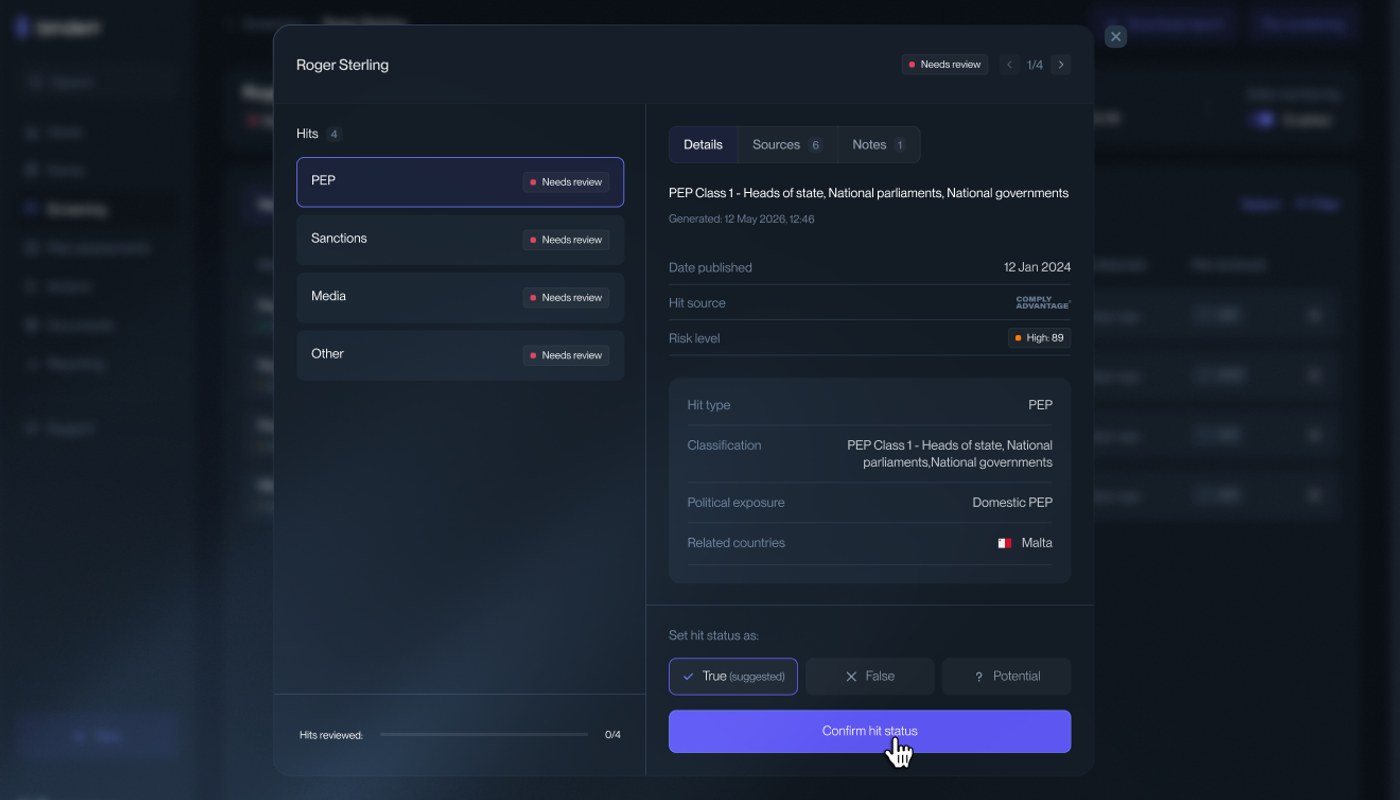
Binderr Compliance helps compliance teams investigate sanctions, PEP, and adverse media matches with automated review and risk assessment tools.
Better Regulatory Compliance
Compliance automation helps businesses maintain AML compliance, customer due diligence, KYB verification, and ongoing AML monitoring requirements more effectively across different regulatory environments. Automated compliance workflows reduce manual errors, improve audit readiness, and support stronger regulatory reporting processes.
Many regulated businesses now use AML compliance software and onboarding automation systems to maintain consistent compliance operations while adapting to changing global AML regulations and financial crime risks.
Reduced Manual Compliance Workloads
AI-powered KYC onboarding software and KYB verification platforms reduce repetitive manual reviews, compliance administration tasks, and document verification processes. Automated identity verification, AML screening, and risk assessment workflows help compliance teams manage onboarding operations more efficiently.
This allows compliance officers to focus on high-risk onboarding cases, Enhanced Due Diligence (EDD), suspicious activity investigations, and complex business verification checks instead of repetitive manual compliance tasks.
Scalable Compliance Operations
Automated compliance systems help banks, fintech companies, crypto exchanges, EMIs, and payment processors scale customer onboarding and business verification processes without increasing operational complexity. API-based onboarding infrastructure and compliance automation tools support faster global expansion and cross-border compliance management.
Scalable AML compliance workflows also help businesses manage higher onboarding volumes, improve verification speed, and maintain consistent customer due diligence processes across multiple jurisdictions.
Real-Time Risk Monitoring & Alerts
Real-time AML monitoring systems continuously track customer activity, transaction behaviour, sanctions list updates, and risk profile changes to identify suspicious activity faster. Automated alerts, dynamic risk scoring, and continuous monitoring tools help businesses respond quickly to financial crime risks and sanctions exposure.
Ongoing AML monitoring also helps regulated businesses maintain stronger compliance operations, reduce fraud risks, and improve financial crime detection throughout the customer lifecycle.
AI-powered AML monitoring systems help compliance teams review sanctions hits, PEP matches, and adverse media risks in real time
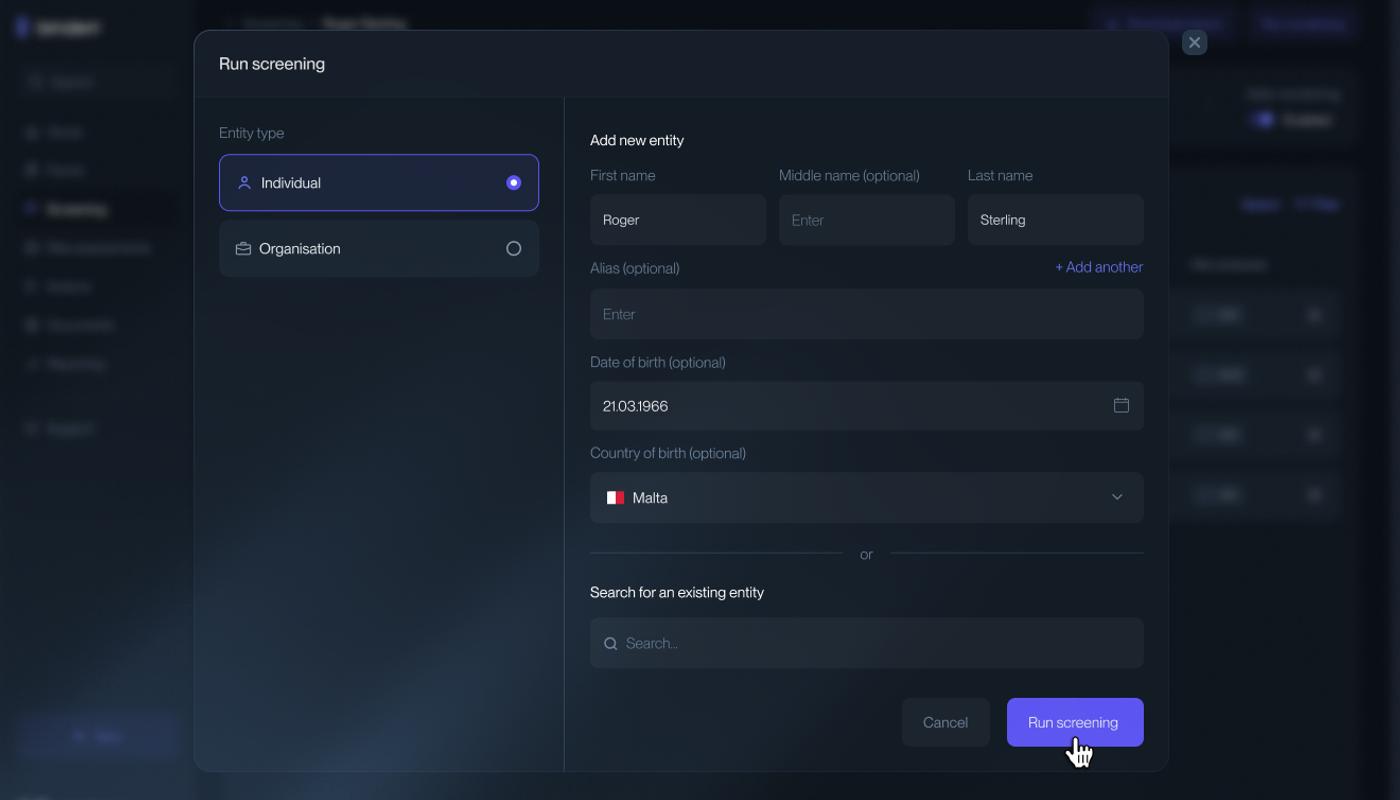
Binderr Compliance provides real-time sanctions screening, PEP monitoring, adverse media analysis, and risk review workflows for regulated businesses.
Industries That Require AML, KYC, and KYB Compliance
Financial institutions, fintech companies, crypto exchanges, and payment providers rely on AML, KYC, and KYB compliance to manage customer onboarding, identity verification, and fraud prevention. Strong AML screening, KYB verification, and ongoing AML monitoring help businesses reduce financial crime risks and maintain regulatory compliance.
Meanwhile, rising cross-border onboarding risks and stricter AML regulations are increasing the need for automated compliance workflows, sanctions screening, and customer due diligence processes. The industries below require robust AML compliance frameworks to strengthen onboarding security and improve financial crime monitoring.
Banks & Financial Institutions - Banks and financial institutions must follow strict AML compliance, KYC verification, and transaction monitoring requirements to prevent money laundering, fraud, and terrorist financing. Ongoing AML monitoring, sanctions screening, and customer due diligence are critical for managing high transaction volumes and cross-border financial activity.
Fintech Companies - Fintech companies rely on automated KYC onboarding software, AML screening, and identity verification tools to onboard customers quickly while maintaining regulatory compliance. AI-powered compliance automation also helps fintech platforms reduce fraud risks and improve the digital onboarding experience.
Crypto Exchanges & Web3 Platforms - Crypto exchanges and Web3 platforms face higher financial crime risks because of anonymous transactions and cross-border digital asset transfers. Strong AML screening, wallet monitoring, KYB verification, and blockchain analytics help crypto businesses strengthen fraud prevention and comply with global AML regulations.
EMIs & Payment Processors - EMIs and payment processors must perform customer due diligence, sanctions screening, transaction monitoring, and ongoing AML monitoring to detect suspicious payment activity and reduce fraud risks. Automated compliance workflows also help payment businesses manage high-volume onboarding operations more efficiently.
Insurance Companies - Insurance providers use AML compliance and KYC verification processes to prevent fraudulent claims, identity fraud, and money laundering risks linked to insurance products and financial payouts. Enhanced Due Diligence (EDD) may also apply to high-risk policyholders or large transactions.
Lending Platforms - Lending platforms rely on identity verification, AML screening, and business verification checks to assess borrower legitimacy and reduce financial crime risks. Automated risk scoring and compliance monitoring also help lenders improve onboarding decisions and fraud prevention.
Wealth Management Firms - Wealth management firms handle high-value transactions and high-net-worth clients, making AML compliance and ongoing monitoring essential. Businesses in this sector often conduct Enhanced Due Diligence (EDD), source of funds checks, and adverse media screening for higher-risk clients.
Forex Brokers - Forex brokers must follow strict AML regulations, customer due diligence requirements, and transaction monitoring obligations to prevent money laundering and suspicious trading activity. Real-time AML monitoring systems help forex platforms detect unusual transactions and sanctions risks faster.
Gambling & Gaming Platforms - Online gambling and gaming platforms face elevated fraud risks because of rapid digital payments and anonymous transactions. Strong KYC verification, AML screening, and ongoing transaction monitoring help businesses prevent financial crime and maintain regulatory compliance.
B2B Marketplaces & SaaS Platforms - B2B marketplaces and SaaS platforms increasingly use KYB verification, business onboarding compliance, and AML screening to verify merchants, vendors, and corporate customers. Automated compliance workflows also help platforms reduce fraud risks and improve onboarding security across global operations.
Binderr End-to-End KYC, KYB & AML Solution
Looking for a complete KYC and KYB solution? Binderr Compliance offers a unified platform for end-to-end onboarding and compliance.
- Unify KYC, KYB, and AML in a single dashboard
- Automate onboarding with workflows, APIs, and integrations
- Perform UBO identification, ownership mapping, and entity screening
- Enable continuous monitoring with alerts and audit trails
- Scale globally with enterprise-grade KYC AML compliance
Bottom Line
AML, KYC, and KYB are now essential parts of modern compliance operations for banks, fintech companies, crypto exchanges, EMIs, payment processors, and regulated businesses. While KYC focuses on identity verification for individuals and KYB focuses on business verification and UBO checks, AML acts as the broader compliance framework used to prevent financial crime, fraud, and suspicious financial activity.
As onboarding volumes and regulatory expectations continue increasing, businesses require scalable AML compliance infrastructure, automated onboarding workflows, and real-time AML monitoring systems to manage risk more effectively. AI-powered compliance automation, dynamic risk scoring, sanctions screening, and transaction monitoring are helping businesses improve onboarding speed while maintaining strong regulatory compliance.
Modern AML compliance software and onboarding automation platforms are becoming critical for businesses handling cross-border onboarding, digital payments, and high-risk customer verification. Solutions like Binderr Compliance help businesses automate AML screening, KYC verification, KYB checks, ongoing AML monitoring, and compliance workflows through one centralised onboarding and compliance platform.