
Banks, EMIs, fintech companies, and payment institutions are facing stronger AML compliance pressure in 2026 as regulators tighten onboarding standards, transaction monitoring requirements, and financial crime reporting obligations.
Cross-border payments, digital banking adoption, and real-time financial services continue to increase compliance risks, forcing regulated businesses to invest in scalable AML software, KYC and KYB verification tools, and automated compliance workflows.
According to the United Nations Office on Drugs and Crime, between 2% and 5% of global GDP is linked to money laundering annually, representing up to $2 trillion in financial crime activity worldwide. Financial institutions now require advanced AML compliance software that can support sanctions screening, adverse media analysis, suspicious activity monitoring, customer risk scoring, and ongoing AML monitoring across multiple jurisdictions.
This guide compares the best AML software providers for banks and EMIs in 2026 based on compliance capabilities, automation features, onboarding efficiency, scalability, and global screening coverage.
Binderr AML Compliance Software for Banks and EMIs
- Compare KYC, KYB, AML screening, and transaction monitoring capabilities
- Evaluate onboarding automation and fraud prevention tools
- Review global sanctions screening and adverse media coverage
- Assess scalability, workflow automation, and API flexibility
- Improve compliance efficiency while reducing operational workload
What is AML Software?
AML software helps banks, EMIs, fintech companies, and regulated financial institutions detect suspicious activity, prevent financial crime, and comply with anti-money laundering regulations. Modern AML compliance software automates KYC and KYB verification, sanctions screening, transaction monitoring, customer risk scoring, adverse media checks, and ongoing AML monitoring.
Banks and EMIs use AML software to streamline customer onboarding, monitor transactions, identify high-risk customers, and strengthen compliance operations. Advanced AML screening software also supports PEP screening, suspicious activity detection, fraud prevention, compliance reporting, and real-time monitoring across multiple jurisdictions.
Modern AML software providers now combine AI-powered AML screening, onboarding automation, UBO verification, Enhanced Due Diligence workflows, and API integrations into one centralized compliance platform. As financial crime risks and digital payments continue to grow in 2026, scalable AML monitoring software is becoming essential for banks, EMIs, payment providers, crypto businesses, and fintech companies.
Access Free Binderr Screening Tool
Quick Comparison: Best AML Software for Banks and EMIs
Financial institutions now require AML compliance software that can support faster onboarding, sanctions screening, transaction monitoring, and ongoing AML compliance across multiple jurisdictions. Choosing the right AML software provider helps banks and EMIs improve compliance efficiency, reduce onboarding risks, and strengthen financial crime prevention.
Unlike traditional compliance tools, modern AML software for banks and EMIs combines AI-powered AML screening, KYC and KYB verification, adverse media monitoring, onboarding automation, and real-time risk detection into one centralized platform. Below is a quick comparison of the top AML software providers in 2026 based on features, automation, scalability, and global screening coverage.
Feature | Binderr | ComplyAdvantage | Sumsub | Ondato | Trulioo |
Sanctions Screening | ✅ | ✅ | ✅ | ✅ | ✅ |
PEP Screening | ✅ | ✅ | ✅ | ✅ | ✅ |
Watchlist Screening | ✅ | ✅ | ✅ | ✅ | ✅ |
Adverse Media Screening | ✅ | ✅ | ❌ | ❌ | ❌ |
Extended Entity Screening | ✅ | ❌ | ❌ | ❌ | ❌ |
Ongoing Monitoring | ✅ | ✅ | ❌ | ❌ | ❌ |
Real-Time Alerts | ✅ | ✅ | ❌ | ❌ | ❌ |
Get Free AML Insights Instantly with Binderr
Key Features to Look for in AML Software
Modern AML software for banks and EMIs must support fast onboarding, real-time risk detection, and scalable compliance automation across multiple jurisdictions.
From KYC and KYB verification to transaction monitoring and sanctions screening, the right AML compliance software helps financial institutions reduce compliance risks, improve operational efficiency, and strengthen financial crime prevention workflows.
KYC and KYB Verification
Strong KYC and KYB verification tools help banks, EMIs, fintech companies, and payment providers streamline customer onboarding while maintaining regulatory compliance. Modern AML software supports identity verification, business verification, OCR document extraction, biometric authentication, proof of address checks, and automated onboarding workflows to reduce manual compliance reviews.
Advanced KYC and KYB software also helps compliance teams verify UBOs, validate company information, screen high-risk customers, and improve onboarding efficiency across multiple jurisdictions. AI-powered onboarding automation allows financial institutions to process customers faster while strengthening fraud prevention and AML compliance operations.
Sanctions and PEP Screening
Sanctions and PEP screening software help financial institutions identify high-risk individuals, politically exposed persons, sanctioned entities, and restricted businesses before onboarding approval. Modern AML screening software checks customers against global sanctions databases, watchlists, law enforcement lists, and regulatory blacklists in real time.
AI-powered AML compliance software also helps reduce false positives through smart matching algorithms, contextual screening, and automated risk scoring. This improves compliance efficiency, reduces manual investigations, and strengthens anti-money laundering controls for banks, EMIs, fintechs, and regulated businesses.
Binderr allows banks, EMIs, fintech companies, and regulated businesses to run AML screening on individuals and organizations through one centralized onboarding workflow. Compliance teams can automate sanctions screening, PEP checks, and customer risk assessments before onboarding approval.
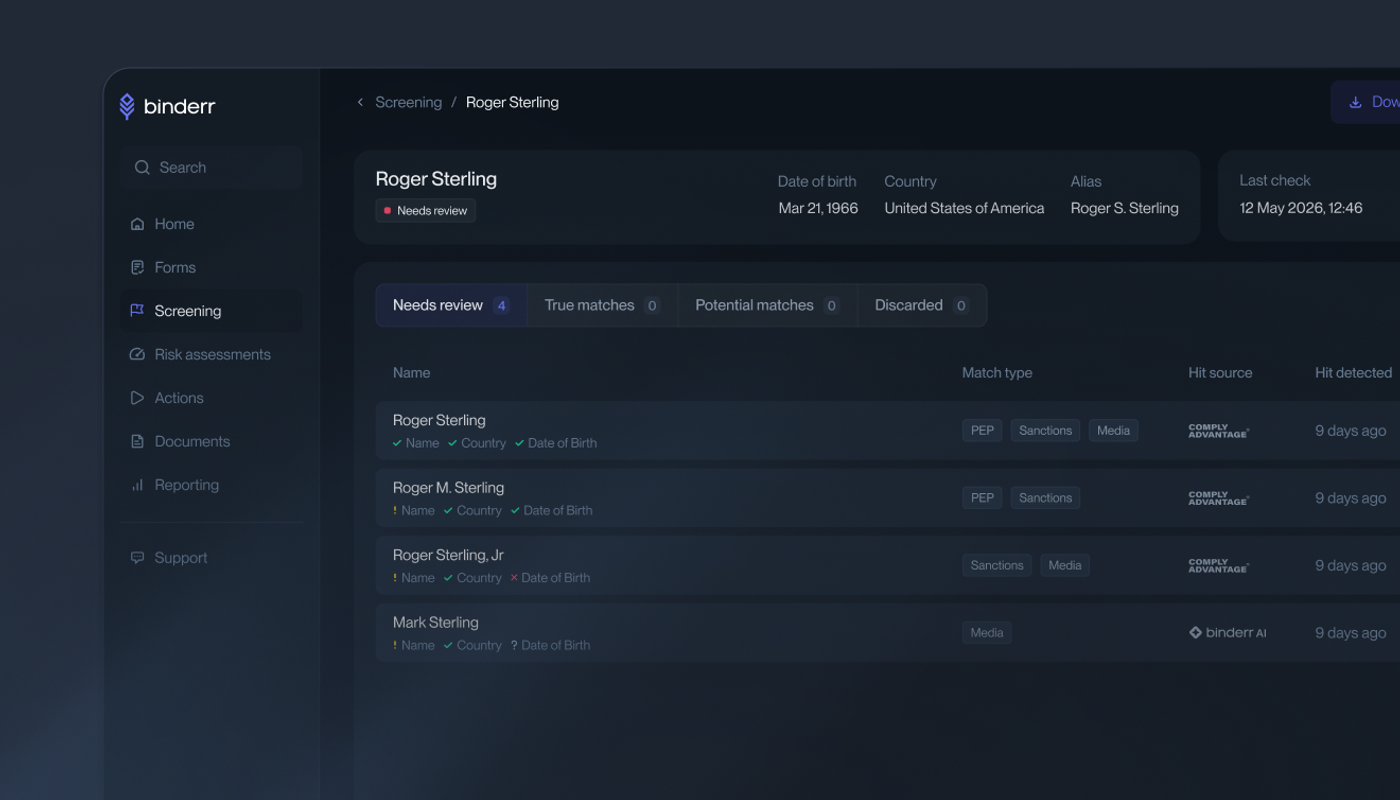
The platform supports streamlined AML onboarding workflows with automated screening, customer data collection, and real-time compliance checks across multiple jurisdictions.
Adverse Media Screening
Adverse media screening software helps compliance teams detect potential financial crime risks by scanning global news sources, regulatory publications, enforcement records, and online media coverage. AI-powered adverse media analysis can identify fraud risks, corruption concerns, money laundering exposure, and reputational threats linked to individuals, businesses, and UBOs.
Modern AML compliance platforms use automated adverse media screening and ongoing monitoring to provide real-time alerts and continuous risk detection. This helps banks and EMIs improve Enhanced Due Diligence workflows, strengthen customer risk profiling, and maintain stronger regulatory compliance standards.
Transaction Monitoring
Transaction monitoring software continuously analyzes customer payments, account activity, transaction behavior, and financial patterns to detect suspicious activity and potential money laundering risks. Advanced AML monitoring systems use AI-powered behavioral analysis, anomaly detection, and automated risk scoring to identify unusual transactions in real time.
Banks, EMIs, payment institutions, and fintech companies rely on transaction monitoring software to strengthen fraud prevention, improve suspicious activity reporting, and automate compliance investigations. Real-time monitoring alerts and ongoing AML monitoring also help compliance teams respond to high-risk activities faster while reducing operational compliance burdens.
Ongoing AML Monitoring
Ongoing AML monitoring helps banks, EMIs, fintech companies, and payment providers continuously track customer risk profiles, transaction behavior, sanctions exposure, and suspicious activity after onboarding. Modern AML monitoring software provides real-time compliance alerts, automated screening updates, and continuous monitoring across sanctions lists, PEP databases, watchlists, and adverse media sources.
AI-powered ongoing AML monitoring also helps compliance teams detect risk changes faster, identify suspicious transactions in real time, and improve regulatory reporting workflows. Continuous AML monitoring reduces manual compliance work, strengthens fraud prevention, and helps regulated businesses maintain stronger anti-money laundering controls across multiple jurisdictions.
Modern AML compliance software must help compliance teams review sanctions matches, PEP alerts, adverse media risks, and suspicious activity efficiently. Binderr centralizes AML investigations and ongoing monitoring into one real-time compliance dashboard.
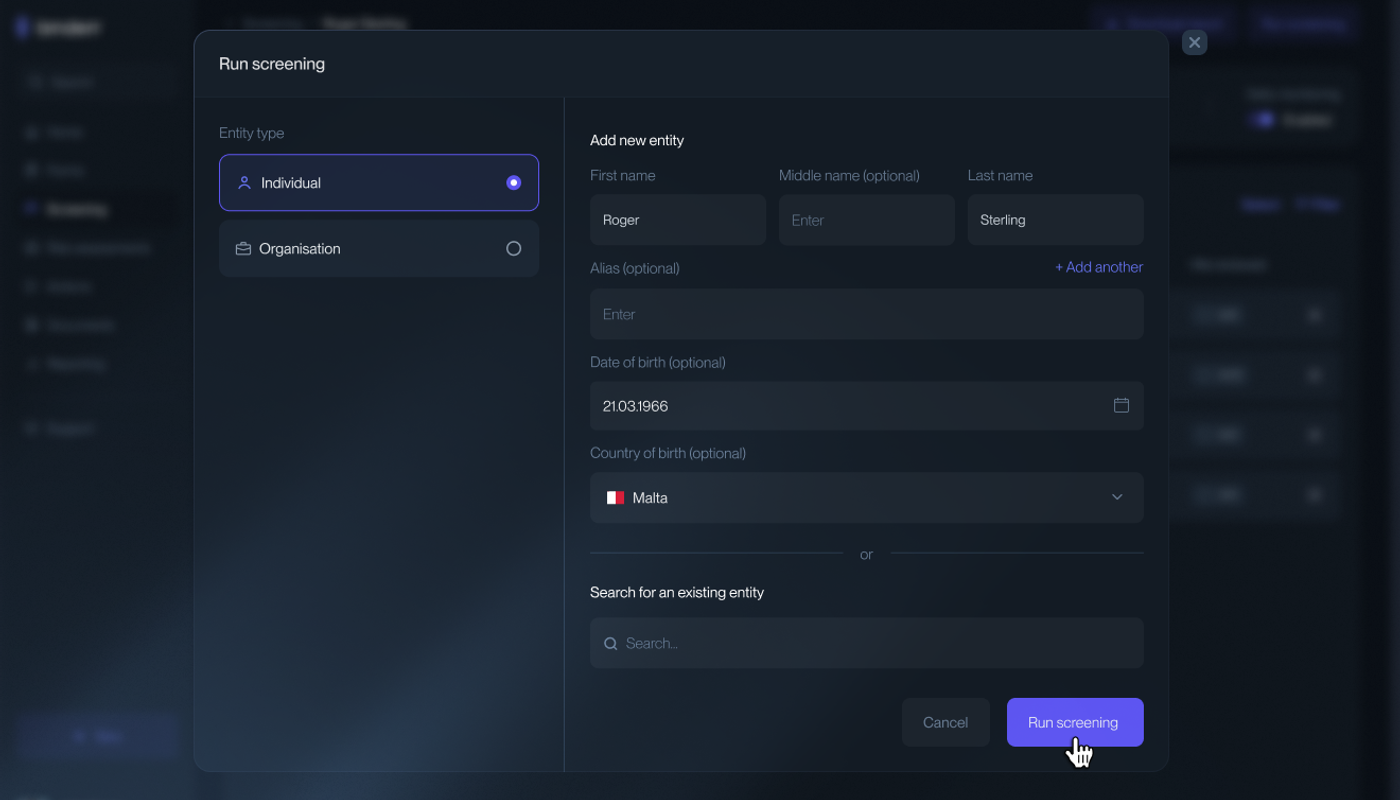
Compliance analysts can review matches, validate risks, manage false positives, and maintain audit-ready AML investigations through one centralized monitoring workflow.
Risk Scoring and EDD Automation
Risk scoring and Enhanced Due Diligence automation help financial institutions categorize customers based on transaction activity, geographic exposure, onboarding risk, industry type, and financial behavior. Modern AML compliance software uses dynamic risk scoring models and AI-powered behavioral analysis to identify high-risk customers and trigger automated EDD workflows.
Advanced AML software for banks and EMIs also helps compliance teams automate customer risk assessments, collect additional compliance documents, monitor high-risk accounts, and improve decision-making accuracy. Automated EDD workflows reduce onboarding delays, improve compliance efficiency, and strengthen financial crime prevention operations.
API and Workflow Integrations
Modern AML software platforms must support flexible API integrations with banking systems, CRMs, fintech infrastructure, payment gateways, onboarding tools, and internal compliance systems. API-driven AML compliance software allows financial institutions to automate onboarding workflows, centralize customer data, and streamline compliance operations across multiple business systems.
Scalable AML software for banks and EMIs also supports workflow automation, real-time screening triggers, document management integrations, and customizable onboarding journeys. Strong integration capabilities help compliance teams reduce operational silos, improve customer onboarding efficiency, and build scalable compliance infrastructure for global operations.
Simplify AML Onboarding with Binderr
- Automated KYC and KYB onboarding workflows
- AI-powered identity verification and biometric checks
- Sanctions, watchlist, and PEP screening during onboarding
- Dynamic risk scoring and automated CDD and EDD workflows
- OCR document extraction and centralized document management
- Branching onboarding forms and customizable workflows
- e-Signatures and compliance reporting tools
- Continuous AML monitoring after onboarding
5 Best AML Software Providers for Banks and EMIs in 2026
Different AML software providers support different compliance and onboarding requirements based on transaction volume, regulatory exposure, customer risk profiles, and global operational reach.
Banks, EMIs, fintech companies, and payment providers often require scalable AML compliance software that can automate KYC and KYB verification, sanctions screening, transaction monitoring, adverse media checks, and ongoing AML monitoring.
Below are some of the best AML software providers in 2026 based on compliance features, onboarding efficiency, financial crime detection, scalability, and workflow automation capabilities.
Binderr
Binderr is a modern AML compliance platform built for banks, EMIs, fintech companies, payment providers, crypto businesses, and regulated financial institutions that require scalable onboarding and compliance automation. The platform combines KYC verification, KYB verification, AML screening, sanctions and PEP checks, transaction monitoring, adverse media screening, and ongoing AML monitoring into one centralized compliance infrastructure.
Unlike traditional AML software providers that focus on only one compliance area, Binderr offers end-to-end onboarding and compliance workflows designed to simplify customer due diligence, improve onboarding speed, reduce manual compliance reviews, and strengthen financial crime prevention. Its AI-powered compliance tools help regulated businesses automate onboarding, monitor customer risks in real time, and maintain stronger regulatory compliance across multiple jurisdictions.
Key Features:
- AI-Powered AML Screening: Advanced AML screening software helps financial institutions screen individuals, businesses, directors, and UBOs against global sanctions lists, watchlists, PEP databases, and adverse media sources in real time.
- KYC and KYB Verification: Automated KYC and KYB workflows support identity verification, business verification, OCR document extraction, biometric face matching, proof of address checks, and onboarding automation.
- Sanctions, PEP, and Watchlist Screening: Real-time sanctions screening and PEP checks help banks and EMIs identify high-risk customers, sanctioned entities, and restricted businesses before onboarding approval.
- Adverse Media Analysis: AI-powered adverse media screening scans global news sources and regulatory databases to identify financial crime risks, fraud exposure, reputational concerns, and suspicious activities.
- UBO Identification and Ownership Mapping: Binderr helps compliance teams identify Ultimate Beneficial Owners, map ownership structures, and screen complex corporate entities for AML and KYB compliance.
- Ongoing AML Monitoring: Continuous AML monitoring provides real-time alerts, automated screening updates, and ongoing customer risk tracking across sanctions, watchlists, and adverse media databases.
- Customizable Compliance Workflows: Flexible onboarding workflows, branching onboarding forms, document management, e-signatures, and workflow automation help businesses streamline customer onboarding and compliance operations.
- API Integrations and Automation: API-driven integrations connect Binderr with banking systems, CRMs, fintech infrastructure, onboarding tools, and internal compliance platforms for scalable compliance automation.
Best For: Binderr is best suited for banks, EMIs, fintech companies, payment processors, crypto businesses, and regulated financial institutions that require end-to-end AML compliance software and scalable onboarding automation.
It is especially useful for businesses handling cross-border payments, high-risk customer onboarding, global sanctions screening, and complex compliance workflows across multiple jurisdictions.
ComplyAdvantage
ComplyAdvantage is a widely used AML compliance software platform designed for banks, EMIs, fintech companies, payment providers, and regulated financial institutions that require advanced financial crime detection and real-time AML monitoring. The platform focuses heavily on AI-powered risk detection, sanctions screening, transaction monitoring, and financial crime intelligence to help businesses strengthen anti-money laundering compliance operations.
The platform is known for its large financial crime database, real-time monitoring capabilities, and machine learning-driven screening systems that help compliance teams identify suspicious activity faster while reducing manual investigations. ComplyAdvantage also helps financial institutions automate customer risk assessments, monitor payment activity, and improve onboarding compliance across multiple jurisdictions.
Key Features:
- AI-Powered Risk Detection: ComplyAdvantage uses machine learning and behavioral analytics to identify suspicious transactions, high-risk customers, and unusual financial activity in real time.
- Sanctions and PEP Screening: The platform screens individuals and businesses against global sanctions lists, watchlists, PEP databases, and enforcement records to support AML compliance and customer due diligence.
- Transaction Monitoring Software: Advanced transaction monitoring tools help banks and EMIs detect suspicious payment behavior, money laundering risks, fraud patterns, and abnormal transaction activity.
- Financial Crime Intelligence Database: ComplyAdvantage maintains a large financial crime intelligence database that continuously updates sanctions, adverse media, and risk information across multiple jurisdictions.
- Adverse Media Screening: AI-powered adverse media monitoring scans global news sources and regulatory publications to identify reputational risks, fraud concerns, and potential financial crime exposure.
- Ongoing AML Monitoring: Continuous monitoring and automated alerts help compliance teams track customer risk changes, sanctions exposure, and suspicious activities after onboarding.
- API Integrations and Automation: Flexible API integrations allow businesses to connect ComplyAdvantage with banking systems, fintech platforms, onboarding workflows, and internal compliance infrastructure.
Best For: ComplyAdvantage is best suited for banks, EMIs, fintech companies, payment institutions, and regulated businesses that require AI-powered AML screening and large-scale transaction monitoring.
It is especially useful for businesses handling high transaction volumes, cross-border payments, digital banking operations, and complex financial crime monitoring workflows.
Sumsub
Sumsub is a global AML compliance and identity verification platform designed for banks, EMIs, fintech companies, crypto businesses, payment providers, and regulated financial institutions that require fast onboarding and scalable compliance automation. The platform focuses heavily on identity verification, AML onboarding, fraud prevention, sanctions screening, and global document verification to help businesses strengthen customer due diligence and reduce onboarding risks.
The platform is widely recognized for its extensive global document coverage, automated onboarding workflows, and fraud prevention capabilities. Sumsub helps financial institutions streamline KYC and AML compliance operations while improving onboarding speed, reducing manual verification work, and supporting compliance across multiple jurisdictions.
Key Features:
- Identity Verification and KYC Automation: Sumsub supports automated identity verification with OCR document extraction, biometric face matching, liveness detection, and AI-powered onboarding workflows for faster customer verification.
- Global Document Coverage: The platform supports identity document verification across multiple countries and document types, helping banks and EMIs onboard international customers more efficiently.
- AML Screening and Onboarding: Integrated AML screening tools help businesses perform sanctions checks, PEP screening, watchlist monitoring, and customer risk assessments during onboarding.
- Fraud Prevention Tools: AI-powered fraud prevention systems help detect suspicious onboarding behavior, identity fraud, account takeover risks, and fake document submissions in real time.
- Biometric Verification and Liveness Detection: Advanced biometric verification tools support face matching and liveness detection to reduce identity fraud and strengthen onboarding security.
- Transaction Monitoring Support: Sumsub also supports transaction monitoring workflows to help financial institutions detect suspicious activities and improve ongoing AML compliance.
- Workflow Automation and API Integrations: API-driven integrations allow businesses to connect Sumsub with fintech infrastructure, payment systems, CRMs, and onboarding workflows for scalable compliance automation.
Best For: Sumsub is best suited for banks, EMIs, fintech companies, crypto businesses, and payment providers that require fast identity verification and scalable AML onboarding workflows.
It is especially useful for businesses onboarding international customers, handling high onboarding volumes, and managing global KYC and AML compliance operations.
Trulioo
Trulioo is a global identity verification and AML compliance platform designed for banks, EMIs, fintech companies, payment providers, crypto businesses, and regulated financial institutions that require scalable onboarding and global customer verification. The platform focuses on identity verification, fraud prevention, behavioral monitoring, AML screening, and risk profiling to help businesses strengthen compliance operations and reduce onboarding risks.
The platform is widely known for its extensive global data coverage, automated verification infrastructure, and fraud intelligence capabilities. Trulioo helps financial institutions verify customers across multiple jurisdictions, automate onboarding workflows, and improve customer due diligence while reducing manual verification work and onboarding delays.
Key Features:
- Global Identity Verification: Trulioo supports identity verification across multiple countries and data sources, helping banks and EMIs onboard international customers faster while maintaining regulatory compliance.
- Fraud Prevention Tools: AI-powered fraud prevention systems help businesses detect identity fraud, synthetic identities, suspicious onboarding behavior, and account takeover risks in real time.
- Behavioral Monitoring and Risk Profiling: Advanced behavioral monitoring tools analyze customer activity, onboarding behavior, and transaction patterns to identify unusual activities and high-risk customer profiles.
- AML Screening and Compliance Checks: Integrated AML screening software supports sanctions screening, PEP checks, watchlist monitoring, and customer risk assessments during onboarding.
- Global Data Coverage: Trulioo provides access to multiple identity and business verification data sources across various jurisdictions, helping financial institutions improve onboarding coverage and compliance efficiency.
- Automated Onboarding Workflows: Automated onboarding and verification workflows help businesses reduce manual reviews, improve onboarding speed, and streamline customer due diligence processes.
- API Integrations and Scalability: Flexible API integrations allow businesses to connect Trulioo with banking platforms, fintech systems, CRMs, payment infrastructure, and internal compliance tools.
Best For: Trulioo is best suited for banks, EMIs, fintech companies, payment providers, and regulated businesses that require global identity verification and scalable onboarding automation.
It is especially useful for businesses onboarding international customers, managing cross-border compliance operations, and handling large customer verification volumes.
Ondato
Ondato is a European-focused AML compliance and identity verification platform designed for banks, EMIs, fintech companies, payment providers, and regulated businesses that require automated onboarding and strong regulatory compliance workflows. The platform combines KYC verification, KYB compliance, AML screening, sanctions checks, onboarding automation, and identity verification tools to help businesses streamline customer due diligence and strengthen anti-money laundering controls.
The platform is particularly popular among financial institutions operating across European markets because of its strong compliance infrastructure, onboarding automation capabilities, and regulatory workflow support. Ondato helps businesses improve customer onboarding efficiency, reduce manual compliance reviews, and maintain stronger AML compliance across multiple jurisdictions.
Key Features:
- KYC and KYB Compliance Workflows: Ondato supports automated KYC and KYB verification workflows, including identity verification, business verification, document collection, and customer due diligence processes.
- AML Screening and Risk Detection: Integrated AML screening software helps businesses perform sanctions screening, PEP checks, watchlist monitoring, and customer risk assessments during onboarding.
- Identity Verification and Biometric Checks: The platform offers biometric verification, face matching, liveness detection, and OCR document extraction to strengthen onboarding security and reduce identity fraud risks.
- Onboarding Automation: Automated onboarding workflows help banks and EMIs streamline customer verification, reduce manual reviews, and improve onboarding speed for regulated financial services.
- European Compliance Workflows: Ondato is designed to support European AML compliance requirements and customer due diligence standards across regulated financial sectors.
- Ongoing Compliance Monitoring: Continuous AML monitoring and automated screening updates help compliance teams track customer risk profiles and regulatory changes after onboarding.
- API Integrations and Scalability: Flexible API integrations allow businesses to connect Ondato with banking systems, fintech infrastructure, payment platforms, and internal compliance tools.
Best For: Ondato is best suited for banks, EMIs, fintech companies, and payment providers that require automated KYC and KYB compliance workflows with strong European regulatory coverage.
It is especially useful for businesses onboarding customers across European markets, managing regulatory compliance obligations, and improving onboarding efficiency.
How to Pick the Best AML Software for a Bank or EMI
Choosing the right AML software for banks and EMIs is important for improving onboarding efficiency, reducing compliance risks, and strengthening financial crime prevention across global operations.
Modern AML compliance software should support KYC and KYB verification, sanctions screening, transaction monitoring, ongoing AML monitoring, onboarding automation, and scalable compliance workflows that align with your regulatory and operational requirements.
Evaluate Regulatory Requirements
Before choosing AML software for banks or EMIs, start by mapping your regulatory obligations across every jurisdiction where your business operates. A strong AML compliance software platform should support customer due diligence, Enhanced Due Diligence, sanctions screening, suspicious activity monitoring, and regulatory reporting requirements based on your local and international AML framework.
- Review your licensing obligations: Banks, EMIs, fintech companies, payment providers, and crypto businesses often face different AML compliance requirements depending on their regulator, license type, and transaction model.
- Check CDD and EDD support: The AML software should help compliance teams automate customer due diligence, collect risk-based documents, and trigger Enhanced Due Diligence for high-risk customers.
- Assess reporting workflows: Strong AML compliance platforms should support audit trails, case management, suspicious activity reporting, and internal compliance documentation.
- Match the software to your risk profile: Businesses handling cross-border payments, high-risk industries, or complex UBO structures need stronger AML screening, KYB verification, and ongoing monitoring tools.
The right AML software should make regulatory compliance easier to manage, not harder to operate. Choose a platform that fits your AML obligations, customer risk exposure, and long-term compliance strategy.
Check Global Screening Coverage
Global screening coverage is one of the most important factors when comparing AML software providers for banks and EMIs. Financial institutions should choose AML screening software that checks customers, businesses, directors, shareholders, and UBOs against sanctions lists, PEP databases, watchlists, adverse media sources, and regulatory enforcement data.
- Sanctions screening coverage: The platform should screen against major global sanctions lists, including OFAC, UN, EU, HMT, and other jurisdiction-specific databases.
- PEP and watchlist checks: AML software should identify politically exposed persons, high-risk individuals, restricted entities, and law enforcement matches during onboarding and ongoing monitoring.
- Adverse media screening: AI-powered adverse media analysis helps detect fraud exposure, corruption links, money laundering risks, and reputational red flags from global media sources.
- Multi-jurisdiction support: Banks and EMIs operating internationally need AML compliance software that supports screening across multiple regions, languages, entity types, and risk categories.
Strong global screening coverage helps financial institutions reduce onboarding risk and identify financial crime exposure earlier. It also improves AML compliance accuracy across cross-border payments and international customer onboarding.
Binderr provides compliance teams with a centralized AML monitoring dashboard to review sanctions matches, adverse media alerts, PEP screening results, and customer risk exposure in real time.
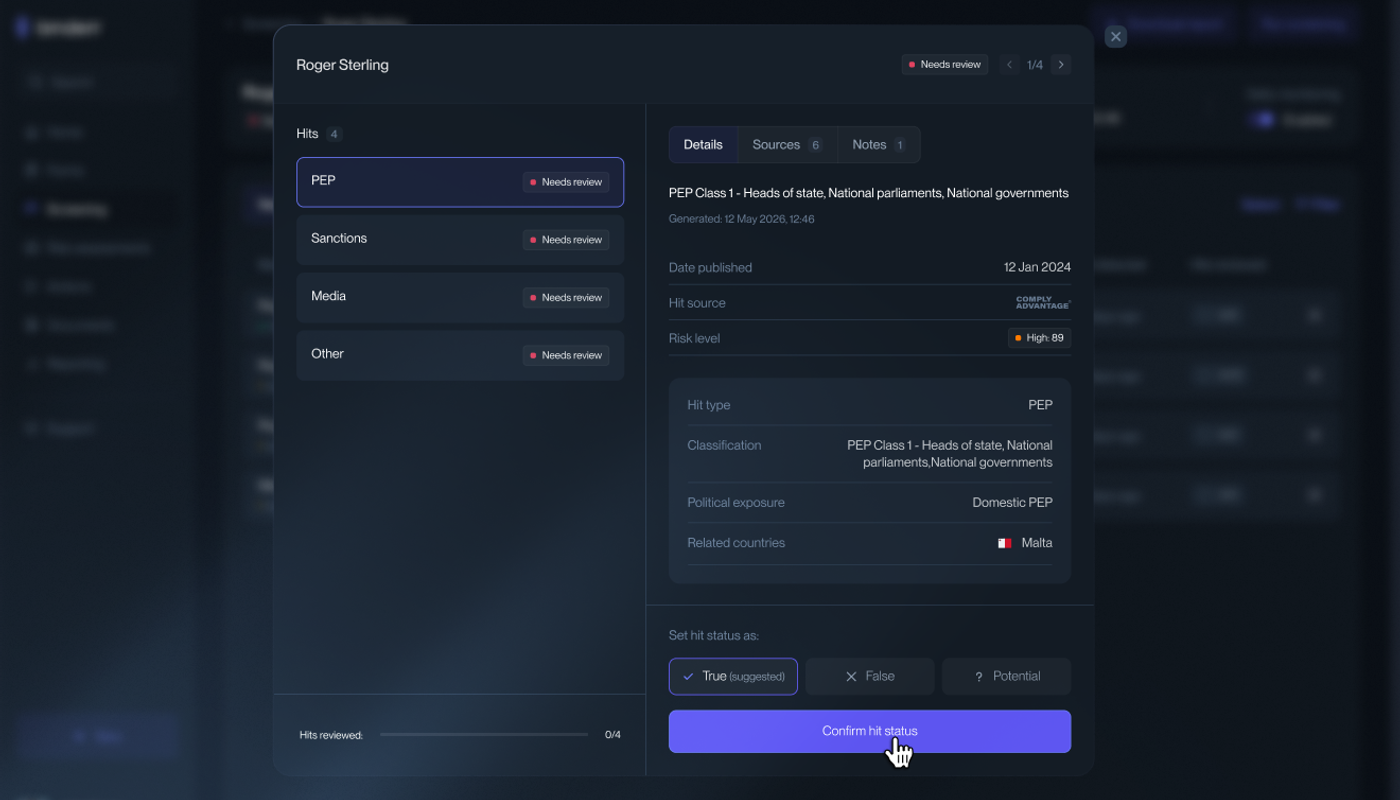
Real-time monitoring workflows help banks and EMIs investigate suspicious activity faster, reduce compliance friction, and maintain stronger anti-money laundering controls across onboarding and ongoing monitoring operations.
Prioritize Automation and AI
Modern AML compliance software should reduce manual work and help compliance teams make faster, risk-based decisions. AI-powered AML software can automate screening, improve false-positive reduction, detect suspicious activity, and streamline onboarding workflows for banks, EMIs, fintech companies, and payment providers.
- Automated onboarding workflows: The platform should automate KYC verification, KYB checks, document collection, risk scoring, and approval flows.
- AI-powered screening: Smart matching algorithms help reduce false positives, identify hidden risks, and improve AML screening accuracy.
- Automated risk scoring: Dynamic customer risk scoring helps compliance teams categorize low-risk, medium-risk, and high-risk customers based on real-time data.
- Faster compliance reviews: AI-driven alerts, case management, and workflow automation help teams investigate suspicious activity without slowing down customer onboarding.
Automation helps banks and EMIs improve compliance efficiency while keeping AML controls strong. The best AML software should support faster onboarding, fewer manual reviews, and smarter financial crime detection.
Assess Scalability
Scalability matters because AML software must support your business as onboarding volumes, transaction activity, and regulatory exposure grow. Banks, EMIs, fintechs, and payment institutions should choose AML compliance software that can handle more customers, more transactions, more jurisdictions, and more complex compliance workflows over time.
- Support high onboarding volumes: The platform should process large numbers of individual and business customers without creating compliance bottlenecks.
- Handle transaction growth: AML transaction monitoring software should scale with higher payment volumes, cross-border transfers, and real-time financial activity.
- Support international expansion: Businesses entering new markets need AML screening, KYB verification, and ongoing monitoring tools that work across multiple jurisdictions.
- Manage complex entity structures: Scalable AML software should support UBO identification, ownership mapping, and risk screening for layered corporate structures.
A scalable AML compliance platform helps financial institutions grow without weakening compliance controls. Choose software that can support today’s onboarding needs and tomorrow’s international expansion.
Compare Integration Capabilities
AML software should connect easily with your existing banking systems, onboarding tools, CRM platforms, payment infrastructure, and compliance workflows. Strong API integrations help banks and EMIs centralize customer data, automate risk checks, and reduce fragmented compliance operations.
- API-first infrastructure: The AML software should offer flexible APIs for KYC, KYB, sanctions screening, transaction monitoring, and ongoing AML monitoring.
- Banking system compatibility: The platform should integrate with core banking systems, payment gateways, fintech stacks, and internal compliance dashboards.
- Workflow automation: Good AML compliance software should trigger checks automatically during onboarding, customer updates, risk reviews, and transaction monitoring events.
- Centralized data management: Integrations should help compliance teams avoid duplicate work, reduce manual uploads, and maintain cleaner audit trails.
Strong integration capabilities make AML compliance easier to operate at scale. The best AML software should fit into your existing systems while improving onboarding speed, monitoring accuracy, and compliance visibility.
AI-Powered AML Screening and Monitoring
- AI-powered adverse media screening across global sources
- Smart matching algorithms to reduce false positives
- Real-time sanctions, watchlist, and PEP screening
- Continuous AML monitoring with instant risk alerts
- Dynamic risk scoring for CDD and EDD workflows
- Screening support for individuals, businesses, and complex entities
- Ongoing monitoring for customer risk changes and suspicious activities
- Automated compliance workflows and centralized investigations
Bottom Line
AML software is now essential for banks, EMIs, fintech companies, and payment providers managing growing regulatory pressure, financial crime risks, and cross-border onboarding challenges in 2026. Modern AML compliance software helps businesses automate KYC and KYB verification, sanctions screening, transaction monitoring, adverse media checks, and ongoing AML monitoring through one centralized compliance platform.
The best AML software for banks and EMIs should support scalable onboarding, AI-powered AML screening, real-time monitoring, fraud prevention, and flexible compliance automation. Platforms like Binderr help financial institutions streamline onboarding workflows, strengthen AML compliance, reduce false positives, and improve operational efficiency across global compliance operations.