
The cryptocurrency industry continues to face increasing regulatory scrutiny worldwide. Crypto exchanges, Web3 platforms, DeFi projects, NFT marketplaces, and other digital asset businesses must implement robust AML compliance programs to prevent money laundering, sanctions violations, fraud, and illicit transactions. Regulators increasingly expect crypto businesses to adopt the same compliance standards as traditional financial institutions.
Modern AML software for crypto exchanges combines KYC verification, sanctions screening, blockchain analytics, wallet monitoring, transaction monitoring, risk scoring, Travel Rule compliance, and ongoing monitoring into a unified compliance framework. These tools help crypto businesses identify suspicious activity, assess customer risk, and comply with evolving global regulations.
This guide compares the best AML software for crypto exchanges and Web3 platforms in 2026, including key features, strengths, ideal use cases, pricing considerations, and compliance capabilities.
Binderr Crypto AML Software
With Binderr Compliance, crypto businesses can automate KYC, KYB, AML screening, sanctions monitoring, adverse media checks, risk scoring, and ongoing compliance monitoring from a single platform.
- AI-powered KYC and identity verification
- Crypto-friendly AML screening workflows
- Sanctions, PEP, and adverse media checks
- Continuous monitoring and alerts
- Risk-based customer onboarding
- KYB verification for institutional clients
- Global compliance coverage
Why AML Software is Essential for Crypto Exchanges & Web3 Platforms
As crypto regulations become stricter, crypto exchanges, Web3 platforms, and digital asset businesses must implement strong AML compliance measures to prevent financial crime and meet regulatory requirements. AML software helps automate KYC, sanctions screening, transaction monitoring, risk assessment, and ongoing compliance monitoring.
Here are the key reasons why AML software is essential for crypto compliance, customer onboarding, risk management, and regulatory reporting.
Rising Global Crypto Regulations - Crypto regulations are evolving rapidly across major markets, with regulators introducing stricter AML compliance requirements for crypto exchanges, Web3 platforms, and virtual asset service providers (VASPs). AML software helps businesses stay compliant by automating screening, monitoring, and customer verification processes.
FATF Travel Rule Requirements - The FATF Travel Rule requires crypto businesses to collect and share sender and beneficiary information for certain transactions. AML software with Travel Rule capabilities helps crypto exchanges meet these obligations while maintaining efficient transaction processing and compliance workflows.
Sanctions Compliance Obligations - Crypto businesses must screen customers, counterparties, and wallet addresses against global sanctions lists to avoid facilitating prohibited transactions. AML screening software helps identify high-risk individuals and entities while reducing the risk of regulatory penalties.
Prevention of Money Laundering and Fraud - Cryptocurrencies can be exploited for illicit activities if proper controls are not in place. AML software helps detect suspicious transactions, identify unusual behavior patterns, and strengthen fraud prevention measures through continuous monitoring and risk analysis.
Customer Due Diligence Requirements - Regulators expect crypto exchanges and Web3 businesses to verify customer identities and assess risk before onboarding users. AML software streamlines customer due diligence (CDD) through automated KYC verification, risk scoring, and ongoing monitoring.
Institutional Investor Expectations - Institutional investors increasingly expect crypto businesses to demonstrate strong compliance frameworks before engaging in partnerships or investments. Robust AML compliance programs help build trust, improve credibility, and support long-term business growth.
Regulatory Reporting Requirements - Many jurisdictions require crypto companies to maintain audit trails, monitor suspicious activity, and support regulatory investigations when necessary. AML software simplifies compliance reporting by centralizing customer data, screening results, transaction records, and risk assessments.
Simplify Crypto Compliance Workflows with Binderr
Managing AML compliance manually can create onboarding delays and increase regulatory risk. With Binderr Compliance, you can:
- Speed Up KYC and Customer Verification
- Streamline AML Compliance Operations
- Identify High-Risk Users Automatically
- Enable Real-Time AML Monitoring
- Generate Regulatory Audit Trails Effortlessly
Quick Comparison of Best AML Software for Crypto Exchanges & Web3 Platforms
Selecting an AML solution for a crypto exchange or Web3 business plays a crucial role in strengthening compliance operations, streamlining user onboarding, and reducing financial crime risks. Top crypto AML platforms bring together KYC checks, sanctions and watchlist screening, transaction monitoring, Travel Rule support, and continuous risk evaluation to help organizations stay compliant and grow with confidence.
The comparison below highlights the key AML compliance features offered by each provider, making it easier to evaluate the best AML software for crypto exchanges, digital asset businesses, and Web3 platforms.
Provider | KYC Verification | AML Screening | Sanctions Screening | Travel Rule Support | Ongoing Monitoring |
Binderr | ✅ | ✅ | ✅ | ✅ | ✅ |
Ondato | ✅ | ✅ | ✅ | ❌ | ✅ |
Trulioo | ✅ | ✅ | ✅ | ❌ | ✅ |
iDenfy | ✅ | ✅ | ✅ | ❌ | ✅ |
Sumsub | ✅ | ✅ | ✅ | ✅ | ✅ |
ComplyAdvantage | ✅ | ✅ | ✅ | ❌ | ✅ |
Special Mention: Blocsys Technologies
Blocsys Technologies is a blockchain development partner that integrates KYC, AML screening, transaction monitoring, Travel Rule support and other compliance capabilities directly into custom crypto exchanges, tokenisation platforms and Web3 products. This allows businesses to build secure, scalable digital asset platforms with compliance workflows embedded into the product from the start.
Key Features to Look for in AML Software for Crypto Businesses
Choosing the right AML software for a crypto exchange or Web3 platform requires more than basic sanctions screening. The best crypto AML software should support KYC verification, blockchain analytics, transaction monitoring, wallet screening, risk scoring, and ongoing AML compliance to help businesses manage regulatory obligations and financial crime risks effectively.
When comparing AML software for crypto businesses, focus on the features that improve compliance efficiency, strengthen risk management, and support scalable customer onboarding and transaction monitoring.
KYC & Identity Verification
Effective KYC verification is the foundation of any AML compliance program for crypto exchanges and Web3 platforms. Strong identity verification processes help businesses confirm customer identities, prevent fraud, comply with regulatory requirements, and reduce the risk of onboarding high-risk users.
- Document Verification - Document verification allows crypto businesses to validate government-issued identity documents such as passports, national ID cards, and driver's licenses. Advanced KYC software uses OCR technology, authenticity checks, and fraud detection tools to verify customer information quickly and accurately during onboarding.
- Biometric Verification - Biometric verification compares a user's facial features against their identity document to confirm ownership and prevent identity fraud. This additional security layer helps crypto exchanges reduce account takeovers, synthetic identity fraud, and unauthorized access attempts.
- Liveness Detection - Liveness detection ensures that the person completing the verification process is physically present and not using a photo, video, mask, or deepfake. Modern AML and KYC solutions use AI-powered liveness checks to strengthen customer due diligence and improve onboarding security.
- Fraud Prevention - Fraud prevention tools analyze user behavior, device information, document authenticity, and identity signals to identify suspicious activity before an account is approved. This helps crypto businesses reduce fraud losses, prevent account abuse, and maintain a secure onboarding process.
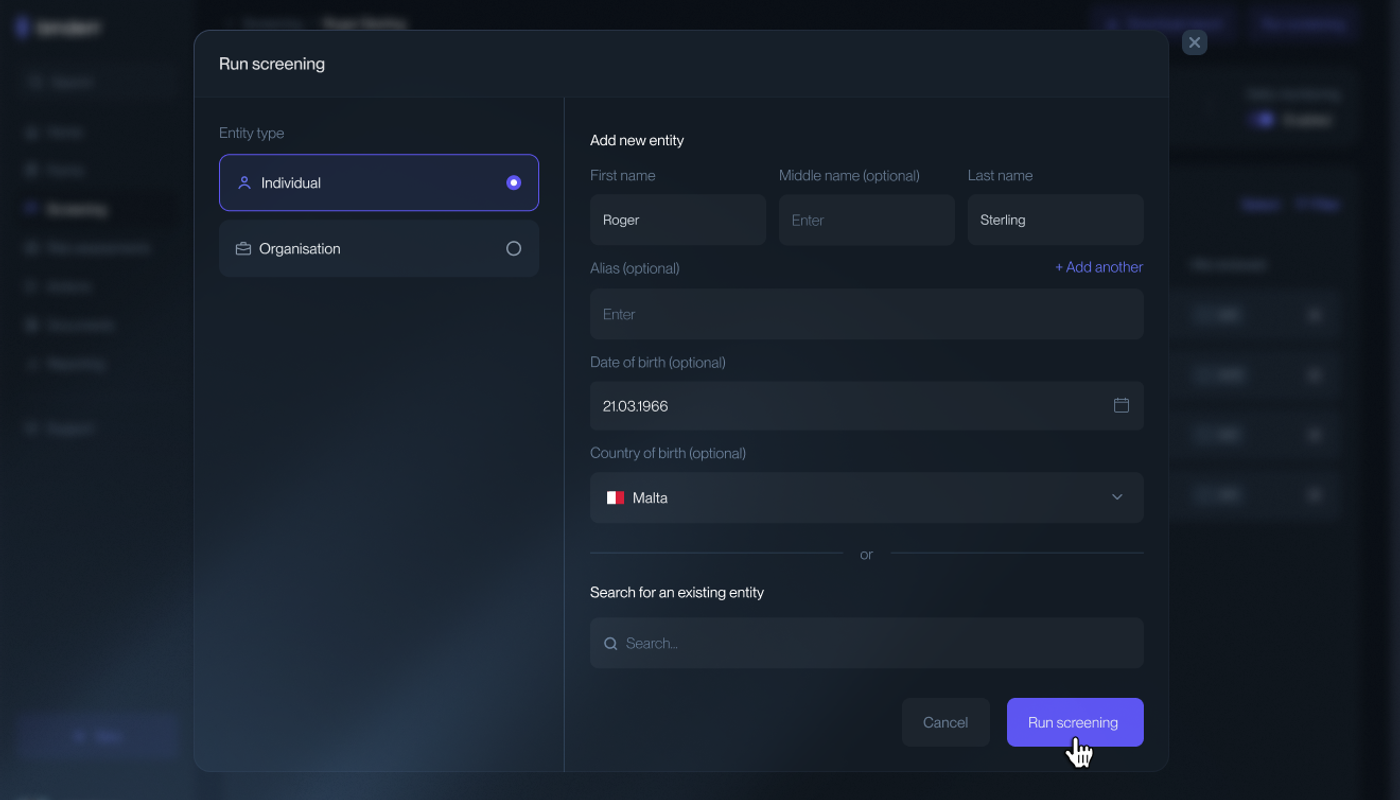
(Before a crypto exchange can onboard a customer, it must verify identities, collect key information, and perform AML screening. Binderr simplifies this process by allowing compliance teams to screen individuals and businesses from a single interface. Users can enter customer details, run sanctions screening, perform PEP checks, and initiate risk reviews in seconds.)
Blockchain Transaction Monitoring
Unlike traditional financial institutions, crypto businesses must monitor blockchain activity to identify suspicious transactions and assess wallet risk. Blockchain transaction monitoring provides visibility into customer activity and helps organizations meet AML compliance requirements.
- Wallet Screening - Wallet screening evaluates cryptocurrency wallet addresses against sanctions lists, darknet markets, ransomware databases, and other high-risk sources. This allows crypto exchanges to identify risky counterparties before processing transactions.
- On-Chain Transaction Analysis - On-chain transaction analysis tracks the movement of digital assets across blockchain networks to uncover suspicious patterns, identify links to illicit activity, and improve transaction transparency. This is a critical feature for crypto AML compliance and blockchain risk management.
- Risk Scoring - Risk scoring assigns a risk level to customers, wallets, and transactions based on factors such as transaction behavior, geographic exposure, sanctions matches, and blockchain intelligence. Automated risk scoring helps compliance teams prioritize reviews and investigations.
- Suspicious Activity Detection - AML monitoring software continuously analyzes transactions for unusual patterns, rapid fund movements, high-risk wallet interactions, and other indicators of potential money laundering. Automated alerts help compliance teams investigate and respond to suspicious activity more efficiently.
Sanctions & Watchlist Screening
Sanctions screening is a critical requirement for crypto exchanges, Web3 platforms, and virtual asset service providers operating in regulated markets. Continuous screening helps businesses avoid dealing with prohibited individuals, entities, and high-risk counterparties.
- OFAC Screening - OFAC screening checks customers, businesses, and wallet addresses against sanctions lists maintained by the U.S. Office of Foreign Assets Control. This helps crypto businesses prevent transactions involving sanctioned individuals, organizations, or jurisdictions.
- UN Sanctions Lists - Many AML software providers include screening against United Nations sanctions lists to support global compliance efforts. Automated checks help organizations identify restricted parties and reduce exposure to international compliance risks.
- Global Watchlists - Global watchlist screening expands compliance coverage beyond sanctions lists by checking customers against regulatory databases, law enforcement records, enforcement actions, and other risk intelligence sources. This creates a more comprehensive risk assessment process.
- PEP Checks - Politically Exposed Person (PEP) screening helps identify individuals who may present a higher risk of corruption, bribery, or financial crime due to their public positions. Crypto compliance teams can use PEP checks as part of enhanced due diligence (EDD) and ongoing monitoring programs.
Ongoing AML Monitoring
AML compliance does not end once a customer is onboarded. Crypto exchanges and Web3 platforms must continuously monitor customers, wallet activity, and transactions to identify emerging risks, sanctions exposure, and suspicious behavior. Ongoing AML monitoring helps businesses maintain compliance, reduce financial crime risks, and respond quickly to changing customer profiles.
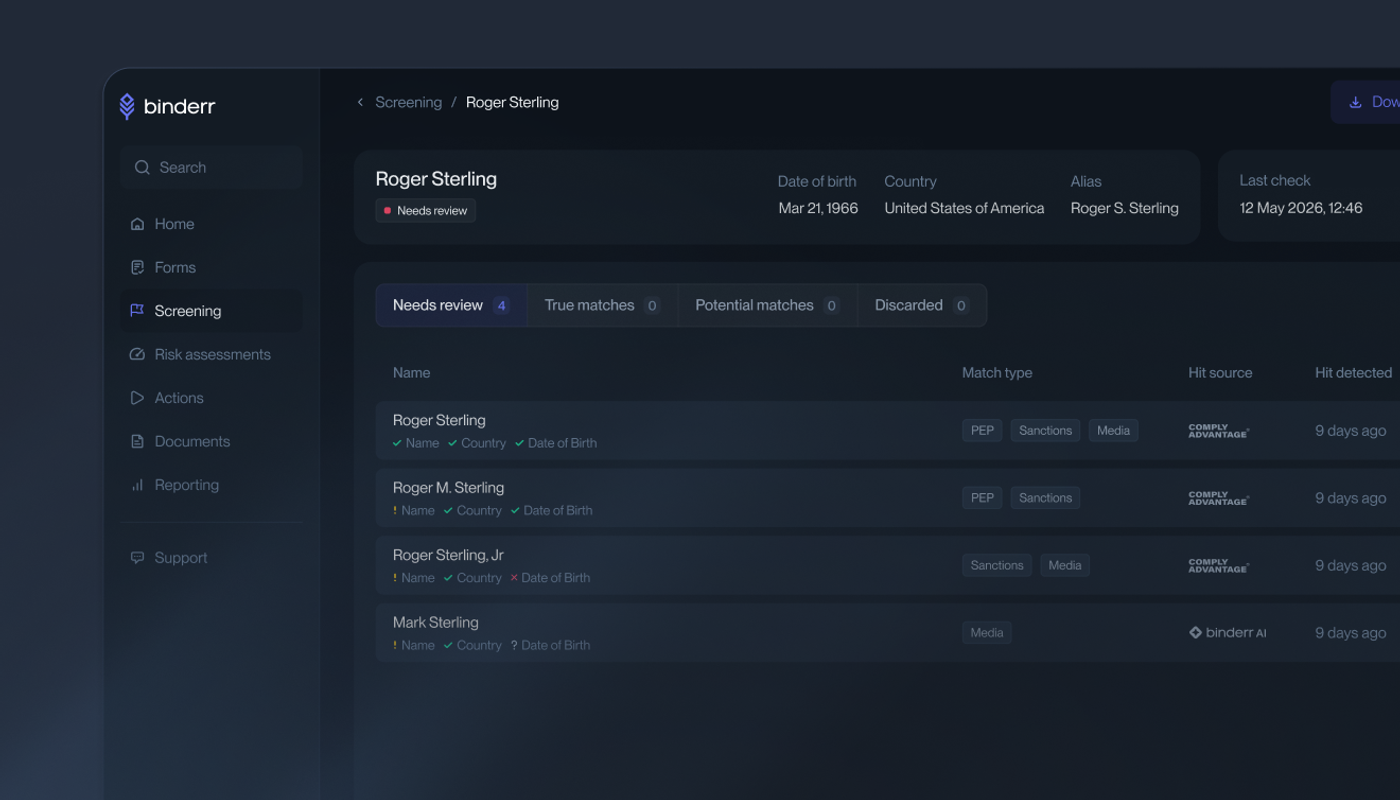
(Binderr centralizes sanctions alerts, PEP matches, adverse media findings, and ongoing monitoring notifications into a single dashboard, helping teams prioritize investigations and maintain compliance records.)
- Real-Time Alerts - Real-time alerts notify compliance teams when suspicious transactions, sanctions matches, unusual wallet activity, or high-risk behaviors are detected. Immediate notifications allow crypto businesses to investigate potential risks quickly and take appropriate action before issues escalate.
- Continuous Screening - Customer risk profiles can change over time, making continuous screening a critical component of AML compliance. Automated AML software continuously screens customers against sanctions lists, PEP databases, watchlists, and adverse media sources to identify new risks as they emerge.
- Risk Reassessment - A customer's risk level should not remain static throughout their lifecycle. AML monitoring software automatically reassesses risk based on transaction activity, geographic exposure, wallet interactions, and screening results, ensuring compliance teams maintain accurate and up-to-date risk profiles.
- Behavioral Monitoring - Behavioral monitoring analyzes transaction patterns, account activity, and customer behavior to identify anomalies that may indicate money laundering, fraud, or other financial crimes. Advanced AML solutions use machine learning and risk models to detect unusual behavior that may otherwise go unnoticed.
Review PEP, Sanctions, and Adverse Media Hits Faster with Binderr
Travel Rule Compliance
As global regulators strengthen oversight of digital assets, Travel Rule compliance has become a key requirement for crypto exchanges and virtual asset service providers. AML software helps businesses automate Travel Rule processes, improve information sharing, and comply with evolving cryptocurrency regulations.
- VASP-to-VASP Communication - Travel Rule solutions enable secure communication between virtual asset service providers (VASPs) when transferring customer information related to qualifying crypto transactions. This helps exchanges meet regulatory obligations while maintaining operational efficiency and data security.
- Beneficiary Verification - Beneficiary verification ensures that recipient information is accurate before a cryptocurrency transfer is processed. Verifying beneficiary details helps reduce fraud risks, improve transaction transparency, and support Travel Rule compliance requirements across jurisdictions.
- Regulatory Reporting Support - Many crypto businesses must maintain records and provide information to regulators during audits or investigations. AML software simplifies regulatory reporting by capturing transaction data, customer information, screening results, and Travel Rule records in a centralized compliance platform.
Risk Scoring & Case Management
Managing compliance at scale requires more than basic screening. Risk scoring and case management tools help crypto exchanges prioritize investigations, streamline compliance operations, and focus resources on the highest-risk customers and transactions.
- Automated Risk Assessment - Automated risk assessment evaluates customers, businesses, wallets, and transactions using predefined risk factors such as geographic exposure, transaction volume, sanctions screening results, and blockchain intelligence. This creates consistent and scalable customer risk scoring across the organization.
- Investigation Workflows - When suspicious activity is detected, compliance teams need structured workflows to review and document investigations. Case management tools centralize alerts, customer records, transaction histories, and supporting evidence, making investigations faster and more efficient.
- Audit Trails - Maintaining detailed audit trails is essential for demonstrating AML compliance. Modern AML software records customer onboarding activities, screening checks, risk decisions, investigations, and monitoring actions, creating a transparent history that supports regulatory reviews and internal audits.
- Compliance Reporting - Compliance reporting tools help generate reports for regulators, auditors, and internal stakeholders. Automated reporting capabilities reduce manual workloads while ensuring crypto exchanges and Web3 platforms maintain accurate records of AML screening, transaction monitoring, customer due diligence, and risk management activities.
Binderr Advanced AML Screening for Crypto Exchanges
Binderr AML Screening Includes:
- Global sanctions screening across major regulatory databases
- PEP screening and enhanced due diligence support
- Adverse media monitoring with AI-powered analysis
- Smart matching technology to reduce false positives
- Screening for individuals, businesses, directors, and UBOs
- Continuous monitoring with instant risk alerts
Best AML Software for Crypto Exchanges & Web3 Platforms
Binderr
Binderr Compliance is an end-to-end compliance platform designed to help crypto exchanges, Web3 platforms, digital asset businesses, and virtual asset service providers (VASPs) streamline AML compliance and customer onboarding.
The platform combines KYC verification, KYB verification, AML screening, sanctions checks, adverse media monitoring, risk assessment, and ongoing monitoring into a single solution, enabling businesses to manage regulatory obligations more efficiently. By automating critical compliance workflows, Binderr helps crypto companies reduce manual reviews, improve onboarding speed, strengthen financial crime prevention, and maintain compliance as they scale.
Key Features:
- KYC Verification: Verify customer identities using document verification, biometric face matching, liveness detection, and AI-powered fraud prevention tools. This helps crypto businesses onboard legitimate users faster while reducing identity fraud and account takeover risks.
- KYB Verification: Conduct comprehensive business verification checks by validating company registration details, ownership structures, directors, shareholders, and Ultimate Beneficial Owners (UBOs). This simplifies onboarding for institutional clients, corporate customers, and business partners.
- AML Screening: Screen customers and businesses against global sanctions lists, watchlists, politically exposed persons (PEPs), and adverse media databases. Automated AML checks help identify high-risk individuals and entities before onboarding.
- Sanctions Screening: Continuously screen users against international sanctions databases, including OFAC, UN, EU, and other regulatory lists. This helps crypto exchanges reduce sanctions exposure and comply with global regulatory requirements.
- Adverse Media Monitoring: Monitor negative news and media coverage associated with customers, businesses, directors, and UBOs. AI-powered adverse media analysis helps compliance teams uncover hidden risks and strengthen due diligence processes.
- Dynamic Risk Scoring: Automatically assess customer risk levels using factors such as geography, business activity, screening results, ownership structures, and compliance indicators. Dynamic risk scoring helps compliance teams prioritize reviews and apply risk-based onboarding.
- Ongoing Monitoring: Continuously monitor customers, businesses, and beneficial owners for changes in sanctions status, adverse media exposure, risk levels, and compliance events. This ensures compliance programs remain effective throughout the customer lifecycle.
- Compliance Reporting: Generate audit-ready compliance reports, screening records, risk assessments, and monitoring logs from a centralized platform. This simplifies regulatory reporting and supports internal audits and compliance reviews.
Best For: Crypto startups and emerging exchanges looking for an all-in-one compliance solution that combines KYC, KYB, AML screening, and ongoing monitoring. Web3 platforms, OTC desks, and digital asset businesses that need scalable onboarding, risk assessment, and customer due diligence workflows.
Start Free Compliance Checks with Binderr
Ondato
Ondato is a compliance and identity verification platform designed to help crypto exchanges, Web3 companies, fintech firms, and other regulated businesses streamline their compliance operations. The platform automates critical processes such as Know Your Customer (KYC) verification, Anti-Money Laundering (AML) screening, customer due diligence, and ongoing monitoring, reducing the manual workload for compliance teams.
With its no-code and low-code workflow capabilities, Ondato enables businesses to build efficient onboarding journeys while maintaining compliance with evolving regulatory requirements. This makes it a valuable solution for organizations looking to scale their operations without compromising security or regulatory standards.
Key Features:
- KYC and Identity Verification: Verify customer identities through document verification, biometric checks, and automated validation processes. This helps businesses onboard legitimate users quickly while reducing the risk of identity fraud.
- AML Screening: Screen customers against global watchlists, sanctions databases, and risk indicators to identify potential money laundering risks before onboarding or during ongoing customer relationships.
- Sanctions and PEP Checks: Automatically detect individuals and entities listed on international sanctions lists or classified as Politically Exposed Persons (PEPs), helping organizations meet regulatory obligations and manage risk exposure.
- Customer Due Diligence (CDD): Collect, assess, and manage customer information to establish risk profiles and ensure compliance with regulatory requirements throughout the customer lifecycle.
- Ongoing Monitoring: Continuously monitor customers for changes in risk status, sanctions exposure, or suspicious activity, enabling businesses to respond proactively to emerging compliance concerns.
Best For: Crypto startups, exchanges, and fintech companies that need a streamlined compliance solution for customer onboarding and verification. Organizations looking to automate KYC, AML screening, and due diligence processes without building complex compliance infrastructure.
Trulioo
Trulioo is a leading identity verification and compliance platform that helps crypto businesses meet regulatory requirements while delivering a smooth onboarding experience for users. The platform provides access to a vast network of trusted data sources across numerous countries, enabling organizations to verify individuals and businesses quickly and accurately.
For crypto exchanges, wallet providers, and Web3 platforms operating across multiple regions, Trulioo offers a scalable solution for managing KYC and AML obligations while reducing fraud and compliance risks.
Key Features:
- Global Identity Verification: Verify customers across hundreds of countries and territories using trusted data sources, helping crypto businesses onboard users from different regions with confidence.
- AML and Sanctions Screening: Screen customers against global sanctions lists, watchlists, and AML databases to identify potential compliance risks and meet regulatory requirements.
- PEP Screening: Detect politically exposed persons (PEPs) and individuals associated with elevated risk profiles, supporting stronger risk-based compliance programs.
- Business Verification (KYB): Verify corporate entities, ownership structures, and business credentials to streamline Know Your Business (KYB) processes for institutional clients and partners.
- Ongoing Monitoring: Continuously monitor customers for changes in risk status, sanctions exposure, or other compliance-related events, helping businesses maintain long-term regulatory compliance.
Best For: Global crypto exchanges that need to verify users across multiple jurisdictions. Web3 platforms and digital asset businesses serving international customer bases. Organizations seeking strong identity verification and AML compliance capabilities with broad global coverage.
iDenfy
iDenfy is a comprehensive identity verification and compliance platform designed to help crypto businesses streamline customer onboarding while reducing fraud and regulatory risks. By combining advanced identity verification, AML screening, and fraud prevention tools, the platform enables companies to verify users quickly and securely without compromising compliance standards.
The solution is particularly popular among crypto startups, exchanges, fintech companies, and digital asset platforms that need an efficient way to meet KYC and AML requirements. With automated verification processes and real-time risk assessment capabilities, iDenfy helps businesses improve customer trust, enhance operational efficiency, and maintain regulatory compliance throughout the customer lifecycle.
Key Features:
- Identity Verification: Verifies customer identities using government-issued documents, biometric checks, and facial recognition technology to ensure users are legitimate and reduce onboarding fraud.
- AML Screening: Screens customers against global watchlists, sanctions databases, and other risk sources to help businesses identify potentially high-risk individuals and comply with AML regulations.
- Sanctions Screening: Automatically checks users against international sanctions lists and politically exposed persons (PEP) databases, helping organizations avoid regulatory violations and financial crime exposure.
- Fraud Prevention: Uses advanced fraud detection mechanisms to identify suspicious activities, document forgery attempts, identity theft, and other fraudulent behaviors before they impact the business.
- Ongoing Monitoring: Continuously monitors customer profiles and risk indicators, allowing businesses to detect changes in risk status and respond proactively to emerging compliance concerns.
Best For: Crypto startups looking for a reliable and cost-effective compliance solution. Digital asset platforms that need strong identity verification and fraud prevention capabilities. Fintech businesses seeking to streamline onboarding while maintaining AML and KYC compliance.
Sumsub
Sumsub is a widely used verification and compliance platform designed to help crypto businesses meet regulatory requirements while delivering a smooth user onboarding experience. The platform combines identity verification, AML screening, fraud prevention, and Travel Rule compliance into a single solution, making it easier for exchanges, wallets, and Web3 companies to manage compliance operations at scale.
With support for global document verification and automated risk monitoring, Sumsub has become a popular choice for regulated digital asset businesses operating across multiple jurisdictions.
Key Features:
- KYC Verification: Verifies customer identities using government-issued documents, biometric checks, and liveness detection to ensure users are legitimate and compliant with regulatory requirements.
- AML Screening: Screens customers against global sanctions lists, politically exposed persons (PEPs), and watchlists to identify potential compliance risks before onboarding.
- Travel Rule Compliance: Helps Virtual Asset Service Providers (VASPs) comply with FATF Travel Rule requirements by securely collecting and sharing required transaction information.
- Fraud Prevention: Uses advanced risk detection tools, behavioral analysis, and document verification technologies to identify suspicious activity and reduce fraud attempts.
- Ongoing Monitoring: Continuously monitors customers for changes in risk profiles, sanctions exposure, and other compliance-related events to support long-term regulatory compliance.
Best For: Crypto exchanges that need a complete onboarding and compliance solution for global users. Web3 platforms are looking to combine identity verification, AML screening, and fraud prevention within a single platform.
ComplyAdvantage
ComplyAdvantage is a leading AML screening and risk intelligence platform designed to help crypto businesses strengthen their compliance programs and manage financial crime risks more effectively. The platform leverages artificial intelligence and continuously updated risk data to identify high-risk individuals and entities, monitor sanctions exposure, and support regulatory compliance efforts.
For crypto exchanges, fintech companies, and digital asset service providers, ComplyAdvantage offers a streamlined way to conduct customer screening and ongoing risk monitoring without relying on outdated compliance databases.
Key Features:
- Sanctions Screening: Screens customers and counterparties against global sanctions lists in real time, helping businesses identify restricted individuals, organizations, and jurisdictions before onboarding or processing transactions.
- Adverse Media Monitoring: Continuously scans news sources and media outlets for negative information related to customers, enabling compliance teams to detect potential reputational and financial crime risks early.
- PEP Screening: Identifies politically exposed persons (PEPs), their associates, and family members, helping organizations apply enhanced due diligence where required by regulations.
- Risk Intelligence: Uses AI-driven risk data and analytics to provide deeper insights into customer risk profiles, allowing compliance teams to make more informed decisions and prioritize investigations.
- Ongoing Monitoring: Continuously monitors customers for changes in risk status, sanctions updates, or newly identified adverse media, ensuring compliance programs remain effective over time.
Best For: Crypto exchanges, fintech companies, and digital asset service providers that need robust AML screening and sanctions monitoring. Organizations are looking for real-time risk intelligence and continuous customer monitoring to strengthen compliance operations.
Custom KYC and AML Integration for Web3 Platforms
Blocsys Technologies
Blocsys Technologies is an AI-powered blockchain development company specializing in enterprise blockchain solutions, tokenization platforms, crypto exchange development, and Web3 applications. We help startups, financial institutions, and enterprises build secure, scalable, and future-ready digital asset platforms tailored to their business objectives.
From blockchain consulting and solution architecture to smart contract development and platform deployment, Blocsys delivers end-to-end development services for tokenization platforms, crypto exchanges, digital asset infrastructure, and Web3 ecosystems. Our focus is on building customized, enterprise-grade blockchain solutions that enable businesses to innovate, scale, and accelerate their digital transformation.
Key Features
- Blockchain Development: Custom blockchain solutions for enterprises, startups, and digital asset businesses using leading blockchain technologies.
- Tokenization Platform Development: End-to-end development of equity, real estate, bond, commodity, and real-world asset (RWA) tokenization platforms.
- Crypto Exchange Development: Development of centralized (CEX), decentralized (DEX), hybrid, OTC, and derivatives trading platforms with enterprise-grade security.
- Smart Contract Development: Design, development, auditing, and deployment of secure smart contracts for DeFi, tokenization, NFTs, and enterprise blockchain applications.
- Web3 & Digital Asset Solutions: Development of Web3 applications, digital wallets, stablecoin platforms, DeFi protocols, and blockchain infrastructure tailored to business requirements.
Best For: Financial institutions and fintech companies or startups launching blockchain products such as asset tokenization platforms, crypto exchanges and digital asset businesses.
How to Choose the Right AML Software for Your Crypto Business
Selecting AML software for a crypto business requires careful consideration of both regulatory obligations and operational needs. Whether you run a crypto exchange, Web3 platform, or digital asset service, the right solution should help mitigate financial crime risks while supporting compliance through features such as KYC verification, AML screening, sanctions monitoring, continuous transaction oversight, and scalable workflows tailored to your organization.
Before selecting an AML compliance platform, evaluate the key factors below to ensure the solution can support your growth, risk management strategy, and long-term crypto compliance needs.
Compliance and Regulatory Obligations
Every crypto business operates within a unique regulatory environment, making compliance requirements one of the most important factors when selecting AML software. The solution should support key obligations such as KYC verification, customer due diligence (CDD), sanctions screening, ongoing monitoring, and Travel Rule compliance where applicable.
Choosing software that aligns with local and international regulations can help reduce compliance risks, simplify audits, and prepare your business for future regulatory changes.
Align the Solution with Your Business Model
Different crypto businesses face different compliance challenges. A crypto exchange may require advanced customer onboarding and transaction monitoring, while a Web3 platform or digital wallet provider may prioritize identity verification and sanctions screening.
Selecting AML software that fits your business model ensures you invest in features that directly support your operational workflows, customer journey, and risk management objectives.
Assess Your Current and Future Scale
The compliance needs of a startup differ significantly from those of an established exchange processing thousands of transactions daily.
As your customer base and transaction volumes grow, your AML software should be able to scale without compromising performance or compliance effectiveness. Look for platforms that support automated workflows, continuous monitoring, and flexible integrations to accommodate future expansion.
Evaluate Your Internal Compliance Capabilities
Some organizations have dedicated compliance teams, while others rely on lean operations with limited resources. If your team is small, automation becomes critical for managing KYC checks, AML screening, risk assessments, and ongoing monitoring efficiently.
Understanding your internal compliance capabilities will help you choose a solution that reduces manual workloads while maintaining strong regulatory oversight.
Compare Pricing Models and Total Costs
AML software pricing can vary significantly depending on features, transaction volumes, verification checks, and monitoring requirements. While upfront costs are important, businesses should also consider long-term value, scalability, implementation costs, and ongoing compliance expenses.
Evaluating the total cost of ownership helps ensure the selected AML compliance solution delivers both operational efficiency and a strong return on investment as your crypto business grows.
Common AML Challenges for Crypto Exchanges
Crypto exchanges and Web3 platforms operate in one of the most complex compliance environments, where evolving regulations, high transaction volumes, and emerging financial crime threats create ongoing challenges. Maintaining effective AML compliance requires businesses to balance regulatory obligations, customer experience, risk management, and operational efficiency while monitoring rapidly changing crypto activity.
Understanding the most common AML compliance challenges can help crypto businesses identify potential gaps, strengthen their compliance framework, and implement the right AML software, KYC verification, and transaction monitoring solutions.
Wallet Risk Identification
Problem: Crypto exchanges and Web3 platforms often struggle to accurately identify whether a wallet address is linked to sanctioned entities, darknet markets, mixers, ransomware operations, or other high-risk activities. Without proper wallet risk assessment, businesses can unknowingly facilitate illicit transactions and increase their AML compliance exposure.
Solution: AML software with wallet screening and blockchain intelligence capabilities can automatically assess wallet risk before transactions are processed. By leveraging blockchain analytics, sanctions screening, and risk scoring tools, compliance teams can identify suspicious wallets and apply enhanced due diligence where necessary.
Cross-Chain Transaction Monitoring
Problem: As users increasingly move assets across multiple blockchains, tracking transaction activity becomes significantly more complex. Criminals often exploit cross-chain bridges and multiple networks to obscure fund flows, making it difficult for compliance teams to detect suspicious activity.
Solution: Advanced crypto AML software can monitor transactions across different blockchain ecosystems and provide a unified view of customer activity. Cross-chain transaction monitoring helps compliance teams identify risky behaviors, improve transaction visibility, and strengthen AML risk management programs.
High False Positive Rates
Problem: Many compliance teams spend considerable time reviewing alerts that ultimately prove to be low risk. Excessive false positives increase operational costs, slow customer onboarding, and reduce the efficiency of AML investigations.
Solution: Modern AML compliance platforms use intelligent risk scoring, AI-powered screening, and configurable risk rules to improve alert accuracy. This allows compliance teams to focus on genuinely suspicious activity while reducing unnecessary manual reviews and investigation workloads.
Sanctions Compliance
Problem: Global sanctions lists are frequently updated, making it difficult for crypto businesses to ensure customers, counterparties, and wallet addresses remain compliant. Missing a sanctions match can lead to regulatory penalties and reputational damage.
Solution: Automated sanctions screening software continuously checks customers and transactions against global sanctions databases, including OFAC, UN, EU, and other watchlists. Continuous monitoring helps businesses identify new sanctions risks and maintain ongoing compliance.
Travel Rule Implementation
Problem: Meeting FATF Travel Rule requirements can be challenging, especially for crypto exchanges operating across multiple jurisdictions. Collecting, validating, and securely sharing transaction information often creates operational and compliance complexities.
Solution: Travel Rule compliance solutions automate the exchange of required sender and beneficiary information between Virtual Asset Service Providers (VASPs). This reduces manual processes, improves data accuracy, and helps crypto businesses meet regulatory obligations more efficiently.
Scaling Compliance Operations
Problem: As crypto exchanges grow, customer onboarding volumes, transaction activity, and compliance obligations increase rapidly. Manual compliance processes can become difficult to manage and may create operational bottlenecks.
Solution: Scalable AML software automates KYC verification, AML screening, customer due diligence, and ongoing monitoring workflows. Automation allows compliance teams to handle higher volumes while maintaining strong regulatory compliance and operational efficiency.
Ongoing Customer Monitoring
Problem: Customer risk profiles can change long after onboarding due to sanctions updates, adverse media exposure, suspicious transactions, or changes in ownership structures. Relying solely on initial due diligence can leave compliance programs exposed to emerging risks.
Solution: Ongoing AML monitoring continuously screens customers against sanctions lists, PEP databases, adverse media sources, and risk indicators. Continuous monitoring enables compliance teams to identify changing risks early and maintain a proactive compliance framework.
Binderr End-to-End AML Compliance for Crypto Businesses
Binderr Compliance helps crypto exchanges and Web3 platforms manage KYC, KYB, sanctions screening, adverse media monitoring, customer risk assessments, ongoing AML monitoring, and compliance reporting from a single platform.
- Unified compliance infrastructure
- Automated onboarding workflows
- Global sanctions and watchlist screening
- Continuous AML monitoring
- Risk-based compliance framework
- Scalable for growing exchanges and Web3 companies
Bottom Line
AML compliance is becoming a critical requirement for crypto exchanges, Web3 platforms, DeFi businesses, and digital asset service providers. The right AML software can help organizations streamline onboarding, monitor transactions, reduce risk, and satisfy regulatory obligations. Carefully evaluate your compliance needs, transaction volumes, and growth plans to select the best AML software solution for your business in 2026.