AML risk assessment sits at the core of modern compliance, guiding how businesses evaluate customer risk before onboarding. Customer risk scoring transforms raw data into clear decisions by assigning structured risk levels based on identity, geography, business activity, and screening results. This approach helps compliance teams move faster while maintaining control over financial crime exposure.
Customer risk scoring brings consistency to AML compliance by replacing subjective judgment with defined risk factors and scoring logic. From sanctions screening to PEP checks and adverse media analysis, each signal contributes to a measurable AML risk score. According to the United Nations Office on Drugs and Crime, up to 5 percent of global GDP is laundered each year, making accurate AML risk assessment and customer risk assessment AML processes critical for every regulated business.
In this guide, you will learn how AML risk assessment works in practice, the key factors that influence customer risk scores, how to build a structured scoring model using an aml risk assessment template, and how to use risk ratings to trigger CDD, EDD, and ongoing monitoring decisions.
Binderr AML Risk Assessment Software
Binderr stands out as a leading AML risk assessment and customer risk scoring platform designed for regulated businesses.
- KYC (Identity Verification) with AI-powered document checks, biometric face matching, and liveness detection
- KYB (Business Verification) with global registry access and entity validation
- AML Screening across sanctions, watchlists, PEPs, and adverse media
- Dynamic Risk Assessment with automated customer risk scoring
- UBO Identification & Ownership Mapping
- Automated CDD and EDD workflows
What Is AML Risk Assessment?
AML risk assessment is the process of identifying, evaluating, and managing money laundering and terrorist financing risks across customers, businesses, products, jurisdictions, transactions, and delivery channels. It supports a risk-based approach by helping organizations prioritize controls and resources.
A business-wide risk assessment looks at overall exposure, while a customer risk assessment AML or client risk assessment AML focuses on individual or entity profiles. Transaction risk assessment reviews financial activity patterns, product risk considers the nature of services offered, and geographic risk evaluates exposure to high-risk jurisdictions.
AML risk assessment is not a one-time task it is ongoing and informs onboarding, CDD, EDD, monitoring, and compliance reviews. Many firms rely on an aml risk assessment template to standardize this process and ensure consistency across teams.
Cut compliance time. Screen and detect risk for FREE.
What Is Customer Risk Scoring in AML?
Customer risk scoring in AML is the process of assigning a risk rating to each customer based on key factors like identity, geography, industry, transaction behavior, sanctions results, PEP status, adverse media, and ownership structure.
The goal is to apply a risk-based approach, helping businesses prioritize high-risk customers, streamline onboarding, and maintain consistent, auditable decisions within a broader AML risk assessment framework.
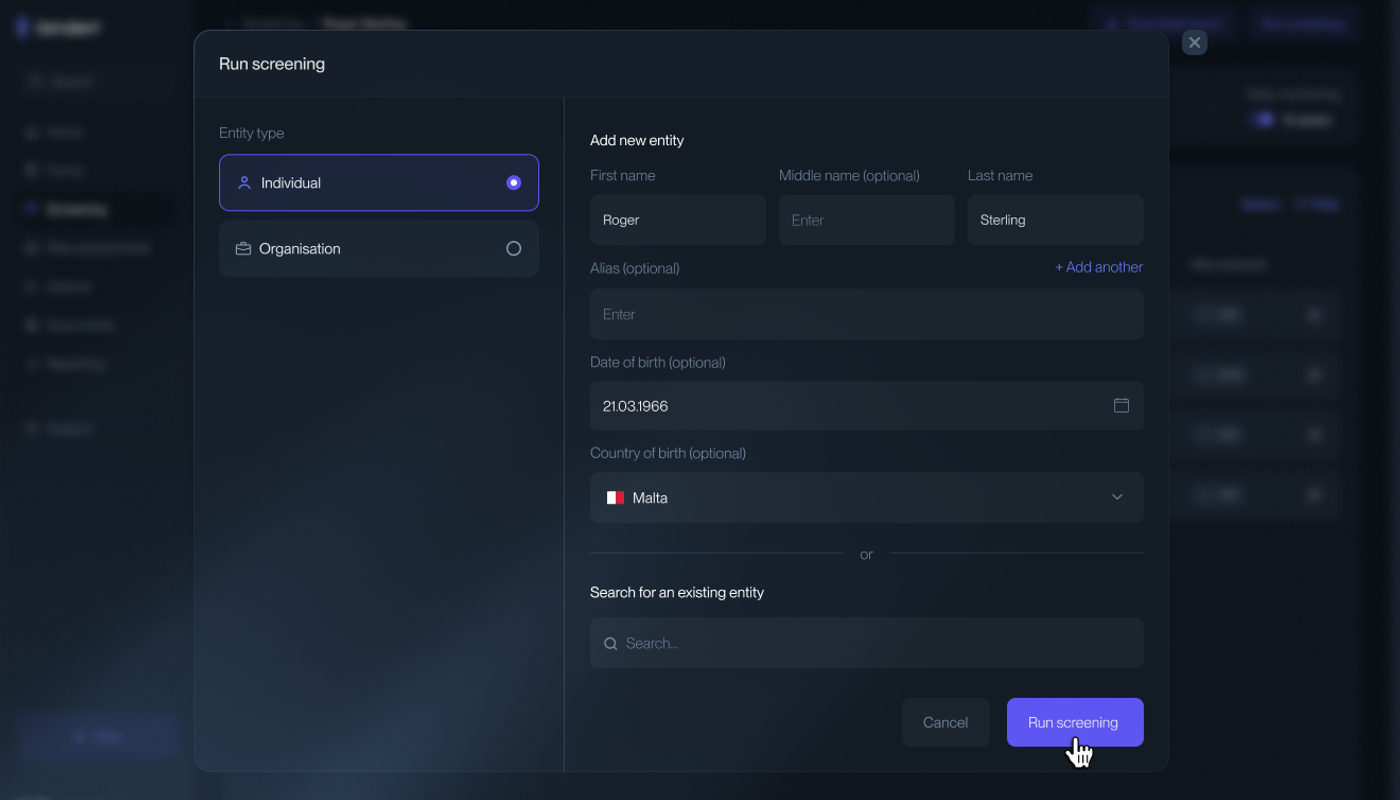
(Before a customer can be scored, the business needs accurate identity or entity data. Binderr allows compliance teams to screen individuals and organisations from one workflow, helping them detect sanctions, PEP, watchlist, and adverse media exposure before assigning a customer risk score.)
Risk scores are usually numeric (e.g., 0–100) or categorized as low, medium, or high risk.
Example:
Risk Score | Risk Level | Typical Action |
0–30 | Low Risk | Standard onboarding |
31–70 | Medium Risk | Additional checks or review |
71–100 | High Risk | EDD, escalation, or rejection |
Low-risk customers typically pass standard KYC checks, while medium-risk customers may need extra review. High-risk customers usually trigger Enhanced Due Diligence (EDD), monitoring, or rejection.
Scoring models should be tailored to each business based on its customers, products, and risk exposure. This helps improve accuracy, reduce false positives, and keep compliance effective across both customer risk assessment AML and client risk assessment AML processes.
Why Customer Risk Scoring Matters for AML Compliance
Customer risk scoring is a core part of any effective AML risk assessment framework, helping businesses evaluate financial crime risk quickly and consistently. It enables compliance teams to apply a risk-based approach, improve AML monitoring, and make informed decisions across onboarding, CDD, and EDD workflows.
Faster onboarding decisions - Customer risk scoring helps streamline AML onboarding by quickly assessing risk levels based on predefined criteria. This allows compliance teams to approve low-risk customers faster while flagging higher-risk profiles for further review, reducing delays and improving the overall onboarding experience.
More consistent CDD and EDD triggers - By using structured AML risk scoring models and an aml risk assessment template, businesses can apply consistent rules to determine when Customer Due Diligence (CDD) or Enhanced Due Diligence (EDD) is required. This reduces reliance on subjective judgment and ensures that similar risk profiles are treated uniformly across the compliance workflow.
Clearer audit trails - Automated AML risk assessment systems create detailed audit trails by recording how each customer risk score was calculated and what actions were taken. This makes it easier to demonstrate compliance during regulatory reviews and provides transparency into decision-making processes.
Better prioritization of high-risk customers - Customer risk scoring enables compliance teams to focus their efforts on high-risk customers who pose greater financial crime risk. By identifying these profiles early, teams can allocate resources more effectively and ensure that enhanced due diligence and monitoring are applied where they are most needed.
Reduced false positives - A well-designed AML risk scoring framework helps reduce false positives by combining multiple risk factors instead of relying on single alerts. This improves the accuracy of AML screening and allows compliance teams to spend less time reviewing low-risk alerts and more time investigating genuine risks.
Risk-based monitoring frequency - AML risk scores can be used to determine how often customers should be reviewed or monitored. Low-risk customers may require less frequent checks, while high-risk customers are subject to ongoing monitoring and more frequent reviews, supporting a risk-based approach to AML compliance.
Check How Binderr Simplifies AML Risk Assessment
Binderr streamlines the entire AML risk assessment process by combining multiple compliance tools into one workflow:
- Run KYC, KYB, and AML checks in one platform
- Automatically assign risk scores based on real-time data
- Trigger CDD or EDD workflows instantly
- Collect documents dynamically based on risk level
- Maintain full audit trails for compliance
Key AML Risk Factors Used in Customer Risk Scoring
Understanding the core AML risk factors helps businesses build accurate and defensible customer risk scores within any AML risk assessment or client risk assessment AML framework.
These factors include customer identity, geography, industry, transaction behaviour, sanctions exposure, PEP status, adverse media, and beneficial ownership.
Customer Identity Risk - Customer identity risk focuses on how well a business can confirm a customer’s identity. This includes checking documents like passports or driver’s licenses and matching details with trusted sources. Biometric checks, such as facial recognition and liveness detection, help confirm the person is real. Red flags include mismatched details, duplicate accounts, or suspicious onboarding behaviour. Weak verification increases fraud and AML risk.
Business or Entity Risk - Business risk looks at how legitimate and transparent a company is. This includes verifying registration details, legal status, and identifying directors, shareholders, and UBOs. Complex ownership, offshore links, or shell companies increase risk. Recently formed or inactive companies may also be higher risk. Strong KYB and UBO checks help uncover hidden issues.
Geographic Risk - Geographic risk assesses the risk linked to a customer’s location. This includes where they live, operate, or are incorporated.High-risk or sanctioned countries increase risk scores. Cross-border activity can also raise risk, especially with low-transparency regions. Businesses must consider sanctions and regulatory differences.
Industry Risk - Some industries carry higher AML risk due to how they operate. Examples include crypto, gambling, cash-heavy businesses, real estate, and offshore services.These sectors often involve large or cross-border transactions. Risk scoring should reflect this and trigger enhanced due diligence where needed.
Product and Service Risk - This risk relates to how products can be misused. High-risk products include large transfers, multi-currency accounts, prepaid cards, and complex investments.Products that allow fast or anonymous transactions increase risk. Businesses should check if usage matches expected behaviour.
Transaction Risk - Transaction risk looks at how customers move money. This includes volume, frequency, size, and counterparties.Unusual patterns, such as sudden spikes or transfers to high-risk regions, may signal suspicious activity. Ongoing monitoring helps detect these issues.
Sanctions and Watchlist Risk - This risk arises when a customer appears on sanctions or watchlists. A confirmed match is a serious issue and may require immediate action.Indirect links, such as ownership ties, also increase risk. Continuous screening is essential for compliance.
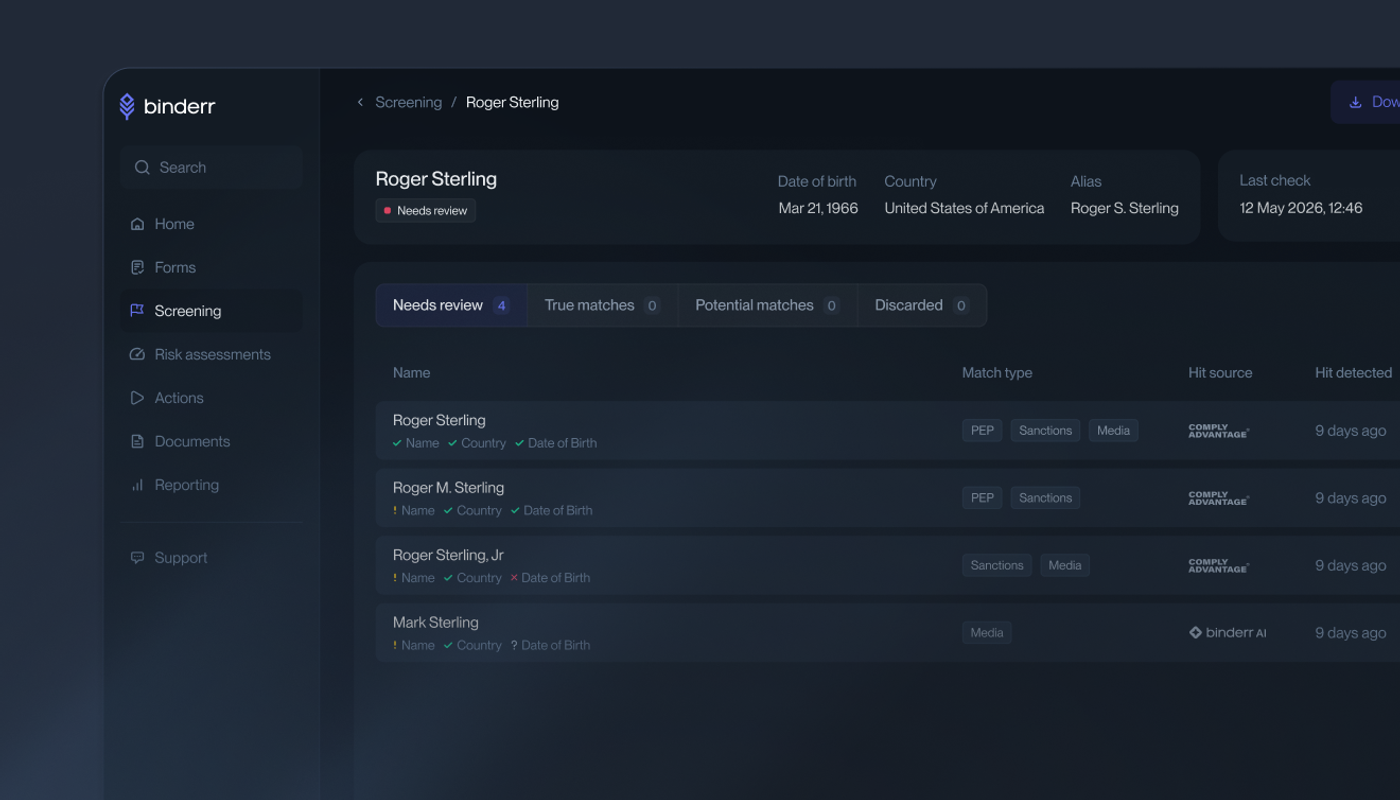
(In Binderr, potential matches are grouped by risk type, such as PEP, sanctions, and media, so compliance teams can quickly see what needs review and decide whether the customer should remain low risk, move to enhanced due diligence, or be escalated.)
PEP Risk - PEPs carry higher risk due to potential exposure to corruption. This includes their family and close associates.When identified, enhanced due diligence is required. Risk scores should automatically increase for PEPs.
Adverse Media Risk - Adverse media risk involves negative news linked to a customer. This includes fraud, corruption, or regulatory issues.Even unconfirmed reports can raise risk and trigger review. Ongoing monitoring helps catch new risks.
Source of Funds and Source of Wealth Risk - This risk focuses on where a customer’s money comes from. It is especially important for higher-risk customers.Businesses should verify sources using documents like bank statements or contracts. Unclear or inconsistent sources increase risk and may require further checks.
Automate onboarding & run checks instantly with Binder.
How to Build an AML Risk Assessment Framework
Turn complexity into clarity by designing a structured AML risk assessment framework that scales with your business.
Learn how to combine customer risk scoring, AML risk factors, and compliance workflows into a practical, audit-ready system.
Step 1: Define Your Risk Categories
Start by clearly defining your AML risk categories so your compliance team can consistently classify customers. Most AML risk assessment frameworks use categories such as low risk, medium risk, high risk, prohibited, and enhanced review. These categories should align with your risk-based approach AML strategy and reflect your regulatory obligations.
Each category should map to specific actions within your AML compliance workflow. For example, low-risk customers may go through standard customer due diligence (CDD), while high-risk customers trigger enhanced due diligence (EDD), senior approval, and ongoing monitoring. Clearly defined categories improve customer risk scoring consistency and support audit-ready documentation.
Step 2: Identify Your Risk Factors
Next, identify the key AML risk factors that will influence your customer risk scoring model. These typically include customer type (individual or business), geographic risk, industry risk, transaction behaviour, beneficial ownership, and product or service exposure. You should also include AML screening results such as sanctions screening, PEP screening, watchlist matches, and adverse media findings.
A strong AML risk assessment framework combines multiple data points to build a complete risk profile. For example, a customer operating in a high-risk jurisdiction with complex ownership and adverse media exposure should score higher than a domestic customer with simple activity. Including these AML risk factors ensures your scoring model reflects real financial crime risk.
Step 3: Assign Weighted Scores
Once risk factors are defined, assign weighted scores to each factor based on its relative importance. In AML customer risk scoring, not all risks are equal. High-impact indicators such as confirmed sanctions matches, PEP status, or links to high-risk jurisdictions should carry significantly more weight than minor discrepancies like small data mismatches.
Weighted scoring helps prioritize high-risk customers and improves decision-making across onboarding, CDD, and EDD workflows. For example, a confirmed sanctions match should immediately elevate a customer to high risk, while a minor address inconsistency may only slightly increase the AML risk score. Proper weighting ensures your AML risk scoring model is both accurate and aligned with regulatory expectations.
Step 4: Connect Scores to Actions
Every AML risk score should directly trigger a defined compliance workflow to ensure consistent decision-making. For example, low-risk customers may proceed through standard onboarding with basic CDD, while medium-risk customers may require additional verification or manual review. High-risk customers should automatically trigger Enhanced Due Diligence (EDD), senior approval, or potential rejection depending on the severity of the risk indicators.
Connecting customer risk scoring to clear actions helps enforce a risk-based approach in AML compliance. It ensures that sanctions screening results, PEP matches, adverse media findings, and geographic risk factors lead to appropriate escalation. This structured workflow reduces ambiguity, improves audit trails, and ensures that compliance teams respond consistently to financial crime risk signals.
Step 5: Document the Rationale
Documenting the rationale behind each AML risk score is critical for regulatory compliance and internal transparency. Firms must clearly record why a customer was classified as low, medium, or high risk, including the specific risk factors considered such as ownership structure, jurisdiction, transaction behavior, and screening results.
Regulators expect detailed audit trails that demonstrate how customer risk assessments were performed. Proper documentation supports internal reviews, regulatory audits, and investigations. It also helps compliance teams justify decisions related to onboarding, EDD triggers, and ongoing monitoring, ensuring that AML risk scoring remains explainable and defensible.
Step 6: Monitor and Update Scores
AML risk scoring should not be static. Customer risk profiles must be continuously monitored and updated as new information becomes available. This includes changes in ownership, new sanctions or PEP matches, adverse media alerts, shifts in transaction patterns, or updates to geographic risk exposure.
Ongoing monitoring ensures that AML risk assessments remain accurate over time. Automated alerts and real-time screening tools can help detect changes quickly, allowing compliance teams to reassess risk levels and trigger appropriate workflows such as additional CDD, EDD, or account review. This dynamic approach strengthens AML compliance and reduces exposure to financial crime.
Step 7: Review and Tune the Model
Regularly reviewing and tuning the AML risk scoring model is essential to maintain effectiveness and accuracy. Compliance teams should analyze false positives, false negatives, escalation outcomes, and case resolution data to identify gaps or inefficiencies in the scoring logic.
By refining risk weights, adjusting thresholds, and incorporating new risk indicators, firms can improve the precision of customer risk scoring. Continuous optimization ensures that the AML risk assessment framework adapts to evolving regulatory expectations, emerging financial crime risks, and changes in customer behavior, ultimately enhancing compliance performance.
Get Advanced AML Screening & Risk Scoring Features with Binderr
Binderr enhances AML risk scoring with advanced capabilities:
- AI-powered sanctions, PEP, and watchlist screening
- Adverse media monitoring across global sources
- Smart matching to reduce false positives
- Screening for complex entities (trusts, partnerships, vessels)
- Dynamic risk scoring integrated with AML workflows
Low, Medium, and High-Risk Customers Explained
Understanding how customers are classified into low, medium, and high-risk categories is essential for effective AML risk assessment and customer risk scoring. These classifications help compliance teams apply the right level of due diligence, streamline onboarding, and ensure regulatory compliance.
Each risk level determines the intensity of CDD, EDD, and ongoing monitoring required, based on factors such as geography, business activity, ownership structure, and AML screening results within a customer risk assessment AML or client risk assessment AML process.
Low-Risk Customers
Low-risk customers are individuals or businesses that present minimal exposure to financial crime risk based on AML risk assessment criteria. These customers typically have verified identities through KYC checks, operate in low-risk jurisdictions, and have straightforward ownership structures with clearly identified UBOs. They show no matches in sanctions screening, PEP screening, or adverse media checks, and their transaction behavior aligns with expected patterns.
From a customer risk scoring perspective, these profiles receive low AML risk scores due to their transparency and predictability. They usually require standard Customer Due Diligence (CDD), minimal manual review, and routine ongoing monitoring. Examples include salaried individuals in regulated economies or small domestic businesses with simple operations.
Medium-Risk Customers
Medium-risk customers fall into a category where certain risk factors are present but not severe enough to trigger immediate escalation. These customers may operate across borders, have foreign ownership, or engage in moderate transaction volumes that require closer scrutiny. Their AML risk score reflects a balanced risk profile, often influenced by geographic exposure, industry type, or partial complexity in ownership structures.
These customers may not trigger sanctions or PEP alerts but could require enhanced verification steps, such as additional documentation, source of funds checks, or periodic reviews. In AML compliance workflows, medium-risk customers often undergo enhanced Customer Due Diligence (CDD+) and are subject to more frequent monitoring compared to low-risk profiles.
High-Risk Customers
High-risk customers are those that present significant exposure to money laundering or terrorist financing risks. These profiles often include individuals or entities linked to high-risk jurisdictions, politically exposed persons (PEPs), or those flagged in sanctions screening, watchlists, or adverse media databases. Complex ownership structures, hidden UBOs, shell companies, and unusual transaction patterns further elevate their AML risk score.
These customers require Enhanced Due Diligence (EDD), including detailed source of funds and source of wealth verification, senior management approval, and continuous AML monitoring. Their risk profile may also trigger real-time alerts and case management workflows within compliance systems.
It is important to note that a high-risk classification does not automatically mean rejection. Instead, it signals the need for deeper investigation, stronger documentation, and stricter compliance controls. Many regulated businesses onboard high-risk customers under controlled conditions, provided that risks are properly mitigated and documented in line with AML regulations and the risk-based approach.
CDD and EDD Triggers in AML Risk Scoring
In a risk-based AML framework, customer risk scores are not just labels they directly determine the level of due diligence required and the actions compliance teams must take. Effective AML risk scoring systems automatically trigger Customer Due Diligence (CDD) or Enhanced Due Diligence (EDD) workflows based on predefined thresholds.
Customer risk scoring should be tightly integrated with onboarding, screening, and ongoing monitoring processes within any AML risk assessment or aml risk assessment template.
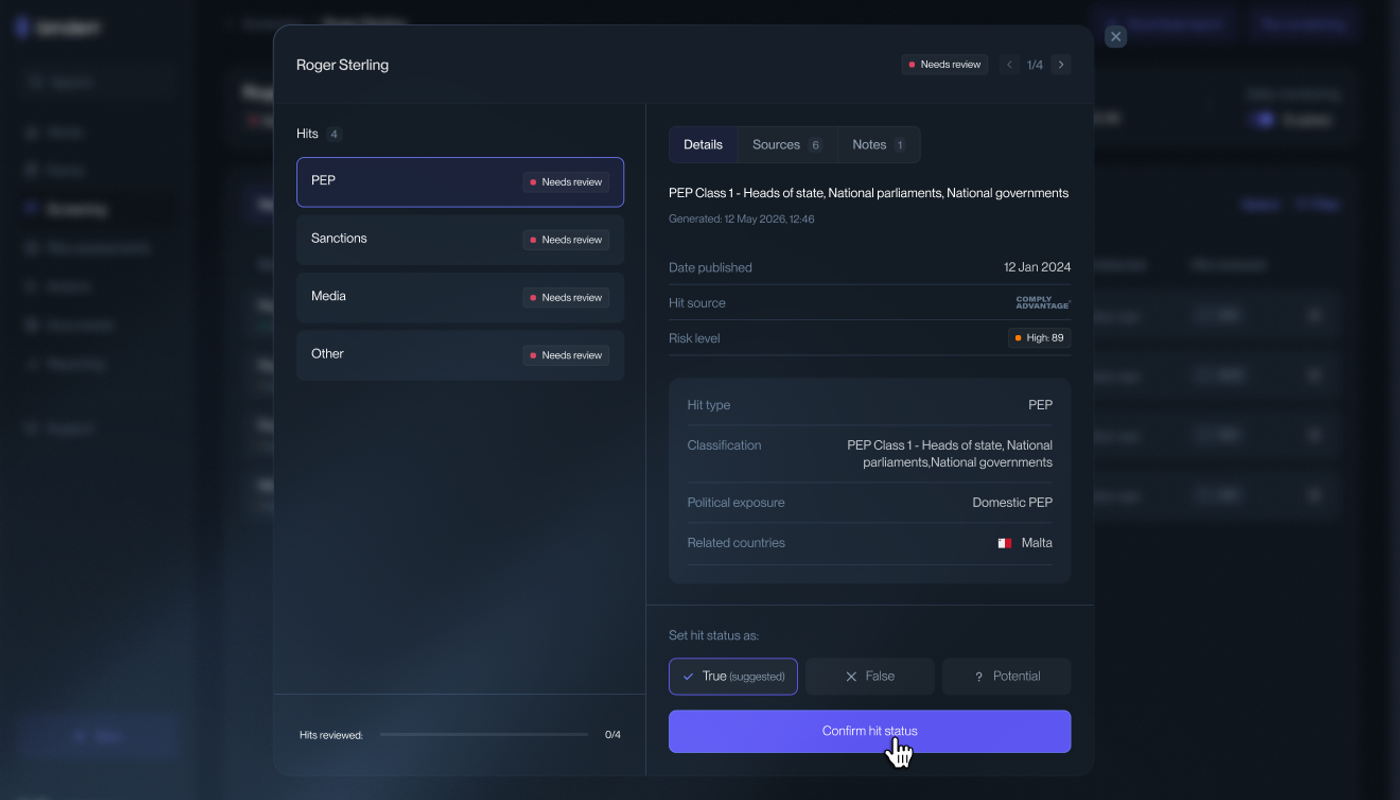
(Binderr enables teams to assess screening hits, verify match status, and record risk decisions within a unified compliance workflow.)
CDD triggers may include:
- New customer onboarding, where identity verification and initial AML screening are required
- Change in ownership, especially when new shareholders or UBOs are introduced
- Change in business activity that may alter the customer’s risk profile
- New product usage, particularly if the product carries higher financial crime risk
- Unusual transaction patterns that deviate from expected behavior
- Expired documents requiring re-verification
- Updated customer information such as address, nationality, or business structure
CDD ensures that businesses collect and verify essential customer information, assess risk factors, and establish a baseline risk profile. It is typically applied to low- and medium-risk customers but must still be thorough and well-documented.
EDD triggers may include:
- PEP match, including politically exposed persons, family members, or close associates
- Sanctions exposure, whether direct or through ownership links
- High-risk jurisdiction involvement, such as countries flagged by FATF
- Complex ownership structures, including layered or offshore entities
- Adverse media findings related to financial crime, corruption, or fraud
- Unclear or unverifiable source of funds or source of wealth
- High transaction volume that exceeds expected thresholds
- Suspicious activity indicators, such as structuring, rapid movement of funds, or inconsistent behavior
EDD involves deeper investigation, including enhanced identity verification, detailed source of funds checks, senior management approval, and more frequent monitoring. It is essential for managing high-risk customers and mitigating potential financial crime exposure.
FCA findings have noted that stronger firms tailor CDD and EDD processes to each customer’s risk profile, ensuring that higher-risk customers are subject to enhanced scrutiny, continuous monitoring, and clearly documented decision-making.
Alert Triggers in Customer Risk Scoring
Alert triggers are a critical component of AML monitoring and customer risk scoring. They enable compliance teams to respond quickly when a customer’s risk profile changes.
In a modern AML compliance workflow, alert triggers are closely tied to the AML screening risk score and broader AML risk assessment processes.
Examples of alert triggers:
- Customer becomes a PEP, requiring immediate reassessment and potential EDD
- New sanctions match appears, triggering urgent review and possible account restrictions
- Adverse media is detected, indicating potential involvement in financial crime or reputational risk
- UBO changes, especially when new beneficial owners introduce higher risk factors
- Company status changes, such as dissolution, insolvency, or regulatory action
- Customer starts transacting with high-risk jurisdictions, increasing geographic risk exposure
- Transaction activity exceeds expected thresholds, suggesting unusual or suspicious behaviour
- Documents expire, requiring updated verification to maintain compliance
- Risk score crosses a defined threshold, automatically escalating the case within compliance workflows
- Previously low-risk customer becomes medium or high risk due to new data or behavioural changes
By integrating alert triggers into AML monitoring systems, businesses can ensure that risk assessments remain dynamic and responsive. This approach strengthens compliance workflows, improves audit readiness, and helps organizations detect and mitigate financial crime risks more effectively.
Common Mistakes in AML Customer Risk Scoring
Avoid the pitfalls that can weaken your AML risk assessment and lead to inconsistent customer risk scoring decisions.
Understanding these common errors helps strengthen compliance workflows, improve AML risk scoring accuracy, and support a more effective risk-based approach.
Using generic scoring templates without tailoring them to the business - Generic AML risk scoring templates often fail to reflect the specific risks a business faces. Each organisation should customise its AML risk assessment framework based on its customer base, products, jurisdictions, and regulatory obligations to ensure accurate customer risk scoring.
Treating risk assessment as a one-time onboarding check - AML risk assessment should not stop at onboarding. Ongoing monitoring is essential to detect changes in customer behaviour, transaction patterns, or risk exposure, ensuring that risk scores remain accurate over time.
Giving too little weight to ownership and UBO risk - Beneficial ownership and UBO structures are critical components of AML risk assessment. Complex or opaque ownership structures can indicate higher financial crime risk, so they should carry appropriate weight in customer risk scoring models.
Ignoring adverse media and PEP exposure - Adverse media screening and PEP checks are key AML risk factors. Ignoring these signals can lead to underestimating customer risk, especially when individuals or entities are linked to corruption, fraud, or political exposure.
Not updating scores after customer behaviour changes - Customer risk scores should be dynamic and updated when new information or behavioural changes occur. Failing to adjust scores based on transaction activity or new alerts can weaken AML monitoring and compliance effectiveness.
Ignoring risk from products, geography, or transaction patterns - AML risk assessment must consider product risk, geographic exposure, and transaction behaviour. Overlooking these factors can result in incomplete risk profiles and ineffective customer risk scoring.
Binderr: Complete AML Compliance Solution
Binderr provides an end-to-end compliance platform covering the entire AML lifecycle:
- KYC and KYB verification
- AML screening and monitoring
- Customer risk scoring
- UBO identification and ownership mapping
- Automated CDD and EDD workflows
- Real-time alerts and monitoring
- Compliance reporting and audit trails
Bottom Line
AML risk assessment is essential for identifying and managing financial crime risk, but customer risk scoring is what turns that insight into consistent action. By using clear risk factors, structured workflows, and an aml risk assessment template, businesses can make faster onboarding decisions, apply the right level of due diligence, and maintain strong compliance.
Binderr Compliance helps you simplify AML risk assessment and automate customer risk scoring, so your team can make faster, smarter compliance decisions with confidence.