Banks process millions of transactions every day, making them a primary target for money launderers, fraudsters, and criminal networks. AML in banking, short for Anti-Money Laundering, is the framework of controls, policies, and technologies that helps financial institutions detect suspicious activity, verify customer identities, and prevent illicit funds from entering the financial system.
The scale of the threat is significant. According to the United Nations Office on Drugs and Crime (UNODC), an estimated 2% to 5% of global GDP is laundered each year, representing hundreds of billions of dollars in illicit funds. To combat these risks, banks rely on AML compliance programs that combine KYC checks, sanctions screening, transaction monitoring, and suspicious activity reporting.
Modern AML banking compliance goes far beyond basic customer verification. Financial institutions must continuously assess risk, monitor customer behavior, identify beneficial owners, and comply with evolving regulations. This guide explains how AML works in banking, the key AML requirements for banks, common compliance challenges, and the technologies helping institutions strengthen financial crime prevention in 2026.
Best AML Screening Software for Banks
- Screen individuals and businesses against sanctions, watchlists, PEP databases, and adverse media sources
- Run real-time AML checks during onboarding and ongoing monitoring
- Use AI-powered matching to reduce false positives and speed up reviews
- Detect adverse media across thousands of global sources
- Apply dynamic risk scoring for CDD and EDD decisions
- Maintain audit-ready records for compliance and regulatory reviews
What Does AML Mean in Banking?
Anti-Money Laundering (AML) in banking refers to the comprehensive framework of regulations, policies, procedures, and technologies that financial institutions use to detect, prevent, and report money laundering, terrorist financing, sanctions evasion, fraud, and other forms of financial crime. AML programs are designed to stop criminals from disguising illegally obtained funds as legitimate income and from exploiting banks to move illicit money through the financial system.
For example, if a customer suddenly begins transferring large sums of money to high-risk jurisdictions without a clear business purpose, the bank's AML monitoring system may generate an alert for investigation. Compliance teams then review the activity and determine whether additional due diligence or regulatory reporting is required.
Access Free Binderr Screening Tool
Why is AML Important for Banks?
Anti-Money Laundering (AML) plays a critical role in helping banks detect, prevent, and report financial crime. Effective AML compliance programs protect financial institutions from money laundering, terrorist financing, fraud, sanctions violations, and regulatory penalties while supporting the integrity of the global financial system.
As regulatory expectations continue to evolve, banks must implement robust AML controls, customer due diligence (CDD), transaction monitoring, sanctions screening, and ongoing risk assessments to remain compliant and reduce financial crime risk.
Meet AML regulatory requirements - Banks must comply with Anti-Money Laundering (AML) regulations designed to prevent money laundering, terrorist financing, and other financial crimes. A strong AML compliance program helps institutions meet legal obligations, satisfy regulatory expectations, and maintain operational continuity.
Avoid costly fines and enforcement actions - Regulators can impose significant penalties on banks that fail to maintain effective AML controls. By implementing robust AML screening, monitoring, and reporting processes, financial institutions can reduce compliance risks and avoid costly enforcement actions.
Detect and prevent financial crime - AML programs help banks identify suspicious activities, unusual transactions, and high-risk customers before criminal activity escalates. Effective transaction monitoring and risk assessment processes play a critical role in financial crime prevention.
Protect brand reputation and credibility - A bank's reputation can be severely damaged if it becomes associated with money laundering or other illicit activities. Strong AML controls demonstrate a commitment to compliance and help protect the institution's credibility with customers, investors, and regulators.
Strengthen customer trust and confidence - Customers expect banks to safeguard their accounts and maintain secure financial services. Effective AML and KYC procedures help create a safer banking environment, increasing customer trust and confidence in the institution.
Support financial system integrity - AML measures help prevent criminals from exploiting the banking system to move or conceal illicit funds. By identifying and reporting suspicious activity, banks contribute to a more transparent and stable global financial system.
Combat terrorist financing and illicit activity - One of the primary goals of AML in banking is to disrupt the flow of funds used to support terrorism, organized crime, and other illegal activities. Through sanctions screening, customer due diligence, and ongoing monitoring, banks help reduce these risks and support broader security efforts.
Simplify the AML Process with Binderr
Binderr brings key AML checks into one streamlined workflow, helping banks verify customers, screen for risk, assess profiles, and monitor changes continuously.
- Verify individuals using AI-powered document checks, biometric face matching, and liveness detection
- Verify businesses using global registry data, corporate records, directors, shareholders, and UBO information
- Screen customers against sanctions, PEPs, watchlists, and adverse media
- Automatically assign customer risk scores based on collected data
- Trigger CDD or EDD workflows based on risk level
- Monitor customers continuously for risk changes
How Does AML Work in Banking?
AML in banking operates through a structured framework of customer verification, risk assessment, AML screening, transaction monitoring, and ongoing compliance reviews. These processes help banks detect suspicious activity, prevent money laundering, and meet Anti-Money Laundering regulatory requirements.
The AML process in banking typically combines KYC, Customer Due Diligence (CDD), sanctions screening, PEP screening, adverse media checks, transaction monitoring, and suspicious activity reporting to identify and manage financial crime risks.
Step 1: Customer Identification
The AML process in banking begins with customer identification. Banks must verify that a customer is who they claim to be before opening an account or providing financial services. This typically involves identity verification using government-issued identification documents such as passports, driver's licenses, or national ID cards.
Banks also perform document verification and biometric verification, including facial recognition and liveness checks, to reduce identity fraud. For business customers, beneficial ownership verification is essential to identify the Ultimate Beneficial Owners (UBOs) who ultimately control or benefit from the organization. Accurate customer identification forms the foundation of effective AML compliance and financial crime prevention.
Step 2: Customer Due Diligence (CDD)
Once a customer's identity has been verified, banks conduct Customer Due Diligence (CDD) to assess potential money laundering and financial crime risks. This process involves collecting information about the customer's occupation, source of funds, business activities, expected transaction behavior, and geographic exposure.
Using this information, banks perform a customer risk assessment and assign a risk classification such as low, medium, or high risk. Higher-risk customers may require Enhanced Due Diligence (EDD), which involves additional verification and monitoring measures. A risk-based approach helps banks allocate compliance resources more effectively while meeting AML regulatory requirements.
Step 3: AML Screening
AML screening helps banks identify customers who may pose elevated compliance risks. During onboarding and throughout the customer relationship, banks screen individuals and businesses against global sanctions lists, politically exposed person (PEP) databases, regulatory watchlists, and law enforcement records.
Banks also conduct adverse media screening to identify negative news related to fraud, corruption, money laundering, terrorist financing, or other criminal activities. Automated AML screening solutions enable financial institutions to detect potential risks quickly, reduce manual reviews, and maintain compliance with evolving AML regulations.
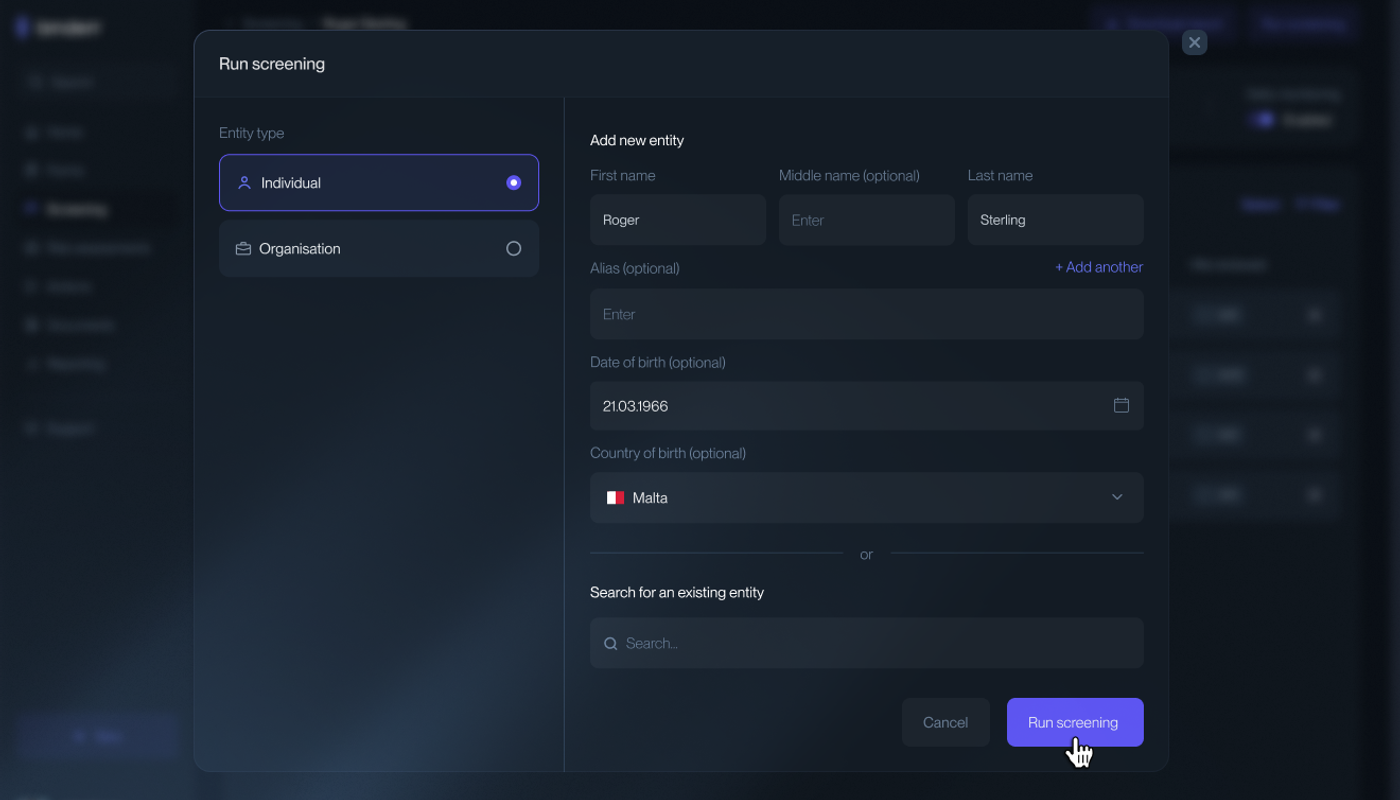
(Creating a new individual screening profile in Binderr before running sanctions, PEP, and adverse media checks.)
Step 4: Transaction Monitoring
After onboarding, banks continuously monitor customer transactions to detect unusual or suspicious activity. Transaction monitoring systems analyze payment patterns, account behavior, transaction volumes, and cross-border transfers to identify potential indicators of money laundering.
Modern AML monitoring in banks often uses real-time monitoring and behavioral analysis to compare customer activity against expected behavior. When suspicious transaction detection rules are triggered, alerts are generated for compliance teams to investigate further and determine whether escalation is required.
Step 5: Ongoing Monitoring
AML compliance does not end after onboarding. Banks must conduct ongoing monitoring to ensure customer information remains accurate and risk assessments remain up to date. Continuous customer review helps identify changes in ownership structures, business activities, geographic exposure, or transaction behavior.
Trigger events such as large transactions, changes in beneficial ownership, sanctions updates, or adverse media findings may require additional reviews. Regular risk profile updates allow banks to respond proactively to emerging risks and maintain effective AML controls throughout the customer lifecycle.
Banks often review hundreds or thousands of screening alerts every month. Modern AML software helps compliance teams prioritize investigations, manage screening outcomes, and maintain a complete audit trail for regulators.
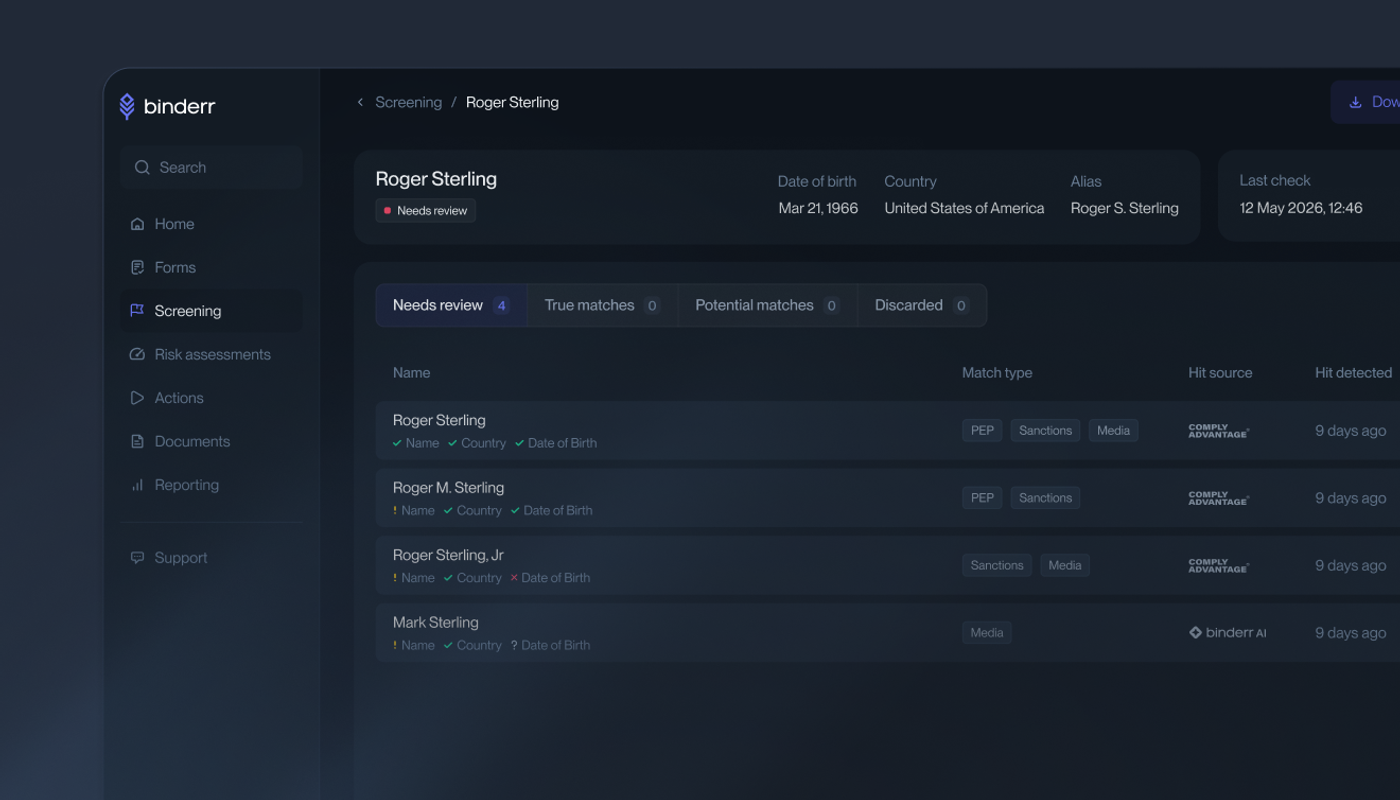
(AML screening dashboard in Binderr showing alerts, match classifications, investigation status, and screening outcomes.)
Step 6: Suspicious Activity Reporting
When a bank identifies activity that may indicate money laundering, fraud, terrorist financing, or sanctions evasion, it must investigate and follow established escalation procedures. Compliance teams review alerts, gather supporting evidence, and determine whether the activity warrants regulatory reporting.
If suspicion remains after investigation, the bank files a Suspicious Activity Report (SAR) with the appropriate regulatory authority, such as FinCEN in the United States. SAR filing is a critical AML requirement that helps regulators and law enforcement agencies detect and disrupt financial crime while ensuring banks meet their regulatory reporting obligations.
Review AML Screening Matches Faster with Binderr
- Review sanctions, PEP, watchlist, and adverse media hits in one place
- View match details, risk levels, source data, and classification
- Reduce false positives with smart matching algorithms
- Prioritise higher-risk alerts for faster investigation
- Confirm, discard, or escalate matches with clear review workflows
- Keep records of screening decisions for compliance reporting
The Three Stages of Money Laundering
Understanding the three stages of money laundering helps banks strengthen AML compliance, detect suspicious activity, and prevent financial crime.
These stages, placement, layering, and integration are central concepts in Anti-Money Laundering (AML) programs, transaction monitoring, and risk assessment processes used by financial institutions worldwide.
Placement
Placement is the first stage of money laundering, where criminals attempt to introduce illegally obtained funds into the legitimate financial system. Because large amounts of unexplained cash can attract attention from banks and regulators, money launderers often use techniques designed to avoid AML detection and reporting thresholds.
Common placement methods include:
- Cash deposits into bank accounts
- Structuring (smurfing) transactions to avoid reporting requirements
- Using cash-intensive businesses to disguise illicit proceeds
- Purchasing monetary instruments such as money orders or cashier’s checks
- Depositing funds through multiple accounts or intermediaries
At this stage, AML transaction monitoring systems and customer due diligence (CDD) controls help banks identify unusual cash activity and potential money laundering risks.
Layering
Layering is the second stage of money laundering and involves creating complex financial transactions to obscure the origin of illicit funds. The goal is to make it difficult for investigators, compliance teams, and law enforcement agencies to trace the money back to criminal activity.
Examples of layering techniques include:
- Multiple transfers between different bank accounts
- Cross-border and international transactions
- Use of shell companies and offshore entities
- Cryptocurrency conversions and transfers
- Complex corporate ownership structures
- Frequent movement of funds through multiple jurisdictions
During the layering stage, AML screening, beneficial ownership verification, sanctions screening, and ongoing monitoring play a critical role in detecting suspicious patterns and hidden connections.
Integration
Integration is the final stage of money laundering, where the laundered funds are reintroduced into the economy as seemingly legitimate assets or income. By this point, the money may appear to have a lawful source, making detection more challenging.
Common integration methods include:
- Property and real estate purchases
- Investments in businesses or financial products
- Luxury asset acquisitions such as vehicles, artwork, or jewelry
- Business activities that generate apparently legitimate revenue
- Loans, dividends, or consulting payments are used to justify fund origins
Banks use enhanced due diligence (EDD), risk assessments, adverse media screening, and ongoing AML monitoring to identify customers whose wealth, transactions, or investment activities may not align with their known financial profile.
Essential AML Checks Banks Use to Detect Financial Crime
Banks rely on a range of AML checks to identify high-risk customers, prevent money laundering, and maintain regulatory compliance.
These Anti-Money Laundering controls include identity verification, sanctions screening, PEP screening, adverse media checks, beneficial ownership verification, and ongoing customer monitoring.
Identity Verification
Identity verification is the foundation of AML compliance in banking. Financial institutions verify a customer's identity using government-issued IDs such as passports, driver's licenses, and national identity cards to confirm that the individual is who they claim to be. Modern customer onboarding processes often combine document verification with facial verification technology to compare a live selfie against the photo on an identity document, helping reduce identity fraud and account takeover risks.
To strengthen security further, banks use liveness detection to determine whether a real person is present during the verification process rather than a photo, video, or deepfake. These identity verification checks support Know Your Customer (KYC) requirements, improve customer due diligence (CDD), and help banks detect fraudulent applications before accounts are opened.
Sanctions Screening
Sanctions screening helps banks identify customers, businesses, and transactions linked to individuals, entities, or countries subject to financial restrictions. AML screening solutions compare customer data against global sanctions lists maintained by authorities such as the Office of Foreign Assets Control (OFAC), the United Nations (UN), the United Kingdom, and the European Union (EU). This process helps prevent prohibited transactions and reduces exposure to sanctions violations.
Banks typically perform sanctions screening during customer onboarding and throughout the customer lifecycle through ongoing monitoring. Automated sanctions screening tools can detect potential matches in real time, enabling compliance teams to investigate alerts quickly and maintain regulatory compliance across multiple jurisdictions.
Politically Exposed Person (PEP) Screening
Politically Exposed Persons (PEPs) are individuals who hold prominent public positions or have close associations with government officials, senior politicians, judges, military leaders, or executives of state-owned enterprises. Because of their influence and access to public funds, PEPs may present a higher risk of bribery, corruption, or money laundering activities.
PEP screening allows banks to identify these individuals and apply Enhanced Due Diligence (EDD) measures where necessary. This often includes deeper background checks, source-of-funds verification, ongoing monitoring, and periodic risk reviews to ensure that higher-risk relationships are managed appropriately.
When a potential match is identified, compliance teams must review the source, classification, risk level, and supporting information before determining whether the match is genuine.
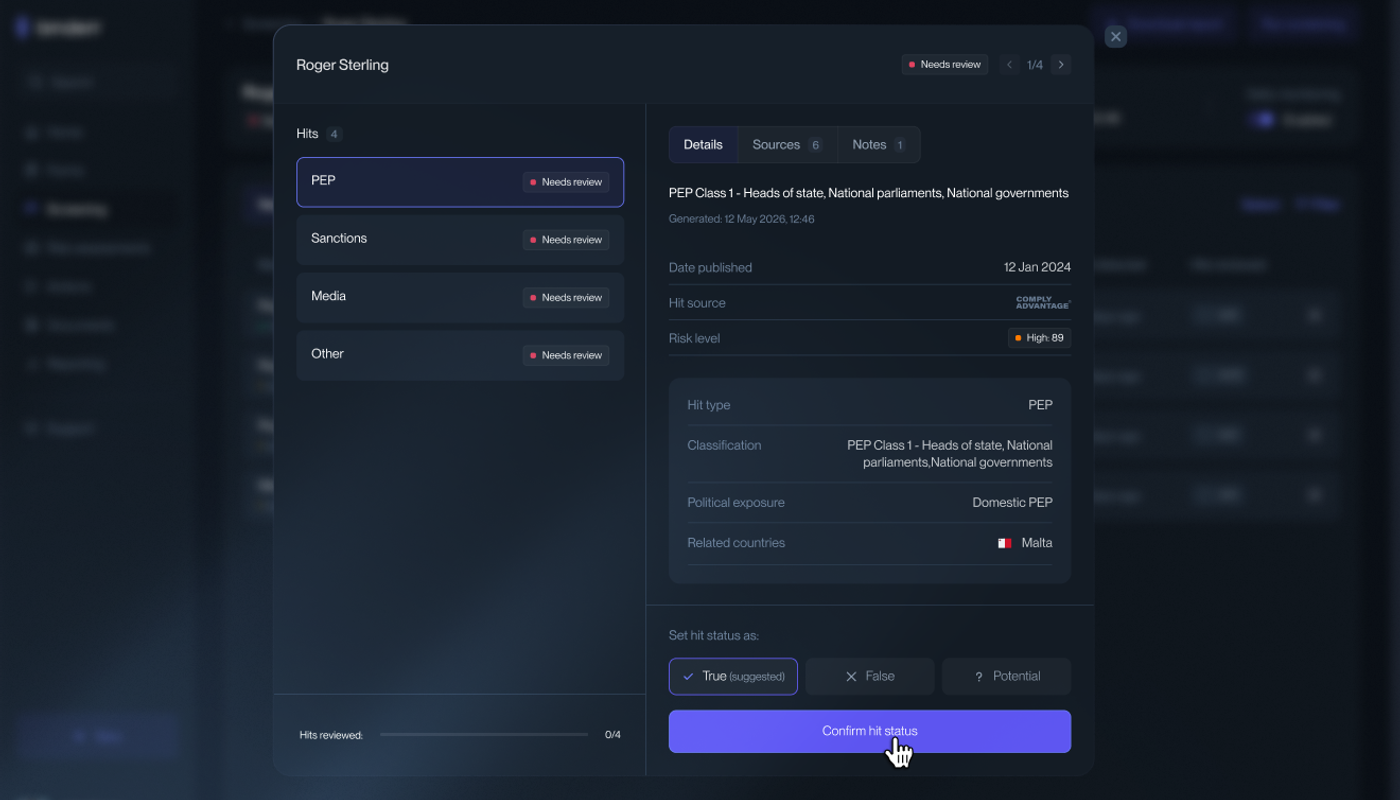
(Reviewing a potential PEP match in Binderr, including classification, source information, risk score, and match confirmation workflow. )
Adverse Media Screening
Adverse media screening, also known as negative news screening, involves monitoring publicly available information for reports that may indicate financial crime, fraud, corruption, sanctions violations, or other illicit activities. Banks use adverse media checks to uncover risks that may not appear on official watchlists or sanctions databases.
By analyzing news articles, regulatory announcements, court records, and other credible sources, financial institutions can identify potential reputational risks and emerging threats. Continuous adverse media monitoring helps compliance teams make informed risk decisions and respond quickly when new concerns arise.
Beneficial Ownership Verification
Beneficial ownership verification focuses on identifying the Ultimate Beneficial Owners (UBOs) who ultimately own or control a company. Criminals often use complex corporate ownership structures, shell companies, and nominee arrangements to conceal their identities, making UBO verification a critical component of AML compliance.
Banks must understand who benefits from a business relationship and verify ownership information against reliable sources. Strong beneficial ownership verification supports corporate transparency requirements, improves risk assessments, and helps financial institutions detect hidden ownership structures that could be linked to money laundering or other financial crimes.
Run Free AML Checks in Minutes with Binderr
Key AML Regulations and Compliance Requirements for Banks
Banks must comply with a complex framework of AML regulations designed to prevent money laundering, terrorist financing, and other financial crimes.
Understanding AML compliance requirements, banking regulations, KYC obligations, customer due diligence standards, and suspicious activity reporting rules is essential for maintaining regulatory compliance and reducing financial crime risk.
FATF Recommendations
The Financial Action Task Force (FATF) is the global standard-setting body for Anti-Money Laundering (AML) and Counter-Terrorist Financing (CTF). Its 40 Recommendations provide a risk-based framework that guides how banks and financial institutions conduct customer due diligence (CDD), Know Your Customer (KYC) checks, beneficial ownership verification, sanctions screening, and suspicious activity reporting. While FATF does not directly regulate banks, its standards heavily influence national AML regulations worldwide.
Bank Secrecy Act (BSA)
In the United States, the Bank Secrecy Act (BSA) forms the foundation of AML compliance. It requires banks to maintain AML programs, monitor transactions, keep detailed records, and submit reports such as Currency Transaction Reports (CTRs) and Suspicious Activity Reports (SARs). The BSA helps regulators and law enforcement identify money laundering, fraud, terrorist financing, and other financial crimes.
USA PATRIOT Act
The USA PATRIOT Act strengthened AML requirements following the events of 9/11 by expanding customer identification and due diligence obligations for financial institutions. Key provisions include enhanced customer verification, information-sharing mechanisms, and stricter controls for high-risk accounts and cross-border transactions. These measures help banks detect and prevent illicit financial activity more effectively.
AML Directives in Europe
The European Union's Anti-Money Laundering Directives (AMLDs) establish AML compliance requirements across member states. These directives focus on customer due diligence, beneficial ownership transparency, politically exposed person (PEP) screening, transaction monitoring, and risk-based compliance programs. Successive AMLDs have increased regulatory expectations and strengthened financial crime prevention across Europe.
Local Banking Regulations
In addition to global standards, banks must comply with local regulatory requirements. Examples include the Financial Conduct Authority (FCA) in the UK, the Financial Crimes Enforcement Network (FinCEN) in the US, the Monetary Authority of Singapore (MAS), and the Australian Transaction Reports and Analysis Centre (AUSTRAC). These regulators enforce AML regulations, oversee compliance programs, and impose penalties on institutions that fail to meet Anti-Money Laundering obligations.
Strengthen Banking Compliance with Binderr
- KYC with AI-powered document verification, biometric face matching, liveness detection, and fraud checks
- KYB with global registry access, company data retrieval, director and shareholder verification, and entity validation
- AML screening across sanctions lists, watchlists, PEP databases, and adverse media sources
- UBO identification and ownership structure mapping to uncover complex ownership chains
- CDD and EDD workflows to support risk-based onboarding decisions
- Ongoing AML monitoring with real-time alerts for risk changes
Bottom Line
AML is a core part of banking compliance, helping financial institutions detect, prevent, and report financial crime. By combining KYC, customer due diligence, screening, transaction monitoring, and ongoing oversight, banks can manage risk and meet regulatory requirements. As financial crime threats evolve, modern AML technology and automation are becoming essential for maintaining effective and efficient compliance programs.
Binderr Compliance helps banks streamline AML screening, KYC verification, UBO checks, risk assessments, and ongoing monitoring through a single automated compliance platform.