
KYB compliance in the EU has become a critical part of customer due diligence as regulators tighten expectations around business verification and transparency. Companies onboarding corporate clients must go beyond basic registration checks and confirm ownership structures, beneficial owners and financial crime risk exposure. For organisations managing KYB Europe operations, strong EU KYB processes help reduce fraud, meet AML compliance requirements and build trust in cross-border business relationships.
Business verification in Europe is evolving as fragmented national AML rules move toward a more unified framework. According to the European Commission, an estimated 1 percent of the EU’s annual GDP is linked to suspicious financial activity, highlighting the importance of robust KYB checks and AML screening. As EU KYB regulations continue to develop, organisations that rely only on company registration data risk missing hidden ownership layers, shell entities and high-risk connections.
In this guide, we have outlined the key components, regulatory context and practical steps needed to build a robust KYB framework across the EU. It also explains how to strengthen corporate verification EU workflows across different Member States. Leveraging solutions like Binderr Services can further streamline compliance by automating verification, screening and monitoring processes, helping businesses stay efficient and compliant as regulations evolve.
Binderr EU KYB Software Solutions
With Binderr Services, you can:
- Global registry coverage: Access company information across 200+ countries and 30,000+ corporate data sources.
- Official company data: Retrieve registration details, incorporation status, addresses, directors and shareholders.
- UBO identification: Identify the natural persons who ultimately own or control a corporate customer.
- Ownership structure mapping: Visualise direct and indirect ownership across complex, multi-layered corporate structures.
- Connected-party screening: Screen companies, directors, shareholders and UBOs against sanctions, PEPs, watchlists and adverse media.
- Dynamic risk assessment: Automatically score businesses using jurisdiction, ownership, industry, screening and profile information.
What Is KYB Compliance in the EU?
KYB compliance in the EU, or Know Your Business, refers to the process of verifying a company’s identity, legal status and ownership structure while assessing its risk exposure under EU AML regulations. For businesses developing a KYB Europe programme, it focuses on corporate customer verification, ensuring that organisations are legitimate and transparent, while KYC, or Know Your Customer, applies to the individuals behind those entities, such as directors and ultimate beneficial owners.
As part of the broader customer due diligence framework, KYB integrates AML screening to detect sanctions, politically exposed persons and adverse media risks. It also includes risk assessment to determine whether standard, simplified or enhanced due diligence measures are required. Together, these controls support corporate verification EU requirements, help organisations comply with EU KYB regulations and prevent financial crime.
Access KYB Compliance Tools for Free
The Main EU Regulations Affecting KYB Compliance
Understand the key EU AML frameworks and EU KYB regulations shaping business verification, beneficial ownership checks and corporate due diligence across Europe. These rules establish the foundation for KYB Europe programmes and influence how regulated organisations structure corporate verification EU processes.
Existing EU Anti-Money Laundering Directives
The existing EU Anti-Money Laundering Directives underpin current KYB compliance across Europe but are implemented through national laws, leading to differences in interpretation and enforcement. They require businesses to conduct customer due diligence, identify beneficial owners, apply enhanced checks for higher-risk clients, report suspicious activity and maintain records.
These directives remain in force in 2026, while the new EU AML framework will begin applying from July 2027. Organisations managing KYB Europe operations must therefore continue following applicable national legislation while preparing their processes for the incoming EU KYB regulations.
Regulation (EU) 2024/1624
Regulation (EU) 2024/1624, known as the Anti-Money Laundering Regulation, introduces a more harmonised and directly applicable set of AML compliance requirements across the EU. It standardises key KYB processes such as customer identification and verification, beneficial ownership checks, ownership and control analysis, and targeted financial sanctions screening.
The regulation also emphasises PEP identification, understanding the purpose of business relationships, applying risk-based due diligence, and maintaining ongoing monitoring and record retention. Although the AMLR is already in force, it becomes applicable to most obliged entities on 10 July 2027, marking a shift toward unified EU KYB regulations and more consistent corporate verification EU standards.
Directive (EU) 2024/1640
Directive (EU) 2024/1640 complements the AMLR by outlining the structural and institutional mechanisms that Member States must establish to support AML enforcement. This includes national supervisory authorities, financial intelligence units, beneficial ownership registers and bank account registers.
It also promotes cooperation between authorities, national risk assessments and robust enforcement systems. While most provisions will apply from July 2027, certain elements such as central beneficial ownership registers must be implemented earlier, with a deadline of 10 July 2026.
This phased approach supports a smoother transition to the EU AML Single Rulebook and helps improve the consistency of KYB Europe and corporate verification EU processes.
Regulation (EU) 2024/1620 and AMLA
Regulation (EU) 2024/1620 establishes the Authority for Anti-Money Laundering and Countering the Financing of Terrorism, which plays a key role in shaping EU AML compliance. AMLA develops the EU AML/CFT Single Rulebook, promotes consistent supervision and coordinates national regulators.
It also supports cooperation between financial intelligence units and issues technical standards. From 2028, AMLA will directly supervise selected high-risk cross-border financial institutions and is preparing to oversee up to 40 complex groups.
For businesses operating across multiple Member States, AMLA is expected to promote greater consistency in EU KYB regulations and reduce some of the regulatory fragmentation currently affecting KYB Europe compliance.
EU Sanctions Regulations
EU sanctions regulations are legally binding and must be clearly distinguished from general AML risk screening, PEP screening and adverse media checks. While AML screening helps identify potential financial crime risks, sanctions compliance requires businesses to ensure that neither the customer nor their beneficial owners are listed on EU sanctions lists.
Under the AMLR, companies must also assess whether sanctioned individuals hold control or majority interests in legal entities. This makes sanctions screening a critical component of EU KYB regulations, particularly for cross-border corporate verification EU checks and relationships involving high-risk jurisdictions.
GDPR and KYB Data Processing
KYB processes involve handling personal data related to directors, shareholders and beneficial owners, making GDPR compliance essential. Organisations must have a lawful basis for processing, collect data for specific purposes and limit access to authorised personnel.
Data should be accurate, securely stored and retained only as long as necessary. Screening systems should minimise bias, and high-risk processing may require impact assessments. The AMLR permits AML-related data processing but requires strict safeguards covering data quality, security and purpose limitation.
These safeguards are especially important for KYB Europe programmes that process information across multiple jurisdictions or use automated corporate verification EU systems.
eIDAS and the European Digital Identity Framework
The eIDAS framework and its extension under Regulation (EU) 2024/1183 support digital onboarding by enabling the use of EU-recognised electronic identification, digital signatures, seals and identity wallets.
These tools can streamline KYB and KYC processes by providing verified identity data for both natural and legal persons. They may also improve the speed and reliability of corporate verification EU workflows.
However, while digital identity solutions enhance efficiency and trust, they do not replace comprehensive KYB checks, including risk assessment, ownership verification and AML screening. Organisations must still ensure their digital processes satisfy applicable EU KYB regulations.
Simplify Compliance for Free with Binderr
What Information Must Be Collected During EU Business Verification?
Provide a comprehensive and practical KYB checklist that helps compliance teams gather all necessary data for EU business verification, customer due diligence and AML compliance.
This section should guide readers through the essential information required to verify a corporate entity, assess risk and meet regulatory expectations across EU jurisdictions. It should also help organisations standardise KYB Europe and corporate verification EU workflows without overlooking local requirements.
Business Information
To establish the legal identity and operational profile of a company, the following core business details must be collected and verified:
- Registered legal name, as listed in official company registers
- Trading name or brand name, if different from the legal name
- Company registration number, which is the unique identifier in the national registry
- Legal form, such as GmbH, SARL, PLC or Ltd
- Incorporation date to assess company age and history
- Registered address
- Principal place of business, if different from the registered address
- Current company status, such as active, dissolved or in liquidation
- Jurisdiction of incorporation
- Tax identification number
- VAT number for EU VAT validation through VIES
- Business activities and descriptions of products or services
- Industry classification, such as a NACE code
- Licensing or regulatory status
- Website and contact information, including email, phone and domain verification
These data points help confirm the company’s existence, legitimacy and operational footprint. They form the foundation of EU KYB compliance and support accurate corporate verification EU checks.
Corporate Documents
Supporting documentation is essential to validate registry data, confirm ownership and establish legal authority. Depending on the risk level and jurisdiction, businesses may need to collect:
- Certificate of incorporation
- Commercial register extract
- Articles of association
- Memorandum of association
- Partnership agreement
- Operating agreement
- Shareholder register
- Director register
- Certificate of incumbency
- Good standing certificate
- Ownership chart
- Regulatory licence
- Tax or VAT documentation
- Board resolution or power of attorney
These documents are critical for verifying legal structure, ownership layers and the authority of individuals acting on behalf of the business. They also provide supporting evidence that corporate verification EU teams can retain within an auditable KYB Europe workflow.
Connected Individuals
EU KYB requirements extend beyond the company itself to include all relevant natural persons connected to the entity. Identifying and verifying these individuals is essential for beneficial ownership transparency and AML screening:
- Directors
- Shareholders
- Ultimate beneficial owners
- Senior managing officials, if no UBO is identifiable
- Authorised signatories
- Legal representatives
- Trustees
- Settlors
- Protectors
- Beneficiaries
- Persons exercising control through other means, such as voting rights or contractual control
Each of these individuals may require identity verification, sanctions screening, PEP checks and adverse media review as part of a complete AML compliance process.
The precise checks should reflect the customer’s risk profile, the applicable EU KYB regulations and the jurisdiction in which the corporate verification EU process is being conducted.
Complete KYB Checks Faster
EU KYB Process Step by Step
Master business verification, UBO identification, AML screening and risk assessment across Europe with a clear, structured approach. This process can help organisations build a consistent KYB Europe framework while accommodating local EU KYB regulations.
Step 1: Collect Business Information
Start by gathering essential company data using a risk-based corporate onboarding form tailored to the customer’s legal structure, jurisdiction and intended services. This includes key KYB data points such as company name, registration number, address, business activity and tax identifiers to support accurate business verification.
Ensure the onboarding process aligns with EU KYB compliance requirements and captures sufficient information for customer due diligence. A structured approach helps streamline AML compliance, reduce onboarding friction and prepare for effective risk assessment and ongoing monitoring.
For corporate verification EU workflows, forms should also be configurable enough to account for differences between Member States, legal forms and regulated sectors.
Step 2: Search the Official Company Register
Verify the company’s legal existence by checking official company registers or trusted registry databases. Compare submitted details with authoritative sources to confirm accuracy and detect discrepancies in registration status, directors or business information.
Using reliable registry data supports EU business verification and strengthens KYB compliance by ensuring the entity is active and legitimate. This step is critical for preventing fraud and maintaining accurate AML records. It also provides a foundational data point for all subsequent verification steps.
For cross-border KYB Europe onboarding, compliance teams may need to access several national registers and account for differences in available data.
Step 3: Obtain Corporate Documents
Request relevant corporate documents such as certificates of incorporation, articles of association or shareholder registers to validate ownership and authority. Focus only on documents necessary to fill gaps identified during registry checks.
Efficient document collection supports AML compliance while minimising unnecessary data handling. It also helps confirm legal structure, ownership details and authorisation, which are essential for customer due diligence and audit readiness.
Proper documentation ensures traceability, strengthens compliance evidence and helps corporate verification EU teams demonstrate that regulatory requirements have been followed.
Step 4: Identify Directors and Representatives
Identify key individuals managing the company, including directors and authorised representatives. Confirm their roles and authority to act on behalf of the business using registry data or official documentation.
This step ensures proper governance verification and supports KYB compliance by linking individuals to the entity. It also prepares for identity verification and AML screening of connected persons.
Clear identification reduces the risk of unauthorised representation and helps establish accountability within the organisation. It is a core component of reliable KYB Europe onboarding.
Step 5: Build the Ownership Structure
Map out the company’s ownership structure by tracing both direct and indirect shareholders across all entity layers. This includes identifying parent companies, subsidiaries and intermediary entities.
Understanding ownership structure is essential for identifying ultimate beneficial owners and assessing risk exposure. It also supports transparency and compliance with EU KYB regulations.
A complete ownership map helps uncover hidden relationships and control mechanisms. It provides a clearer view of how influence is distributed within the organisation and strengthens corporate verification EU decisions.
Step 6: Identify the UBOs
Determine the ultimate beneficial owners by applying both ownership thresholds and control criteria. Do not rely solely on percentage ownership. Consider individuals who exercise control through other means.
Accurate UBO identification is a core requirement of KYB compliance and EU AML frameworks. It ensures transparency and helps detect hidden ownership or potential financial crime risks.
Proper identification also supports regulatory reporting obligations and strengthens the integrity of the overall compliance process. Organisations operating a cross-border KYB Europe programme should also consider how ownership rules are applied in each relevant jurisdiction.
Step 7: Verify Connected Individuals
Conduct identity verification on UBOs, directors and authorised representatives based on risk level and regulatory requirements. Use reliable identity documents or electronic verification methods.
This step strengthens AML compliance by confirming the identities of individuals linked to the business. It also supports sanctions screening and reduces the risk of onboarding fraudulent entities.
Verified identities improve trust and accountability within the onboarding process. They also help ensure that corporate verification EU workflows connect legitimate individuals with the correct company records.
Screen Directors, UBOs and Representatives With Binderr
Once the individuals connected to a corporate customer have been identified and verified, they should be screened for sanctions, PEP, watchlist and adverse media exposure. Binderr allows compliance teams to add a new individual or organisation, enter relevant matching information and initiate screening from one structured workflow.
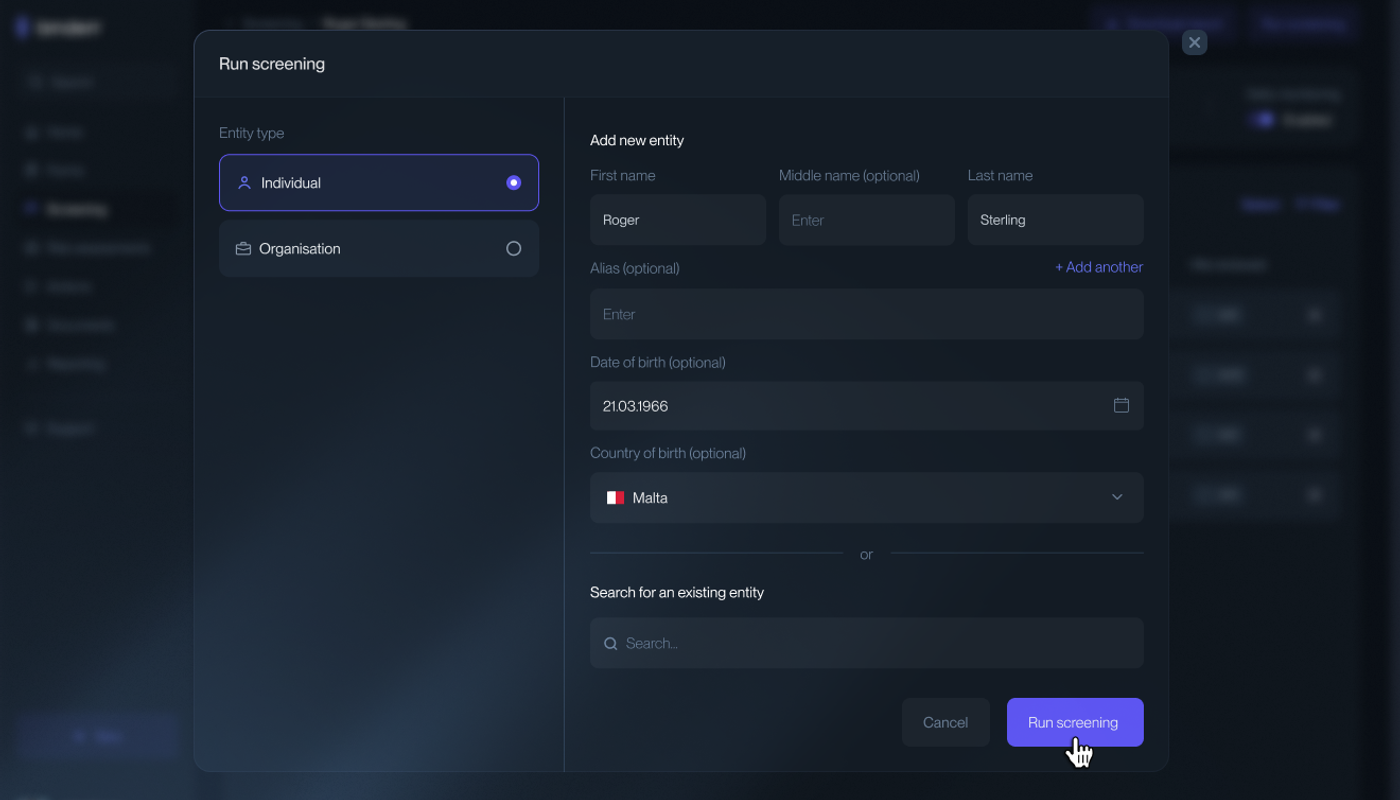
(Binderr allows compliance teams to screen individuals and organisations using names, aliases, dates of birth and country information.)
Step 8: Run AML Screening
Screen the company and all relevant individuals against sanctions lists, politically exposed persons databases, watchlists and adverse media sources. Use automated AML screening tools where possible.
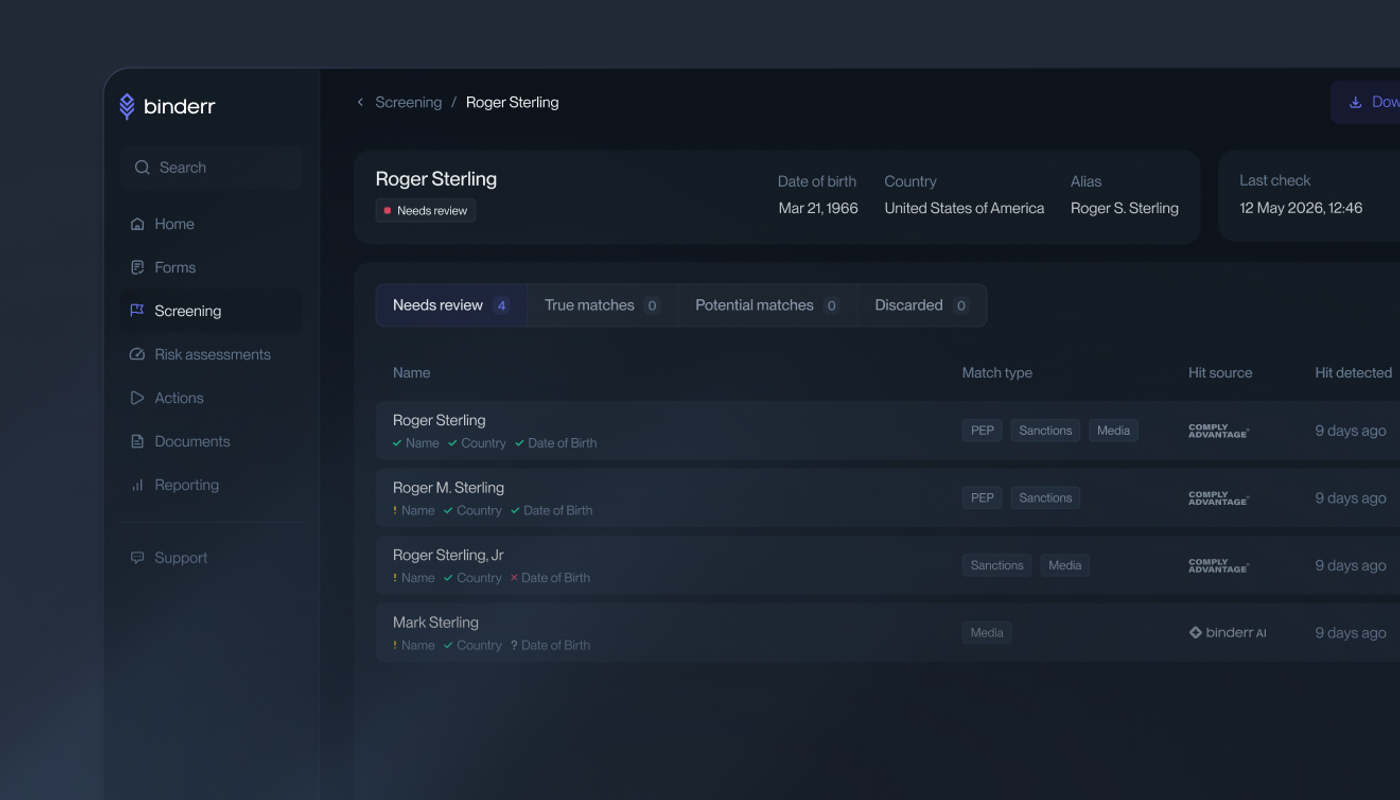
(Binderr organises PEP, sanctions and adverse media results into review queues, helping compliance teams compare matching information and prioritise alerts.)
Effective AML screening helps identify financial crime risks and ensures compliance with EU sanctions regulations. It is a critical component of KYB and ongoing monitoring processes.
Regular updates to screening data enhance detection accuracy and enable faster identification of emerging risks. Screening configurations should reflect the organisation’s risk appetite and applicable EU KYB regulations.
Step 9: Assess the Customer’s Risk
Evaluate the overall risk profile of the business using a structured risk assessment model. Consider factors such as jurisdiction, industry, ownership complexity and transaction behaviour.
A documented risk-scoring methodology supports consistent decision-making and regulatory compliance. It also determines whether standard due diligence or enhanced due diligence is required.
Consistent risk evaluation helps prioritise compliance resources effectively and ensures that higher-risk cases receive appropriate attention. It also promotes greater consistency across multi-country KYB Europe operations.
Step 10: Apply CDD or EDD
Based on the risk assessment, apply appropriate customer due diligence or enhanced due diligence measures. Collect additional information for high-risk or complex cases.
EDD may include deeper ownership analysis, source of funds verification and increased monitoring. This ensures compliance with AML regulations and mitigates potential financial crime risks.
Applying the correct level of diligence improves overall risk management and enhances the organisation’s ability to detect suspicious activity early. These decisions should remain consistent with EU KYB regulations and documented internal policies.
Step 11: Approve, Reject or Escalate
Make a final onboarding decision based on the collected data, verification results and risk assessment. Approve low-risk customers, reject unacceptable cases or escalate them for further review when necessary. This ensures that decisions are aligned with compliance policies and risk appetite.
Maintain a clear audit trail by recording the decision, reviewer, supporting evidence, overrides, approval conditions, monitoring requirements and review date. This ensures transparency and supports regulatory audits.
A well-documented decision process strengthens accountability and compliance oversight across corporate verification EU and KYB Europe workflows.
Simplify the EU KYB Process With Binderr
- Collect company information through customisable onboarding forms.
- Retrieve official registry data across multiple jurisdictions.
- Verify company registration details, status, directors and shareholders.
- Build visual ownership structures across direct and indirect entity layers.
- Identify the individuals who ultimately own or control the business.
- Run KYC checks on UBOs, directors and authorised representatives.
How EU KYB Requirements Differ Between Member States
KYB Europe compliance varies significantly across Member States because of differences in national company law, registry infrastructure and AML supervision. While some countries provide highly digitised company registers with real-time data access, others rely on manual filings or limited public information.
Language barriers, document certification requirements and varying levels of beneficial ownership transparency can complicate cross-border business verification. These inconsistencies mean that organisations must adapt their corporate verification EU processes to meet local regulatory expectations while maintaining a consistent risk-based approach across jurisdictions.
Although the EU AML Regulation aims to harmonise EU KYB regulations from July 2027, full standardisation will not eliminate national differences in licensing regimes, enforcement practices or supervisory interpretation.
Businesses operating across Europe should invest in multi-country registry access, local compliance expertise and flexible onboarding workflows. Effective KYB Europe compliance requires combining centralised oversight with country-specific controls, ensuring accurate company verification, UBO identification and AML screening across diverse regulatory environments.
Verify Cross-Border Ownership With Binderr KYB Software
A basic company register search may reveal immediate shareholders but fail to show the complete ownership chain or the natural persons exercising ultimate control. Binderr combines global registry access with ownership structure mapping to help compliance teams move beyond first-layer company information.
- Access corporate data across 200+ countries.
- Search information from 30,000+ corporate data sources.
- Retrieve company status, registration information, directors and shareholders.
- Trace direct and indirect shareholders across multiple entity layers.
- Visualise complex ownership structures and corporate hierarchies.
- Identify UBOs behind intermediary companies and holding structures.
Best Practices for EU KYB Compliance
Stay ahead of evolving EU KYB regulations with smarter, streamlined strategies that reduce risk and improve efficiency.
Discover practical approaches to business verification, UBO identification, AML screening and ongoing monitoring across KYB Europe operations.
Use a Risk-Based Approach
Apply a risk-based approach to KYB compliance by tailoring the level of business verification and due diligence to the customer’s risk profile.
Higher-risk entities may require enhanced due diligence, while lower-risk businesses can be onboarded with standard checks. This helps maintain efficiency without compromising AML compliance or the quality of corporate verification EU decisions.
Use Authoritative Registry Sources
Rely on official company registers, regulatory databases and trusted public authorities when verifying EU businesses.
Using authoritative sources improves data accuracy and ensures that company information, legal status and registration details are reliable for compliance purposes. It also provides a stronger foundation for cross-border KYB Europe checks.
Verify Ownership Through Multiple Sources
Cross-check ownership information using customer declarations, shareholder registers, official company records and independent data providers.
This helps confirm the accuracy of beneficial ownership details and reduces the risk of relying on incomplete or outdated information. It also provides stronger evidence that corporate verification EU requirements have been addressed.
Apply Ownership and Control Tests Together
Assess both ownership percentages and control mechanisms when identifying ultimate beneficial owners.
Even if no individual meets the 25% ownership threshold, control through voting rights or other means may still indicate beneficial ownership under EU KYB regulations.
Use Event-Driven Monitoring
Implement ongoing monitoring that triggers reviews when key changes occur, such as updates to ownership, directors, company status or sanctions screening results.
Event-driven monitoring helps keep KYB data current and supports continuous AML compliance. It is especially valuable for KYB Europe programmes involving large numbers of customers across different jurisdictions.
Prepare for the EU Single Rulebook
Align existing KYB processes with the upcoming EU AML Regulation by reviewing current controls and identifying gaps.
Preparing early for the EU Single Rulebook ensures smoother compliance when AMLR requirements become applicable in July 2027. It also gives corporate verification EU teams time to improve workflows, data sources, risk models and monitoring controls.
EU KYB Record-Keeping Requirements
Effective KYB record-keeping is a core component of EU AML compliance and ensures that organisations can demonstrate a clear, auditable trail of their business verification and customer due diligence processes.
For organisations managing KYB Europe customers, records must be accurate, complete and easily retrievable for regulatory inspections, internal audits and ongoing monitoring. Record-keeping controls should also reflect applicable EU KYB regulations and national requirements.
Records should allow the organisation to demonstrate:
- What information was collected during onboarding, including company data, ownership details and supporting documentation
- Which official and independent sources were checked, such as company registers, BRIS, beneficial ownership registers and screening databases
- How ultimate beneficial owners were identified, including ownership calculations and control assessments
- Which AML screening results were reviewed, including sanctions, PEP and adverse media findings
- How false positives were investigated, documented and resolved
- How the customer’s risk profile was assessed using a risk-based approach
- Why the business relationship was approved, rejected or escalated for enhanced due diligence
- Who made the compliance decision, including any senior management approvals
- When the next periodic review or ongoing monitoring trigger is due
- What changes were detected after onboarding, such as updates to ownership, directors or sanctions status
In addition to these elements, organisations should maintain:
- Copies of corporate documents and identity verification records
- Risk-scoring models and decision logic used during onboarding
- Internal communications related to compliance decisions
- Evidence of ongoing monitoring alerts and follow-up actions
- Audit logs showing access, updates and modifications to customer records
These records allow corporate verification EU teams to explain how information was gathered, evaluated and used to reach a compliance decision.
Under the incoming EU Anti-Money Laundering Regulation, CDD documents, transaction records and compliance assessments must generally be kept for at least five years after a relationship ends, a transaction is completed or a relationship is refused. Authorities may require longer retention in specific cases, within legal limits.
National AML laws before July 2027 may set different retention periods or requirements. Businesses operating across the EU should align their policies with current national rules, their broader KYB Europe framework and the upcoming EU Single Rulebook.
Binderr’s End-to-End Compliance Capabilities
- KYC and identity verification: Verify passports, identity cards and driving licences across 230+ countries and 11,000+ document types.
- Biometric verification: Use face matching, liveness detection and AI-powered fraud checks to verify connected individuals.
- KYB and business verification: Retrieve company data, validate entities and verify corporate registration information.
- Director and shareholder verification: Identify and assess the key individuals associated with a business.
- UBO identification: Find and verify the natural persons who ultimately own or control the customer.
- Ownership structure mapping: Unravel and visualise complex, multi-jurisdictional ownership chains.
Bottom Line
Effective EU KYB compliance goes far beyond simply confirming that a company exists in a registry. A robust process must verify the legal entity, understand its business activity, identify representatives, trace ownership and control, and confirm beneficial owners.
It should also include AML screening, risk assessment, enhanced due diligence where needed and continuous monitoring. Together, these measures create a more reliable corporate verification EU process and help organisations manage risk across their KYB Europe operations. As the EU moves toward a unified AML Single Rulebook, businesses have a valuable opportunity to modernise their KYB workflows, replace fragmented manual processes and build scalable, compliant systems ahead of the 2027 regulatory shift.
Preparing early for incoming EU KYB regulations can help organisations improve data quality, strengthen ownership verification and create more consistent compliance decisions across Member States. Binderr Services can help streamline KYB Europe processes with automated company verification, ownership checks, AML screening, risk assessment and ongoing monitoring in one unified platform.