
Every corporate customer onboarding journey now depends on effective KYB verification and AML screening. Businesses are expected to validate company legitimacy, review ownership structures, and detect compliance risks before approving commercial accounts.
Global regulators are increasing pressure on businesses to strengthen corporate verification and ongoing AML monitoring. According to the United Nations Office on Drugs and Crime, an estimated 2% to 5% of global GDP is connected to money laundering activity each year. Manual KYB checks and fragmented compliance workflows are becoming harder to manage at scale.
Today’s automated KYB onboarding platforms combine business verification, AML screening, UBO verification, sanctions checks, and risk scoring into one streamlined workflow. Businesses can reduce onboarding delays, improve compliance accuracy, lower false positives, and onboard corporate clients faster across multiple jurisdictions.
Inside this guide, we explain how KYB onboarding works, key compliance requirements businesses must follow in 2026, common onboarding challenges, and how automated KYB solutions help companies build scalable global compliance operations.
Binderr KYB Compliance Software
- Automated KYB onboarding and corporate verification workflows
- Global business verification across 200+ countries and jurisdictions
- Integrated AML screening, sanctions checks, and adverse media monitoring
- UBO verification, ownership mapping, and dynamic risk scoring
- Continuous AML monitoring with real-time compliance alerts
What is KYB Onboarding?
KYB onboarding, or Know Your Business onboarding, is the process businesses use to verify corporate customers before establishing a business relationship. Financial institutions, fintech companies, payment providers, and crypto platforms use KYB checks to verify company legitimacy, identify UBOs, assess risk, and meet AML compliance requirements.
Unlike KYC, which verifies individuals, KYB onboarding focuses on businesses, directors, shareholders, ownership structures, and corporate activities. Modern KYB workflows combine business verification, AML screening, sanctions checks, and risk assessment into one streamlined compliance process.
As compliance requirements continue to grow in 2026, businesses must perform stronger corporate due diligence before onboarding commercial clients. Automated KYB onboarding solutions help reduce fraud risk, improve onboarding speed, lower false positives, and support scalable global compliance operations.
Why KYB Onboarding Matters in 2026
Stronger AML regulations and rising financial crime risks are pushing businesses to improve KYB onboarding and corporate verification processes.
As global compliance expectations continue to grow, businesses must combine business verification, UBO checks, AML screening, and ongoing monitoring into one scalable onboarding workflow.
Rising Global AML Compliance Requirements: Global AML regulations are becoming stricter across banking, fintech, crypto, and payment industries. Businesses must strengthen KYB onboarding, customer due diligence, sanctions screening, and AML monitoring processes to meet growing compliance expectations and avoid regulatory penalties.
Growth of Cross-Border Business Transactions: International business expansion is increasing the need for stronger global business verification and KYB compliance workflows. Companies onboarding cross-border corporate customers must verify business entities, assess jurisdiction risk, and monitor international AML exposure more effectively.
Increased Focus on UBO Transparency: Regulators are placing greater emphasis on beneficial ownership transparency and UBO verification in 2026. Businesses must identify shareholders, ownership structures, and controlling parties to reduce shell company risks and improve corporate compliance.
Higher Financial Crime and Fraud Risks: Financial crime risks continue to rise across digital banking, payments, crypto, and online business platforms. Strong KYB checks, AML screening, adverse media monitoring, and fraud detection systems help businesses reduce exposure to suspicious entities and high-risk customers.
Faster Digital Business Onboarding Expectations: Modern businesses expect faster corporate onboarding without unnecessary compliance delays. Automated KYB onboarding solutions help companies streamline business verification, reduce manual reviews, and improve customer onboarding experiences while maintaining AML compliance.
Continuous Monitoring Becoming Standard: One-time verification is no longer enough for regulated businesses operating globally. Continuous AML monitoring, sanctions updates, adverse media screening, and ownership change alerts help businesses maintain stronger long-term compliance and risk management.
Reduce Compliance Risk with Binderr
Binderr Compliance combines onboarding and continuous AML monitoring within a single workflow.
- Real-time sanctions updates and risk alerts
- Adverse media monitoring and reputation tracking
- Customer risk profile changes and reviews
- UBO ownership changes and entity monitoring
- Suspicious activity detection and fraud analysis
- Automated compliance alerts and monitoring notifications
How the KYB Onboarding Process Works
Modern KYB onboarding combines business verification, AML screening, UBO verification, and risk assessment into one structured compliance workflow.
From company verification to ongoing AML monitoring, each stage of the KYB onboarding process helps businesses reduce fraud risk, improve compliance accuracy, and onboard corporate customers more efficiently.
Collecting Corporate Business Information
The KYB onboarding process starts with collecting important corporate information to verify the legitimacy of a business. Companies are typically required to provide incorporation documents, company registration details, tax identification numbers, jurisdiction information, and business activity details during onboarding.
Accurate business information helps compliance teams perform faster business verification, improve AML compliance checks, and reduce onboarding delays. Automated KYB onboarding platforms can also simplify document collection and corporate verification workflows for global business onboarding.
Verifying Business Legitimacy and Company Status
Once business information is collected, companies must verify whether the corporate entity is active, legally registered, and operational. This stage usually includes registry checks, company status validation, address verification, and director verification across trusted global business registries.
Strong business verification processes help businesses reduce fraud exposure, detect shell companies, and improve customer due diligence accuracy. Automated KYB verification tools also help compliance teams streamline global company verification across multiple jurisdictions.
Identifying UBOs and Mapping Ownership Structures
UBO verification is one of the most important stages of the KYB onboarding process. Businesses must identify beneficial owners, analyze shareholder structures, and review controlling interests to understand who ultimately owns or controls a company.
Complex ownership structures, nominee arrangements, and layered entities can increase AML and fraud risks. Effective ownership mapping and UBO verification help businesses improve transparency, strengthen compliance controls, and meet global AML regulatory requirements.
Running AML Screening and Sanctions Checks
AML screening helps businesses identify potential financial crime risks before onboarding corporate customers. Companies are screened against sanctions lists, PEP databases, adverse media sources, and global watchlists to detect suspicious or high-risk entities.
Modern AML screening solutions use automated monitoring and smart matching technology to reduce false positives and improve compliance efficiency. Continuous sanctions screening also helps businesses maintain stronger ongoing AML compliance.
Assessing Business Risk and Customer Due Diligence
After verification and AML screening, businesses perform customer due diligence and risk assessments to evaluate the overall compliance risk of a corporate customer. This process often includes geography risk analysis, industry risk reviews, transaction profile assessments, and dynamic risk scoring.
Risk-based KYB onboarding helps businesses apply stronger compliance controls for high-risk customers while improving onboarding efficiency for lower-risk entities. Automated risk scoring also supports faster and more consistent compliance decisions.
Applying Enhanced Due Diligence for High-Risk Businesses
Enhanced Due Diligence, or EDD, is applied when businesses identify elevated AML or financial crime risks during onboarding. High-risk jurisdictions, complex ownership structures, politically exposed persons, and crypto-related activities commonly trigger additional compliance reviews.
EDD workflows may include deeper source of funds checks, additional business verification, detailed ownership analysis, and ongoing transaction monitoring. Strong EDD processes help businesses reduce regulatory exposure and improve anti-money laundering compliance.
Strengthening Compliance with Ongoing Monitoring
KYB onboarding does not end after initial business verification is completed. Continuous AML monitoring helps businesses track ownership changes, sanctions updates, adverse media alerts, and license status changes throughout the customer lifecycle.
Real-time monitoring and automated compliance alerts help businesses identify new risks faster and maintain stronger long-term compliance. Ongoing monitoring also supports audit readiness and improves risk management across global business operations.
Best Practices for Building a Strong KYB Onboarding Process
Effective KYB onboarding strategies help businesses strengthen AML compliance, improve business verification accuracy, and reduce fraud risks across global onboarding workflows.
By combining automated AML screening, UBO verification, ongoing monitoring, and risk-based compliance checks, businesses can build faster, more secure, and scalable KYB onboarding processes for corporate customers.
Use Risk-Based Onboarding Workflows
Risk-based KYB onboarding allows businesses to apply stronger compliance checks to high-risk customers while simplifying onboarding for lower-risk entities. Instead of using the same onboarding process for every business, companies can use dynamic risk scoring, industry classification, transaction profiling, and jurisdiction-based analysis to build smarter customer due diligence workflows.
This approach helps compliance teams improve AML compliance, strengthen fraud prevention, reduce onboarding delays, and allocate compliance resources more efficiently. Risk-based onboarding also supports scalable corporate onboarding operations for fintech companies, banks, crypto platforms, payment providers, and regulated businesses operating globally.
Automate Repetitive Verification Tasks
Manual KYB checks and document reviews can slow down business onboarding and create operational bottlenecks for compliance teams. Automated KYB onboarding solutions help businesses streamline business verification, document collection, AML screening, sanctions checks, and customer due diligence through one centralized workflow.
Automation improves onboarding speed, reduces manual errors, lowers operational costs, and creates a more consistent compliance process. Modern compliance platforms also support API integrations, OCR technology, AI-powered document extraction, and automated registry verification for faster corporate onboarding.
Centralize Compliance Data
Managing compliance records across disconnected systems can create onboarding inefficiencies, compliance gaps, and audit challenges. Centralized KYB compliance platforms allow businesses to manage business verification records, AML screening data, sanctions checks, ownership information, and customer due diligence reports from one secure dashboard.
A centralized compliance workflow improves visibility across onboarding operations and helps businesses maintain stronger audit trails, compliance reporting, and ongoing monitoring processes. It also enables compliance teams to access customer risk profiles and verification data more efficiently.
Verify UBOs Thoroughly
UBO verification is critical for identifying who ultimately owns or controls a business entity. Businesses must review ownership structures, shareholder relationships, controlling interests, and layered entities to reduce shell company risks and improve corporate transparency.
Strong beneficial ownership verification helps businesses meet AML compliance requirements, improve customer due diligence accuracy, and reduce exposure to financial crime risks. Advanced ownership mapping tools can also help compliance teams identify hidden ownership relationships across complex business structures.
Reduce False Positives with AI Screening
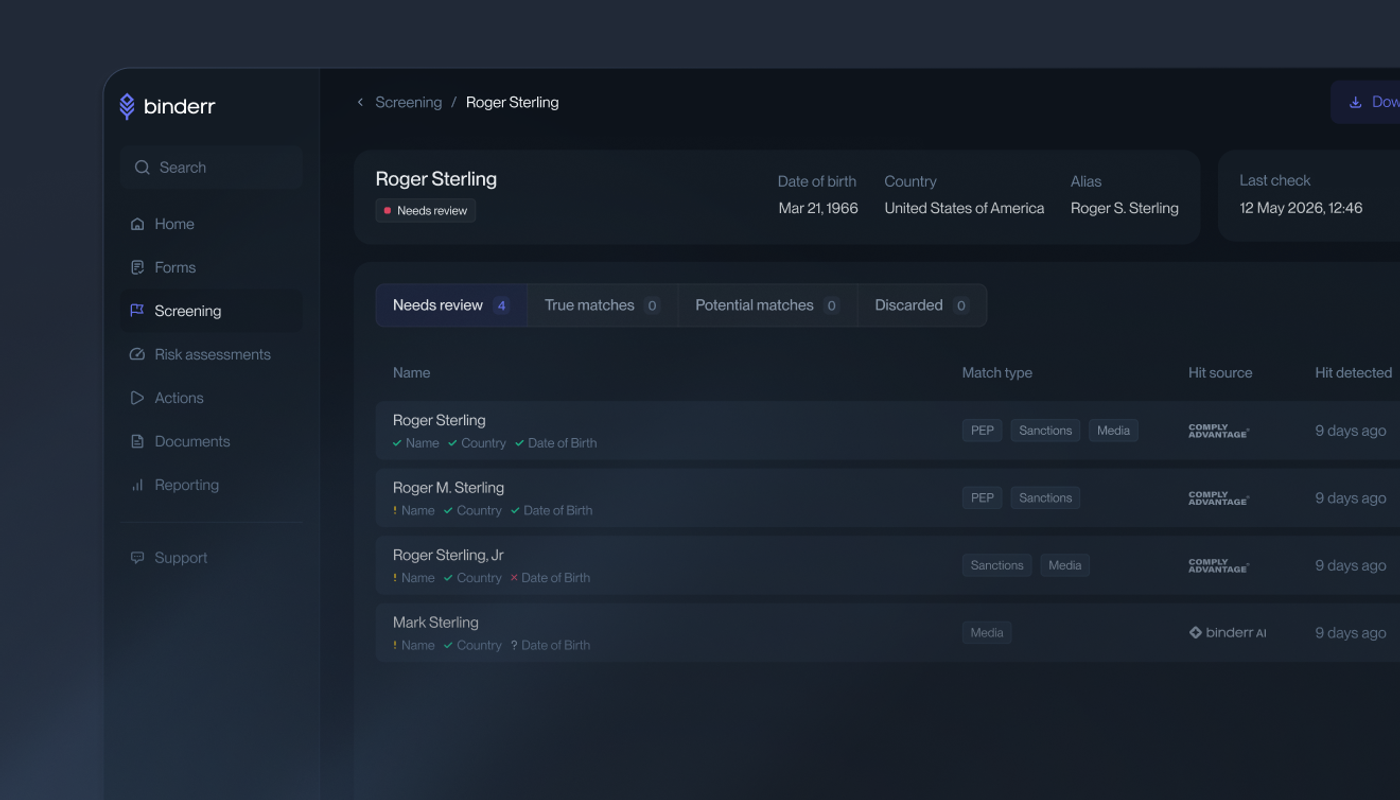
High volumes of false positives can overwhelm compliance teams and slow down AML onboarding processes. AI-powered AML screening solutions use smart matching algorithms, automated risk analysis, and contextual screening technology to improve screening accuracy and reduce unnecessary manual reviews.
Modern AML screening systems help businesses identify real sanctions risks, adverse media exposure, and suspicious entities more effectively. Reduced false positives also improve onboarding speed and helps compliance teams focus on high-risk business customers.
AI-powered AML screening tools like Binderr Compliance help compliance teams investigate PEP matches, sanctions alerts, and adverse media risks more efficiently. Smart match scoring and structured review workflows help businesses reduce false positives while improving AML compliance accuracy.
Maintain Audit Logs
Accurate audit logs are essential for maintaining strong compliance documentation and supporting regulatory reporting requirements. Businesses should maintain detailed records of KYB verification checks, onboarding decisions, AML screening results, sanctions reviews, and ongoing monitoring activities.
Strong audit trails improve internal compliance oversight, support audit readiness, and help businesses demonstrate regulatory compliance during inspections or external reviews. Centralized compliance records also make it easier to investigate suspicious activity and track customer onboarding history.
Customize Onboarding Based on Risk Profiles
Different industries, business models, and jurisdictions carry different levels of compliance and AML risk. Flexible KYB onboarding workflows allow businesses to apply customized due diligence requirements, enhanced verification checks, and risk-based compliance controls based on customer profiles.
Customized onboarding processes help businesses improve compliance efficiency while maintaining a better customer experience for legitimate businesses. Risk-based workflows also support stronger fraud prevention and more scalable global business onboarding operations.
Automate Global KYB Onboarding with Binderr
- UBO identification and ownership mapping
- Integrated sanctions, PEP, and adverse media screening
- AI-powered AML screening with reduced false positives
- Dynamic risk scoring for CDD and EDD
- Continuous monitoring with instant alerts
- KYC verification for directors and UBOs
- Automated onboarding workflows and audit trails
How to Automate KYB Onboarding
Automated KYB onboarding helps businesses streamline corporate verification, improve AML compliance, and reduce manual onboarding delays across global operations.
From AI-powered business verification to real-time AML screening and automated workflows, modern KYB automation tools help businesses onboard corporate customers faster while maintaining stronger compliance controls.
Integrating KYB APIs into Existing Onboarding Systems
Modern businesses are increasingly using KYB APIs to automate business verification and simplify corporate onboarding workflows. API-based KYB integrations allow businesses to connect onboarding platforms with AML screening tools, sanctions databases, global business registries, and risk assessment systems in real time.
Integrated KYB onboarding systems help businesses reduce manual reviews, improve onboarding speed, and maintain more consistent AML compliance processes. API-driven workflows also support faster customer due diligence and scalable global business onboarding across fintech, banking, payments, and crypto industries.
Using AI and OCR for Faster Document Verification
AI-powered document verification and OCR technology help businesses automate data extraction from incorporation documents, business licenses, tax certificates, and corporate records. Instead of manually reviewing uploaded files, compliance teams can verify business information faster and improve onboarding efficiency.
Advanced OCR and AI verification systems also reduce manual errors, improve data accuracy, and speed up KYB onboarding workflows. Automated document verification helps businesses streamline customer onboarding while maintaining stronger AML and compliance controls.
Automating AML Screening and Sanctions Monitoring
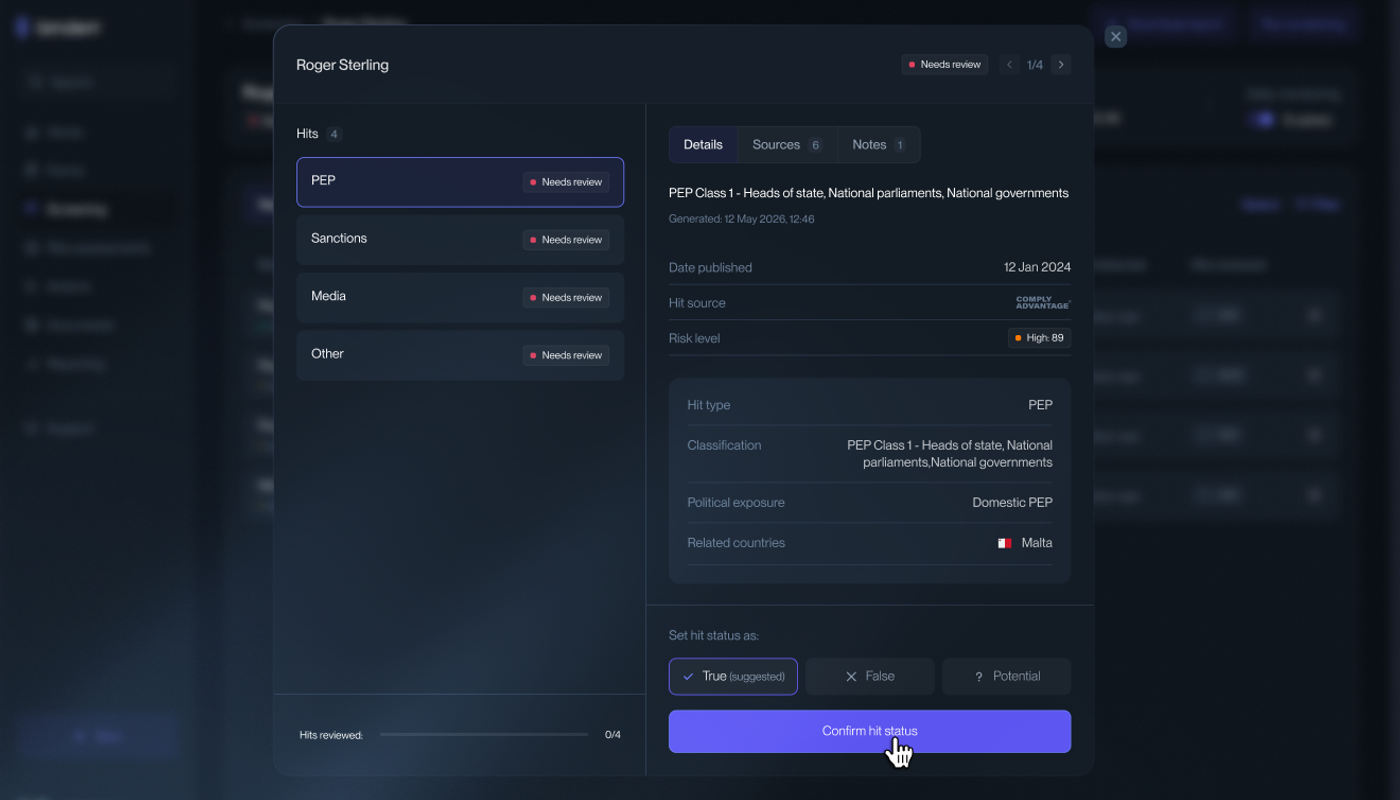
Automated AML screening helps businesses detect sanctions risks, politically exposed persons, adverse media exposure, and suspicious entities during corporate onboarding. Modern AML onboarding systems can screen businesses and UBOs against global watchlists in real time.
Continuous sanctions monitoring and automated compliance alerts also help businesses identify new risks after onboarding is completed. Automated AML screening reduces false positives, improves compliance efficiency, and strengthens anti-money laundering risk management across global operations.
Modern AML onboarding platforms like Binderr Compliance provide centralized screening dashboards that help compliance teams review sanctions matches, adverse media hits, and suspicious entities in real time. Automated AML screening workflows also improve investigation speed, reduce manual reviews, and strengthen ongoing compliance monitoring.
Connecting Global Business Registry Data Sources
Access to global business registry data is essential for accurate corporate verification and KYB compliance. Modern KYB onboarding platforms connect with multiple registry and compliance data sources to verify company registration details, legal status, directors, shareholders, and ownership information.
Global registry integrations help businesses improve business verification accuracy, reduce onboarding delays, and simplify cross-border compliance workflows. Access to reliable registry data also helps compliance teams detect fraudulent or inactive business entities more effectively.
Building No-Code Corporate Onboarding Workflows
No-code onboarding workflows allow businesses to create customized KYB onboarding processes without relying heavily on technical development teams. Businesses can configure onboarding forms, verification steps, AML checks, risk scoring rules, and compliance approval flows through simple drag-and-drop workflow builders.
Flexible no-code KYB onboarding systems help businesses adapt faster to changing compliance requirements and customer onboarding needs. They also improve operational efficiency and support scalable onboarding for regulated businesses handling large volumes of corporate customers.
Using Real-Time Compliance Dashboards for Risk Monitoring
Real-time compliance dashboards help businesses monitor onboarding activity, customer risk scores, AML screening results, and ongoing compliance alerts from one centralized platform. Compliance teams can track onboarding progress, review suspicious activity, and manage customer due diligence workflows more efficiently.
Advanced compliance dashboards also improve visibility across global onboarding operations and support faster compliance decision-making. Real-time monitoring tools help businesses strengthen risk management, improve audit readiness, and maintain stronger ongoing AML compliance.
Solving Common KYB Onboarding Challenges
Businesses often face multiple operational and compliance challenges while managing corporate onboarding and KYB verification processes.
From manual business verification delays to AML screening inefficiencies and ongoing monitoring gaps, solving these onboarding challenges is essential for building faster, safer, and more scalable KYB compliance workflows.
Manual Verification Delays
Many businesses still rely on manual KYB checks, spreadsheet-based reviews, and fragmented compliance workflows during corporate onboarding. Manual document verification and business verification processes can slow down onboarding approvals, increase operational costs, and create poor customer onboarding experiences.
Automated KYB onboarding solutions help businesses streamline customer due diligence, business verification, AML screening, and document collection through one centralized workflow. Faster onboarding processes improve compliance efficiency while helping businesses onboard corporate customers more quickly.
Complex Ownership Structures
Layered ownership structures, nominee arrangements, and offshore entities can make UBO verification more difficult for compliance teams. Identifying beneficial owners across multiple jurisdictions often requires deeper ownership mapping and enhanced due diligence reviews.
Advanced UBO verification and ownership mapping tools help businesses improve corporate transparency, reduce shell company risks, and strengthen AML compliance processes. Automated ownership analysis also helps businesses detect hidden relationships and high-risk entities more efficiently.
False Positives During AML Screening
Traditional AML screening systems often generate excessive false positives that overwhelm compliance teams and delay customer onboarding. Large volumes of inaccurate sanctions matches and adverse media alerts can increase manual review workloads and slow down onboarding operations.
AI-powered AML screening solutions use smart matching technology, contextual screening, and automated risk analysis to improve screening accuracy. Reducing false positives helps businesses improve onboarding speed, strengthen compliance efficiency, and focus on genuine financial crime risks.
Inconsistent Global Registry Data
Business registry data can vary significantly across jurisdictions, making global business verification more challenging for regulated businesses. Missing company information, outdated records, and inconsistent registry formats can increase onboarding delays and compliance risks.
Modern KYB compliance platforms connect with multiple global registry data sources to improve verification accuracy and simplify cross-border business onboarding. Access to real-time registry data helps businesses perform stronger customer due diligence and reduce fraud exposure.
High Customer Drop-Off Rates
Lengthy onboarding forms, repetitive document requests, and slow verification processes can increase customer abandonment during corporate onboarding. Businesses that fail to deliver smooth onboarding experiences may lose legitimate customers to faster competitors.
Automated KYB onboarding workflows help businesses reduce onboarding friction through faster verification, AI-powered document collection, and streamlined compliance checks. Faster onboarding experiences improve customer satisfaction while maintaining strong AML and compliance controls.
Cross-Border Compliance Complexity
Businesses onboarding international corporate customers must navigate different AML regulations, sanctions requirements, and business verification standards across multiple jurisdictions. Managing varying compliance obligations manually can create operational inefficiencies and increase regulatory exposure.
Global KYB onboarding solutions help businesses centralize compliance workflows, automate jurisdiction-based risk assessments, and simplify international business verification. Scalable compliance systems also help businesses maintain more consistent AML compliance across global operations.
Ongoing Monitoring Gaps
Many businesses focus heavily on initial KYB onboarding but fail to maintain ongoing AML monitoring after onboarding is completed. Changes in ownership structures, sanctions exposure, or adverse media risks can go undetected without continuous compliance monitoring.
Continuous AML monitoring solutions help businesses track real-time sanctions updates, ownership changes, suspicious activity, and customer risk profile changes throughout the customer lifecycle. Ongoing monitoring strengthens long-term compliance and improves overall financial crime risk management.
End-to-End KYB Compliance with Binderr
- Automated KYB onboarding and global business verification
- Integrated AML screening, sanctions checks, and adverse media monitoring
- Advanced UBO verification and ownership structure mapping
- Dynamic risk scoring with customizable compliance workflows
- Continuous AML monitoring with real-time compliance alerts
Bottom Line
KYB onboarding is becoming essential for fintech companies, banks, payment providers, crypto businesses, and regulated platforms onboarding corporate customers globally. Strong KYB verification and AML compliance processes help businesses reduce fraud risks, improve customer due diligence, and verify legitimate business entities faster.
Automated KYB onboarding solutions help businesses streamline business verification, sanctions screening, UBO verification, and ongoing AML monitoring through one centralized workflow. Faster onboarding approvals, reduced false positives, and real-time compliance monitoring also help businesses improve operational efficiency while maintaining stronger financial crime controls.
Binderr Compliance helps businesses simplify KYB onboarding, AML screening, UBO verification, and ongoing monitoring through one unified global compliance platform.