
AML compliance Europe is entering a new phase shaped by stricter regulations, cross-border financial activity, and evolving financial crime tactics. Businesses must navigate a unified yet complex framework that includes AMLR, AMLD, and the oversight of AMLA, all within the broader scope of EU AML regulations and aml eu directives. As digital onboarding and global transactions increase, organisations need robust KYC, KYB, screening, and monitoring processes to stay compliant and reduce risk.
Financial crime continues to rise across the region, with Europol estimating that around 1 percent of the EU’s annual GDP is linked to suspicious financial activity. This growing threat is driving regulators to enforce stronger AML compliance requirements and push for harmonisation across member states. Companies must adopt a risk-based approach that integrates customer due diligence, sanctions screening, and continuous monitoring to detect and prevent illicit activity under evolving EU AML regulations.
In this guide, we will break down the European AML framework, explain key regulatory components such as AMLR, AMLD, AMLA, and aml eu directives, and explore how businesses can implement effective KYC, KYB, screening, and monitoring processes to build a compliant and scalable AML program.
Binderr AML Compliance Solution
- KYC (Identity Verification) with AI-powered document checks, biometric face matching, and liveness detection
- KYB (Business Verification) with global registry access and ownership mapping
- AML Screening across sanctions, PEPs, watchlists, and adverse media
- Ongoing Monitoring with real-time alerts for risk changes
- Dynamic Risk Assessment with automated scoring
- UBO Identification and ownership structure visualisation
What Is AML Compliance?
Anti-Money Laundering (AML) compliance refers to the laws, regulations, and procedures organizations follow to detect, prevent, and report financial crimes such as money laundering and terrorist financing. In Europe, AML compliance Europe is governed by EU AML regulations and national laws, requiring businesses to implement effective controls aligned with aml eu directives.
At its core, AML compliance focuses on identifying suspicious activity, verifying customer identities through KYC, and monitoring transactions. This helps protect the financial system and prevent illicit funds from entering the economy. Beyond meeting regulations, AML compliance helps businesses avoid penalties, reputational damage, and operational risks. European regulators expect a proactive approach, with controls embedded into daily operations.
A key principle is the risk-based approach, where businesses assess customer risk and apply appropriate due diligence. Low-risk customers may require simplified checks, while high-risk individuals, such as PEPs, require enhanced due diligence. Organizations must also conduct sanctions screening, monitor customer activity, maintain audit trails, and report suspicious transactions to Financial Intelligence Units (FIUs).
Overall, AML compliance is about building a strong framework to prevent financial crime and support trust in the European financial system under EU AML regulations.
Try FREE AI powered AML screening with Binderr
Why AML Compliance Matters in Europe
AML compliance Europe is critical for preventing financial crime, ensuring regulatory adherence, and maintaining trust across cross-border financial systems.
With evolving EU AML regulations, AMLA oversight, and increasing enforcement driven by aml eu directives, businesses must adopt robust AML frameworks, including KYC, KYB, and ongoing monitoring.
Prevents money laundering and terrorist financing - AML compliance Europe helps organizations detect and prevent illicit financial activities such as money laundering and terrorist financing. By implementing strong KYC, KYB, and transaction monitoring processes, businesses can identify suspicious behavior early and report it to relevant authorities.
Ensures compliance with EU regulations - Adhering to EU AML regulations, including AMLR and AMLD, ensures that businesses meet legal obligations across member states. A structured AML compliance program helps organizations stay aligned with evolving regulatory requirements and aml eu directives.
Protects against fines and penalties - Non-compliance with European AML regulations can result in significant financial penalties and enforcement actions. By maintaining robust AML controls, businesses reduce the risk of fines, sanctions, and costly legal consequences.
Builds trust with customers and regulators - Strong AML compliance demonstrates a commitment to transparency and financial integrity. This builds trust with customers, regulators, and partners, enhancing the organization’s reputation in the European financial ecosystem.
Supports secure cross-border operations - AML compliance enables businesses to operate confidently across EU borders by meeting harmonized regulatory standards defined by EU AML regulations. Effective screening, monitoring, and due diligence processes ensure secure and compliant international transactions.
Reduces reputational and operational risk - Implementing AML risk management practices helps organizations avoid association with financial crime. This reduces reputational damage and minimizes operational disruptions caused by investigations or regulatory scrutiny.
Enables safer digital onboarding - AML compliance supports secure digital onboarding by integrating identity verification, biometric checks, and risk scoring. This allows businesses to onboard customers quickly while maintaining strong fraud prevention and compliance standards.
Start managing compliance the easier way with Binderr.
The European AML Regulatory Framework
An overview of the key regulations shaping AML compliance in Europe, including AMLR, AMLD, and AMLA.
Understand how EU AML regulations, aml eu directives, and supervisory bodies work together to enforce financial crime prevention across member states.
AML Regulation (AMLR)
The AML Regulation (AMLR) represents a major shift in European AML compliance by introducing directly applicable rules across all EU member states. Unlike directives, which require national implementation, AMLR ensures consistent enforcement of anti-money laundering standards across Europe.
- Direct applicability: AMLR applies uniformly across all EU countries without the need for local transposition, reducing regulatory fragmentation and inconsistencies.
- Harmonised rules: It establishes a single rulebook for AML compliance, covering KYC, KYB, Customer Due Diligence (CDD), Enhanced Due Diligence (EDD), sanctions screening, and ongoing monitoring.
- Compliance expectations: Businesses must adopt a risk-based approach, implement robust AML compliance programs, maintain audit trails, and ensure continuous monitoring of customers and transactions to detect suspicious activity and prevent financial crime.
AML Directives (AMLD)
The AML Directives (AMLD), often referred to as aml eu directives, have historically shaped the European AML framework, gradually strengthening compliance requirements and expanding the scope of regulated entities.
- AMLD4: Introduced the risk-based approach, mandatory Customer Due Diligence (CDD), and requirements for identifying Ultimate Beneficial Owners (UBOs).
- AMLD5: Expanded AML obligations to crypto-asset service providers (CASPs), enhanced transparency through UBO registers, and strengthened PEP and sanctions screening requirements.
- AMLD6: Focused on criminal liability, defining money laundering offenses more clearly and increasing penalties for non-compliance.
- Evolution toward AMLR: The transition from directives to a regulation reflects the EU’s goal of achieving full harmonisation, reducing regulatory gaps, and ensuring consistent AML enforcement across all member states.
AMLA
The Anti-Money Laundering Authority (AMLA) is a centralised EU body designed to strengthen supervision and coordination of AML efforts across Europe.
- Purpose: AMLA aims to enhance the effectiveness of AML compliance by providing centralized oversight and ensuring consistent application of EU AML regulations.
- Supervisory role: It directly supervises high-risk financial institutions and monitors compliance with AMLR requirements.
- Coordination: AMLA facilitates cooperation between national regulators, Financial Intelligence Units (FIUs), and other authorities to improve information sharing and enforcement.
- Direct supervision of selected entities: Certain cross-border or high-risk institutions fall under AMLA’s direct supervision to ensure stricter compliance controls.
- Support for national regulators: AMLA provides guidance, technical standards, and best practices to help national authorities enforce AML regulations effectively.
Financial Intelligence Units (FIUs)
Financial Intelligence Units (FIUs) play a critical role in detecting and investigating financial crime within the European AML ecosystem.
- Suspicious transaction reporting: Regulated entities must submit Suspicious Activity Reports (SARs) or Suspicious Transaction Reports (STRs) to FIUs when potential money laundering or terrorist financing is detected.
- Information sharing: FIUs collaborate across borders, sharing intelligence with other FIUs, law enforcement agencies, and regulatory bodies to track illicit financial flows.
- Investigations: FIUs analyze financial data, identify patterns of suspicious behavior, and support criminal investigations related to money laundering, fraud, and other financial crimes.
Who Must Comply with European AML Regulations?
A wide range of regulated entities must comply with European AML regulations, reflecting the EU’s comprehensive approach to combating money laundering, terrorist financing, and financial crime under AML compliance Europe. Under the EU AML framework and aml eu directives, obligations extend beyond traditional financial institutions to include any business that handles financial transactions, manages assets, or facilitates the movement of funds.
This includes banks, credit institutions, payment providers, electronic money institutions (EMIs), fintech companies, and crypto-asset service providers (CASPs), all of which must implement robust AML compliance programs aligned with EU AML regulations.
Across these industries, businesses must implement AML screening, verify ultimate beneficial ownership (UBO), maintain audit trails, and ensure continuous monitoring to remain compliant with evolving European AML regulations and directives such as AMLD and AMLR.
Core Components of an AML Compliance Program
Understand the essential building blocks required to establish a robust AML compliance program in Europe.
These components support effective AML risk management, regulatory compliance, KYC, KYB, and ongoing monitoring.
AML Risk Assessment: Conduct a comprehensive AML risk assessment to identify, evaluate, and mitigate exposure to money laundering, terrorist financing, and proliferation financing risks. This includes analysing customer profiles, geographic exposure, transaction types, delivery channels, and product risks. A risk-based approach ensures that resources are allocated efficiently and high-risk areas receive enhanced scrutiny.
Internal AML Policies: Develop and maintain robust internal AML policies and procedures that align with EU AML regulations, including AMLR and AMLD requirements. These policies should clearly define onboarding processes, KYC and KYB procedures, sanctions screening protocols, escalation workflows, and reporting obligations to ensure consistent compliance across the organisation.
Customer Risk Classification: Implement a structured customer risk classification framework that assigns risk levels (low, medium, high) based on factors such as customer type, jurisdiction, transaction behaviour, and PEP or sanctions exposure. Dynamic risk scoring models help prioritise monitoring efforts and trigger Enhanced Due Diligence (EDD) where necessary.
AML Governance: Establish strong AML governance with clear oversight, accountability, and reporting structures. This includes defining roles and responsibilities, ensuring board-level awareness, and integrating AML compliance into enterprise risk management. Effective governance supports regulatory alignment and strengthens internal controls.
Compliance Officer: Appoint a qualified AML Compliance Officer or Money Laundering Reporting Officer (MLRO) responsible for overseeing the AML compliance program. This role includes managing suspicious activity reporting, liaising with Financial Intelligence Units (FIUs), ensuring regulatory adherence, and maintaining audit readiness.
Staff Training: Provide ongoing AML training programs to ensure employees understand their responsibilities in preventing financial crime. Training should cover KYC, KYB, sanctions screening, red flag identification, suspicious activity reporting, and updates on evolving EU AML regulations. Regular training enhances awareness and reduces compliance risks.
Independent Audits: Conduct regular independent AML audits to evaluate the effectiveness of the compliance program. Audits should assess internal controls, risk assessments, screening processes, and reporting mechanisms. Independent reviews help identify gaps, ensure regulatory compliance, and support continuous improvement of AML frameworks.
Streamline AML Processes with Binderr
Binderr simplifies the entire compliance workflow:
- Run KYC, KYB, and AML checks in one platform
- Automatically assign risk scores
- Trigger EDD workflows for high-risk users
- Collect documents dynamically
- Maintain full audit trails
Key KYC Requirements for AML Compliance in Europe
Know Your Customer (KYC) is a foundational pillar of AML compliance in Europe, enabling regulated businesses to verify customer identities, assess risk, and prevent financial crime. Under EU AML regulations, organizations must implement robust KYC procedures that align with the risk-based approach and support ongoing monitoring throughout the customer lifecycle.
Below are the key KYC requirements every European business must address:
Identity verification - Businesses must accurately verify the identity of individuals before establishing a business relationship. This typically involves collecting personal information such as full name, date of birth, address, and nationality, and validating it against trusted data sources. Digital identity verification solutions are increasingly used to streamline onboarding while maintaining compliance with EU AML standards.
Document verification - Customers are required to provide official identification documents such as passports, national ID cards, or driver’s licenses. These documents must be authenticated to ensure they are genuine, unaltered, and valid. Advanced document verification technologies use AI and machine learning to detect forgery, tampering, and inconsistencies in real time.
Biometric verification - Biometric checks, such as facial recognition, are used to match the customer’s live image with the photo on their identity document. This adds an additional layer of security and helps prevent identity theft and impersonation. Biometric verification is widely adopted across Europe for secure digital onboarding.
Liveness detection - Liveness detection ensures that the person completing the verification process is physically present and not using a spoofed image, video, or deepfake. Techniques such as motion analysis, blink detection, and 3D facial mapping help confirm authenticity and reduce fraud risks.
PEP identification - Businesses must identify whether a customer is a Politically Exposed Person (PEP), or associated with one. PEPs present a higher risk due to their potential exposure to corruption or bribery. Screening against global PEP databases helps organizations apply Enhanced Due Diligence (EDD) where necessary.
Sanctions screening - Customers must be screened against international sanctions lists, including those issued by the EU, UN, UK, and other relevant authorities. Sanctions screening ensures that businesses do not engage with individuals or entities subject to financial restrictions, helping avoid regulatory penalties and reputational damage.
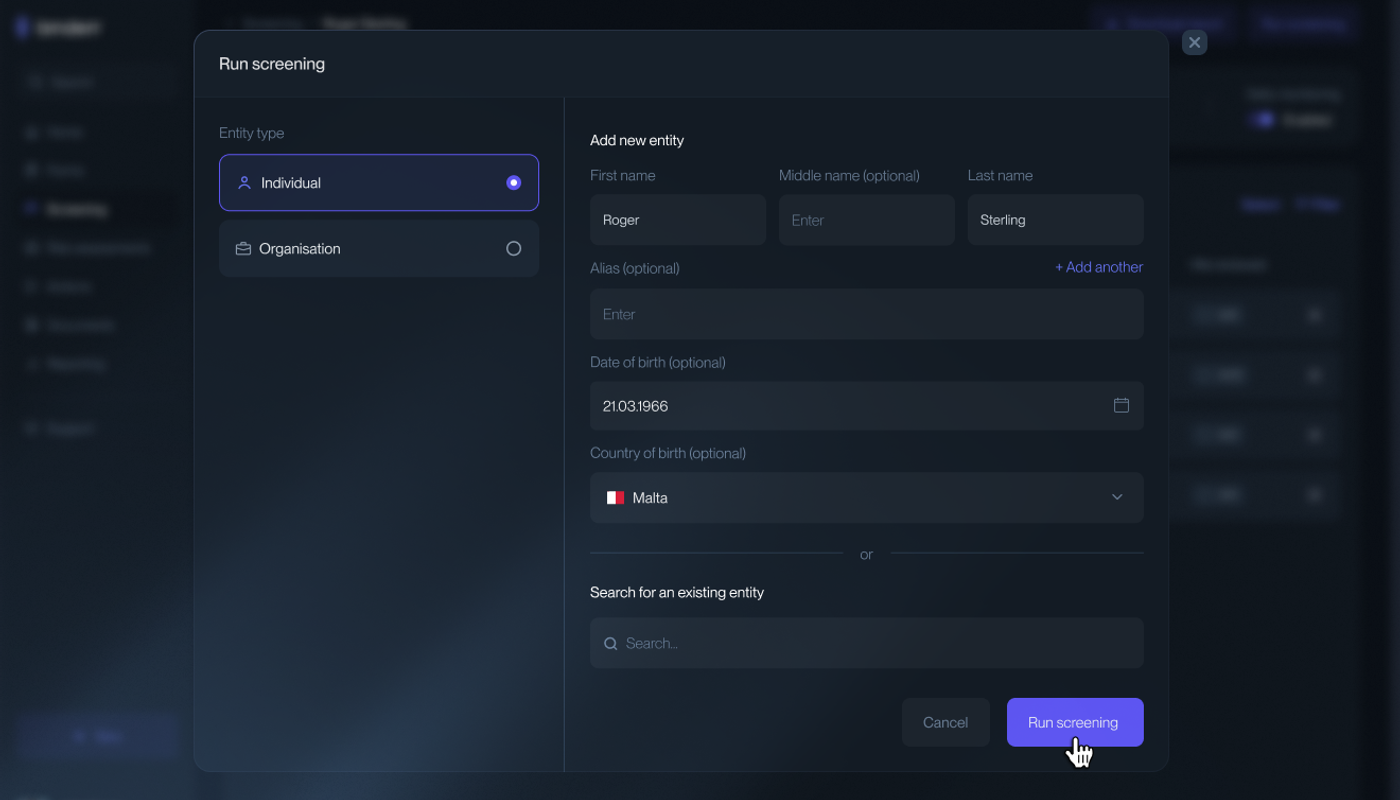
(Binderr allows compliance teams to screen individuals and organisations against global sanctions, PEPs, adverse media, and watchlists from a single onboarding workflow.)
Risk scoring - Each customer must be assigned a risk score based on factors such as geography, occupation, transaction behavior, and screening results. Risk scoring enables businesses to apply a risk-based approach, determining whether Simplified Due Diligence (SDD), standard CDD, or Enhanced Due Diligence (EDD) is required.
Customer onboarding - KYC processes must be integrated into a seamless and compliant onboarding workflow. This includes collecting customer data, verifying identity, conducting screening checks, assigning risk levels, and documenting the entire process. Automated onboarding solutions help reduce friction, improve user experience, and ensure consistent AML compliance across European markets.
Try Binderr KYC screening for Free
KYB Requirements for AML Compliance in Europe
Know Your Business (KYB) is a critical component of AML compliance in Europe, ensuring that organizations verify the legitimacy, ownership, and risk profile of corporate clients before establishing a business relationship. Under EU AML regulations, including AMLR and AMLD frameworks, businesses must conduct thorough due diligence on legal entities to prevent money laundering, terrorist financing, and fraud.
Business Verification - Business verification involves confirming that a company is legally registered and actively operating. This includes validating the company name, registration number, legal structure, and jurisdiction. Automated KYB solutions can streamline this process by accessing official registries and verifying data in real time.
Registry Checks - Registry checks are essential for confirming the authenticity of a business. Companies must be cross-checked against official government databases such as national company registries, EU-wide databases, and commercial data providers. These checks help identify discrepancies, inactive entities, or shell companies used for illicit activities.
Company Ownership - Understanding company ownership is vital for assessing risk. Businesses must identify all individuals or entities that hold ownership stakes, including direct and indirect shareholders. This helps uncover hidden ownership structures that may be used to obscure illicit financial flows.
Director Verification - Director verification ensures that individuals managing the company are legitimate and not associated with financial crime. This includes verifying identities, screening against sanctions and PEP lists, and checking for adverse media. Directors play a key role in governance, making their verification essential for AML compliance.
Shareholder Verification - Shareholder verification involves identifying and validating all shareholders, particularly those with significant ownership stakes. This process includes screening for sanctions, politically exposed persons (PEPs), and negative news to assess potential risks associated with the business.
UBO Identification - Ultimate Beneficial Owner (UBO) identification is a core requirement under EU AML regulations. Businesses must identify individuals who ultimately own or control more than a specified threshold (typically 25%) of the company. UBO verification helps prevent the misuse of complex corporate structures for money laundering.
Ownership Mapping - Ownership mapping involves visualizing and analyzing the full ownership structure of a company, including subsidiaries, parent companies, and cross-border entities. This process helps detect layered ownership, nominee arrangements, and hidden control mechanisms that may indicate higher risk.
Corporate AML Screening - Corporate AML screening includes checking the business, its directors, shareholders, and UBOs against global sanctions lists, PEP databases, watchlists, and adverse media sources. Continuous screening ensures that any changes in risk status are detected promptly, supporting ongoing monitoring and compliance with EU AML requirements.
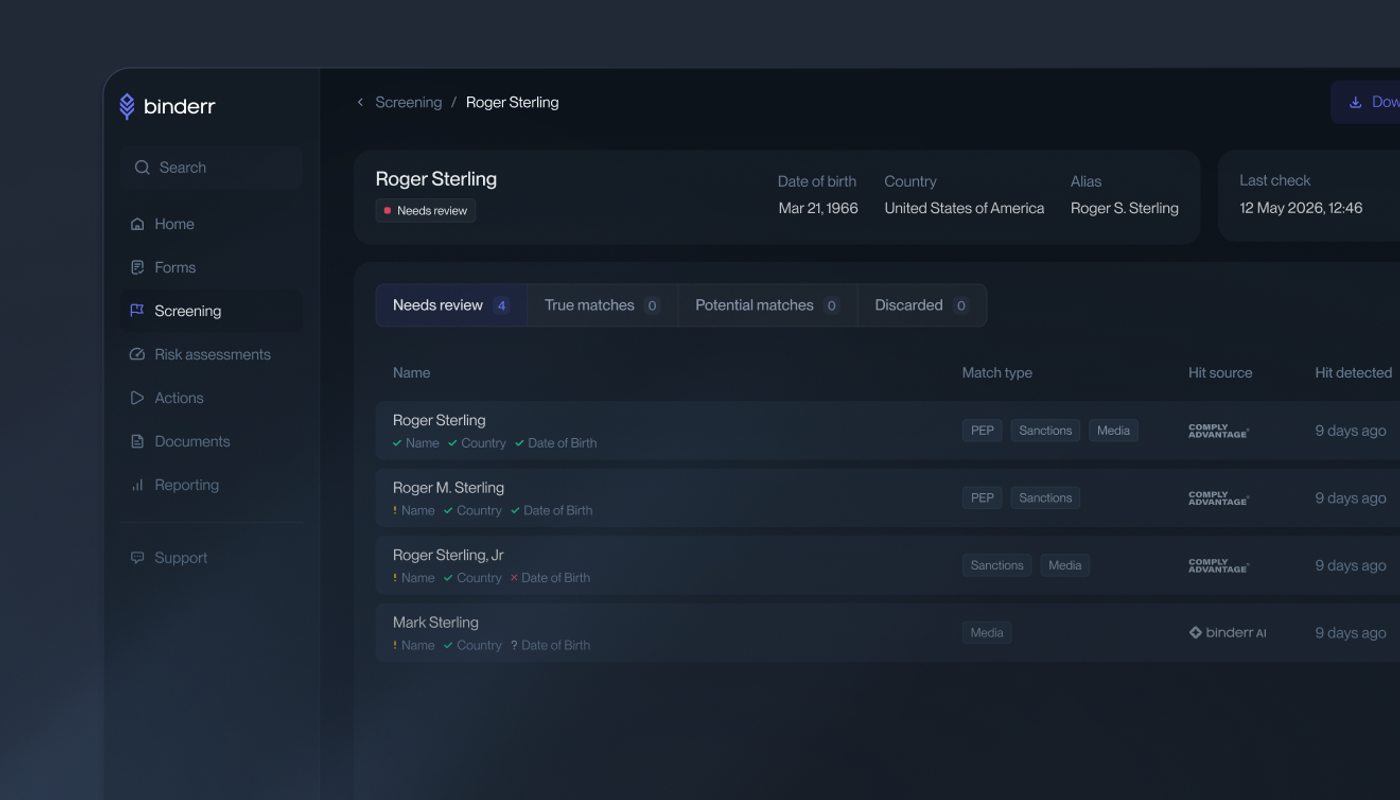
(Instead of reviewing every alert manually, Binderr groups potential matches and provides identity attributes, screening categories, and confidence indicators so analysts can prioritise investigations faster.)
By implementing robust KYB procedures, businesses can strengthen their AML compliance programs, reduce exposure to financial crime, and meet regulatory expectations across Europe.
Automate KYB and AML for FREE with Binderr
Customer Due Diligence (CDD) Requirements in European AML Compliance
Customer Due Diligence (CDD) is a foundational pillar of AML compliance in Europe, ensuring that businesses understand who their customers are, assess their risk levels, and monitor their activities to prevent financial crime. Under EU AML regulations, including AMLR and AMLD frameworks, organizations must apply a risk-based approach to CDD, tailoring the depth of checks based on the customer’s risk profile.
Identity Collection
Identity collection is the first step in the CDD process. Businesses must gather accurate and verifiable information about their customers, including full name, date of birth, address, and nationality. For individuals, this typically involves collecting government-issued identification such as passports or national ID cards. For businesses, identity collection extends to company registration details, legal structure, and operational information. This step ensures that organizations can confidently establish the true identity of their customers before entering into a business relationship.
Risk Profiling
Risk profiling involves assessing the potential risk a customer poses in terms of money laundering or terrorist financing. European AML compliance requires firms to evaluate factors such as geographic location, industry sector, transaction behavior, and customer type. Customers are typically categorized into low, medium, or high-risk tiers. High-risk customers, such as politically exposed persons (PEPs) or those linked to high-risk jurisdictions, require enhanced scrutiny. Effective risk profiling enables organizations to allocate compliance resources efficiently and apply appropriate levels of due diligence.
Document Collection
Document collection supports identity verification and risk assessment by providing tangible evidence of a customer’s identity and activities. This includes collecting identification documents, proof of address, corporate registration certificates, and supporting documentation for business operations. In digital onboarding environments, document verification technologies and biometric checks are often used to validate authenticity and prevent fraud. Proper document collection ensures compliance with regulatory requirements and strengthens audit readiness.
Purpose of Relationship
Understanding the purpose and intended nature of the business relationship is a key requirement under EU AML regulations. Organizations must determine why the customer is engaging with their services, whether it is for personal banking, investment, payments, or corporate transactions. This helps establish a baseline for expected behavior and allows compliance teams to detect anomalies or suspicious activities more effectively. Clearly defining the purpose of the relationship also supports ongoing monitoring and risk assessment.
Source of Funds
Source of funds refers to identifying where the customer’s money originates. This is particularly important for higher-risk customers or large transactions. Businesses must verify whether funds come from legitimate sources such as employment income, business revenue, investments, or asset sales. In some cases, additional documentation such as bank statements, contracts, or financial records may be required. Verifying the source of funds helps prevent the integration of illicit money into the financial system.
Expected Activity
Expected activity involves establishing a clear understanding of how the customer is likely to use the service over time. This includes anticipated transaction volumes, frequency, geographic regions, and types of transactions. By defining expected behavior, organizations can implement effective transaction monitoring systems that flag deviations or unusual patterns. This proactive approach supports early detection of suspicious activity and ensures compliance with ongoing monitoring obligations under European AML frameworks.
Enhanced Due Diligence (EDD) Requirements in Europe
Enhanced Due Diligence (EDD) is a critical component of AML compliance in Europe, applied when a customer or transaction presents a higher risk of money laundering, terrorist financing, or other financial crimes. Under EU AML regulations, including AMLD and the upcoming AMLR, businesses must go beyond standard Customer Due Diligence (CDD) and implement deeper verification, monitoring, and risk assessment measures.
EDD is required in several high-risk scenarios:
- High-risk countries: When customers are linked to jurisdictions identified by the European Commission or FATF as high-risk or non-cooperative, businesses must apply stricter controls. This includes verifying the legitimacy of transactions, understanding cross-border fund flows, and conducting enhanced sanctions screening.
- Politically Exposed Persons (PEPs): Individuals holding prominent public positions, along with their family members and close associates, pose a higher corruption risk. EDD requires detailed background checks, source-of-wealth verification, and continuous monitoring to detect suspicious activity.
- Complex ownership structures: Businesses with layered ownership, offshore entities, trusts, or shell companies require deeper KYB and UBO verification. Organizations must map ownership chains, identify ultimate beneficial owners, and assess control structures to prevent concealment of illicit funds.
- Large or unusual transactions: Transactions that are inconsistent with a customer’s profile or exceed expected thresholds trigger EDD. This includes analyzing transaction patterns, verifying the source of funds, and assessing the economic purpose behind the activity.
- High-risk industries: Sectors such as cryptocurrency, gambling, real estate, and high-value goods trading are more vulnerable to financial crime. Businesses operating in or dealing with these industries must apply stricter AML screening, monitoring, and risk scoring.
- Additional documentation: EDD requires collecting more comprehensive information, including proof of source of funds, source of wealth, business activity documentation, contracts, and financial statements. This helps establish transparency and legitimacy.
- Senior management approval: Establishing or continuing a business relationship with high-risk customers requires explicit approval from senior management. This ensures accountability and reinforces a risk-based approach to AML compliance.
By implementing robust EDD procedures, organizations can strengthen their AML risk management framework, reduce exposure to financial crime, and meet European regulatory expectations for enhanced scrutiny and ongoing monitoring.
Detect Risk Faster with Binderr AML Screening
- Global sanctions and PEP screening
- AI-powered adverse media analysis
- Smart matching to reduce false positives
- Continuous monitoring with alerts
- Screening for complex entities
How AML Automation Improves Compliance
AML automation transforms compliance from a reactive, manual process into a proactive, scalable system that aligns with modern European regulatory expectations. By leveraging advanced technologies such as artificial intelligence, machine learning, and API-driven integrations, businesses can streamline compliance workflows, reduce human error, and ensure consistent adherence to EU AML regulations.
Automated Onboarding - Automated onboarding enables businesses to verify customers in real time, reducing friction while maintaining compliance. Digital onboarding workflows collect and validate customer data instantly, ensuring that KYC and KYB requirements are met from the first interaction. This improves customer experience while accelerating time-to-service.
Identity Verification - Automated identity verification uses document verification, biometric authentication, and liveness detection to confirm customer identities securely. These tools help prevent identity fraud, ensure regulatory compliance, and support remote onboarding across jurisdictions within Europe.
KYB (Know Your Business) - KYB automation simplifies business verification by accessing official registries, validating company data, and mapping ownership structures. It enables accurate identification of directors, shareholders, and Ultimate Beneficial Owners (UBOs), ensuring transparency and compliance with EU AML directives.
AML Screening - Automated AML screening checks individuals and entities against global sanctions lists, PEP databases, adverse media sources, and regulatory watchlists. Real-time screening ensures that businesses can detect high-risk customers instantly and comply with EU, UN, UK, and US sanctions requirements.
Risk Scoring - Risk scoring engines assign dynamic risk levels to customers based on multiple factors, including geography, industry, transaction behavior, and screening results. Automated risk assessment supports a risk-based approach, allowing compliance teams to prioritize high-risk cases and apply Enhanced Due Diligence (EDD) where necessary.
Ongoing Monitoring - Continuous monitoring ensures that customer profiles remain up to date. Automated systems track changes in sanctions lists, PEP status, adverse media, and customer behavior, triggering alerts when risk levels change. This supports regulatory requirements for ongoing due diligence and real-time risk management.
Case Management - Integrated case management systems centralize alerts, investigations, and reporting. Compliance teams can review flagged activities, document decisions, and maintain audit-ready records. Automation improves efficiency, ensures consistency, and supports regulatory reporting obligations across European jurisdictions.
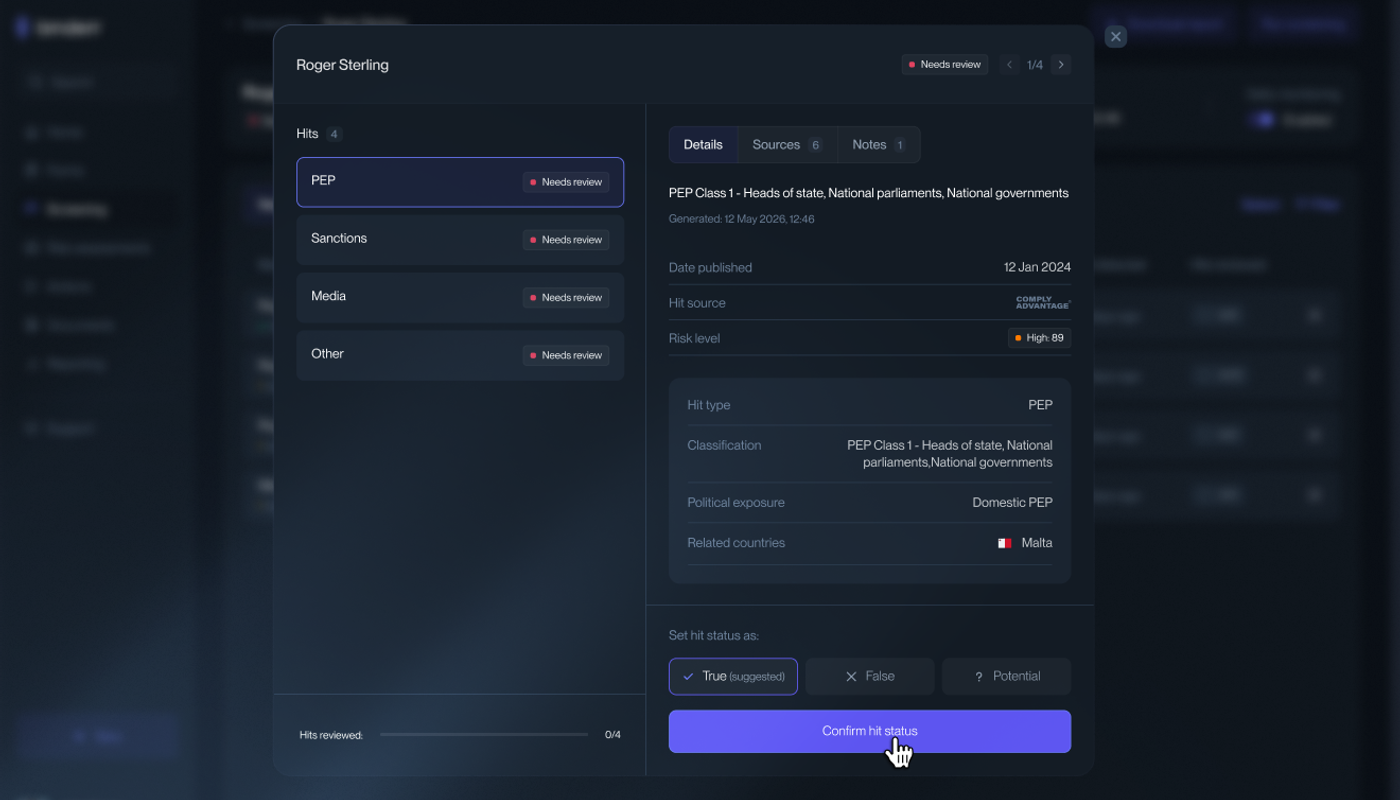
(Binderr screening alert includes detailed evidence, source references, PEP classifications, sanctions information, adverse media, and analyst workflows. Teams can confirm whether a hit is a true match, false positive, or potential match while maintaining a complete audit trail for regulators.)
Common AML Compliance Challenges
Organizations operating under European AML regulations face a wide range of operational, technical, and regulatory challenges. As financial crime becomes more sophisticated and cross-border activity increases, maintaining effective AML compliance requires constant adaptation and investment.
Multiple jurisdictions - Businesses operating across the EU must navigate different national interpretations of AML directives, local supervisory expectations, and varying enforcement practices. Even with the introduction of AMLR and AMLA, regulatory fragmentation still creates complexity in aligning compliance programs across borders.
Manual onboarding - Relying on manual KYC and KYB processes slows down customer onboarding, increases operational costs, and introduces human error. Manual document checks, identity verification, and risk assessments make it difficult to scale compliance operations efficiently.
False positives - AML screening systems often generate large volumes of false positives during sanctions, PEP, and adverse media checks. This creates unnecessary workload for compliance teams, delays onboarding, and increases the risk of missing genuine threats due to alert fatigue.
Fragmented systems - Many organizations use separate tools for KYC, KYB, screening, transaction monitoring, and case management. This lack of integration leads to data silos, inconsistent risk assessments, and inefficient workflows, making it harder to maintain a unified AML compliance program.
Complex ownership - Identifying Ultimate Beneficial Owners (UBOs) is increasingly difficult due to layered corporate structures, offshore entities, trusts, and nominee arrangements. Mapping ownership accurately requires advanced KYB capabilities and access to reliable global corporate data.
Poor data quality - Incomplete, outdated, or inconsistent customer data undermines AML risk assessments and screening accuracy. Poor data quality can lead to missed risks, incorrect risk scoring, and compliance failures during audits or regulatory reviews.
Resource shortages - Compliance teams often struggle with limited staff, budget constraints, and increasing regulatory demands. Skilled AML professionals are in high demand, making it difficult for organizations to maintain adequate expertise and coverage.
Build a Full AML Compliance Program with Binderr
Binderr offers an end-to-end compliance platform:
- Unified onboarding (KYC + KYB)
- AML screening and monitoring
- Dynamic risk assessment
- UBO identification and mapping
- CDD and EDD workflows
- Compliance reporting and audit trails
Bottom Line
AML compliance Europe is becoming more unified through AMLR and AMLA, strengthening EU AML regulations and aligning aml eu directives across member states. Businesses must go beyond onboarding with continuous KYC, KYB, screening, and monitoring to manage risk effectively.
Automation helps streamline processes, reduce costs, and improve audit readiness. Companies using integrated AML platforms are better prepared for evolving regulations and financial crime risks. Binderr Compliance helps you simplify AML operations with automated KYC, KYB, screening, and continuous monitoring all in one powerful platform.