
A company’s address is more than a location. It is a key signal of company identity during KYB address verification. Business address verification and company address verification help confirm where a company is registered, where it receives official correspondence, and where it operates, supporting accurate onboarding decisions in any address verification business process.
Inaccurate or inconsistent address data can weaken trust in a company profile. Borrowed, outdated, or fabricated addresses make it harder to verify legitimacy. Virtual offices, mail-forwarding services, residential locations, and cross-border entities add complexity, especially when multiple unrelated companies share the same address. These factors do not prove misconduct on their own, but unexplained mismatches raise risk and require closer review within business address verification workflows.
This guide explains how to approach business address verification with clarity and precision. It covers which address types to check, the documents and data sources that support company address verification, and how automated address verification business systems work.
Binderr Business Address Verification Software
- Global company registry access across 200+ countries
- Automated address validation and verification workflows
- OCR-powered document extraction for proof-of-address checks
- Integrated AML screening (sanctions, PEPs, watchlists, adverse media)
- UBO identification and ownership structure mapping
- Dynamic risk scoring for CDD and EDD decisions
What Is Business Address Verification?
Business address verification is the process of confirming that a company’s address is valid, current, and genuinely linked to the business. It involves checking the address format, matching it with registry data, and comparing it with supporting documents to detect inconsistencies and support KYB, CDD, and AML compliance. Company address verification plays a central role in any address verification business strategy.
Business address verification should not exist as an isolated document check. Binderr brings proof-of-address evidence together with company registration details, identity verification, incorporation data, and other KYB information within a single company profile.
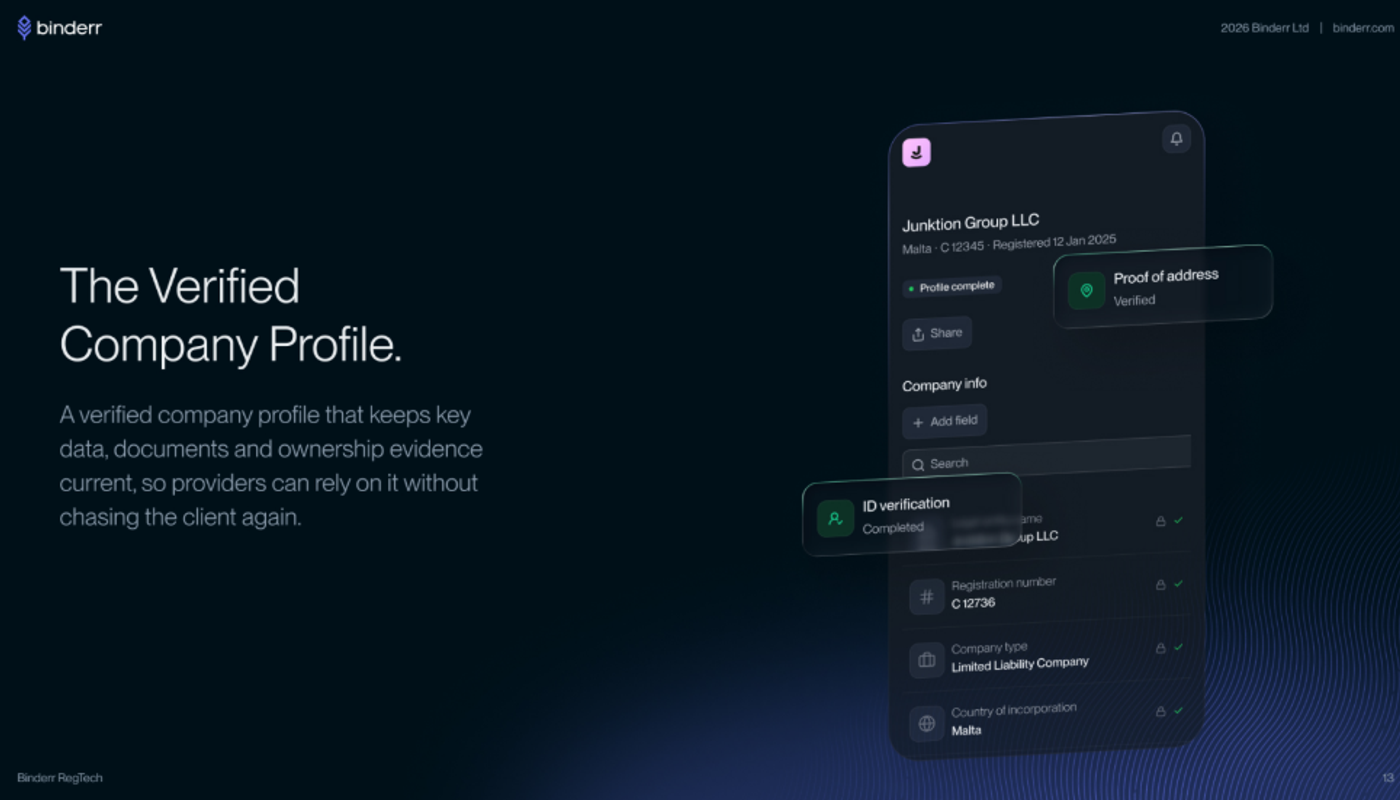
(Binderr’s Verified Company Profile combines proof-of-address verification with core KYB data in one structured record.)
Start Business Verification for Free
Why Is Business Address Verification Important for KYB?
Accurate business address verification is a cornerstone of effective KYB compliance, helping organisations confirm legitimacy and reduce onboarding risk.
By validating company locations and identifying inconsistencies, businesses can strengthen fraud prevention, improve risk assessment, and ensure regulatory alignment through robust company address verification practices.
Confirms the Company’s Registered Details - Business address verification confirms that a company’s submitted address matches official registry records. It helps verify the entity’s existence and legal identity, but registry data alone does not prove where the business operates, so additional evidence may be needed in company address verification.
Identifies False or Misleading Company Information - Address verification business processes can reveal incorrect or fake addresses, unauthorised use of premises, and altered documents. These issues may signal misleading company information and should be reviewed during KYB checks.
Supports Shell Company and Fraud Detection - Address intelligence can highlight patterns linked to shell companies, such as many entities at one address or use of virtual offices. However, these signals are not inherently suspicious and should be assessed in context during business address verification.
Improves Customer Risk Scoring - An address mismatch can contribute to a higher risk score when combined with other indicators such as high-risk jurisdictions, complex ownership structures, unusual business activity, or adverse media findings. In KYB address verification, these signals help compliance teams assess whether enhanced due diligence is required.
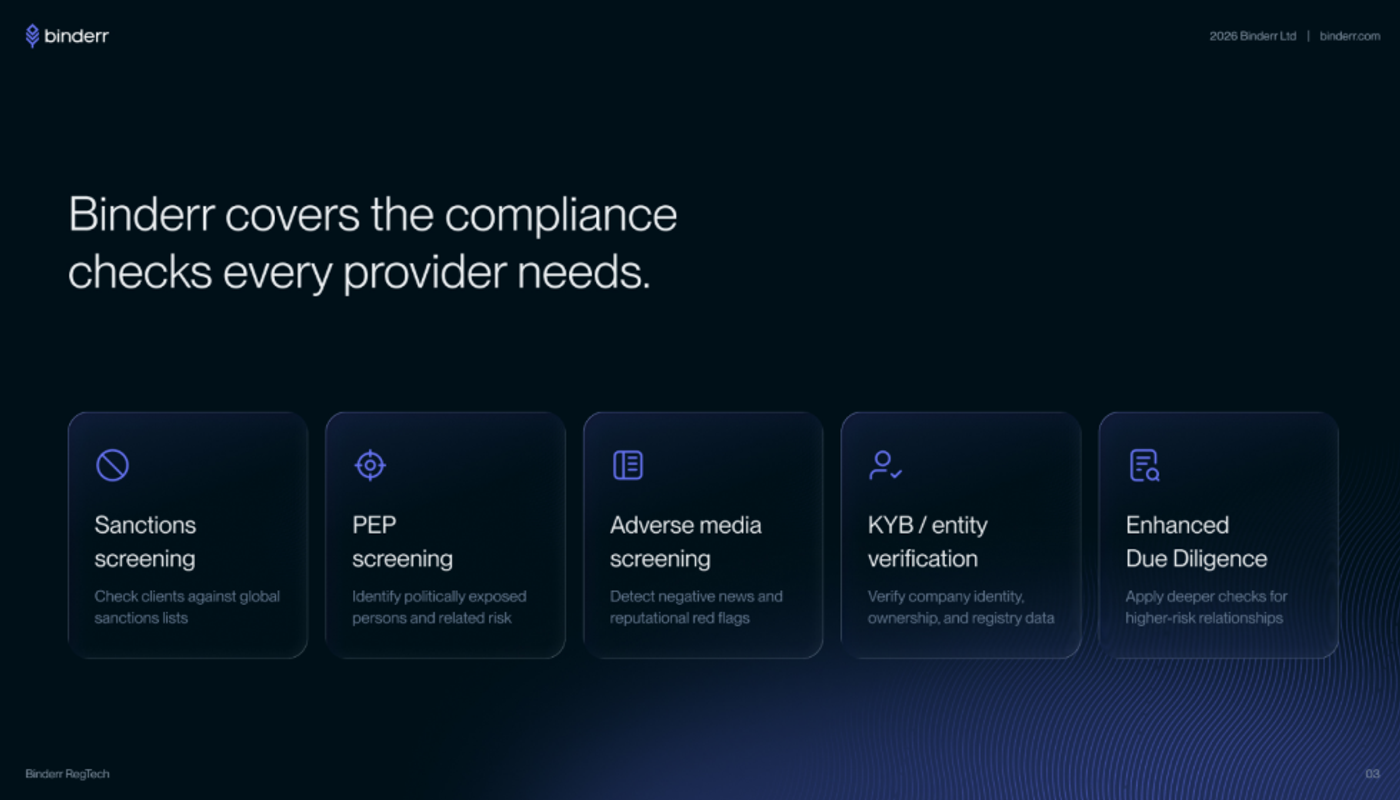
Binderr connects KYB and entity verification with sanctions, PEP, adverse media, and EDD checks, giving analysts a broader view of the company before an onboarding decision is made.
Reduces Unnecessary Onboarding Delays - Automated business address verification tools can streamline onboarding by matching registry data, extracting information from documents, and standardising address formats. This reduces manual data entry and minimises repeated requests for proof of business address, helping organisations onboard customers more efficiently within an address verification business system.
Strengthens Audit Readiness - Maintaining a clear audit trail is essential for compliance. Recording submitted address data, source records, reviewed documents, match outcomes, risk decisions, manual overrides, and timestamps ensures that every step of the company address verification process is documented and can be reviewed during audits or regulatory inspections.
Verify Businesses Without the Manual Work
Which Types of Business Addresses Should Be Verified?
Understanding the different types of business addresses is essential for effective business address verification and KYB compliance. Companies often use multiple addresses for legal, operational, and correspondence purposes, and each one plays a distinct role in verifying a company’s legitimacy and risk profile.
By identifying and verifying registered offices, trading locations, and operational addresses, organisations can strengthen company address verification processes, improve KYB accuracy, and detect inconsistencies that may indicate fraud or misrepresentation in an address verification business environment.
Address type | Primary purpose | Important KYB question |
Registered office | Official legal and regulatory correspondence | Does it match the relevant company registry? |
Principal place of business | Main location from which the company is managed | Is the company genuinely directed or operated from here? |
Trading address | Location used for commercial activity | Is it consistent with the stated business model? |
Headquarters | Central management or administrative location | Does it correspond with group and corporate information? |
Branch address | Location of a local branch or establishment | Is the branch officially registered where required? |
Mailing address | Address used to receive correspondence | Why is it different from the registered or trading address? |
Virtual office | Third-party address and administrative service | Is its use legitimate and proportionate to the company’s activities? |
Residential address | Home address used for a business | Is this reasonable for the company’s size, sector, and operating model? |
How Does Automated Business Address Verification Work?
Understand how automated business address verification streamlines KYB processes by validating company location data quickly and accurately.
This section explains the step-by-step workflow, including address validation, data matching, and risk assessment in automated KYB address verification systems used in address verification business solutions.
Step 1: Collect the Address
The first step in business address verification is to collect accurate and complete address data from reliable sources. This typically includes onboarding forms, company documents, registry data, existing CRM records, or information provided by an authorised representative. Ensuring that the data is captured at the point of entry reduces the risk of inconsistencies later in the KYB verification process.
It is important to distinguish between different address types such as registered office, trading address, or principal place of business. Labelling each address correctly allows compliance teams to apply the appropriate verification checks and improves the accuracy of company address verification across multiple data sources.
Step 2: Parse and Standardise the Information
Once collected, the address data should be parsed and standardised using automated tools. This involves breaking down the address into structured components such as building number, street name, city, region, postal code, and country. Address standardisation ensures consistency across systems and supports accurate matching during KYB address verification.
Automation also helps handle variations in abbreviations, punctuation, local formatting, and transliteration. For example, “Street” vs “St” or differences in international address formats can be normalised to improve matching accuracy. This step is essential for reducing false mismatches in automated address verification business systems.
Step 3: Validate the Address Structure
Address validation checks whether the structure of the address is complete and logically consistent. This includes verifying that required fields are present and that combinations such as postal code, city, and country align with recognised geographic data. Address validation helps confirm that the location exists and is deliverable.
However, it is important to note that validation alone does not confirm that the company is genuinely associated with the address. It is a foundational step in business address verification, ensuring that only plausible and correctly formatted addresses proceed to deeper verification checks.
Step 4: Retrieve Official Company Records
The next step is to retrieve official company records and compare them with the submitted address details. This involves accessing trusted sources such as national company registries, EU interconnected business registers, and Legal Entity Identifier (LEI) databases. These sources provide authoritative information on a company’s registered office and legal status.
For example, EU business registers are connected through the Business Registers Interconnection System (BRIS), while GLEIF Level 1 data includes verified legal entity names and registered addresses. Cross-referencing these records strengthens KYB address verification by confirming whether the submitted address aligns with official corporate data in company address verification workflows.
Step 5: Extract Information from Documents
OCR (Optical Character Recognition) and advanced document-processing technology play a critical role in automated business address verification by converting unstructured documents into structured, searchable data. These tools can accurately extract key fields such as the company name, registered or operating address, issue date, document issuer, and account or reference number from various proof-of-address documents like utility bills, bank statements, and tax certificates.
In addition to data extraction, modern systems incorporate document-quality and fraud detection checks. These include identifying low-resolution scans, inconsistent fonts, altered metadata, or signs of tampering. By combining OCR with validation rules, organisations can improve KYB accuracy, reduce manual review time, and strengthen fraud prevention during onboarding.
Check Business Registry Data
Step 6: Compare the Records
Once the data is extracted, the system compares the submitted business address against multiple trusted sources to verify consistency. These sources may include official company registry records, proof-of-address documents, tax filings, banking evidence, licence databases, and existing customer profiles. This multi-source comparison helps confirm whether the address is genuinely associated with the legal entity.
Different matching techniques are used to improve accuracy. Exact matching checks for identical entries, while partial matching allows for minor differences such as abbreviations. Fuzzy matching accounts for spelling variations or formatting inconsistencies, and contextual matching evaluates whether differences are reasonable based on jurisdiction, address type, or business structure. Together, these methods enhance the reliability of KYB address verification and company address verification.
Step 7: Analyse Address-Related Risk
After matching, the system evaluates address-related risk factors to determine whether the business presents potential compliance concerns. This includes analysing how many entities are registered at the same address, whether the address type (e.g., virtual office or residential) aligns with the company’s stated activities, and whether there have been recent or frequent address changes.
Additional risk indicators include inconsistencies across documents, links between the address and directors or UBOs, and discrepancies between the operational location and declared business model. These insights contribute to overall risk scoring and help identify potential shell companies, fraud risks, or high-risk jurisdictions within the KYB verification process.
Turn Address Data Into Actionable Risk Signals
Once a business submits its address and supporting documents, the information should feed directly into the company’s KYB risk assessment. Binderr’s dynamic onboarding workflows adapt data collection to the entity type, jurisdiction, and customer responses, reducing unnecessary document requests.

(With Binderr, business address information becomes part of the risk decision rather than remaining trapped in an onboarding form or separate spreadsheet.)
Step 8: Approve, Reject, or Escalate
Based on the verification results and risk analysis, the system determines the appropriate onboarding outcome. A business may be marked as verified if all data aligns, or verified with minor differences if discrepancies are low-risk and explainable. In cases where inconsistencies remain, the system may request additional evidence or trigger a manual review.
Higher-risk scenarios may require Enhanced Due Diligence (EDD), particularly where address mismatches are combined with other red flags such as complex ownership structures or adverse media. If the address cannot be verified or presents significant risk, the application may be rejected. This structured decision-making supports consistent and compliant KYB workflows in an address verification business environment.
Step 9: Store an Audit Trail
Maintaining a comprehensive audit trail is essential for regulatory compliance and internal accountability. The system records key details such as the data source, retrieval timestamp, document version, matching logic applied, risk score, reviewer actions, and final decision outcome. This ensures that every step of the business address verification process is transparent and traceable.
A well-maintained audit trail supports regulatory audits, dispute resolution, and ongoing monitoring. It also enables organisations to demonstrate adherence to AML and KYB requirements, ensuring that decisions are based on verifiable evidence and consistent risk assessment practices.
See How Binderr Streamlines Address Verification
Binderr simplifies the entire process by:
- Automating address collection and validation
- Matching company data with global registries instantly
- Extracting document data using OCR technology
- Running AML screening alongside address checks
- Assigning dynamic risk scores automatically
- Triggering EDD workflows for high-risk cases
- Maintaining full audit trails for compliance
How to Verify Virtual Offices, Shared Workspaces, and Mailbox Addresses
Do Not Reject the Address Automatically
Virtual offices, shared workspaces, and mailbox addresses are increasingly common in modern business operations, especially for startups, remote teams, and international companies. These setups can provide flexibility, cost efficiency, and access to professional business locations without the need for permanent physical premises. In many cases, a virtual office address is a legitimate part of a company’s business address verification profile.
However, during KYB address verification, it is important to assess whether the use of such an address aligns with the company’s declared activities and risk profile. Rather than rejecting these addresses outright, compliance teams should evaluate them within the broader context of company address verification and address verification business processes.
Identify the Service Provider
To verify a virtual office or shared workspace, it is essential to identify the service provider and understand the nature of the arrangement. This includes confirming the provider’s name, reviewing the service agreement, and determining the duration and scope of services offered.
From a KYB compliance perspective, verifying the legitimacy of the service provider helps ensure that the business address is not being misused or fabricated. Understanding these details supports accurate business address verification and strengthens the overall KYB verification process.
Compare the Arrangement with the Business Model
A key step in business address verification is determining whether the address type is consistent with the company’s stated business activities. For example, a remote consultancy or digital agency may reasonably operate from a virtual office, while a manufacturing company claiming production at a mailbox address would raise questions. Similarly, regulated entities such as financial institutions may be required to demonstrate a physical presence or local substance depending on jurisdictional rules.
This comparison helps compliance teams identify potential inconsistencies that could indicate higher risk or misrepresentation. By aligning the address type with the business model, organisations can improve KYB accuracy and detect anomalies early in the onboarding process. This approach ensures that address verification is not performed in isolation but as part of a broader company verification and risk assessment framework.
Request Additional Evidence Where Risk Is Higher
When the use of a virtual office or shared workspace presents elevated risk, additional documentation may be required to support the business address verification process. This can include a virtual office agreement, proof of an operating address, employee or payroll records, local licences, tax registration documents, supplier or logistics records, and bank correspondence. These documents help establish whether the company has genuine operational activity beyond the registered address.
Requesting supplementary evidence allows compliance teams to perform enhanced due diligence (EDD) where necessary and reduce the risk of onboarding shell companies or fraudulent entities. By combining document verification with address matching and risk scoring, organisations can strengthen their KYB verification process and ensure that virtual or mailbox addresses are used legitimately and transparently.
Binderr Advanced Address Verification Features
Binderr enhances verification with:
- AI-powered document verification and fraud detection
- Deep ownership structure mapping for KYB checks
- Integrated AML screening across global databases
- Real-time monitoring for address and risk changes
- Smart matching algorithms to reduce false positives
Common Business Address Verification Mistakes
Avoid common pitfalls that can weaken your KYB address verification process and increase compliance risk.
Understanding these mistakes helps improve accuracy, reduce fraud exposure, and strengthen business address verification workflows.
Treating postal validation as full verification - Postal validation confirms that an address is correctly formatted and deliverable, but it does not prove that a company is genuinely connected to that location. Business address verification for KYB requires additional checks, such as matching registry data and reviewing supporting documents, to confirm legitimacy.
Assuming official registry information is always current - Company registry records are a key source for company address verification, but they may not always reflect recent changes. Some registries rely on self-reported updates, so compliance teams should corroborate registry data with independent documents or additional sources when performing KYB address verification.
Accepting a website as independent proof - A company website can support business address verification, but it should not be treated as independent evidence. Websites are self-published and can be easily altered, so they should be used alongside more reliable sources such as registry extracts, bank statements, or utility bills.
Ignoring differences between branches and parent entities - Large organisations often operate through multiple branches, subsidiaries, or legal entities, each with its own address. Failing to distinguish between these can lead to incorrect conclusions during KYB verification. It is important to verify the correct address for the specific legal entity being onboarded.
Applying one document rule to every jurisdiction - Different countries have varying standards for proof of business address and document availability. Applying a single document requirement across all jurisdictions can lead to gaps or unnecessary friction. A risk-based approach to business address verification allows for flexibility while maintaining compliance.
Using rigid matching thresholds - Strict address matching rules can result in false mismatches due to formatting differences, abbreviations, or transliteration issues. Effective company address verification should allow for normalisation and contextual matching to improve accuracy without increasing risk.
Verifying the address but ignoring ownership and AML risks - Business address verification is only one part of the KYB process. Focusing solely on the address without considering beneficial ownership, AML screening, and overall risk assessment can leave significant gaps in compliance. Address checks should be integrated into a broader KYB and AML framework.
Complete Compliance Solution with Binderr
Binderr provides a full end-to-end compliance platform:
- KYC identity verification with biometric checks
- KYB business verification with global registry access
- AML screening across sanctions, PEPs, and adverse media
- UBO identification and ownership mapping
- Dynamic risk scoring for CDD and EDD
- Ongoing monitoring with real-time alerts
Conclusion
Business address verification helps confirm that a company’s location is accurate and genuinely linked to its operations. Company address verification and address verification business processes improve fraud detection and support compliance.
It should be part of a wider KYB process, alongside ownership checks, AML screening, and monitoring. Automation speeds up verification, but higher-risk cases still need human review.
With Binderr Compliance, organisations can connect company verification with UBO identification, AML screening, risk scoring, document collection, and ongoing monitoring in one streamlined workflow.