
Law firms face increasing pressure to meet anti-money laundering obligations while maintaining efficient client onboarding. AML software for law firms helps automate identity verification, client due diligence, sanctions screening, and risk assessments, reducing compliance burdens and improving accuracy across legal workflows.
Regulators continue to strengthen AML requirements for lawyers involved in property transactions, corporate matters, trusts, and other high-risk services. According to the United Nations Office on Drugs and Crime, an estimated 2% to 5% of global GDP is laundered each year. Legal AML software helps firms identify potential risks early through KYC checks, AML screening software, and ongoing monitoring.
Choosing the best AML software for law firms requires evaluating screening coverage, compliance automation, reporting capabilities, and integration options. This guide compares leading AML compliance software solutions for lawyers, highlighting their features, pricing, and suitability for different legal practices.
Binderr AML Solution for Law Firms
With Binderr Compliance, you can;
- Verify client identities in minutes with automated KYC checks
- Screen against global sanctions, PEP, and watchlists
- Monitor clients continuously for emerging AML risks
- Assess and prioritize risk with automated scoring
- Streamline compliance workflows and case management
- Connect seamlessly with your existing legal tech stack
- Compare transparent pricing and scalability options
Why Law Firms Need AML Software
Law firms face increasing anti-money laundering (AML) obligations as regulators place greater emphasis on client due diligence, risk assessments, and ongoing monitoring. AML software for law firms helps automate compliance processes, reduce manual workloads, and identify potential financial crime risks during client onboarding and throughout the business relationship.
From KYC software for law firms and AML screening software to sanctions checks, beneficial ownership verification, and ongoing AML monitoring, the right legal AML software can help lawyers maintain compliance while improving efficiency and client experience.
Meeting evolving AML and regulatory compliance standards - Law firms operate in a constantly changing regulatory environment, making it essential to keep pace with AML requirements and compliance obligations. AML software helps firms adapt to new regulations by automating checks, maintaining consistent procedures, and supporting regulatory reporting.
Fulfilling client due diligence (CDD) responsibilities - Client due diligence is a core requirement for legal professionals when onboarding new clients. AML compliance software simplifies CDD by collecting client information, verifying identities, and assessing risk levels before a business relationship begins.
Verifying beneficial ownership structures and stakeholders - Many legal matters involve companies, trusts, or complex ownership arrangements. Legal AML software helps identify and verify beneficial owners, giving firms greater visibility into who ultimately controls or benefits from an entity.
Conducting source of funds and source of wealth assessments - Understanding where a client’s funds originate is an important part of AML compliance. AML software for law firms can support source of funds and source of wealth reviews by gathering documentation, organizing evidence, and helping compliance teams assess potential risks.
Screening clients against sanctions lists and PEP databases - Law firms must ensure they are not engaging with sanctioned individuals or high-risk politically exposed persons (PEPs). AML screening software automates sanctions and PEP checks across global databases, helping firms identify potential compliance concerns quickly.
Maintaining continuous monitoring of client risk profiles - Client risk can change over time due to new sanctions, adverse media coverage, or changes in ownership structures. Ongoing AML monitoring helps firms stay informed of these developments and respond appropriately when risk levels increase.
Creating clear, audit-ready records and compliance documentation - Regulators often require firms to demonstrate how compliance decisions were made. AML software creates detailed audit trails, stores verification results, and maintains records that can be easily accessed during reviews or regulatory inspections.
Streamlining compliance processes to reduce manual workload - Manual AML checks can be time-consuming and prone to errors. Law firm compliance software automates repetitive tasks such as KYC verification, client onboarding, and risk assessments, allowing legal teams to focus more time on client service and casework.
Run free AML screening checks with Binderr
Simplify Legal Client Onboarding and Due Diligence with Binderr
- Verify individual clients with AI-powered KYC checks
- Verify companies using global business registry data
- Screen clients against sanctions, watchlists, PEPs, and adverse media
- Automatically assign risk scores using dynamic risk assessment
- Trigger Enhanced Due Diligence (EDD) for high-risk clients
- Collect additional documents through customizable workflows
- Maintain complete audit trails and compliance records
Quick Comparison of Best AML Software for Law Firms and Lawyers
Choosing the best AML software for law firms is essential for meeting regulatory obligations, streamlining client onboarding, and reducing compliance risk. Modern AML compliance software helps lawyers automate KYC checks, sanctions screening, client due diligence, and ongoing monitoring while maintaining accurate audit trails.
Below, we compare the top AML software for lawyers and law firms based on features, compliance capabilities, ease of use, and overall value.
Software | KYC | AML Screening | Monitoring | KYB | Free Trial |
Binderr | ✅ | ✅ | ✅ | ✅ | ✅ |
ComplyAdvantage | ✅ | ✅ | ✅ | ✅ | ❌ |
Sumsub | ✅ | ✅ | ✅ | ✅ | ❌ |
Trulioo | ✅ | ✅ | ✅ | ✅ | ❌ |
iDenfy | ✅ | ✅ | ❌ | ❌ | ❌ |
Key Features to Look for in AML Software for Law Firms
Selecting the best AML software for a law firm involves assessing the features and functionality that enable strong compliance practices, efficient client onboarding, and effective risk management. An ideal AML solution should streamline due diligence tasks, minimize manual effort, and help legal professionals stay aligned with changing regulatory obligations.
When comparing AML software for lawyers, focus on features such as KYC verification, AML screening software, sanctions and PEP checks, client due diligence software, ongoing monitoring, and compliance reporting to ensure comprehensive protection against financial crime risks.
Client Identity Verification
Client identity verification is the foundation of effective AML compliance for law firms. Modern AML software for lawyers uses automated document verification, biometric authentication, liveness detection, and database cross-checks to confirm that clients are who they claim to be.
These tools help legal professionals meet Know Your Customer (KYC) requirements while reducing onboarding delays and minimizing the risk of identity fraud. By automating identity checks, law firms can create a faster, more secure client onboarding experience and maintain accurate compliance records.
Comprehensive AML Screening
Comprehensive AML screening software enables law firms to assess client risk before accepting new business. Solutions typically screen individuals and businesses against global sanctions lists, regulatory watchlists, law enforcement databases, and financial crime records.
Advanced AML compliance software can also identify links to high-risk jurisdictions, suspicious entities, and known criminal networks. This helps lawyers perform thorough client due diligence (CDD) and make informed risk-based decisions while maintaining regulatory compliance.
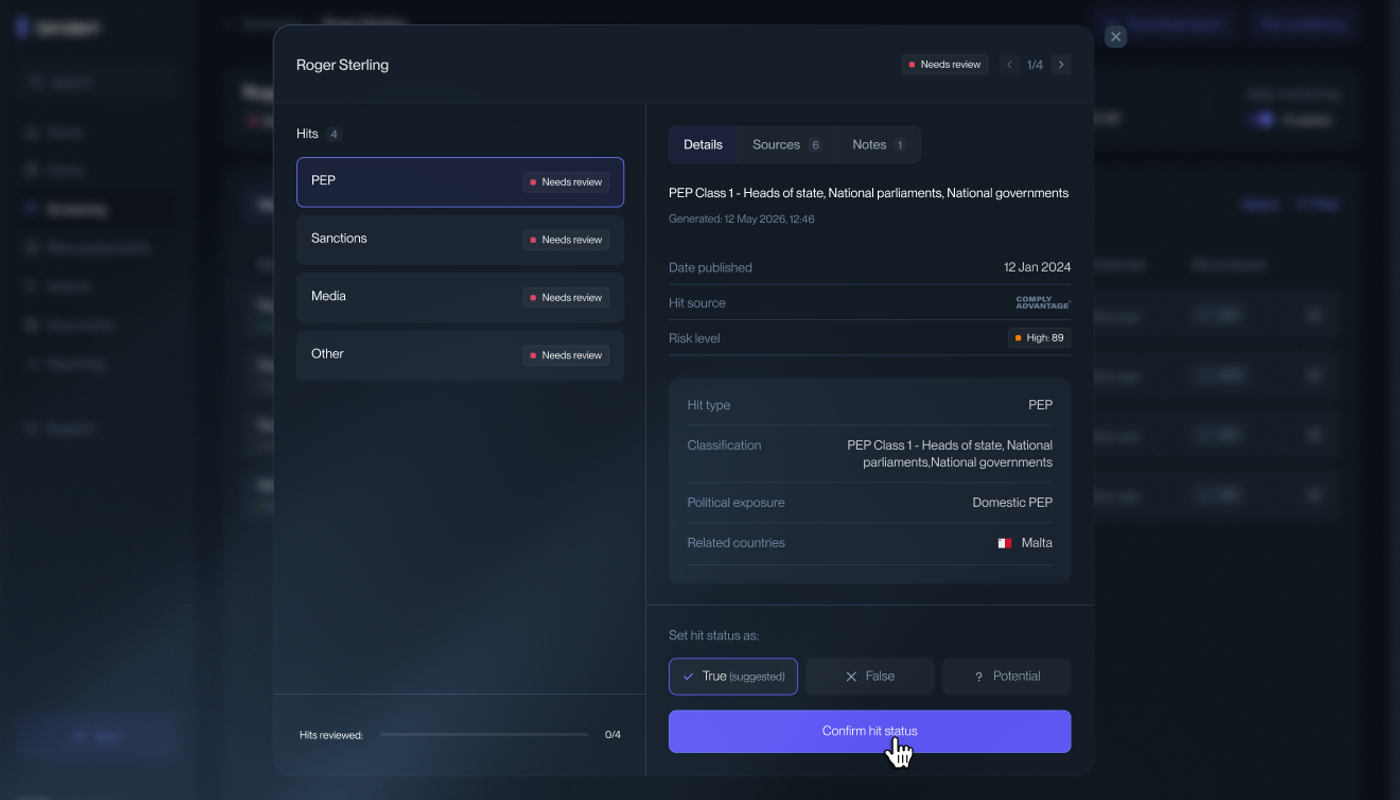
(Binderr consolidates sanctions screening, PEP checks, adverse media screening, and compliance alerts into a single review interface. Legal compliance teams can investigate potential matches, assess risk levels, and document decisions for audit purposes.)
Continuous Sanctions Monitoring
AML monitoring software provides ongoing sanctions screening long after the initial client onboarding process. Instead of relying on one-time checks, law firms receive real-time alerts whenever a client's sanctions status changes or new regulatory restrictions are introduced.
Continuous monitoring helps legal practices stay compliant with evolving AML regulations, identify emerging risks quickly, and demonstrate proactive compliance efforts during audits or regulatory reviews.
Politically Exposed Person (PEP) Screening
PEP screening helps law firms identify politically exposed persons, their family members, close associates, and related entities that may present elevated money laundering or corruption risks.
Legal AML software automatically searches global PEP databases and applies risk scoring to highlight clients requiring enhanced due diligence (EDD). By identifying high-risk relationships early, lawyers can implement appropriate compliance controls and reduce exposure to financial crime risks.
Adverse Media and Reputation Checks
Adverse media screening allows law firms to uncover potential reputational and compliance risks that may not appear on sanctions or watchlists. AML software scans thousands of trusted news sources, regulatory publications, court records, and public databases to identify negative media coverage related to fraud, corruption, money laundering, terrorism financing, or other criminal activity.
These insights support stronger risk assessments, improve client due diligence processes, and help legal professionals avoid engaging with high-risk clients or entities.
Automated Risk Assessment
Modern AML risk assessment software helps law firms automatically evaluate and score clients based on multiple risk factors, including jurisdiction, transaction type, beneficial ownership structure, sanctions exposure, and adverse media findings.
Instead of relying on manual reviews, lawyers can use automated risk scoring models to categorize clients as low, medium, or high risk and apply the appropriate level of client due diligence (CDD) or enhanced due diligence (EDD). This improves consistency, reduces compliance workloads, and helps firms identify potential money laundering risks earlier in the onboarding process.
Source of Funds Validation
Effective AML software for law firms should support the collection, verification, and review of source of funds and source of wealth documentation. Lawyers can securely request bank statements, tax records, property sale documents, investment records, and other supporting evidence directly from clients.
Automated workflows help compliance teams assess whether funds are consistent with a client's profile, reducing the risk of accepting proceeds from illicit activities and strengthening AML compliance procedures.
Continuous Client Monitoring
AML monitoring software enables ongoing monitoring of clients long after onboarding is complete. The platform can automatically track changes in sanctions lists, politically exposed person (PEP) status, adverse media coverage, company ownership structures, and other risk indicators.
Continuous client monitoring helps law firms meet regulatory obligations, identify emerging risks in real time, and maintain accurate risk assessments throughout the client relationship.
Track Risk Without Manual Reviews
Compliance Reporting and Audit Trails
Comprehensive compliance reporting tools create detailed records of every AML check, KYC verification, screening result, risk assessment, and compliance decision.
Audit-ready reports make it easier to demonstrate compliance during regulatory inspections or internal reviews. Robust audit trails provide a clear history of actions taken, helping law firms prove that appropriate AML controls, client due diligence measures, and ongoing monitoring procedures were followed.
Integration with Legal Practice Software
The best AML software for lawyers integrates seamlessly with legal practice management systems, case management platforms, document management tools, and client onboarding solutions. These integrations eliminate duplicate data entry, streamline compliance workflows, and ensure AML screening, KYC checks, and client due diligence processes are embedded directly into everyday legal operations.
By connecting compliance software with existing legal technology stacks, firms can improve efficiency, reduce administrative burden, and deliver a smoother client onboarding experience.
Advanced AML Screening and Risk Assessment for Law Firms with Binderr
- Global sanctions screening across major regulatory lists
- PEP screening for clients, directors, and beneficial owners
- AI-powered adverse media analysis
- Dynamic risk scoring for CDD and EDD
- UBO verification and ownership structure mapping
- Director and shareholder screening
- Continuous monitoring with real-time alerts
Top 5 Best AML Software of 2026
Binderr
Binderr is a comprehensive AML and client onboarding platform built to help law firms meet regulatory obligations while reducing the administrative burden of compliance. The platform combines identity verification, business verification, sanctions screening, beneficial ownership checks, risk assessment, and ongoing monitoring into a single workflow.
This allows legal practices to onboard clients faster, maintain accurate compliance records, and demonstrate regulatory compliance through audit-ready documentation.
Key Features:
- Individual and Business Verification: Verify both individual clients and corporate entities through automated KYC and KYB checks, helping firms establish client identities quickly and accurately.
- Global Sanctions, PEP, and Adverse Media Screening: Screen clients against international sanctions lists, politically exposed persons (PEP) databases, and adverse media sources to identify potential compliance risks before onboarding.
- Beneficial Ownership Verification: Identify and verify ultimate beneficial owners (UBOs) behind complex corporate structures, supporting compliance with AML and transparency requirements.
- Ongoing Monitoring and Real-Time Alerts: Continuously monitor clients for changes in sanctions status, PEP exposure, adverse media mentions, or other risk indicators, with automated alerts when issues arise.
- Risk Scoring and Compliance Workflows: Automatically assess client risk levels using configurable risk models and route cases through appropriate due diligence and approval processes.
- Audit-Ready Reporting and Record Keeping: Maintain detailed compliance records, screening results, and verification evidence to support regulatory audits and internal reviews.
- Centralized Client Onboarding: Manage onboarding, verification, screening, and compliance documentation from a single platform, reducing manual processes and improving operational efficiency.
Best For: Law firms that want a complete AML compliance solution covering client onboarding, KYC, KYB, sanctions screening, and ongoing monitoring. Particularly suitable for firms handling corporate clients, cross-border matters, or higher-risk transactions that require enhanced due diligence.
ComplyAdvantage
ComplyAdvantage is a leading AML and financial crime risk intelligence platform designed to help organizations detect, assess, and manage compliance risks more effectively. For law firms, the platform provides powerful screening and monitoring capabilities that simplify client due diligence, reduce manual compliance workloads, and support regulatory obligations.
By leveraging real-time risk data and advanced monitoring tools, ComplyAdvantage enables legal professionals to identify potential risks early and maintain ongoing compliance throughout the client relationship.
Key Features:
- Comprehensive Sanctions Screening: Screens clients against global sanctions lists from major regulatory authorities, helping law firms identify restricted individuals and entities before onboarding.
- Politically Exposed Person (PEP) Screening: Detects PEPs and their associates, allowing firms to apply enhanced due diligence measures where required.
- Adverse Media Monitoring: Continuously scans global news sources and risk databases to identify negative media coverage that may indicate financial crime or reputational risks.
- Real-Time Risk Intelligence: Uses continuously updated risk data to provide timely alerts and insights, helping compliance teams respond quickly to emerging threats.
- Ongoing Monitoring: Automatically monitors clients after onboarding and notifies firms of changes in risk status, sanctions exposure, or adverse media findings.
- Customizable Risk Scoring: Enables firms to tailor risk assessment criteria based on their compliance policies, client profiles, and practice areas.
- API and Workflow Integrations: Integrates with existing onboarding, case management, and compliance systems to streamline AML processes and reduce manual data entry.
Best For: ComplyAdvantage is best suited for law firms that require robust AML screening and continuous monitoring capabilities. It is particularly valuable for firms handling high-risk clients, international transactions, or complex corporate structures. Firms seeking real-time risk intelligence and automated compliance workflows will benefit most from its platform.
Sumsub
Sumsub is a comprehensive compliance platform that helps law firms streamline client onboarding, identity verification, and anti-money laundering (AML) obligations from a single system.
Designed for organizations that work with clients across multiple jurisdictions, it combines Know Your Customer (KYC), Know Your Business (KYB), sanctions screening, and ongoing monitoring into one integrated solution. This makes it particularly valuable for legal practices that need to manage complex compliance requirements while maintaining an efficient client experience.
Key Features:
- Global Identity Verification (KYC): Verifies individual clients using government-issued documents, biometric checks, and automated verification workflows across numerous countries and regions.
- AML Screening and Risk Detection: Screens clients against global sanctions lists, politically exposed persons (PEP) databases, watchlists, and adverse media sources to identify potential compliance risks.
- Business Verification (KYB): Enables firms to verify corporate clients, review company registration details, and identify beneficial owners to support regulatory compliance.
- Ongoing Monitoring: Continuously monitors clients for changes in sanctions status, PEP exposure, or adverse media mentions, helping firms stay informed about emerging risks after onboarding.
- Risk Scoring and Case Management: Automatically assesses client risk levels and provides tools for documenting investigations, compliance decisions, and audit trails.
- Transaction Monitoring Capabilities: Helps identify unusual or suspicious activity patterns that may require additional review or enhanced due diligence.
- Global Coverage: Supports verification and compliance checks across a wide range of jurisdictions, making it suitable for firms handling international matters and cross-border transactions.
Best For: Law firms that regularly onboard international clients and need a scalable compliance solution. Legal teams seeking a single platform for KYC, KYB, AML screening, monitoring, and compliance management.
iDenfy
iDenfy is a digital identity verification and fraud prevention platform designed to help businesses verify customers quickly while maintaining compliance with AML and KYC regulations. The platform combines AI-powered document verification, biometric authentication, and risk screening tools to streamline onboarding and reduce the risk of identity fraud.
Its user-friendly interface and fast verification process make it particularly attractive for organizations that need efficient customer onboarding without complex compliance workflows.
Key Features:
- AI-Powered Identity Verification: Verifies government-issued identity documents from multiple countries using advanced AI and OCR technology to detect forged, altered, or invalid documents.
- Biometric Face Matching: Compares a user's selfie with their identity document photo to confirm that the person presenting the document is its legitimate owner.
- Liveness Detection: Uses advanced liveness checks to prevent spoofing attempts involving photos, videos, masks, or deepfake technologies.
- AML and Sanctions Screening: Screens individuals against global sanctions lists, politically exposed persons (PEP) databases, and watchlists to support regulatory compliance.
- Fraud Prevention Tools: Identifies suspicious behavior and potential fraud indicators during the onboarding process, helping businesses reduce financial and reputational risks.
- Automated Verification Workflows: Enables organizations to automate customer verification processes, reducing manual reviews and accelerating onboarding times.
- Global Document Coverage: Supports a wide range of identity documents from numerous countries, making it suitable for businesses serving international customers.
- Compliance Reporting: Maintains verification records and audit trails that can assist with regulatory reviews and compliance documentation requirements.
Best For: Organizations that prioritize fast, accurate identity verification and fraud prevention during customer onboarding. Small to mid-sized businesses looking for an easy-to-implement KYC solution with built-in AML screening capabilities.
Trulioo
Trulioo is a global identity verification and AML compliance platform designed to help law firms confidently onboard clients from different countries and jurisdictions. With access to extensive international data sources, the platform enables legal professionals to verify identities, conduct AML checks, and meet regulatory obligations without relying on manual processes.
Its broad geographic coverage makes it particularly valuable for firms handling cross-border transactions, international clients, immigration matters, corporate law, and other practices where verifying individuals and businesses across multiple regions is essential.
Key Features:
- Global Identity Verification: Verify individuals across more than 195 countries using trusted data sources, helping law firms onboard international clients quickly and accurately.
- AML and Sanctions Screening: Screen clients against global sanctions lists, watchlists, politically exposed persons (PEPs), and other risk databases to support AML compliance requirements.
- Business Verification (KYB): Conduct Know Your Business checks to verify companies, beneficial owners, and corporate structures, which is especially useful for corporate and commercial legal practices.
- Document Verification: Validate government-issued identity documents and compare them against trusted data sources to reduce fraud risks during client onboarding.
- Risk-Based Compliance Workflows: Configure verification and screening processes based on client risk levels, helping firms apply enhanced due diligence where required.
- Global Coverage and Data Sources: Access a wide network of international data providers, enabling consistent verification standards across multiple jurisdictions.
- API and Integration Capabilities: Integrate identity verification and AML checks directly into existing legal onboarding and compliance workflows for greater efficiency.
Best For: Law firms that regularly work with international clients, cross-border transactions, and multinational businesses. Particularly valuable for corporate, immigration, private client, and commercial law practices that require reliable identity verification across multiple jurisdictions.
Picking the Best AML Software for Your Law Firm
When evaluating AML software for a law firm, it’s important to consider how well the platform aligns with regulatory requirements, operational efficiency, and the unique demands of your practice. A reliable AML solution can simplify client onboarding, automate KYC verification, strengthen client due diligence processes, and help minimize compliance risks.
Use the criteria below to compare AML software for lawyers and identify a solution that delivers effective AML screening, ongoing monitoring, risk assessment, and compliance management.
Review Your Compliance Obligations
Before selecting AML software for law firms, identify the specific anti-money laundering regulations that apply to your practice. Firms handling property transactions, corporate law, trusts, estates, or cross-border matters often face stricter client due diligence (CDD) and enhanced due diligence (EDD) requirements.
The ideal AML compliance software should support regulatory reporting, maintain audit-ready records, automate risk assessments, and help your team meet record-keeping obligations with minimal manual effort.
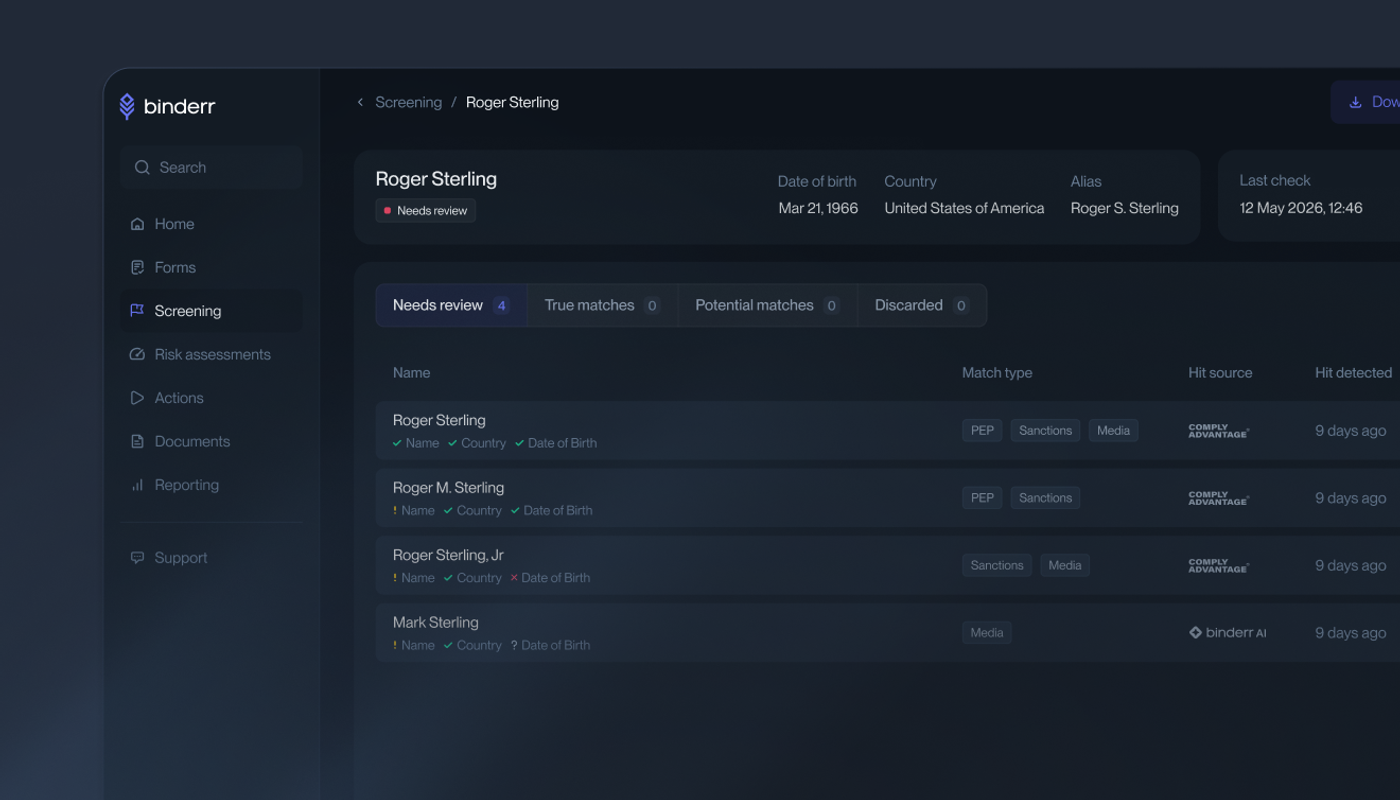
(Binderr enables legal teams to classify potential matches as true, false, or potential hits and maintain a complete compliance audit trail. This supports regulatory reporting, internal reviews, and AML record-keeping obligations.)
Evaluate Your Firm’s Practice Areas
Different legal specialties have unique compliance needs. Conveyancing firms may prioritize source of funds verification and identity checks, while corporate law firms often require robust KYB capabilities and beneficial ownership verification.
Immigration lawyers, trust and estate practitioners, and international legal practices may need enhanced sanctions screening and ongoing monitoring. Choosing legal AML software tailored to your firm's services ensures more efficient client onboarding and stronger compliance controls.
Examine Screening Capabilities
Comprehensive AML screening software should provide access to global sanctions lists, politically exposed person (PEP) databases, adverse media sources, law enforcement watchlists, and regulatory enforcement records.
Look for solutions that deliver accurate matching, configurable risk scoring, and detailed screening reports. Strong screening coverage helps lawyers identify high-risk clients early, reduce false positives, and strengthen anti-money laundering compliance across the client lifecycle.
Assess Ongoing Monitoring Features
AML obligations do not end after onboarding. Effective AML monitoring software continuously screens clients against updated sanctions lists, PEP databases, and adverse media sources.
Real-time alerts, automated risk reassessments, and continuous monitoring capabilities help law firms detect emerging risks quickly and maintain compliance with evolving regulations. Ongoing monitoring is especially valuable for firms managing long-term client relationships or handling high-risk transactions.
Prioritize Workflow Automation
One of the most valuable features in AML software for law firms is workflow automation. Manual compliance processes can be time-consuming, error-prone, and difficult to scale as your client base grows. Look for AML compliance software that automates key tasks such as client onboarding, identity verification, sanctions screening, PEP checks, adverse media monitoring, risk assessments, and ongoing monitoring.
Advanced legal AML software can automatically trigger enhanced due diligence (EDD) reviews for high-risk clients, generate compliance reports, maintain audit trails, and send alerts when client risk profiles change. By reducing repetitive administrative work, lawyers and compliance teams can focus on higher-value legal matters while maintaining strong regulatory compliance.
Analyze Pricing Structures
AML software pricing varies significantly depending on the provider, feature set, and volume of checks performed. Before selecting a platform, compare subscription-based plans, pay-per-check models, and enterprise pricing options to determine which structure best fits your firm's needs.
When evaluating costs, consider more than just the monthly fee. Review what is included in the package, such as KYC verification, AML screening software capabilities, ongoing monitoring, beneficial ownership verification, source of funds checks, and compliance reporting tools. Some providers charge separately for additional screenings or monitoring services, so understanding the total cost of ownership can help avoid unexpected expenses and ensure long-term value.
Common AML Compliance Obstacles for Law Firms
Law firms face increasing pressure to meet anti-money laundering (AML) regulations while maintaining efficient client onboarding and legal operations. From conducting client due diligence and KYC checks to monitoring high-risk clients and verifying beneficial ownership, compliance requirements continue to grow in complexity.
Understanding these AML compliance challenges can help firms choose the right AML software for law firms, strengthen risk management processes, and reduce the burden of manual compliance tasks.
Rising Regulatory Expectations
Law firms face increasing pressure from regulators to strengthen AML compliance programs, maintain detailed audit trails, and demonstrate effective client due diligence. Frequent updates to anti-money laundering regulations can make it difficult for firms to keep policies, AML screening procedures, and compliance records current.
AML software for law firms helps address these challenges by automating compliance workflows, conducting ongoing monitoring, and maintaining audit-ready records. Modern AML compliance software also supports sanctions screening, PEP checks, and risk-based assessments to help firms meet evolving regulatory expectations.
Challenging Beneficial Ownership Structures
Complex corporate entities, trusts, and layered ownership arrangements can make beneficial ownership verification difficult. Without clear visibility into ownership structures, law firms may struggle to identify ultimate beneficial owners and assess potential AML risks.
Legal AML software simplifies beneficial ownership verification by providing access to company data, ownership records, and KYB checks. Automated client due diligence software helps lawyers identify controlling parties, document findings, and reduce compliance risks associated with opaque structures.
Managing Cross-Border Matters
Cross-border transactions often involve multiple jurisdictions, varying regulatory requirements, and increased exposure to sanctions and financial crime risks. Law firms handling international matters must conduct enhanced AML checks while managing complex compliance obligations.
AML screening software helps firms assess international clients through global sanctions screening, adverse media monitoring, and risk assessment tools. Ongoing AML monitoring software can also identify changes in risk profiles and support compliance across multiple jurisdictions.
Dealing with High-Risk Clients
Clients operating in high-risk industries or jurisdictions may present elevated money laundering and financial crime risks. These matters often require enhanced due diligence, additional source of funds verification, and more frequent compliance reviews.
AML software for lawyers supports enhanced due diligence by automating risk scoring, sanctions screening, PEP identification, and adverse media checks. This enables firms to manage high-risk clients more effectively while maintaining strong AML compliance controls.
Reliance on Manual Compliance Workflows
Manual AML checks, spreadsheet-based tracking, and paper-based processes can slow client onboarding and increase the likelihood of errors. These inefficient workflows often create compliance gaps and place additional pressure on legal teams.
Law firm compliance software automates KYC verification, client due diligence, AML screening, and compliance reporting. By reducing manual work, firms can improve accuracy, accelerate onboarding, and strengthen overall AML compliance processes.
Limited Compliance Resources
Many law firms, particularly smaller practices, have limited compliance personnel and budgets. Managing AML obligations manually can consume valuable time and divert resources away from client service and legal work.
AML compliance software helps firms do more with fewer resources by automating routine compliance tasks and centralizing monitoring activities. Features such as legal client onboarding software, ongoing monitoring, and automated reporting improve efficiency while supporting regulatory compliance.
Binderr End-to-End AML Compliance for Law Firms
- Automate client onboarding and identity verification
- Screen clients against global sanctions, watchlists, and PEP databases
- Verify beneficial ownership structures with confidence
- Monitor clients continuously for emerging AML risks
- Generate comprehensive compliance reports and audit trails
- Maintain audit-ready records for regulatory reviews
- Scale compliance workflows as your firm grows
Bottom Line
The best AML software for law firms combines identity verification, AML screening, beneficial ownership verification, ongoing monitoring, and compliance reporting in a streamlined workflow. Binderr Compliance stands out for firms seeking an all-in-one compliance platform that combines KYC, KYB, sanctions screening, beneficial ownership verification, and ongoing monitoring within a single solution.
ComplyAdvantage, Sumsub, Trulioo, and iDenfy each offer strengths in specific areas, making them suitable for firms of different sizes and compliance requirements. By selecting the right platform, law firms can improve onboarding efficiency, strengthen compliance controls, reduce risk exposure, and maintain audit-ready records in an increasingly demanding regulatory environment.