You can set up a business in Gibraltar as a self-employed trader, a partnership, a branch or a limited company. A company pays 15% only on income that arises in Gibraltar. There is no VAT, no capital gains tax and no inheritance tax, and Companies House registers a company in three working days.
The hard part is the admin around the business. Most firms need a business licence from the Office of Fair Trading, premises on a lease of at least 12 months and a registration for every worker with the Department of Employment. Company services such as the registered office are licensed work, so a licensed firm must provide them.
This is where we come in. We set up your Gibraltar company from €1,899, with the licensed registered office and secretary included, and most companies are ready in about a week. One team handles the KYC pack, the constitution, the filing and the papers your licence and bank ask for. You tell us the plan, we get it done.
Gibraltar Company Incorporation
Binderr
Corporate tax
15% standard rate
Time to incorporate
1 Week
Cost
Starting from €1,899
If you only need the company itself, read our guide on how to incorporate a company in Gibraltar.
Why Set Up a Business in Gibraltar
People set up a business in Gibraltar for a 15% tax rate on local profits, no VAT, low start-up fees and a registry that works in days. Gibraltar is a British Overseas Territory with its own parliament, tax office and company registry. Since July 2026, its land border with Spain has had no passport checks.
15% Tax Only on Income Earned in Gibraltar
The Income Tax Office sets corporation tax at 15% from 1 July 2024. Utility, fuel, water and telephony companies, and companies with a dominant market position, pay 20%. Companies are taxed on income accrued in and derived from Gibraltar. The test looks at where the work that earns the profit is done, not where the customer is. A self-employed person pays personal income tax on profits instead.
No VAT, Capital Gains Tax or Inheritance Tax
Gibraltar has no VAT, so a service business invoices its customers without adding it. There is also no inheritance tax, no gift tax and no wealth tax. Capital gains are not taxed, apart from some property sales since 1 January 2025, and dividends a Gibraltar company receives from other companies are not taxed either. It is one reason Gibraltar counts among the low tax countries in Europe. Goods are the exception: since 15 July 2026, a transaction tax applies to goods imported or made for sale in Gibraltar.
Set Up a Business in Gibraltar
Setting up a business in Gibraltar is very doable, and a limited company gives you the most room to grow. These are the main gains.
- 15% on local profits: Income that arises outside Gibraltar falls outside the charge.
- No VAT on services: You invoice your customers with no VAT added.
- Owners in any country: A private company needs one director, who can live abroad.
- Easy access to Spain: No passport checks at the land border since July 2026.
- Fast registry: Companies House registers a company in three working days.
- Company from €1,899: We set it up for you in about a week, office and secretary included.
Low Fees and a Fast Registry
The fees to start a business in Gibraltar are low. Companies House charges £100 plus £10 stamp duty to register a company and £20 to register a business name, and it normally registers a company in three working days, or 24 hours for £200. The Office of Fair Trading charges £189.50 for a new business licence with one business class, under fees in force from 1 August 2025, and £119 a year to renew it. A service provider with turnover of £20,000 or less registers for free instead.
Easier Access to Spain Under the 2026 Treaty
The EU-UK Agreement in respect of Gibraltar was signed on 14 July 2026 and has applied provisionally since 15 July 2026, according to Spain's Ministry of Foreign Affairs. It removes the fence and the passport checks at the land border, and Schengen checks now take place at Gibraltar's port and airport instead. That makes travel easier for staff and clients, and the Ministry says the agreement protects about 15,000 cross-border workers. Gibraltar itself stays outside the EU.
Choosing a Structure to Start a Business in Gibraltar
To start a business in Gibraltar, you choose one of four structures: self-employed in your own name, a partnership, a private limited company, or a branch of a foreign company. The choice decides who carries the debts, how the profits are taxed and which offices you register with.
Self-Employed Sole Trader
A self-employed person trades in their own name and is personally liable for every business debt. Under the Government's guide of 30 July 2026, someone trading only under their own forename and surname goes straight to the Business Application, while any other trading name is registered as a business name first, for £20. The Income Tax Office then registers you on form SE1. It suits one person testing a local idea, and the sole trader vs limited company choice usually turns on liability and tax.
Partnership, Limited Partnership or LLP
In an ordinary partnership, every partner is liable for the debts without limit, and the partnership has no legal personality of its own, as Companies House guidance note 22 explains. The partners register a business name under the Business Names (Registration) Act 1918, and each is taxed on their share of the profits. A limited partnership adds partners whose liability stops at their capital, as long as they stay out of management. A limited liability partnership gives every member limited liability and needs at least two members. It suits partners who all want a role in management, which is the usual reason to set up an LLP. Either way, the partners open a partnership bank account in the business name.
Private Limited Company
A private company limited by shares is a separate legal person, so the owners' liability stops at their shares. Companies House guidance note 10 requires at least one director and a company secretary, and a sole director cannot also act as the secretary. The company keeps a registered office in Gibraltar, pays 15% on Gibraltar income and files accounts and an annual return. It suits anyone with customers abroad, investors, staff or real financial risk, and it is the route we handle for you. Read more about how to set up a limited company in Gibraltar.
Branch of a Foreign Company
A company formed elsewhere can trade in Gibraltar without forming a new one. Companies House guidance note 9, updated in December 2025, says it must register within one month, under Part XII for a place of business or Part XIV for a branch. It files its constitution, a certificate of good standing, its directors and a person resident in Gibraltar who accepts legal papers. Branches are taxed on the same basis as companies. The subsidiary vs branch office choice mostly turns on liability, because a branch stays part of the foreign company.
For most people starting a business in Gibraltar, the choice comes down to self-employment or a company. Self-employment is quicker for one person who lives and sells locally. A company protects your personal assets, lets the owners live abroad and costs £110 to register.
Gibraltar Company Incorporation
Binderr
Corporate tax
15% standard rate
Time to incorporate
1 Week
Cost
Starting from €1,899
Setting Up a Company in Gibraltar as a Non-Resident
Setting up a company in Gibraltar from abroad is straightforward, because company law sets no residency or nationality test for owners or directors. Self-employment is different, because a business licence can be refused to a person who is not entitled to live or work in Gibraltar. For owners abroad, the company is the practical route.
No Residency Rule for Company Owners
A private company can have one director and one shareholder, and the same person can hold both roles from any country. Documents are certified at home and filed in Gibraltar, so nobody has to travel. Locally, the company needs a registered office and a secretary. Companies House guidance note 2 says providing a registered office is regulated under the Financial Services Act 2019, so it comes from a licensed firm. Our guide to setting up a company as a non-resident covers tax residence and source of funds.
Self-Employment Needs the Right to Live or Work
Self-employed registration is built for people based in Gibraltar. The Department of Employment asks for proof of a Gibraltar trading address dated within the last 3 months. The OFT also lists, among the grounds for an objection to a licence, an applicant who is not entitled to reside or work in Gibraltar. A founder abroad who wants to own a Gibraltar business should use a company instead.
Detached Workers and Work Permits
A business based elsewhere can send staff for a short job without setting up locally. Under section 19 of the Income Tax Act, it works with a Gibraltar business as a subcontractor and registers its staff as detached workers, with a free notification for visits under 48 hours. Staff hired locally who are not British or EU nationals need a work permit before they start, issued for one post and for up to 12 months. Employing someone without one carries a fixed penalty of £3,000.
Where the Company Is Managed
If every decision is taken in your home country, that country may treat the company as its own tax resident. Board meetings held in Gibraltar, with directors who take real decisions, support the Gibraltar position. Owners who move to Gibraltar themselves can also look at Category 2 residency alongside the company.
Read more: Gibraltar company incorporation for non-residents.
Set Up a Gibraltar Company From Abroad
You can set up a Gibraltar company without living there or travelling. We run each step remotely for you.
- No trip to Gibraltar: Documents certified at home and filed for you in Gibraltar.
- No residency test: Owners and the director can live in almost any country.
- Secretary provided: A licensed firm acts as the secretary every company must have.
- Registered office in place: A licensed Gibraltar address from the day of filing.
- Tax residence planned: We agree where the board meets before anything is filed.
- Bank file ready: Built in parallel, for our banking partners to review once the company exists.
Best Industries to Start a Business in Gibraltar
Online gaming, financial services, professional and online services, and trade serving the local market are the main sectors here. The first two need an authorisation from their own regulator on top of the company. The last two need a business licence from the Office of Fair Trading and suitable premises.
Online Gaming and Betting
Gambling businesses are licensed under the Gambling Act 2005, so they do not take a separate business licence from the Office of Fair Trading. The company comes first, and the Gibraltar gaming licence then runs on its own timeline. Banking and payments are the other big step, so plan the gambling payment gateways and the bank account for a gambling company early.
Financial Services, Payments and DLT
Insurers, e-money issuers, payment firms, investment firms, fund managers and DLT providers are authorised by the Gibraltar Financial Services Commission. Activities regulated under the Financial Services Act 2019 need no OFT licence, but each regime sets its own capital, governance and approval rules, so budget for them separately. Read more on how to get an EMI or payment licence in Gibraltar.
Professional and Online Services
Consultants, agencies, software firms and other service businesses need a licence for each service they provide, chosen from the OFT's Service Categories List. Where a service business does not need premises, for example because it works online, the OFT may waive the premises rule. A company that only provides services to companies in its own group needs no business licence under section 25(1) of the Fair Trading Act 2023, which suits a holding company structure.
Retail, Wholesale and Import
Shops, wholesalers and importers need a licence to trade in goods, listing each category they sell. The OFT requires real commercial premises, usually a shop or store, and a trader cannot work from home, even when every sale is online and delivered. An office is not normally accepted either. The licence also lets the business get an HM Customs code to import goods in its own name. Since 15 July 2026, goods placed for sale in Gibraltar carry the transaction tax instead of import duty.
Gibraltar Company Incorporation
Binderr
Corporate tax
15% standard rate
Time to incorporate
1 Week
Cost
Starting from €1,899
Business Licensing in Gibraltar
Business licensing in Gibraltar sits with the Office of Fair Trading under the Fair Trading Act 2023. Anyone who trades in goods or provides services in Gibraltar needs a business licence, unless another law already regulates the activity or an exemption applies. The application is online and moves quickly when the premises and documents are ready.
Who Needs a Gibraltar Business Licence
A Gibraltar business licence covers the business, the premises and any conditions written into it. You do not need one as an employee, as a director or shareholder of a company that carries on business, for services to companies in your own group, for services to a single family office or for rental income from property in Gibraltar. A cottage industry, artisan or service provider with turnover of £20,000 or less registers with the OFT for free instead, unless it runs a Specified Business such as healthcare, therapy or tattooing.
Activities Licensed Under Other Laws
A business regulated under another law deals with its own regulator and does not take an OFT licence. The OFT lists the Financial Services Act 2019, the Gambling Act 2005, the Medical and Health Act 1997, the Legal Services Act and the Leisure Areas (Licensing) Act 2001, among others. A business licensed under the Tobacco Act 1997 still needs an OFT licence as well.
Premises Rules for a Business Licence
Get the premises before you apply, because the OFT cannot issue a licence without them. It usually wants a tenancy agreement or lease of at least 12 months, with interior and exterior photographs or a site plan. A registered office address from a corporate service provider and a virtual office that only receives mail are both refused. Service businesses that do not need premises can ask for a waiver, but traders and some firms that hold client money cannot.
Business Licence Fees and Renewal
Under the Fair Trading (Fees) Regulations 2024, applied from 1 August 2025, a new licence costs £189.50 for one business class, or £270 for a trade class and a service class together. Renewal costs £119 a year for one class and £216.50 for both. A licence lasts one year, and the OFT emails a renewal notice about a month before it expires. After you apply, the OFT publishes a public notice within 5 working days, and objections can be lodged for 5 working days after that.
How to Register a Business in Gibraltar
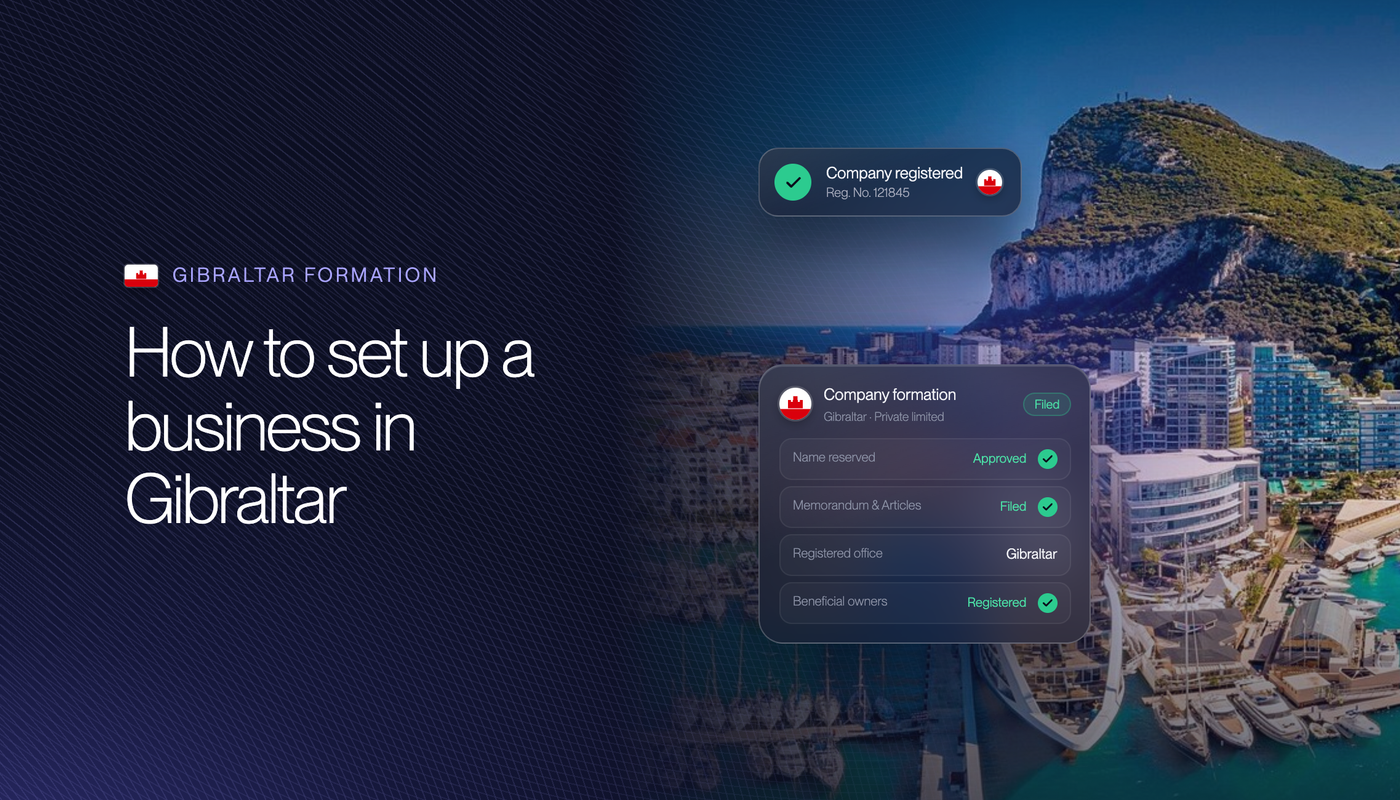
To register a business in Gibraltar as a company, you form the company at Companies House, submit one online Business Application for registration and the licence, register any working director with the Department of Employment and file the beneficial owners within 30 days. We run the company side for you and prepare the papers the other offices ask for.
Before You Start
Settle three things first: the structure, whether a regulator other than the OFT licenses your activity, and premises that suit the business or a case for a waiver. Then check that the name is free on the Gibraltar Companies House register, because a name refused late means drafting the documents twice.
We Form the Company at Companies House
We prepare the application to register the company, the memorandum and articles of association and the first notice of the registered office. The licensed firm provides the registered office and the secretary. We file everything with the £100 registration fee and the £10 stamp duty, and the registry normally issues the certificate in three working days. Corporation tax registration follows automatically, because the Income Tax Office registers every new company through Companies House.
We Prepare the Papers for Your Business Application
Once the company exists, the Business Application goes in online on the OFT portal. It merges business registration under the Business Trades and Professions (Registration) Act 1989 with the licence under the Fair Trading Act 2023, and only asks for licence details if you need one. We supply the company papers it asks for: the certificate, the incorporation number and the directors' identity documents. You add the lease and the photographs of your premises.
We Handle the Post-Registration Filings
Within 30 days of incorporation, the company must give the details of its beneficial owners to the Registrar under the Register of Ultimate Beneficial Owners Regulations 2017, and we file them for you. The particulars of the directors and the secretary go to Companies House within 14 days of appointment. If a director will work in the business, the Department of Employment needs a Notice of Terms of Engagement for them, and the Income Tax Office needs a letter requesting PAYE registration. We prepare those papers with the company file.
We Prepare the Bank File
We build the bank file from the same KYC pack: the certificate, the constitution, the registers, a short business plan and source of funds evidence. Our banking partners start their review as soon as the company exists, so the account usually opens within days.
Full-Service Company Set Up in Gibraltar
With us, the whole setup takes about a week when the documents are ready. This is what we do.
- Name cleared first: Checked with the Registrar before any document is drafted.
- Constitution drafted: Memorandum and articles prepared for your share structure.
- Registry filing done: Fee and stamp duty paid, certificate in three working days.
- Licensed office and secretary: In place on the day the company is registered.
- Ownership filed on time: Beneficial owners filed inside the 30 day deadline.
- Licence papers ready: Company documents prepared for your Business Application.
- One point of contact: The same team from the first question to the open account.
Documents Needed to Set Up a Company in Gibraltar
To set up a company in Gibraltar, every director, shareholder and beneficial owner gives identity, address and source of funds evidence to the licensed firm. The company then needs its own documents for the registry and the Business Application. Most delays come from gaps in the first set, so we check every page before filing.
For Each Owner and Director
- Passport: A valid passport, certified by a lawyer, notary or accountant.
- Proof of address: A recent utility bill or bank statement, usually from the last 3 months.
- Source of funds: Bank statements, sale contracts or payslips that show where the money comes from.
- Source of wealth: A short written account, with evidence, of how the wider wealth was built.
- CV or profile: Mainly for directors, to show they can run the business.
For the Company and the Business Application
Companies House needs the application to register the company, the memorandum and articles and the notice of the registered office. The licensed firm also wants a short business plan: what the company will do, where its customers are and how money will move. For the Business Application, the OFT adds the business registration number, the lease with photographs or a site plan and, for some services, qualifications or insurance. A business that will hold client money gives proof of a client account.
For a Corporate Shareholder
Where another company holds the shares, add its certificate of incorporation, its constitution, its register of directors and its own beneficial owners. Map the whole ownership chain before the file is built.
Certification and Translation
Companies House guidance note 9 accepts copies certified by a government official, a notary public, or an officer of the company on oath before a Commissioner for Oaths. Documents not in English need a certified translation. Names and dates must match on every page. The documents needed to open a business bank account overlap with this list, so we collect both at once.
Cost of Company Set Up in Gibraltar in 2026
Our price to set up a company in Gibraltar starts from €1,899 for a standard private company limited by shares. It covers structure advice, the KYC pack, the constitution, the £100 registry fee and £10 stamp duty, the licensed office and secretary for year one and the first ownership filing. Trusts, foundations, funds, regulated and high-risk businesses are quoted separately.
Cost item | When it is paid | Typical amount | What it covers |
|---|---|---|---|
Company incorporation with Binderr, all of the above included | Once, before filing | From €1,899 | The company, filed and ready to trade |
Business licence, if the company trades in Gibraltar | On issue, then yearly | £189.50, then £119 to renew | One business class at the OFT |
Annual return and accounts filing | Yearly | £103 and £26 if filed on time | The two Companies House filings |
Accounts and tax return | Yearly | About £700 to £2,500, as a planning range | Small company accounts and the CT1 |
Registered office and secretary renewal | Yearly, from year two | Quoted with your setup | The licensed office and secretary |
Business account with our banking partners | Monthly | About €30 to €100 a month on a published plan | A multi-currency account |
Realistic first-year total | Year one | About €3,200 to €6,500 for a simple company | Our price, filings, accounts and an account plan |
The registry and licence figures are official. The accounts figure is a planning range, pounds are converted at recent rates, and your written quote is what counts. Premises rent and staff costs come on top for a business that trades locally.
First-Year Cost by Company Profile
Company profile | Realistic first year | What drives the cost |
|---|---|---|
Simple company with one owner abroad | About €3,200 to €4,500 | Light accounts, no local licence or staff |
Startup trading in Gibraltar | About €4,500 to €7,000 | Licence, payroll and fuller accounts, before rent |
Holding company serving its own group | About €3,200 to €4,500 | Few transactions, no OFT licence for group services |
Several owners or a corporate shareholder | About €4,000 to €7,500 | Deeper owner checks on every layer |
Company that needs an audit | Add about €2,300 to €11,500 | Above the small company audit exemption |
Gaming, insurance, payments or DLT | Quoted separately | A regulatory licence, capital and specialist banking |
A quiet company with one owner sits at the bottom of these ranges. A company with premises, staff and a licence sits near the top. Read more: how much a Gibraltar company costs and our guide to company formation costs.
Gibraltar Company Incorporation
Binderr
Corporate tax
15% standard rate
Time to incorporate
1 Week
Cost
Starting from €1,899
How Long Starting a Business in Gibraltar Takes
Starting a business in Gibraltar as a company takes about a week with us from a complete file, and the registry itself takes three working days. The business licence runs on its own timeline: the OFT publishes a public notice within 5 working days of a complete application, and objections can be made for 5 working days after it.
Stage | Typical time |
|---|---|
KYC pack and owner checks | A few days when the documents are clear |
Companies House registration | 3 working days, 24 hours for £200, 2 hours for £500 |
Beneficial ownership filing | Within 30 days of incorporation |
Business Application | Notice within 5 working days, then 5 working days for objections |
Vacancy notification before a hire | At least 10 days before the start date |
Business account with our banking partners | Days after the company exists |
The company is the quick part. The premises and the licence take longer, so we form the company while you finalise the lease, and a complete application with no objections moves fastest.
What Slows a Business Set Up in Gibraltar
Several layers of owners, a trust in the chain, documents that need translation and money from several sources all add days to the setup. On the licence side, a missing lease, premises that do not match the Official Address Register or an objection add time. We send one document list at the start and clear the name in parallel. A licence from the Gibraltar Financial Services Commission or under the Gambling Act 2005 runs on a much longer, separate timeline.
Gibraltar Company Formation From €1,899
Our price for a standard Gibraltar company starts from €1,899, and you see the first-year budget before you pay.
- From €1,899: A standard private company limited by shares, holding or trading.
- Registry costs inside: The £100 fee and £10 stamp duty are in the price.
- Year one covered: Licensed registered office and secretary for the first year.
- About a week: From a complete file to the certificate of incorporation.
- First-year budget: About €3,200 to €6,500 for a simple company.
- Quoted in writing: Scope and price confirmed before anything is filed.
Tax and Compliance After Starting a Business in Gibraltar
A Gibraltar company pays 15% corporation tax on Gibraltar income, makes two payments on account and files a CT1 return within nine months. It also files accounts and an annual return, renews its business licence each year and runs PAYE and social insurance for its staff. A self-employed person files a personal return instead.
Corporation Tax Returns and Payments on Account
The Income Tax Office wants a complete return within nine months after the end of the month in which the accounting period ends: the CT1 form, the accounts and a tax computation. A company with no assessable income still files. Payments on account fall on 28 February and 30 September. Late-return penalties since 1 January 2025 start at £100 for a micro or small company and rise to £450 after 3 months and £750 after 6 months.
Self-Employed Tax and Social Insurance
A self-employed person pays income tax on net profit under the allowance based system, with rates of 14%, 17% and 39%, or the gross income based system, with rates from 6% to 28%. The tax year runs from 1 July to 30 June, payments on account are due by 31 January and 30 June, and the tax return is due by 30 November. Social insurance is 20% of gross earnings, between £30.45 and £53.55 a week.
PAYE and Social Insurance for Employees
Employers deduct income tax and social insurance and pay them to the Income Tax Office by the 15th of each month. Under Legal Notice 120 of 2025, in force from 1 July 2025, the employee pays 10% of gross earnings, between £14.33 and £40.79 a week, and the employer pays 18%, between £31.97 and £56.22 a week. The 2026 Budget left these rates unchanged. For an employee aged 60 or over, only the employer's share is paid.
Registering Staff and the Minimum Wage
Every worker needs a Notice of Terms of Engagement with the Department of Employment, and every vacancy must be notified before you hire, at least 10 days before the start date, for a fee of £10. Employers with 10 or fewer employees have been exempt from vacancy fees and penalties since 1 January 2022. The minimum wage is £10 an hour from 1 August 2026, under Legal Notice 230 of 2026.
Accounts, Annual Return and Licence Renewal
A private company files accounts within 12 months of its year end, and micro and small companies file an abridged balance sheet only. Every limited company is audited unless it qualifies for the small company exemption. The annual return costs £103 when filed on time and £257.50 in the first year it is late. The business licence is renewed every year for £119.
Read more: Gibraltar company annual filing and compliance.
Gibraltar Company Incorporation
Binderr
Corporate tax
15% standard rate
Time to incorporate
1 Week
Cost
Starting from €1,899
Business Banking for Gibraltar Companies
A Gibraltar company can bank locally or with our banking partners. Local banks suit companies with owners, staff and customers in Gibraltar, and their rules are strict for owners abroad. Our regulated partners open multi-currency accounts in days, remotely, from the same KYC pack we build for the company.
Gibraltar International Bank's Fees and Charges Guide of 18 September 2025 sets a business account fee of £15 a month, with SEPA payments at £15 and SWIFT payments at £25. It takes applications through an emailed questionnaire and aims to open an account within 14 days of a complete file. NatWest International charges £12.50 a month on its January 2025 tariff, but needs every owner and director to live in the Channel Islands, the Isle of Man or Gibraltar, with no nominees. Trusted Novus Bank only considers businesses registered in Gibraltar or the UK.
Gibraltar left the FATF grey list on 23 February 2024 and the EU high-risk list on 5 August 2025, so EU businesses no longer have to apply enhanced due diligence to it. Eligible deposits at Gibraltar banks have been protected up to £120,000 since January 2026. Reviews are still thorough, so the file should be complete the first time.
Read more: how to open a Gibraltar business bank account and why banks reject business account applications.
Faster Accounts Through Our Banking Partners
We work with regulated banking partners that open multi-currency business accounts for Gibraltar companies in days, fully remotely, with no minimum balance and published monthly plans. They are payment and e-money institutions, not banks. We prepare the file from the same KYC pack and make the introduction. If these accounts are new to you, read what an EMI account is and how a multi-currency business account works. Companies that build up cash can later add cash management on top.
Feature | Local banks | Our banking partners |
|---|---|---|
Time to open | GIB aims for 14 days from a complete file | Usually a few days from a complete file |
Owners abroad | NatWest International needs local owners | Accept Gibraltar companies with owners abroad |
Monthly fee | £12.50 to £15 on published tariffs | About €30 to €100 on a published plan |
International payments | SWIFT at £15 to £25 each | Low per-payment fees on a published plan |
A local bank still suits a company with premises, staff and customers in Gibraltar. For an owner abroad who needs to pay and get paid internationally, our partners open faster and cost less to run.

Equals Money
Business Bank Account
Time to onboard
2 Days
Account opening fee
Free
Monthly fee
€30

3S Money
Cross-border payments
Time to onboard
4 Days
Account opening fee
Free
Monthly fee
Starting from € 100
Gibraltar vs Malta, the Isle of Man and the UK
Founders who weigh up Gibraltar usually also look at Malta, the Isle of Man and the UK. Malta is the EU option, the Isle of Man is the zero-tax Crown Dependency and the UK is the cheapest company to form. We set up companies in all four, so the table uses our own prices.
Factor | Gibraltar | Malta | Isle of Man | UK |
|---|---|---|---|---|
Company tax | 15% on Gibraltar income | 35% headline, about 5% effective after the 6/7ths refund | 0% on most activities | 19% or 25% |
VAT | None, transaction tax on goods | VAT applies | VAT applies, UK VAT area | VAT applies |
EU member | No | Yes | No | No |
Known for | Gaming, insurance, financial services | EU holding and gaming companies | Holding, e-gaming, shipping | Low-cost trading companies |
Our price | From €1,899 | From €1,299 | From €1,499 | From €350 |
Time with us | About 1 week | About 1 week | About 1 week | About 1 week |
Gibraltar's 15% sits between the low rates of the Isle of Man and Malta and the higher UK rates, and it is the only one of the four with no VAT. Malta wins where the business must be inside the EU, the Isle of Man wins on the headline rate and the UK wins on price.
Gibraltar vs Malta
Malta charges 35% and refunds six sevenths to shareholders on trading profits, for an effective rate of about 5%, but the refund is claimed after the tax is paid. Gibraltar charges 15% once, on Gibraltar income only. Malta is in the EU and charges VAT, which suits businesses selling into EU markets. Our guide to registering a business in Malta covers the sole trader and company routes there.
Malta Company Incorporation
GCS Malta
Effective tax
~5% for non-resident
Time to Incorporate
1 Week
Cost
Starting from €1,299
Gibraltar vs the Isle of Man
The Isle of Man taxes most company profits at 0%, against 15% in Gibraltar, and it sits inside the UK VAT area. Both are outside the EU, and both have large online gaming sectors. Choose the Isle of Man for a zero rate on international income, and Gibraltar for a business with no VAT that works across the border with Spain. See how to register a business in the Isle of Man.
Isle of Man Company Incorporation
Binderr
Corporate tax
0% for most activities
Time to incorporate
1 Week
Cost
Starting from €1,499
Gibraltar vs the UK
A UK company costs less to form, from €350 with the £100 Companies House fee included, and pays 19% or 25% corporation tax on its profits. Gibraltar costs more to set up, needs a licensed office and secretary, and charges 15% on Gibraltar income only, with no VAT. The UK suits a business selling mainly to British customers. Read how to set up a limited company in the UK.
UK Company Incorporation
Binderr
Corporate tax
19% (small profits) / 25% (main rate)
Time to Incorporate
1 Week
Cost
€350 (no pre-payment)
Who a Gibraltar Company Is Wrong For
A Gibraltar company is the wrong tool if every decision will be taken in your home country, because that country may tax the company anyway. It is also a poor fit for a business that sells mainly into one EU country and needs a local VAT number, local staff and a local bank.
An Irish company or a Malta company is simpler there, and our guide on how to start a business in Malta sets out the EU route.
It is not the right choice for a founder who wants zero tax on everything, because 15% is a real tax on Gibraltar income. It suits a retailer poorly if they cannot commit to a shop on a 12 month lease, since the OFT will not license a goods business from home or a virtual office. A local freelancer with turnover of £20,000 or less may not need a company at all, because a service provider of that size registers with the OFT for free.
Common Mistakes When Setting Up a Business in Gibraltar
Most mistakes when setting up a business in Gibraltar come from doing the steps in the wrong order, not from the law itself. Trading before the licence, the wrong premises, late staff registration and a lapsed licence cause the most trouble. Each one is cheap to avoid and costs time or a fine to fix.
Trading Before the Licence Is Issued
Some owners start selling once the company is registered, because they think the certificate is enough. The certificate creates the company, but section 24 of the Fair Trading Act 2023 makes it an offence to carry on business without a licence, and failing to register a business can bring a £3,000 fine from the Department of Employment. Submit the Business Application as soon as the company exists and keep the receipt. The Department of Business says its enforcement team does not act against a business that can show its application is being processed.
Using a Registered Office as Business Premises
The registered office from a licensed firm is a legal address for notices. It is not a place to trade. The OFT will not accept a corporate service provider's registered office, or a virtual office that only receives mail, as licensed premises. A founder who has nothing else loses time finding a lease after the application stalls. Find premises with a lease of at least 12 months first. If you provide services online and need no premises, ask for a waiver with the application and explain how the business runs without them.
Hiring Before the Vacancy Is Notified
Employers sometimes agree a start date and register the job afterwards. A vacancy notified within 10 working days of the start date costs an extra £15, and one notified after the start costs an extra £30, unless you have 10 or fewer employees. Failing to register an employee at all can bring a £3,000 fine, and so can employing a non-EEA national without a work permit. Notify the vacancy at least 10 days ahead and file the Notice of Terms of Engagement before the first day of work.
Letting the Business Licence Lapse
A licence lasts one year. Owners who change email address can miss the OFT's renewal notice, and a lapsed licence means the business is unlicensed until it renews. If it stays expired for more than 6 months, the OFT starts the process to revoke it for good. Keep your contact details current with the OFT, and put the renewal date in the same calendar as the annual return and the CT1 return, which a company files even when no tax is due.
Start a Company in Gibraltar for Complex Cases
Some plans need more thought before you start a company in Gibraltar. Send us your details if any of these apply, and we get back to you.
- Regulated activity: Gaming, payments or insurance planned before the company is formed.
- Moving from sole trader: The business, the staff and the licence moved into a company.
- Owners in several countries: Share structure and board set up for every owner.
- Corporate shareholders: Every layer of the ownership chain mapped and checked.
- Hiring from abroad: Work permits and start dates lined up with the company.
- Existing company clean-up: Late returns, accounts or ownership filings brought up to date.
Bottom Line
You can set up a business in Gibraltar in several ways, and the limited company is the most flexible. It pays 15% only on Gibraltar income, with no VAT, no capital gains tax and no inheritance tax. Companies House registers it in three working days, and its owners can live abroad.
The work sits around the company: a business licence from the OFT at £189.50 where the company trades locally, suitable premises, staff registered with the Department of Employment and yearly returns. Since July 2026 the land border with Spain has had no passport checks, which makes daily business across the border easier.
We set up your Gibraltar company from €1,899 in about a week through our Gibraltar company incorporation service, with the licensed office and secretary included. A simple company costs about €3,200 to €6,500 across its first year. For the wider steps in any country, see how to set up a company in 2026.
How do I set up a business in Gibraltar?
How much does it cost to start a business in Gibraltar?
How long does company set up in Gibraltar take?
Do I need a business licence in Gibraltar?
Can I run a business from home in Gibraltar?
Can a non-resident set up a company in Gibraltar?
How do I register a business in Gibraltar as self-employed?
What taxes does a business in Gibraltar pay?
Is setting up a company in Gibraltar better than being self-employed?
What documents do I need to start a company in Gibraltar?
What do I need to do before hiring when starting a business in Gibraltar?
Can I open a bank account when I set up a Gibraltar company?
Is Gibraltar in the EU after the 2026 treaty?
Sources
- HM Government of Gibraltar, Guide to Business Registration in Gibraltar (30 July 2026)
- Office of Fair Trading, Business Licensing Requirements under the Fair Trading Act 2023 (2026)
- Office of Fair Trading, Business licence applications and fees from 1 August 2025
- Companies House Gibraltar, Guidance Note 19 Table of Fees (August 2025)
- Income Tax Office, Corporate tax rates, returns and penalties (2026)
- Income Tax Office, Self-employed registration and tax (2026)
- Social Security (Insurance) Act (Amendment of Contributions) Order 2025, Legal Notice 120 of 2025
- Conditions of Employment (Standard Minimum Wage) (Amendment) Order 2026, Legal Notice 230 of 2026
- Department of Employment, Employment Service registration explained (2026)
- Gibraltar Financial Services Commission, Company Manager permission (2026)
- Register of Ultimate Beneficial Owners, Nominators and Appointors Regulations 2017 (November 2025 version)
- Gibraltar International Bank, Fees and Charges Guide (18 September 2025)
- NatWest International, Business account charges and eligibility (January 2025)
- Ministry of Foreign Affairs of Spain, The Agreement in respect of Gibraltar (July 2026)
- EY, Gibraltar issues Budget 2026 (14 July 2026)
- PwC Worldwide Tax Summaries, Gibraltar corporate taxes (reviewed 22 August 2026)